|
November 2023
Flood Damage Reduction Work Group Celebrates 25th Anniversary
In September the FDRWG celebrated the 25th anniversary of the Red River Basin (RRB) Mediation Agreement by touring the southern end of the RRB. The tour highlighted several sites with flood damage reduction and natural resource benefits, including projects at the Upper South Branch Buffalo River, Manston Slough, City of Breckenridge, and Mustinka River. The tour was supported by the Buffalo-Red River and Bois de Sioux Watershed Districts.
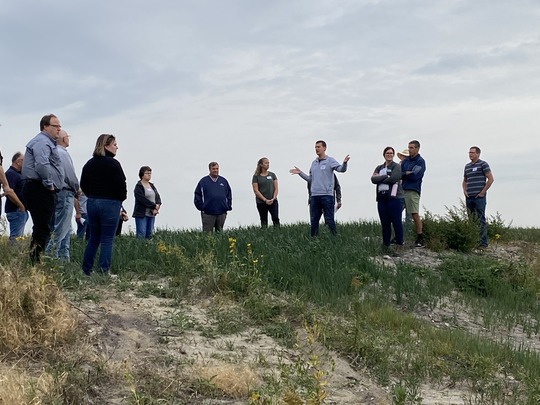 Bennett Uhler of Houston Engineering explains features of the Buffalo-Red River Watershed District’s stream channel restoration project on the Upper South Branch Buffalo River, south of Barnesville, MN. Photo credit: DNR.
Several dignitaries participated in all or portions of the day including Minnesota State Senators Rob Kupec and Jordan Rasmussen, and Minnesota State Representative Erin Koegel. The top executives from three Minnesota agencies, DNR, BWSR and MDA, also attended the celebration. Local, state and federal partners and stakeholders participated, together with other members of the FDRWG.
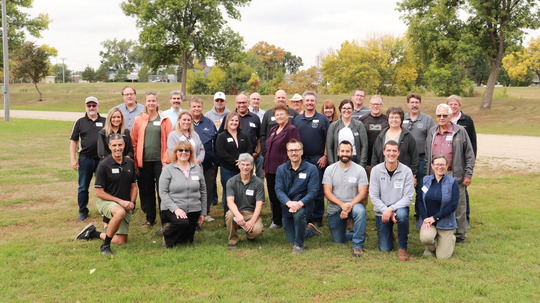 Participants in the September 22, 2023 FDRWG Anniversary Tour. Photograph taken at Welles Park in Breckenridge, MN. Photo credit: Houston Engineering.
The 1998 Mediation Agreement grew from a mandate from the Minnesota Legislature to resolve gridlock over state permitting of flood projects in the RRB. The agreement provided the framework for a new, collaborative approach to implementing both flood damage reduction and natural resource protection and enhancement in the RRB in ways that benefit all Minnesota citizens. The keys to this approach are clearly identified goals, comprehensive watershed planning, early consultation and collaboration on projects among stakeholders, and a cooperative approach to addressing permitting requirements.
Comments during the lunch break at Welles Memorial Park in Breckenridge noted the value of a collaborative approach that enables multiple needs to be met and accesses different sources of funding. City of Breckenridge Building Official Chris Loehr thanked legislators for bond funding approved last spring that will enable completion of the final phase of the City’s flood protection and interior drainage improvements. DNR Commissioner Sarah Strommen noted that the FDRWG was originally formed from groups that weren’t used to working together. In the years since, the group has demonstrated the power of collaboration many times over.
Since 1998 the Mediation Agreement has spurred completion of 18 projects across the RRB. An additional 17 projects are currently in various stages of planning or development.
More information:
News and Views – RRWMB December 1998 Newsletter Regarding the Mediation Agreement: https://acrobat.adobe.com/link/review?uri=urn:aaid:scds:US:56b1a3ef-5504-3474-af0b-73d6487cef1b
New Outlet Provides Flood Relief at Pine Lake
Homeowners on the east shore of Pine Lake treasure the recreational opportunities afforded by the largest lake in Clearwater County, Minnesota. At over 1,200 acres, this lake attracts anglers, boaters and nature-lovers from far and wide. Managing water levels, however, can be a challenge since the lake is only 15 feet deep and its shore is flat and low-lying. After spring snowmelt, it’s not uncommon for homeowners to experience flooding in their yards and outbuildings. Spring cleanup can be a heavy lift.
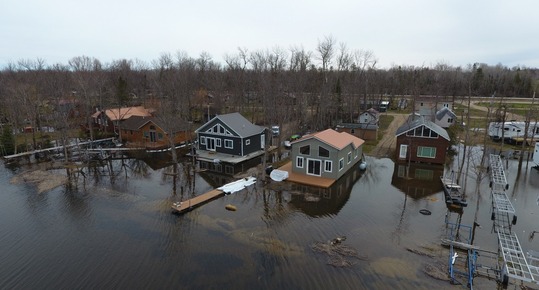 Lakeshore flooding, spring 2019. Photo credit: HDR.
In 2014 the Red Lake Watershed District (RLWD), which manages the lake’s outlet along the Lost River, convened a project team comprised of local residents, the DNR, and other parties with an interest in lake management. After investigating a series of alternative project concepts to alleviate lakeshore flooding, which were set aside due to problems with land availability or environmental impacts, the group landed on a relatively low-cost solution that enhances water and fisheries resources at Pine Lake. This solution replaced the aging and inadequate outlet installed 40 years prior with a modern outlet consisting of a gated structure sited next to a fish-friendly, rock-arch rapids. These features work in tandem to control water levels across a range of runoff conditions annually and seasonally.
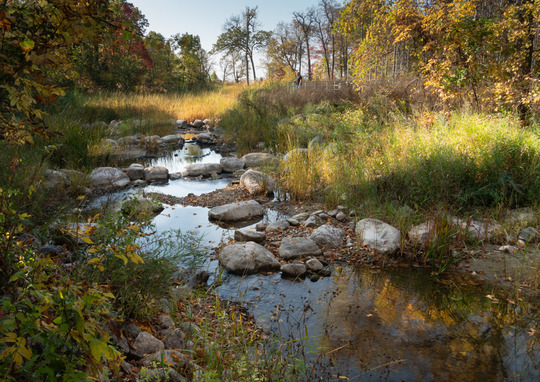 The new rock arch rapids below new gated outlet. Photo credit: Janet Nelson.
Terry Sorenson served on the Project Team that explored alternative solutions at Pine Lake, and subsequently joined the RLWD Board of Managers. Sorenson notes that the district can both store water and release water much more quickly with the project in place. It meets the needs of recreational users, homeowners and fish in the Lost River to the maximum extent within the limits set by the flat character of the lake basin and annual variations in rainfall. The project is also much safer to operate for District staff.
“It was a long process, but we were able to get the agencies, District and locals together on a single solution that works,” said Sorenson.
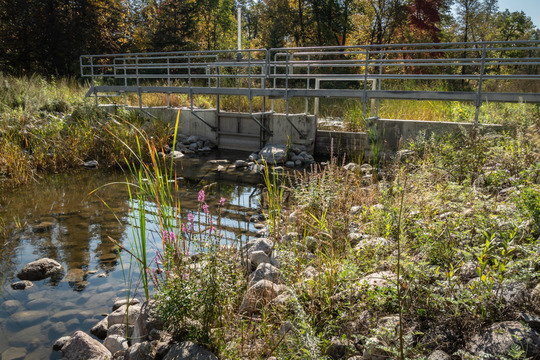 Pine Lake outlet gate from downstream side. The rock arch rapids are outside the photo to left. Photo credit: Janet Nelson.
RLWD invested in the project not only for the sake of local homeowners, but also as part of its commitment to incrementally add flood storage throughout the Red Lake Watershed toward a goal of 20-percent reduction in peak flood flows on the Red River. The old outlet was not capable of drawing down lake levels fast enough in the fall, so in approximately 4 out of 5 years the designed drawdown could not be achieved. The new outlet ensures drawdown is feasible in every year, supplying 1,200 acre-feet of flood storage capacity during the spring runoff.
Nick Kludt, DNR Red River fisheries specialist, points to the value of the meandering flow path through the rock-arch weirs at the outlet. This outlet design maintains the existing lake runout elevation while restoring natural fish passage between the lake and the Lost River downstream. The riparian vegetation is developing nicely at the site, and the dense root mass will help stabilize the near-shore area in higher flows.
“As a multi-purpose structure, tying the constructed channels into the natural riverbed was tricky,” said Kludt. “The contractor and consulting engineers did an excellent job.”
|
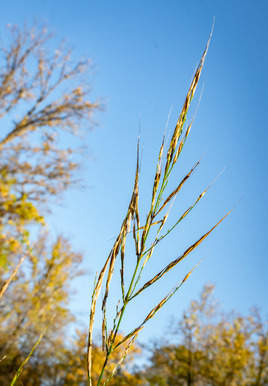
Photo caption: Wild rice growing at the outlet site, fall 2023. Photo credit: Janet Nelson.
BdSWD Celebrates Startup of Redpath Impoundment and Mustinka River Rehabilitation Projects
On September 22, 2023, the Bois de Sioux Watershed District and about 50 invited guests celebrated a major new flood project with a groundbreaking ceremony along the Mustinka River. Nearly 15 years of planning, engineering and negotiations with state agencies, local landowners and others enabled this two-part project at Redpath Impoundment and the Mustinka River. The project will provide local and regional flood risk reduction as well as rehabilitation of over 5 miles of the Mustinka River. Flood reduction will benefit area roads, agricultural lands, farmsteads and communities. Seasonal flood storage provided by the project will reduce Mustinka River flows that discharge directly to Lake Traverse, as well as breakout flows that move overland toward the Rabbit River and deposit unwanted sediments into the Red River.
The project will also restore 950 acres of grassland, 76 wetland acres and 6.7 miles of meandering stream on the Mustinka River.
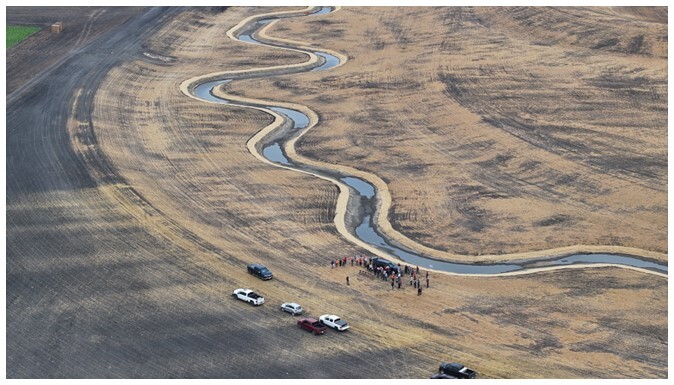 BdSWD groundbreaking ceremony along the newly restored channel of the Mustinka River. Photo credit: Moore Engineering.
“The Redpath impoundment is a component of the Red River Basin 20 percent flow reduction strategy,” said Chad Engels, BdSWD Engineer. “The project will provide approximately 19,000 acre-feet of gated flood water storage and control 200 square miles of upstream drainage.”
In fall of 2022, the BdSWD completed work on Phase 1 of the project, which primarily focused on relocating utilities. During the summer and fall of 2023 the District’s construction contractor made substantial progress on Phase 2, including restoration of the meandering channel of the Mustinka River and construction of the north levee of the impoundment.
During the 2023 Minnesota Legislative Session, Senator Jordan Rasmussen worked closely with the BdSWD and Red River Watershed Management Board (RRWMB) to secure flood hazard mitigation funds for the Redpath Impoundment and other Red River Basin projects.
“This Project is truly multi-purpose and will incorporate water storage, fish and wildlife habitat enhancements, and water quality improvements and will add to the overall base of resources in the BdSWD, Red River Basin and State of Minnesota,” said Robert Sip, RRWMB executive director.
Several partners are involved in funding the project, including the BdSWD, RRWMB, DNR Flood Hazard Mitigation Program, Lessard-Sams Outdoor Heritage Council, Legislative-Citizen Commission on Minnesota Resources, and Clean Water Fund via Minnesota Board of Water and Soil Resources. The FDRWG supported the project team and reviewed project plans multiple times over the course of its development.
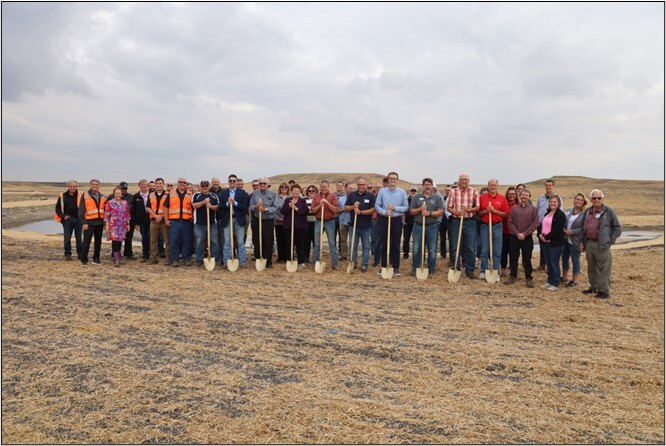 Participants at the groundbreaking ceremony on the Mustinka River. Photo credit: Moore Engineering.
The total project cost including land acquisition is approximately $62 million. To complete the project, $13.7 million is needed from the State of Minnesota through the Flood Hazard Mitigation Program, subject to legislative bonding approvals.
More information about the Project can be found at:
Moore Engineering Mustinka River Rehabilitation September Update - YouTube
Moore Engineering Mustinka Rehabilitation August 2023 Construction Update - YouTube
RedPath Fact Sheet
Announcements:
- In May 2023 the Minnesota State Legislature authorized bond funding for several flood projects in the Red River Basin. Cities receiving funding include Moorhead $11 million, Newfolden $5.45 million, Roseau $1.9 million, Breckenridge 1.5 million, and Perley $625,000. Three projects sponsored by watershed districts (WDs) will receive funding: Redpath Impoundment now under construction by the Bois de Sioux WD $4.4 million; Roseau Lake Rehabilitation in the Roseau River WD $1.575 million and Klondike Clean Water Retention Project in the Two Rivers WD $250,000. Additional bonding needs will be considered in the 2024 legislative session.
-
Two new ring levees were built to protect rural farmsteads in the Red Lake Watershed District in 2023 using DNR funding. Two additional ring levees have been approved in the same district, and these are expected to be completed either this fall or in the 2024 construction season. Funding remains available for one to two additional ring levees. For more information on eligibility and application procedures, click
-
The FDRWG has received a grant of $920,000 from the State’s Environment and Natural Resources Trust Fund (ENRTF) to monitor projects developed to reduce flood risks and enhance natural resources over the next 5 years. Planning is currently under way to finalize the list of sites and develop site-specific monitoring plans. The information gathered will help the FDRWG and Red River Basin watershed districts manage existing projects and plan new projects to optimize the benefits produced. More information will be provided in future issues of FDRWG Currents.
- Each year the FDRWG and Red River Watershed Management Board (RRWMB) hold a joint conference to share information and promote collaboration in the Red River Basin. The 2024 Annual Joint Conference will be held in Moorhead on March 19 and 20. For more information, check the RRWMB website in January.
- The Work Group’s next meeting will be in-person on Wednesday, December 13 at the Prairie Grains Conference in Grand Forks, ND. Contact the Red River Basin Coordinator for meeting details.
|