|
Staff Newsletter | Minnesota Department of Natural Resources |
|
|
Oct. 20, 2023
In This Issue
|
|
DNR launches Investment Optimization Team
 By Kelli Bruns, Investment Optimization Team lead
|
|
IOT members:
- Jeb Alessio (OSD)
- Mimi Daniel (CMO)
- Jamie Gangaware (FAW)
- Jack Lauer (FAW)
- Lonnie Lilly (FOR)
- Sam Minkler (OSD)
- Jason Moeckel (EWR)
- Kerry Ross (OSD)
- Stacy Smith (PAT)
- Maggie Snyder (OSD)
|
I am excited to share the Minnesota Department of Natural Resources has established an Investment Optimization Team.
This team will support our implementation of the transformational, one-time investments in Minnesota's natural resources as a result of the 2023 legislative session. These investments are in addition to the DNR's base funding and include the Get Out MORE package, totaling about
$150 million. |
|
|
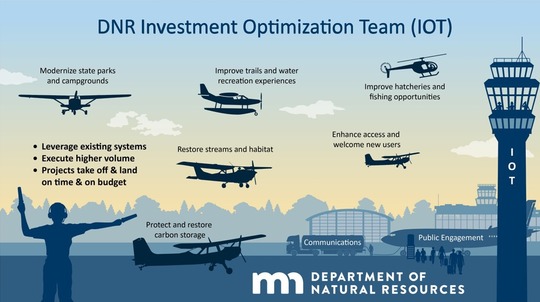
The purpose of the IOT is to provide agency-wide coordination to ensure we successfully implement this unprecedented level of investment. A metaphor that might be helpful is to think of IOT as air traffic control, directing coordination across a complex array of individual activities.
The IOT members will be supporting this work as well as continuing with their current roles, and I want to thank them for their efforts and dedication to this important work.
Importantly, the IOT will augment and coordinate, not reinvent or replace, the existing systems, processes and policies which guide our work. The team will serve as a central hub by identifying needs and opportunities in key areas (such as planning and design, communications, and engagement), tracking progress, coordinating across divisions and work teams, and elevating items for decision or direction as needed. The IOT will also look for efficiencies in our work to carry beyond the implementation of this historic budget opportunity.
The team members bring strong and diverse skills and experience that will be essential to the success of the IOT. This includes creative problem-solving, systems thinking, the the ability to operate at the agency level with strong teamwork. They will also consult with other agency experts as needed to move our important work forward.
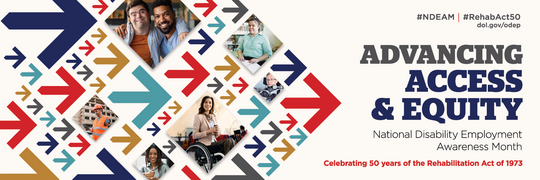
October is National Disability Employment Awareness Month
Let's celebrate!
 By Jill Westberry, Americans with Disabilities Act coordinator
At the DNR, we want to honor National Disability Employment Awareness Month and celebrate the many and varied contributions of America's workers with disabilities. NDEAM also generates awareness surrounding advancements in disability employment, including inclusive policies and practices.
The DNR will host a virtual lunch-and-learn webinar in celebration of NDEAM on Thursday, Oct. 26 from noon to 1 p.m. We'll kick off the webinar with some fun trivia and a brief reasonable accommodation presentation as it relates to assistive technologies at the DNR. Our partner, the Minnesota System of Technology to Achieve Results Program, will join us to shine a light on advancements in assistive technologies and digitally-based accommodations. The Minnesota STAR Program administers the statewide accommodation fund. The DNR submits an application for 50% reimbursement (maximum) of eligible accommodation expenses on a quarterly basis to ensure divisions receive at least partial reimbursement.
In accordance with the 2023 theme, we'll demonstrate at the webinar how the DNR is advancing access and equity through use of these types of technologies, reasonable accommodations, and partnerships.
There are a multitude of disability-inclusive advancements the DNR has implemented in the past few years, such as revamping the ADA intranet page, developing an eLearning course and PowerPoint presentation for new supervisors with the Learning and Development team, implementing consistent reasonable accommodation practices, incorporating new Connect 700 program processes, forging strategic partnerships, and more.
A Teams invite was sent to all DNR employees for the NDEAM celebration. Please mark your calendars and plan to join us. Any staff member in need of accommodation(s) to participate in the meeting should reach out to me at jill.westberry@state.mn.us as soon as possible. CART captioning services will be provided.
|
|
Free leadership coaching available
 When it comes to well-being, most employees are familiar with our EAP service, LifeMatters. It’s the 24/7 hotline available to all employees and household members for counseling, legal and financial consultation, and convenience services to help navigate work and personal life situations. But did you know that the team who manages our EAP services also provides services to develop leadership skills and team dynamics?
The “Resolve Team” is made up of state employees and is housed in Minnesota Management and Budget. Resolve consultants help employees develop the skills needed to foster productive and psychologically safe workplaces. Common services include consultation and guidance for challenging and sensitive situations, and presentations and training to support healthy workplace culture. Resolve consultants can also facilitate discussions among two or more staff to improve collaboration and communication. Subjects might include individual employee concerns, conflict management, leadership dynamics, or navigating change. Visit the Resolve website for more topics.
When you engage the Resolve team in coaching services, you and the consultant will discuss areas of concern and opportunities for growth. Consultations could be a one-time discussion or longer-term, like once a week for a year.
Interested? Our agency contact is Steven Reuter. You may reach out to him directly with an email or meeting request, or by calling 651-259-3732. You can also use the Resolve team email address: eap.consultants.mmb@state.mn.us.
Questions? Contact Laura Grunloh or any Well-being Action Team member.
Oct. 31 is the deadline for the well-being reward
 Employees enrolled in the State Employee Group Insurance Program are eligible to earn $70 off their deductible the following year by reporting their activities. Oct. 31 is the deadline to earn a reduced deductible in 2024.
Review the well-being reward overview to learn more and review eligible activities and point values. Questions about eligibility, data security and data privacy are addressed in the FAQ.
A wide range of activities can help you reach the 300 points needed to earn the reward, some of which are listed below. You need to manually report your progress in Virgin Pulse (“Home” tab, then click “Rewards”) to receive the points for some activities, including webinars, vaccines/boosters and flu shots. Click on the “Benefits” tab then “view all” to access Enrich (financial wellness platform), Foodsmart (healthy eating platform), Koa Health (mental health platform), Noom (health weight app), and Wellbeats (on-demand library for a variety of well-being goals).
- Attend a well-being webinar (25 points). Details are available on the well-being webinar website. Upcoming sessions include:
- Oct. 18: Learn about Allyship
- Oct. 25: Pathways to Healing
- Get a COVID-19 vaccine or booster (100 to 200 points)
- Get a flu shot (100 points)
- Complete the health assessment questionnaire in Virgin Pulse (100 points)
- Attend a virtual fitness class via Wellbeats app (50 points)
Questions? Contact Laura Grunloh or any Well-being Action Team member.
|
|

Frosty facts
 By Pete Boulay, climatologist
In Minnesota, we are no strangers to frost. But frost comes in various forms — sometimes beautiful, like the hoarfrost that forms icy feathers on trees, wires and poles. Hoarfrost forms in a manner similar to dew, except the temperature of the object must be below freezing. The origination of the word "hoary" is old English, describing someone with old age having white hair or a white beard.
Other forms include:
Window frost, which forms when water vapor hits a surface that is below freezing. It causes feathery frost to form on window panes, but the same process can form a slippery coating on bridge decks.
Rime icing, when water droplets are supercooled. This can happen in a cloud when the temperature is below freezing. These small droplets freeze instantly on an object like an airplane. The word "rime" means "crust."
Advection frost, which is when the horizontal transport of a cold air mass combines with a below-freezing temperature. This kind of frost is responsible for damage to agricultural areas of Florida and Texas when those areas experience cold snaps.
|
|
DNR videographer wins Emmy Award
|
|
 DNR Videographer Nick Frantzen.
|
 Frantzen and former DNR Assistant Communications Director Kim Pleticha.
|
|
|
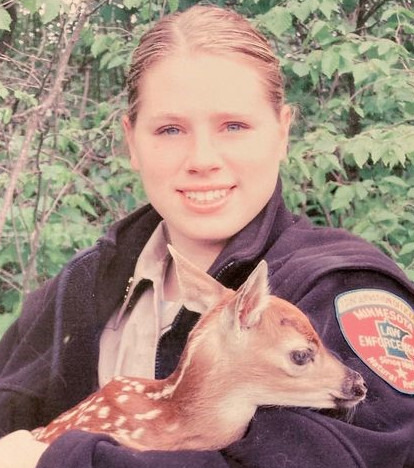
Videographer Nick Frantzen, who works in the Office of Communication and Outreach, and former Assistant Communications Director Kim Pleticha won an Upper Midwest Emmy for the video they created about DNR Conservation Officer Sarah Grell.
Officer Grell died in a car accident while on duty in May of 2021. The DNR worked closely with Officer Grell’s family on the video which recognizes her career, her tragic death, and how much she meant to her family and colleagues. The Grell family wanted to make sure part of Officer Grell’s legacy was a message of making safety a priority every day in our work. The video, titled "Minnesota Conservation Officer Sarah Grell: End of Watch,” was shared with all DNR employees at the safety stand-up event earlier this year and is shown to new DNR employees as part of their orientation.
Frantzen recorded and edited the video, while Pleticha produced it. It won in the category of short-form content for politics or government.
Frantzen also received a silver award in the public health or safety category for the same video at the Minnesota Association of Government Communicators Northern Lights Contest earlier this year.
A commemorative Emmy statue will be sent to Region 2 headquarters to honor Officer Grell and her legacy safety message.
Conservation Officer Sarah Grell.
|
|
MNIT implements Service Desk Support Hub
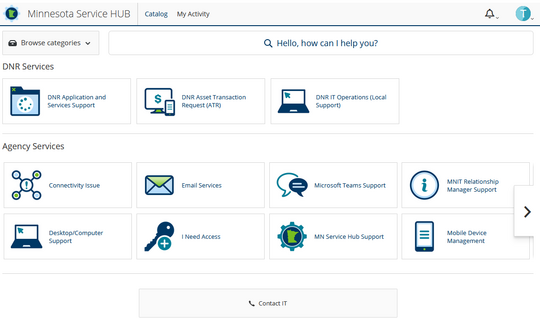 MNIT is streamlining the help desk process to provide fast support for DNR employees. As of Oct. 19, MNIT stopped accepting emails at MNITServices.dnr@state.mn.us. Instead, all IT support requests should be directed through the Minnesota HUB online web application.
Optional MNIT Service Desk Hub training
There will be an optional training session to help users learn how to create an IT Service Desk ticket and how to find services in the tool.
The one-hour session will be held Wednesday, Nov. 1 for DNR employees to explore using the service hub, ask questions, and connect with MNIT.
Date: Wednesday, Nov. 1
Time: 11:30 a.m. to 12:30 p.m.
Where: Microsoft Teams
Help Minnesota charities, residents via
payroll deduction
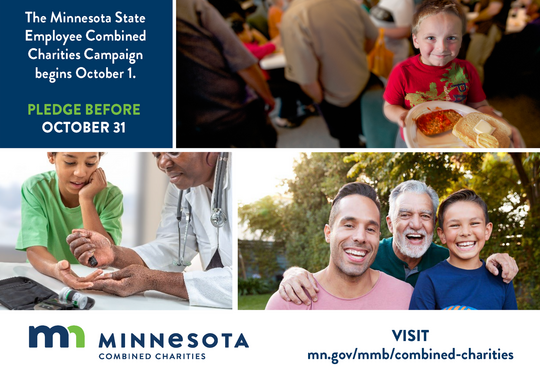 The Combined Charities campaign is more than halfway done. The DNR's goal for October is to get 5% of DNR employees to contribute a recurring payroll deduction in self- service to support vital health, education, environmental, arts, and social service programs throughout the state.
If you have already set up your contribution – thank you! If you haven't, there is still time to help the DNR reach its goal.
Though the campaign ends Oct. 31, you can set up these payroll deductions in self-service at any time. Any payroll deduction will begin in January and run through December.
To set up new or edit existing deductions:
- Go to the self-service portal (state.mn.us/employee.) and log in.
- Select “My Pay."
- Select “Charitable Deductions.” From this page, you can review, add, or update voluntary deduction information.
For more information and to learn more about participating federations, head to the State of Minnesota Combined Charities website.
Cybersecurity Awareness Month: Be cybersmart
 Cybersecurity Awareness Month is dedicated to education on how to protect your work and personal data and information – and one of the most common ways cybercriminals will try to access your information is through phishing.
Phishing attempts are getting more and more complex, and cybercriminals will use all the tools at their disposal to get you to click on a harmful link or attachment. IT security trends showed cybercriminals even used COVID-19 to target people working from home with more phishing attacks and by looking for unsecured devices, such as home Wi-Fi networks.
The best way to defend your data and information is to learn how to recognize and avoid phishing:
- Be vigilant. Even with familiar senders, be cautious when viewing attachments or clicking on links.
- Do not click on links or open attachments in unsolicited or unexpected messages.
- Hover over the sender email address to look past the display name to see where the email was actually sent from.
- Always go directly to a site to login.
- If it looks suspicious, or too good to be true, it probably is.
To report a suspicious message:
- Don’t click on any links or open any attachments.
- Select the message in the Outlook inbox pane.
- Select the “Report Phishing” button found in the Outlook ribbon. This button will forward the email to the MNIT Security Operations Center.
- You can also select Ctrl + Alt + F to forward the email as an attachment to spam.reporting@state.mn.us.

Catching a break
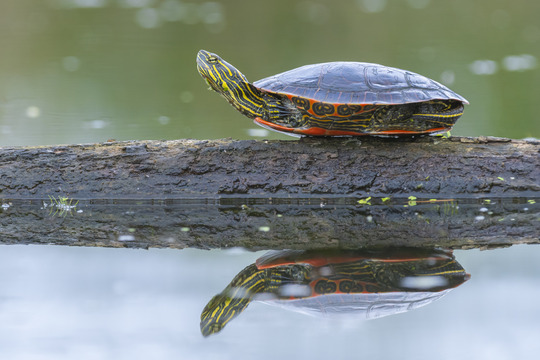 Photo credit: Dominique Braud
By Carolyn Howell, MCV intern
Strolling by a local pond on a quiet summer evening, one might not guess that the painted turtle basking on a nearby log can be commercially harvested for local and international sale. But that will change beginning Jan. 1, 2024, when a ban on commercial trapping of wild turtles goes into effect in Minnesota.
Part of the environment, natural resources, climate, and energy omnibus bill passed by the state Legislature in May, the ban seeks to protect and stabilize wild turtle populations. Minnesota is the 35th state to outlaw commercial turtle trapping — the result of a multiyear collaboration between the Minnesota DNR, the Minnesota Herpetological Society, and the Center for Biological Diversity.
Minnesota Conservation Volunteer is the magazine of the DNR. Supported by reader donations, its mission is to encourage conservation and sustainable use of Minnesota’s natural resources. For more info, visit mndnr.gov/MCV or subscribe.
DNR, partners replace undersized culverts
|
|
|
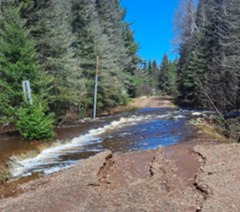
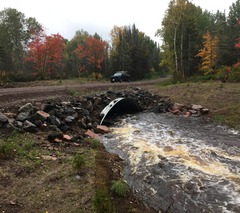
A culvert along Hockamin Creek before replacement (left) and after (right).
By Cheri Zeppelin, regional information officer
North Shore streams and rivers are flashy. They tend to be steep, with few lakes and ponds to slow run-off, and are primarily fed by surface water like snow runoff and rain. They can quickly swell to high water with swift currents and recede to low flows just as quickly.
Recent rains along the North Shore offered a resiliency test for a newly completed stream habitat restoration project in Lake County.
Earlier this summer, the DNR, the Lake County Soil and Water Conservation District, the Minnesota Pollution Control Agency and Trout Unlimited pooled resources to replace two undersized culverts that were significant fish barriers on Hockamin Creek, an important trout tributary to the Baptism River. The existing, smaller culverts were not able to manage water flows during spring snow runoff, nor the larger summer rain events that have become more common in recent years.
As a result, flooded roadways created infrastructure and public safety challenges, and culvert washouts degraded the habitat of the stream bed for trout. Undersized culverts that lack natural substrate in them also accelerate water velocities through the culvert, making them impassable for fish at times, and can prevent trout from moving upstream during summer to find cool water refuge and to spawn in the fall.
Prior to culvert replacement, a spring run-off overtopped one of the culverts and flooded a roadway. The newly installed culvert with natural stream bed bottom performed very well on a recent, similar-sized rain event, with additional capacity built in to manage higher flows if needed.
Fish habitat and connectivity is an important part of fisheries management. There are more than 300 undersized culverts in Lake County alone. Continued replacement work means more miles of stream habitat for fish, better opportunities for anglers, and improved infrastructure security for those who rely on those roads.
Fishing pier completed on Green Prairie Fish Lake
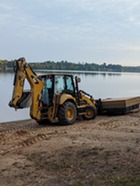
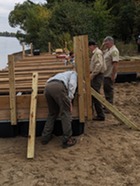
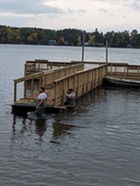
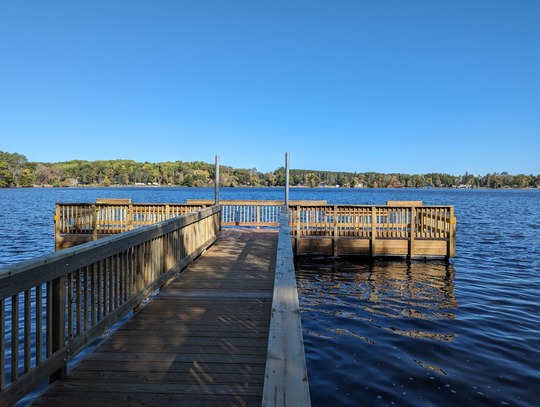 The Little Falls fisheries office (Eric Altena, Brady Becker, Al Schmidt and Steve Marod), with significant coordination and effort from Sauk Rapids Parks and Trails staff (Jon oBell, Brady Smith, Robert Dammann and Terry Storey) recently completed the assembly and installation of a 64-foot, ADA-accessible fishing pier on Green Prairie Fish Lake in Morrison County.
The fishing pier not only provides accessible opportunities for angling, but will relieve some pressure on the local public access dock. The pier will also allow anglers to access areas slightly farther out from the vegetation line in the lake.
Parks and Trails staff voluntarily worked overtime on their days off to complete the assembly and installation of the pier, which was purchased with Game and Fish funding in 2022. The Green Prairie Fish Lake Association provided a volunteer to help drill and install spindles, and will maintain the pier as part of its installation agreement.
The Darling and Green Prairie townships were also instrumental in allowing the public beach area to be used for assembly and launching of the pier.
Photo credit: Eric Altena
|
|
Kudos to conservation officers
 |
|
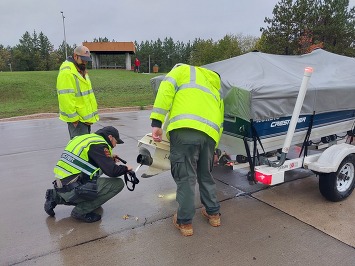
As always, this year's open water season was a busy one for the watercraft inspection program. As program staff look back at the summer in preparation for making improvements in 2024, the invasive species team wants to give some shout-outs to successful enforcement efforts
which back the
inspection program. |
Last winter, Enforcement collaborated with the program to update protocols for roadside checks and make improvements for the upcoming season. District Enforcement supervisors led the implementation of those new protocols during a spring 2023 fishing opener event by maximizing the efforts of watercraft inspectors and conservation officers to cover a planned roadside AIS check, as well as two public accesses in the area. This meant pairing watercraft inspectors with conservation officers, allowing the inspectors to shadow and learn from the officers. It also meant the pairs could cover more area and increase inspections, education and enforcement.
Many conservation officers throughout the state were quick to respond to watercraft inspectors when the inspectors ran into violations or challenging situations. The conservation officers' excellent responsiveness, follow-through and public education supported watercraft inspectors in the field and resulted in improved aquatic invasive species prevention this season.
Accounts Payable reminders
 Invoices
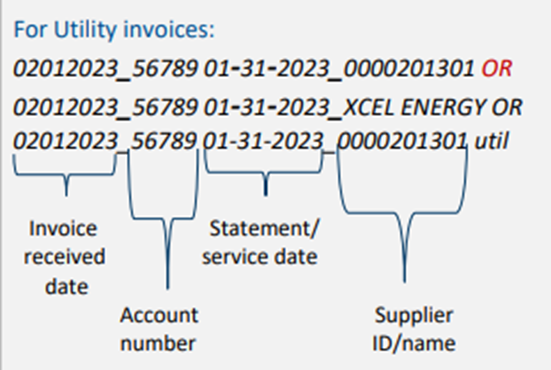
Utility naming conventions:
Budgetary approvers:
A digital signature should be used for signing "okay to pay" on invoices. If a wet signature must be used, the signature needs to be legible so it can be verified as being signed by a budgetary approver. If the signature is not legible, print the name beside the signature.
Employee Business Expenses
Benefits derived from travel:
Per the policy, "employees traveling on state business are not to receive benefits issued such as free lodging, reward points, cash payments, discount coupons, free tickets and frequent flyer mileage. Benefits received from these sources as a result of state-paid travel are the property of the state. These benefits must be returned to the state according to M.S. 43A.38, subd.2, which reads in part: 'Employees in the executive branch in the course of or in relation to their official duties shall not directly or indirectly receive or agree to receive any payment of expense, compensation, gift, reward, gratuity, favor…from any source, except the state for any activity related to the duties of the employee unless otherwise provided by law.'
In addition, M.S. 15.435, Airline Travel Credit, prohibits state employees to travel on state business and claim commercial frequent flyer mileage as their own when using state funds. Any benefit received must be returned to the state. If this cannot be done by the issuing airline then the employee must notify the state within 90 days of receipt. The state also cannot use or pay an employee for personal frequent flyer miles."
Refer to the Employee Business and Travel Expenses policy found under the policies and procedures section of the Administrative Manual for more information.
Purchasing Cards
Rewards, loyalty programs and other incentives:
Per the policy:
- "It is against state and existing DNR policy for an employee to personally benefit from the use of a state purchasing card by participating in any vendor’s 'reward' program. Cardholder must ensure rewards are not accrued even if it is necessary for the cardholder to opt out of the reward program.
- When using the state purchasing card, the acceptance of items or any other benefit, including, but not limited to, customer loyalty points, rewards, gas discounts free items, or gift cards for the benefit of the employee and not for the benefit of the state agency is prohibited. (See Minn. Stat. 43A.38 subd. 2 and 15.43 subd 1.)
- Purchasing cautions for agency rewards, loyalty programs, and other incentives:
- The merchants used with the purchasing card should be based on the best price and efficiency and not influenced by a rewards/loyalty program.
- Merchants should be selected considering best value, which includes, but is not limited to price, quality, location, and efficiency.
- An agency should not create an 'exclusive' type relationship with a particular vendor."
Refer to the Purchasing Card Use Policy on the Intranet for more information.

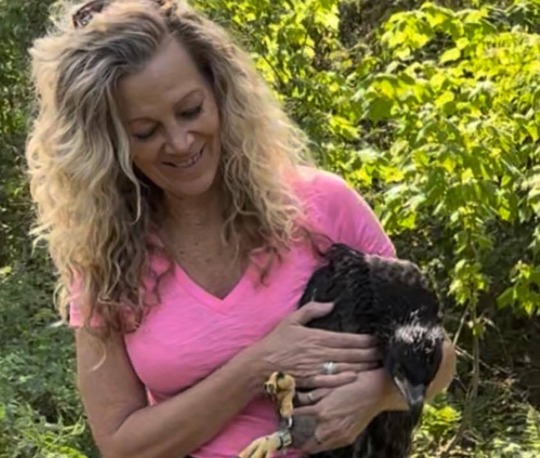
Nongame Wildlife Information Officer
Lori Naumann
|
|
Meet the Carcass Queen
By Elizabeth Nault-Maurer,
Ecological and Water Resources information officer
It’s not hard to find the Nongame Wildlife Program offices at the DNR's Central Office — just follow the birds.
Situated on the second and third floors in Central Office, the cubes are adorned in taxidermy. Mounted eagles, hawks, and songbirds, each have a unique story and each is managed by Lori Naumann. The mounted birds are used to educate Minnesotans about nongame wildlife species and the threats they face.
“We report out at the end of every year to the U.S. Fish and Wildlife Service about what carcasses we possess and how they came into our possession,” Lori said. “We are required to have federal permits to possess protected migratory birds for educational purposes, so I am in charge of the inventory of the nongame mounts and the carcasses in our freezer.”
This responsibility is one of the many Lori holds as the Nongame Wildlife Program information officer, but it comes with the unique nickname: “Carcass Queen."
“Jan Welsh was the first Carcass Queen,” Lori said. “She originated the nickname and we worked closely together managing our mount inventory. When she left her position, she bequeathed the unofficial title to me.”
Lori grew up near a county park, a wetland, and a lake. She and her friends spent their summers exploring and learning about the natural area around them.
|
 Work site:
Central Office
Years at DNR:
33
Prior experience: Administering the statewide falconry and wildlife rehabilitation permitting programs for Minnesota
Education:
B.A. degree in psychology from Metropolitan State University
Family:
"I live in White Bear Lake with my puppy, Birdie (my seventh English setter!)"
Something coworkers might not know:
"I was in choir as a three year old, and have sung professionally since I was a teen."
|
|
|
Lori developed a love for fishing and briefly tried out duck hunting in high school, but it wasn’t for her. However, the English setters she met while upland bird hunting were, and she has loved the breed since 1990.
This love of the natural world drew Lori to the DNR, where she began her career working in what was then called the "Office of Planning." From there, she moved to the wildlife section of Fish and Wildlife, where she worked for eight years before joining the Nongame Wildlife program in 1999.
In Lori’s first job with the Nongame Wildlife Program, she administered the falconry program and public information and outreach, as well as supported the Nongame Wildlife Program supervisor, two regional biologists, and an information officer. After receiving her bachelor’s degree in psychology in 2007, she moved into the role of information officer, where she’s been ever since.
Lori runs marketing and promotion for the Nongame Wildlife Program, administers permits, and spends time in the field supporting nongame biologists in their work. She also operates the extremely popular EagleCam and leads the EagleCam team, which celebrated its tenth season this year. Lori has taken raptor rehabilitation courses and is often called to assist with raptor bandings, injured birds, carcass collection. She also presents at tax conferences, schools, lake association meetings and Minnesota Outdoor Skills and Stewardship webinars.
Lori might be known as the Carcass Queen, but she’s also the heart of the Nongame Wildlife Program. Her passion for wildlife and learning is apparent to everyone she meets. Her relentless support of Minnesota’s wildlife and the nongame tax checkoff is one of the reasons the program is as strong and successful as it is.
“I have learned so much about Minnesota wildlife and all that our state has to offer. The curiosity, love for nature and the outdoors in my colleagues is infectious and I still learn new things every day," Lori said.

Welcome home, walleye fingerlings
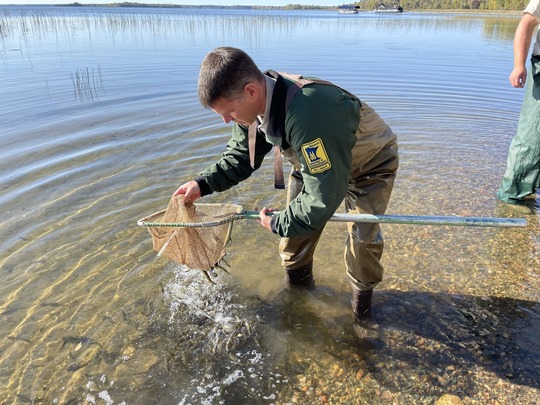 DNR Brainerd area fisheries staff are wrapping up the fall walleye fingerling harvest. The crew (Carl Mills, David Lockwood and Andy Wiebusch) harvested the five-month-old walleye fingerlings from 10 area rearing ponds to support stocking efforts in 21 area lakes. Photo credit: Cheri Zeppelin
|
|
Submit to Spotlight
Send Spotlight articles and photos to newsletter.dnr@state.mn.us.
Next Spotlight is scheduled for Nov. 3. Deadline for content is Nov. 1.
|
|
|
|
|