|
Staff Newsletter | Minnesota Department of Natural Resources |
|
|
Sept. 15, 2023
In This Issue
Climate Week is Sept. 18-22
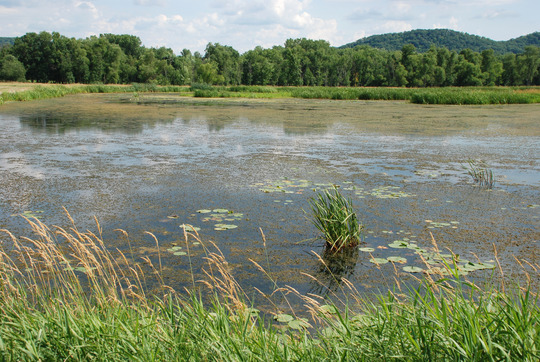 A wetland at the Whitewater Wildlife Management Area.
|
|
|
By Greg Hoch, Fish and Wildlife
prairie habitat supervisor
Climate Week is Sept. 18-22. The Minnesota Department of Natural Resources has a responsibility to manage the impacts of climate change to protect Minnesota's natural resources and ensure outdoor recreation opportunities for future generations.
As the state's population grows, public lands play an increasingly important role in providing clean water and air, carbon sequestration, habitat for pollinators and other wildlife, and protection for plants, animals and geological features.
A good example of this is Minnesota's prairies, wetlands and forests, which use photosynthesis to capture carbon dioxide and store the carbon in plants and soils. However, natural landscapes do a lot more than just capture and store carbon. Grasslands, wetlands, peatlands and forests also hold large volumes of water in plants and soils, preventing flooding and erosion. During dry periods, natural lands can release this water, reducing the impacts of droughts.
Research from the University of Minnesota also shows that restoring grasslands with high-diversity seed mixes stores more carbon than low-diversity mixes.
|
Climate change and the
One Minnesota Budget
The historic One Minnesota Budget invests $308.4 million for the Minnesota DNR, of which $37.7 million will be dedicated to mitigating and adapting to climate change. This includes:
- $15.2 million for the Minnesota ReLeaf Program to enhance community forests.
- $10 million to enhance grasslands and restore wetlands on wildlife management areas for carbon capture and resiliency.
- $6 million for investments to acquire, restore and enhance scientific and natural areas throughout the state.
- $4.2 million to help private woodland owners sustainably manage their forest lands, a key strategy for increasing carbon storage.
- $1.6 million to protect and restore carbon storage in state-administered peatlands, which hold about 37% of the carbon stored by Minnesota's ecosystems.
- $800,000 for accelerated tree seed collection to grow future forests and increase tree planting on public and private lands.
|
|
|
The Minnesota Department of Natural Resources and partners have been planting high-diversity mixes for years to benefit wildlife and pollinators. Turns out, those same activities are also the best practices for capturing and storing more carbon.
The Minnesota DNR has been restoring, protecting and enhancing natural plant communities for decades. Along with developing and adopting new climate change strategies in our work, it’s helpful to recognize that the Minnesota DNR has been actively engaged in carbon capture for a long time. When it comes to natural lands, what's good for wildlife, pollinators, grazing and timber harvest is often also what's good for mitigating and adapting to climate change.
Additionally, the Fish and Wildlife Division is working on a new Small Wetlands Program to identify unrestored wetlands in Wildlife Management Areas and developing and overseeing restoration plans for those wetlands.
While the program primarily focuses on waterfowl and other wetlands wildlife, these wetlands will capture, filter and help recharge groundwater. Small wetlands are also great for capturing and storing carbon. According to an Audubon magazine article, these wetlands are "pots of gold" for their value in mitigating climate change and its effects.
Engineers and scientists continue to work on new, innovative technologies for capturing carbon and pumping it underground. While every bit helps, the natural world has been doing that for millions of years. Natural lands make watersheds and landscapes more resilient to the changes we are already seeing with the climate, and future changes.
Office of Enterprise Sustainability to host Climate Week lunch-and-learn for state employees
The Office of Enterprise Sustainability will host "The Role We Play," a virtual event to celebrate Climate Week on Wednesday, Sept. 20 from noon to 1 p.m. The event will focus on climate change, its impact on Minnesota, what state government is doing, and how state employees fit in.
The agenda includes:
- A welcome and introduction from Lt. Gov. Peggy Flanagan.
- Information about Minnesota's changing climate, adaptation and resilience actions.
- A recognition of the one-year anniversary of the Minnesota Climate Action Framework.
- A presentation on the Inflation Reduction Act tax credits and rebates resources.
- Actions you can take at work.
If you can't join live, the event will be recorded and made available after.
Minnesota DNR recognizes youth for outstanding conservation efforts
|
|
|
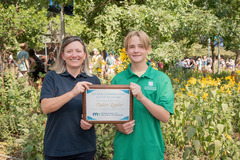
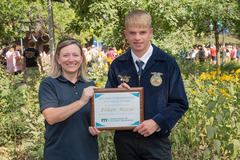
Left: Minnesota DNR Commissioner Sarah Strommen with 4-H member Tyler Egler and right: Minnesota DNR Commissioner Sarah Strommen with FFA member Ethan Maras.
Minnesota DNR Commissioner Sarah Strommen recently honored two youths for their outstanding conservation efforts during a ceremony Friday, Sept. 1, at the Minnesota State Fair.
Tyler Egler from Newport in Washington County received the 4-H award and Ethan Maras from Morris in Stevens County received the Future Farmers of America award.
The DNR Commissioner’s Youth Awards are given annually to a 4-H member and FFA student who have demonstrated initiative, leadership, creativity and achievement in conservation and wise use of natural and agricultural resources. This is the 32nd year of the award program.
Egler, a 4-H member, has always had a particular interest in amphibians and fish. Egler also participates in the 4-H Outdoor Wilderness Leadership and Service Program. These interests and experiences led Egler to develop a 4-H project about the Blanchard’s cricket frog.
Maras has a strong interest in waterfowl hunting and habitat, so he jumped at the opportunity to work for the conservation organization Delta Waterfowl. Maras’ work focused on the annual maintenance of “hen houses,” or nesting structures for ducks, in a three-county area in west central Minnesota. His responsibilities included recording nesting activities using an app-based map called “Quick Capture,” cleaning and re-stocking nesting materials, performing any repairs needed to the hen houses, and tracking his budget.
Technology needs survey open through Oct. 10

All Minnesota DNR and MNIT staff are invited to participate in the technology needs survey to help identify what IT tools and equipment you need to perform your job every day — no matter if you work in the field, in an office, or remotely.
Please take a few minutes to share your needs and insights. Questions about the survey can be directed to project manager Linse Lahti.
|

Fun weather and climate facts
 By State Climatologist Luigi Romolo
As a young boy, I was fascinated with weather. When I was 6 years old, I contracted strep throat and my mom brought me to the pharmacy to get my medicine. There, I saw a "Fun Weather Facts" book on the shelf. I tugged on my mom's pant leg, begging her to buy the book for me. She agreed and I spent my recovery reading weather facts that completely blew my mind.
In the same spirit, here are some weather and climate facts I hope you find fascinating:
- A typical cumulus cloud can weight more than one million pounds.
- The temperature of a lightning bolt is many times hotter than the surface of the sun.
- At any given time, there are about 2,000 thunderstorms worldwide.
- Thunder is caused after the heat from lightning causes the air to rapidly increase in temperature. The air expands so quickly from this temperature change it creates a sonic boom that we call thunder.
- The highest maximum temperature ever recorded in Minnesota is 115 degrees Fahrenheit in Beardsley. The average maximum temperature in July in Death Valley is about 115 degrees Fahrenheit.
- Rain drops are not shaped like teardrops, but more like the top half of a hamburger bun.
- Meteorology was founded by Aristotle in 350 BC.
- Earth is three million miles closer to the sun during the northern hemisphere winter than during the northern hemisphere summer.
- There are about 1,200 tornadoes in the U.S. each year. Minnesota sees about 29 tornadoes each year, but in 2010, had 113.
- Snow is not white, but colorless. When sunlight hits the snow, the full spectrum of white light is reflected to us, making it appear white.
- The largest hail stone recorded in the U.S. was about eight inches in diameter, comparable to the size of a volleyball.
Well-being Action Team launching a
new parents group
 The Well-being Action Team is launching a "new parents group" in October to bring together Minnesota DNR staff who are expecting or have recently become parents (newborn to two years old).
While the first pilot group will focus on topic areas relevant to new parents, the team encourages anyone interested to participate!
The purpose of the group is to provide resources, build a network, and learn from one another through questions and discussion. The group will focus on topics that support new parents in their work life such as:
- understanding parental leave options,
- managing telework and childcare,
- pumping at work,
- tips for returning to work,
- managing sleep deprivation.
The kickoff meeting will be held Oct. 12 from noon to 1 p.m. The team will introduce the concept of "total responsibility transfer" and ask for feedback on what types of topics staff are interested to learn more about. The team encourages people to provide feedback at the first meeting, even if you do not fall into the category of new or expecting parent but have ideas or information that might be valuable to the group.
The meeting invitation will be sent in the next week or two.
|
|
Features available in Microsoft Teams, Office 365
Microsoft Teams
Compact chat list
You can access this feature by switching to compact mode. To do so, go to settings and then "chat density" under the "general" tab. From there, select "compact." After you exit settings, you will see a more condensed view in your message pane (existing feature) as well as a compacted chat list (new feature). The compacted chat list includes hidden message previews and allows you to see more chats on your screen at one time.
Pin or favorite channels on Teams Walkie Talkie
Teams Walkie Talkie allows you to pin or favorite up to five channels on the Microsoft Teams Walkie Talkie homepage. You can then easily switch between the channels. You will also receive a visual alert on the pin channels when a secondary channel has notifications.
Ink color for Microsoft Whiteboard
You can choose from a wide range of colors for ink using the latest color picker feature. In addition, you can change the opacity level of pens with a slider. Recently used colors will also be added to your color palette and color picker feature.
Inspiration on Viva Insights
Microsoft's Viva Insights app has an "Inspiration" library with articles about well-being, work culture, impact and resilience. Open apps on the left navigation in Teams to find and open Viva Insights. Scroll to the bottom of the page and find the Inspiration library to explore the articles. If you find a good article, you can select the share icon at the bottom of the article to share via chat with a coworker or copy list to post in a Teams channel or in a meeting.
If you use Edge as your web browser and open Viva Insights on the web, you can select "read aloud" to have the articles read aloud. You can also change the speed and voice.
Office 365
Updated experience for document conflict resolution in OneDrive Sync
Microsoft has changed the experience to resolve Office document conflicts in the OneDrive Sync app. Before, selecting the "resolve" action on a conflict would require you to choose between opening the file in the Office desktop app to merge changes or keeping both versions of the file (forking the document and appending the computer's name to the forked file). Now, you can only open the document with a conflict in Office to merge the changes. The option to fork the document has been removed.
Now is the time to prepare for emergencies
September is National Preparedness Month
 Gov. Tim Walz has proclaimed September 2023 as Emergency Preparedness Month in Minnesota. National Preparedness Month highlights the importance of preparing for emergencies and disasters.
The best way to keep you, your family and your community safe is to plan in advance for hazards like violent storms, fires, damaging winds, snowstorms, extreme heat and flooding.
Make sure the older individuals in your life have plans as well. Older adults are disproportionately impacted by hazardous events, particularly if living alone, on a low income, having a disability or residing in remote rural areas. Visit the ready.gov website for tips on developing emergency plans for older individuals.
Prepare yourself and others by using communication plans, emergency toolkits and alert systems to account for the specific needs you might have in an emergency. Make a plan and consider the following as you prepare:
Shelter and evacuation
- Think about where you will shelter.
- Think about how you will evacuate.
- Create a budget that includes an emergency savings fund.
Communication and documents
- Make backup copies of important documents.
- Talk with family members about your emergency plan.
- Stay in touch when disaster strikes.
Consider your family's needs
|
|

Birdwatching with a side of salt
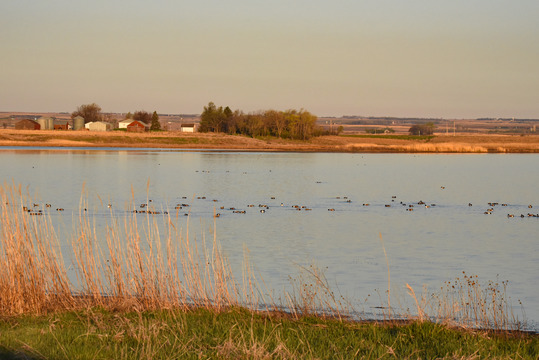 Photo credit: Keith Olstad
By Anthony Hauck
On the right fall or spring day, it can seem as if every duck, goose, and shorebird on the continent is raucously enjoying a stay at Salt Lake in western Lac qui Parle County, where I grew up. “Lac qui Parle” is the French translation of the original Dakota name for nearby Lac qui Parle Lake, meaning “lake which speaks.” On that right migration day, Salt Lake is the “lake which sings.”
In spring, the birdsong is symphonic because all the players have arrived. Lines of greater white-fronted and snow geese trumpet their return. Giant flocks of dabbling ducks and rafts of diving ducks add plenty of sax. Shorebirds, like American avocets and marbled godwits, flute from the mudflats. Yellow-headed and red-winged blackbirds chime in from cattail pockets. Even the surrounding prairie pipes in, with western meadowlarks and, if you’re really lucky, a bobolink or a chestnut-collared longspur. It’s harmony.
The orchestra convenes here each spring and fall because of the lake’s unique makeup. Yes, it’s actually salty! The water has about one-third the salt content of seawater, the result of mineral leaching from the area’s alkaline soils. Sago pondweed and brine shrimp flourish in this salty environment, a pairing which serves as a veritable bird buffet. Not only is it Minnesota’s only saltwater lake; it’s the most alkaline water body between the Atlantic Ocean and Utah’s Great Salt Lake.
Visiting Minnesota’s own Salt Lake can be an exhilarating experience. Binoculars will help you enjoy the show, but don’t be surprised if it’s the soundtrack that truly tops your chart.
Minnesota Conservation Volunteer is the magazine of the DNR. Supported by reader donations, its mission is to encourage conservation and sustainable use of Minnesota’s natural resources. For more info, visit mndnr.gov/MCV or subscribe.
|
|
Accounts Payable reminders
 We are happy to welcome Ashley Kastner back to the accounts payable team — welcome back, Ashley!
Accounts payable is also pleased to announce that four new staff members have joined our team. The new staff are currently in training.
Invoices
The Dates – Accounts Payable document is a helpful resource for detailed information regarding invoice and invoice received dates, goods and services received dates, and prompt pay dates.
Quick reference:
- Invoice date: The actual date provided on the supplier’s invoice.
- Invoice received date: Date the invoice was first received by a DNR employee.
- Goods and service received date: Date the goods and services were received by the agency.
- Prompt pay date: The date a payment must be made for it to be paid on time. Invoices must be coded, approved, receipted in SWIFT, and submitted to Accounts Payable within 17 days of the later of either the invoice received date or the goods/service received date.
- If an invoice is going to miss prompt pay, or if in doubt, include a late reason.
Employee business expenses
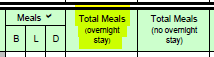
Meal reimbursement claims for the last day of an overnight stay should be entered in the "total meals (overnight stay)" column (MWI/MWO earn code):
 Purchasing cards
Accounts payable encourages staff to upload and use the most to up-to-date purchasing card version to get the most current program updates. The current version (DNR Purchasing Card Log and Instructions – Version 9.10) can be found on the Intranet under DNR purchasing forms.
|
|

Conservation Officer Mike Krauel
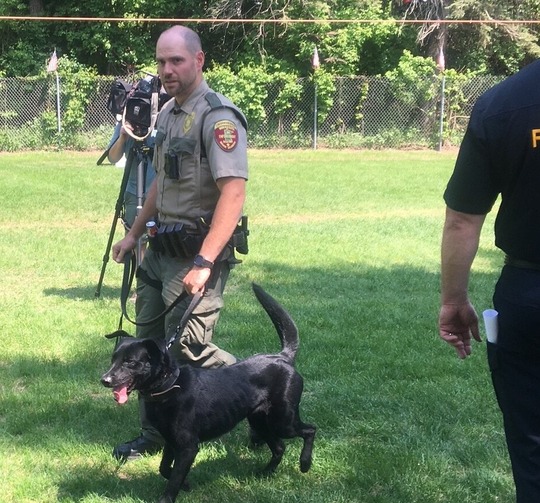 Conservation Office Mike Krauel and K9 Bolt at the St. Paul Police Department’s K9 School graduation earlier this year.
|
|
A winding journey to a fulfilling career
By Joe Albert,
Enforcement Division communications coordinator
When Mike Krauel started to ponder possible professions in high school, conservation law enforcement was high on his list.
After all, he loved the outdoors and, in particular, loved to hunt – deer, ducks and geese. But therein he also saw a problem: He didn’t want to be working while he could be out hunting. So he started college with an eye toward being a physical education teacher. He grew bored with that idea after a while, then set his sights on being a doctor. That lasted for only a short time after he followed around a real doctor and figured out the profession definitely wasn’t for him.
A fortuitous meeting and a couple days spent working with a Minnesota DNR state park manager convinced him to change his major to ecology, and while still in college, he began working night security at Mille Lacs Kathio State Park. He kept working in different positions for the Parks and Trails Division after graduating from St. Cloud State University in 2010, but that desire to work in law enforcement was still there.
Krauel thought about going back to school for a degree in law enforcement, but with a new baby at home, quitting his job wasn’t in the cards. Then he learned about a new program the Enforcement Division had created – the CO Prep program, which provides a pathway for people without a traditional law enforcement background to become conservation officers. He applied and began the long journey to becoming a CO, especially one who comes in via the Prep program. There were tests and interviews, and a lengthy and in-depth background investigation.
|
 Work location:
Mora
Job title:
Conservation officer
Joined DNR:
Five years in Parks and Trails before moving to Enforcement in 2015.
Education:
Bachelor’s degree in ecology from St. Cloud State University
Hobbies:
Hunting and fishing with his kids and coaching his son’s baseball and football teams; camping; kayaking; golfing; and going running with his wife.
Something that might surprise your colleagues:
"I bought my own horse when I was in high school, took lessons and became a pretty good rider."
|
|
|
Then there were several months of law enforcement education, several months at the CO Academy, and several more months of field training with experienced officers.
“It was a big learning curve, and there’s a lot of new information thrown at you all at once,” said Krauel, who was part of the division’s first-ever CO Prep class and now is stationed in Mora. “A lot of it was learning how to handle difficult situations that I hadn’t ever really even thought about before.”
His thoughts now, nearly nine years after becoming a CO?
“Very thankful to have made the move,” Krauel said.
He particularly enjoys the variety of work. In addition to his duties in the Mora station, Krauel is a K9 handler, use of force instructor, and a field training officer. In the latter role, he works with new officers between the time they graduate from the Academy and the time they’re out on their own in their first stations.
“Every day is different, and I really enjoy the contact we have with people,” Krauel said. “I really love the ice fishing season, and I love working from a snowmobile. But every season is fun because it’s new. When we first get out in the boat in the spring, that’s exciting. And when fall rolls around, it’s exciting to check hunters. I really like the changing of the seasons and the fact that I don’t have to do the same thing every day. That would get old.”
Among his various duties, Krauel’s role as K9 handler is the newest. He’s among five K9/handler teams in the Enforcement K9 Unit, having graduated with K9 Bolt earlier this year from the St. Paul Police Department’s K9 School (along with CO Mike Fairbanks and K9 Fennec and CO Adam Seifermann and K9 Jet). Bolt, a black Lab, is trained in zebra mussel detection, tracking of persons, wildlife detection, evidence recovery and performing educational demonstrations.
The two train every day to ensure they’re always ready to assist other conservation officers and law enforcement agencies when they’re called upon.
“There’s a lot to learn, but it’s really rewarding when you see the dog finally get what you’re trying to teach them,” Krauel said.
|
|

See you next year, State Fair
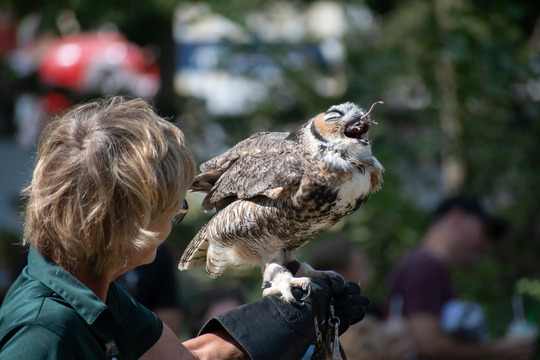 A raptor eats a rodent during the Raptor Center presentation at the Minnesota DNR building and grounds at the 2023 Minnesota State Fair. Photo credit: Deb Rose
The Minnesota DNR building and grounds at the fair drew thousands of visitors daily to hear presentations and bands, have a moment of relaxation by the fish pond, and learn about Minnesota's natural resources, conservation and outdoor recreation.
A huge shout-out to everyone who helped with the Minnesota DNR's presence at the fair. It's an immense amount of preparation and work behind the scenes, with staff and volunteers dedicating hundreds of hours to create a unique attraction for visitors and help people learn more about the outdoors.
Fish Cam stats
- The livestream of the Fish Pond had 19,750 views this year, with 12,800 unique viewers.
- About 41% of visitors watched the camera after YouTube recommended it.
- The most viewers at one time was 163.
- The average viewer watched it for 30 minutes.
- The total watch time was 8,678 hours.
- The most views came from Minnesota (13,176) and Illinois (1,102, but includes DNR staff on VPN), followed by Texas (484), Wisconsin (479), California (291), Missouri (281), Iowa (219), and Florida (211).
Thank you, Dawn!
|
|
|
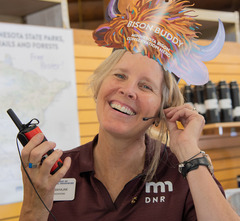
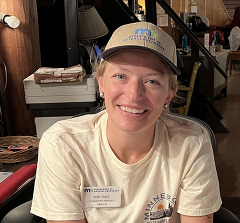
After nine years of coordinating the magic of the Minnesota DNR's presence at the State Fair, our Stewardship Education Coordinator Dawn Bahajak (left) will retire on Oct. 6.
Dawn has spent the last 38 years in public service, having worked with the North Dakota and Wisconsin DNRs, the Minnesota Zoo and the city of Fridley. While at the Minnesota DNR, Dawn has lent her expertise to the Project Learning Tree and School Forest programs, served as a founding member of the Minnesota Master Naturalist volunteer program and shared her passion for nature as the Natural Resources Education Committee chair.
The Office of Communications and Outreach invites you to farewell events to wish Dawn a happy retirement:
- On-site get together Oct. 5 from noon to 1:30 p.m., Central Office, first floor by the rock wall (please bring a State Fair-inspired dish or snack to share)
- Off-site retirement party Oct. 5. For more information, check out the e-vite.
As we bid Dawn a fond farewell, we'd also like to introduce you to OCO's new Events Coordinator Amelia English (right), who will take on the monumental State Fair planning task for the 2024 event.
Thank you, Dawn, and welcome to the Minnesota DNR, Amelia!
|
|
Submit to Spotlight
Send Spotlight articles and photos to newsletter.dnr@state.mn.us.
Next Spotlight is scheduled for Oct. 6. Deadline for content is Oct. 4.
|
|
|
|
|