Earth Day is Saturday, April 22
Earth Day began on April 22, 1970 when more than 20 million Americans demonstrated to call for greater protections for the environment. Since then, Earth Day has focused on recycling, global warming, clean energy, planting trees, investing in our planet, and more.
Earth Day has roots in the conservation movement that had been underway decades before. This focus on the environment and natural world led to federal legislation like the Clean Air, Clean Water and Endangered Species acts, as well as the creation of the Environmental Protection Agency. States also passed their own environmental protection laws, which in Minnesota included the Environmental Quality Act, the mine reclamation law, the Wild and Scenic Rivers Act and more.
As a conservationist in the early 1930s said (according to the “DNR’s First 50 Years" publication) in a quote which is as true then as it is now:
“We are … planning with an eye to permanency so that future generations will inherit an empire of wealth rather than a land shorn of the blessings which nature bestowed upon it.”
Ways you can celebrate Earth Day every day
1. Save water
On average, each American uses an average of 82 gallons of water a day at home. Reducing your water use can help conserve fresh water supply, as well as save energy and reduce greenhouse gas emissions.
2. Buy only what you'll eat
About 30% to 40% of food supply is wasted each year, and food requires a lot of resources to grow, package, transport and store. Try not to buy more than what you need, and compost spoiled food or food scraps if there are extra.
3. Reduce consumption and waste
Most climate impacts or greenhouse gas emissions come from the production or use phase of the life cycle. This means we need to make conscious choices to limit the demand for new items and extend the useful life of things already available. Think of creative ways to reduce, reuse and recycle, like the Le Sueur County women who learned how to repurpose plastic bags into beds for people experiencing homelessness.
4. Save energy at home
Everyone who pays a utility bill in Minnesota can enroll in clean energy programs, regardless of whether you own or rent. MPCA, Minnesota Commerce Department, the U.S. Department of Energy and Xcel Energy also all have energy-saving tips to help you save energy.
5. Get there sustainably
Transportation is Minnesota's largest source of greenhouse gas emissions. Opting to bike or walk, use public transit, carpool, and avoid unnecessary trips are great ways to reduce your consumption.
Earth Day is only the beginning. How we choose to live year-round makes a world of difference!
Gov. Tim Walz proclaims April to be
Earth Month in Minnesota
WHEREAS: Earth Day was first celebrated on April 22, 1970, with the goal of inspiring an appreciation of our nation’s natural resources through conservation and protection; and
WHEREAS: From the conception of Earth Day, environmental activists across Minnesota have
engaged in this national movement and established a tradition of environmental consciousness. On the very first Earth Day in 1970, approximately 350 University of Minnesota students protested against unsustainable energy practices; and
WHEREAS: Indigenous movements in our state and across the world have organized to preserve the health and stability of the environment; and
WHEREAS: The global community now faces extraordinary challenges, such as global health issues, food and water shortages, economic struggles, and climate extremes; and
WHEREAS: These challenges will continue to have more severe, negative, and lasting impacts on people with lower incomes, people of color, and immigrants; and
WHEREAS: The people of Minnesota must continue to step forward and take action to create positive environmental change to combat these extraordinary challenges; and
WHEREAS: People and organizations across Minnesota celebrate Earth Month with activities throughout the month of April in recognition of our commitment to environmental stewardship while remembering that #OneDayIsNotEnough.
NOW, THEREFORE, I, TIM WALZ, Governor of Minnesota, do hereby proclaim April 2023 as: EARTH MONTH
Spring turkey hunting begins
Gov. Tim Walz, DNR Commissioner Sarah Strommen celebrate
season at the Governor's Turkey Hunt
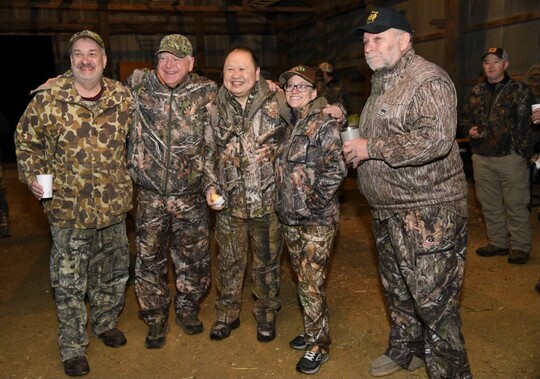
From left to right: Rep. Rick Hansen, Gov. Tim Walz, Sen. Foung Hawj, DNR Commissioner Sarah Strommen, and Tom Glines with the National Wild Turkey Federation.
Gov. Tim Walz and DNR Commissioner Sarah Strommen celebrated the spring turkey hunting season near Northfield on Saturday, April 15. Walz and Strommen were joined by National Wild Turkey Federation Director of Development Tom Glines, Rep. Rick Hansen, Sen. Foung Hawj, and members of the Learn-to-Hunt program.
“It was a beautiful morning to spend some time in the woods and join friends and neighbors in celebrating one of the many outdoor sports and activities Minnesota has to offer,” Walz said in a news release. “I’m grateful for our state’s partnership with the National Wild Turkey Federation for introducing more people to turkey hunting, restoring wild turkeys, and ensuring this tradition can carry on for generations to come.”
The Minnesota Governor’s Turkey Hunt highlights spring turkey hunting and celebrates the conservation success of the decades-long partnership between the National Wild Turkey Federation and the DNR to restore wild turkeys and introduce people to turkey hunting. In 1973, 29 wild turkeys were relocated to Minnesota in southeastern Houston County. Thanks to the efforts of the DNR and conservation partners including the NWTF, turkeys now range across nearly the entire state. More than 50,000 people hunt turkeys in Minnesota each spring.
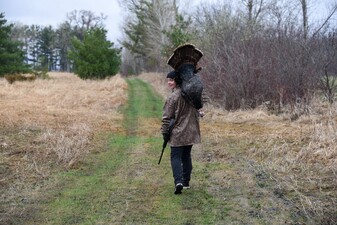
The Minnesota Governor’s Turkey Hunt coincides with NWTF’s annual statewide, mentored turkey hunt, which has introduced thousands of Minnesotans to turkey hunting. Turkey hunting continues in Minnesota through Wednesday, May 31. Details on the season are available on the DNR website.
|
Tribal Relations Work Team visits Mille Lacs Band of Ojibwe
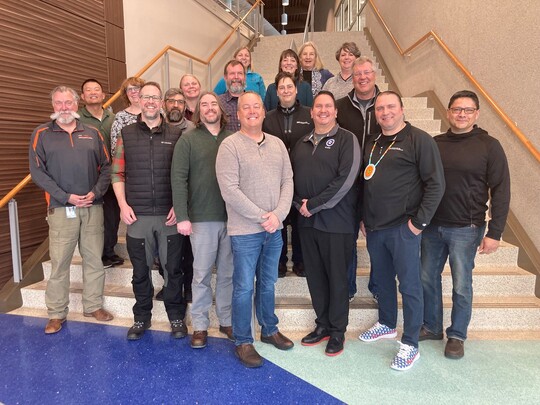
First row, left to right: Scott Roemhildt, Grant Wilson, Alex Watson, Phil Seefeldt, Kelly Applegate, Bradley Harrington, Scott Staples. Second row: Marc Bacigalupi, Teresa Ebbenga, Angela Aarhus-Ward, Randall Doneen, Greg Snyder, Christa Maxwell, Mike Liljegren. Third row: Amanda Dirnberger, Kerry Ross, Molly MacGregor, Shelly Patten.
The best way to work with Tribal governments is to go to their place, introduce yourself and ask them to introduce themselves. DNR's Director of Tribal Relations Bradley Harrington achieved this goal when the 20 members of the Tribal Relations Work Team spent March 30-31 with natural resources staff of the Mille Lacs Band of Ojibwe in Onamia.
The team recognizes that the DNR and Tribal governments benefit from working together, learning from one another, and partnering where possible. Timely and meaningful consultation between the DNR and Tribal governments facilitates better understanding and informed decision-making on matters of mutual interest and helps to establish mutually respectful and beneficial relationships.
Introductions of staff from DNR and from the Mille Lacs Band was the first order of business. Everyone shared a story about how they came to work in natural resources.
Harrington started by sharing his vision of Anishinaabe natural resources:
- The natural resource is a gift to us from the spirits; it is everything from the sunlight that shines on plants to the animals that eat that plant to the snow that falls in winter.
- The natural resource maintains or enhances your life and literally keeps you well.
- The natural resource is supported by a spiritual belief system.
Most shared a memory from their childhood – observing wildlife from a tree house, hunting with a family member or mentor, or watching birds as a baby. Those experiences followed them into their education and the careers they chose, they said.
“I can be the bridge between my culture and the world of wildlife management,” said Jordan Williams, Mille Lacs wildlife manager and an enrolled member of the Leech Lake Band of Ojibwe.
“I am a protector, I am protecting resources for the Mille Lacs Band and for the world. We are looking out for everyone, we are all on this earth together,” said Kelly Applegate, Mille Lacs Band Natural Resources commissioner.
“I like fish, I like science and I like working with Tribal communities,” said Carl Klimah, Mille Lacs fisheries manager. “I ask myself, 'how can tribal knowledge translate into fish management?'”
“I love the teacher part of my job,” said Mike Liljegren, the DNR’s assistant director of Lands and Minerals Division.
“This is why we are here, to learn about each other,” said Marc Bacigalupi, the DNR’s Northwest region fisheries manager.
The Tribal Relations Work Team’s functions and scopes are to:
- Provide leadership to advance the DNR’s strategic priority to consult and collaborate with Tribal governments.
- Review and recommend revisions to Op Order 129: Tribal Consultation as needed.
- Guide prioritization of DNR staff attendance at Tribal-State Relations Training.
- Develop training about native nations and native governance, and related resources for DNR staff.
- Track issues and topics that arise in communications from Tribal governments to the DNR to identify trends or themes in need of attention.
Amanda Dirnberger from the DNR and Aarik Robertson from Mille Lacs Corporate Ventures served as facilitators.
The team meets monthly and plans to visit a Dakota community in southern Minnesota in the fall.
Members of the DNR’s Tribal Relations Work Team attending the Mille Lacs meeting were: Bradley Harrington, Theresa Ebbenga, Shelly Patten, Grant Wilson, Scott Roemhildt, Randall Doneen, Scott Staples, Phil Seefeldt, Angela Aarhus Ward, Marc Bacigalupi, Greg Snyder, Mike Liljegren, Christa Maxwell, Alex Watson, Kerry Ross, and Molly MacGregor.
April is Month of the Military Child
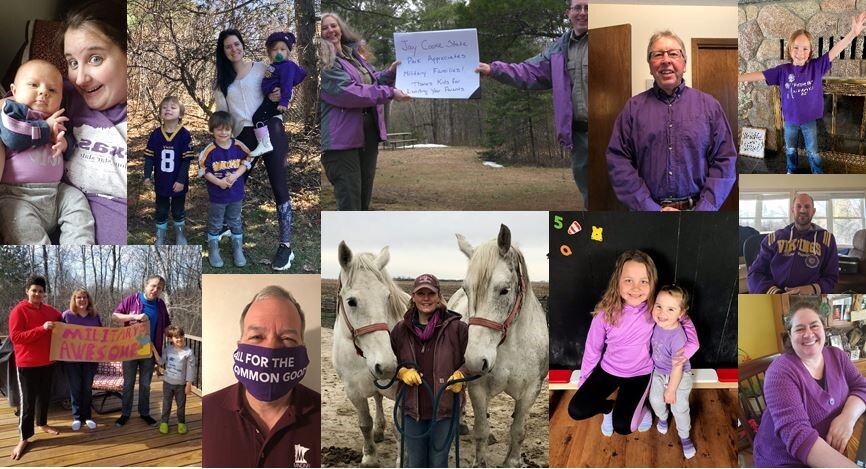
DNR staff and families wear purple to show their support for military kids.
This month, Minnesotans across the state celebrate the Month of the Military Child. More than 23,000 children in Minnesota have at least one parent or guardian currently serving in the military and many more children are dependents of veterans. As a Yellow Ribbon company, the DNR wants to salute all military kids in recognition of the important role these youth serve!
The Minnesota National Guard’s Child and Youth Program offers military youth activities year-round, and many Yellow Ribbon communities and companies are hosting extra events this month. Find the MNG Child and Youth Program on social media or reach out to a DNR Beyond the Yellow Ribbon team member to learn how to get connected.
For more military-related updates, sign up for the Beyond the Yellow Ribbon Newsletter through GovDelivery. Learn about and connect with the Beyond the Yellow Ribbon Team on the Intranet.
 Meet DNR mammal specialist Melissa Boman
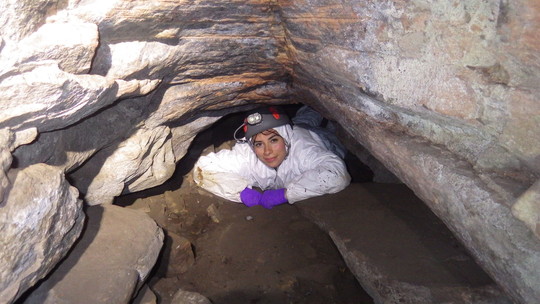
Photo credit: Melissa Boman
As a mammal specialist for the DNR’s Minnesota Biological Survey, Melissa Boman keeps tabs on small, unsung creatures that don’t often win popularity contests or make it onto wildlife calendars, yet play important roles in ecosystems. She calls them “charismatic microfauna.”
Since 2016, Boman has worked with mice, shrews, lemmings, and voles, and has occasionally helped with salamander and turtle counts. However, a good chunk of her efforts go toward Minnesota’s bats, which are facing a worse prospect than simply being misunderstood: white-nose syndrome, a deadly fungal disease that since 2006 has marched across North America and since 2015–16 has wiped out huge numbers of Minnesota’s cave-hibernating bats.
When she’s not checking bat boxes, crawling into caves, or wading through bogs in search of little wriggling creatures, Boman also fly-fishes, paints outdoor scenes, and is finishing a master’s degree in natural resources and environmental sciences at the University of Illinois Urbana-Champaign.
MCV deputy editor Keith Goetzman caught up with her this past winter as she was looking ahead to surveying caves for bats at locations including Soudan Underground Mine at Lake Vermilion–Soudan Underground Mine State Park and Mystery Cave at Forestville–Mystery Cave State Park.
Read the Q+A: Minding the Microfauna
Minnesota Conservation Volunteer is the magazine of the DNR. Supported by reader donations, its mission is to encourage conservation and sustainable use of Minnesota’s natural resources. For more info, visit mndnr.gov/MCV or subscribe.
Try "box breathing" to help manage stress
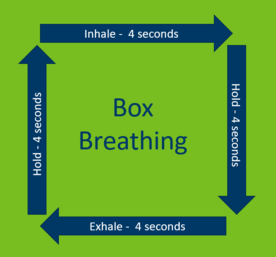
The next time you are feeling stressed, try one or two minutes of box breathing: inhale for four seconds; hold for four seconds; exhale for four seconds; hold for four seconds; repeat. It might help to visualize a box in your mind as you breathe, as shown.
This mindfulness technique has been shown to relax the nervous system, lower heart rate, and calm the mind. Navy SEALs use this technique to stay calm and focused in high-stress situations.
|
What is mindfulness?
Have you heard the term “mindfulness” and wondered what it really means? Simply put, mindfulness is a practice of focusing your awareness on the present. A common mindfulness practice is simply focusing on breathing in and out, like when practicing box breathing.
Practicing mindfulness can be done through a meditation session or in smaller moments throughout the day:
- Even something as easy as avoiding multitasking can be a way to practice mindfulness. The next time you find yourself multitasking (such as reading email during a Teams meeting), take a moment to decide what you need to focus on and give that your full attention.
- Just one minute of noticing through one of your senses you can be a mindful exercise to calm your fight-or-flight response, like sitting with good posture and becoming aware of the sounds around you.
Benefits of mindfulness
Anyone can practice mindfulness and benefit from it. Practicing mindfulness in the workplace can, according to the Niagra Institute, help with increased focus, improved communication, reduced conflict, increased helpfulness, increased emotional intelligence, reduced burnout, and improved physical health.
Mindfulness resources for state employees
-
LifeMatters 5-minute mindfulness sessions: use login: stmn1 to access a four-part audio series on developing mindfulness. This Employee Assistance Program resource is available to all employees, regardless of benefit eligibility.
-
Mindfulness resources through Virgin Pulse: All employees who are eligible for insurance benefits have access to well-being resources through Virgin Pulse. Once you have created a Virgin Pulse account, log in and select the “Benefits” tab and the top and “view all” for a list of programs. Koa Health and Wellbeats are two programs that include mindfulness practices.
-
Koa Health Foundations provides free access to more than 100 evidence-based programs to help with stress, anxious thoughts, trouble sleeping, and more. Watch this 3-minute video for an overview of the app.
-
Wellbeats provides more than 1,000 on-demand health and wellness classes that cover everything from high-intensity interval training and strength training to yoga and mindfulness.
- Contact Michelle Mitchell if you have questions about using Wellbeats, and Christine Eck if you have questions about using Koa Health. Using these programs can earn you points to save $70 off your 2024 medical plan deductible.
For questions or more information: If you are feeling anxiety or stress (either in the workplace or your personal life), EAP provides free and confidential services to support you. Visit the Well-being Action Team page on the intranet for details. Contact Laura Grunloh or any Well-being Action Team member if you have questions.

Fowl-weather research: the tornado and the defeathered chicken
By Kenny Blumenfeld, DNR climatologist
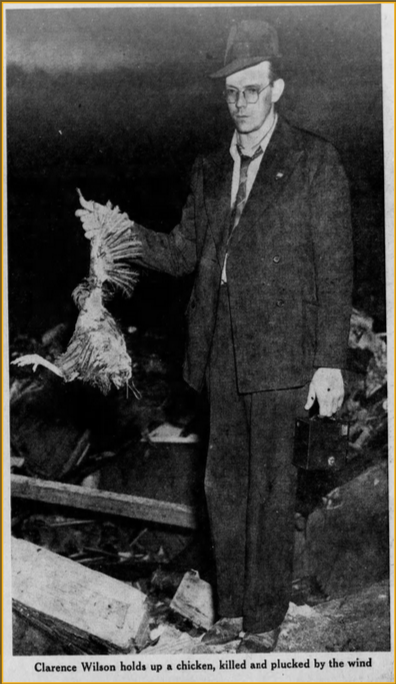
Left: An article in the Minneapolis Star on Monday, June 19, 1939 after a tornado in the Anoka area.
Tornadoes can induce extraordinary, seemingly freakish damage, and the quest to understand their true wind speeds is a centuries-old exercise. One widespread phenomenon reported historically at farms was that many chickens, whether killed or not, had been de-feathered by the tornado.
These observations prompted an unusual experiment by Professor Elias Loomis in 1842, to answer the question, “how strong must the winds be to strip a chicken of its feathers?” The answer to this question could provide insights into the true wind speeds of a tornado.
Of course, wind tunnels and other modern scientific equipment were not available, so Loomis proposed to shoot dead chickens out of a cannon, calculate their velocities, and then find the speeds at which defeathering occurs.
The first chicken, launched from a six-pound cannon with five ounces of gunpowder, was blown to bits. Loomis and his team did manage to calculate the velocity of the mangled bird at 341 mph. Loomis then noted that chickens in tornadoes were generally not blown to bits, and concluded that tornado winds must therefore be lower than 341 mph. Case closed!
This conclusion is accurate, though not necessarily for the right reasons. Originally, the most destructive tornadoes were estimated by T.T. Fujita to have winds up to 318 mph, based on debris trajectories analyzed from 8mm film. However, modern scientific and engineering techniques now indicate that the strongest winds in the very strongest tornadoes are slightly above 200 mph, but that over 99% of tornadoes have winds below that level.
Additionally, later research demonstrated that chicken-defeathering was not a direct result of the winds at all, but rather a stress response (“flight-molt”), and therefore not a good indicator of tornado intensity.
|
Annual Commissioner's Awards in full swing
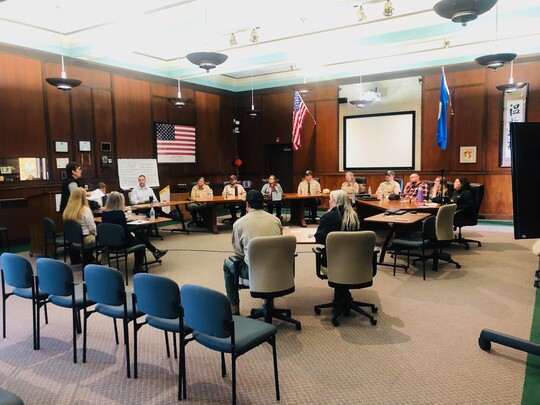
Deputy Commissioner Barb Naramore talks to attendees at the Winona event on April 11.
The Annual Commissioner’s Awards and Listening Session events are in full swing. Events have been held in Winona, Baxter, St. Paul and Finland. The events in Grand Rapids and Thief River Falls on April 20 and 21 were canceled due to weather conditions and will be rescheduled. Feel free to attend any of the three remaining events and stay tuned for the announcement of the rescheduled events.
- April 25, 10 a.m. - 12:15 p.m., Willmar
Kandiyohi County Health and Human Services, 2200 23rd St. NE, Willmar (Multi-Purpose Room #0030)
- April 27, 9-11 a.m., St. Paul - Listening session only (no awards presented)
Central Office Lobby, 500 Lafayette Road
- April 28, 10:15 a.m. - 12:30 p.m., Windom
Windom DNR, 175 County Rd 26, Windom
You can read more about the awards on the Commissioner's Awards Intranet page.

Fire Intelligence Officer Jolene Soltis
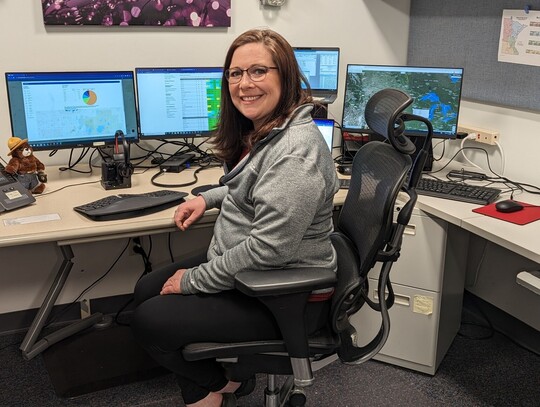 Keeping Minnesota wildland firefighters
apprised of fire intelligence
By Leanne Langeberg, Minnesota Interagency Fire Center information officer
Wildland fire intelligence data plays an essential role in the daily decision-making and coordination from the local area forestry office to the National Interagency Fire Center in Boise, Idaho. Fire Intelligence Officer Jolene Soltis plays a valuable role in connecting Minnesota’s wildland firefighters and support staff to the information they need to stay current on changing fire weather conditions, lightning strikes, ongoing incidents, and the availability of resources.
Stationed at the Minnesota Interagency Fire Center in Grand Rapids, Jolene’s behind-the-scenes work provides valuable information for firefighters throughout the state. Servicing the Minnesota Incident Command System partners, comprised of federal, state and tribal wildland fire management agencies in Minnesota, her position is part of the Minnesota Interagency Coordination Center. Jolene works closely with all MNICS partners to prepare and share daily intelligence critical for planning wildland fire response and prescribed burn activities throughout Minnesota.
“It’s rewarding to think how the work I do helps the different levels of wildland firefighting professionals in Minnesota and beyond,” Soltis said.
Jolene’s public service career started in 2002 as a Cass County corrections officer in Walker, Minnesota. During this time, she gained valuable dispatching and coordination skills as an emergency services dispatcher. But life had other plans for Jolene. After receiving a cancer diagnosis, she knew she had to redirect her career to focus more on a work-life balance. So, she returned to school and earned a degree in Human Resources Management from Bemidji State University, then moved back to the Grand Rapids area to be closer to family.
A cancer survivor, Jolene’s resolve and passion for public service has led her to MNCC. Initially, she took on a temporary dispatching role as a DNR Smokechaser before accepting the permanent fire intelligence officer role in 2021.
“I knew it would be a great way to reconnect to the work I enjoy while allowing me to learn and grow into another area of public service that I am passionate about,” she said.
In spring, Jolene is usually busy turning on weather stations scattered throughout Minnesota so the stations can gather data again. The variety of daily tasks Jolene fulfills as a fire intelligence officer varies throughout the year, but rest assured once fire season kicks in, her daily activities become a fine-tuned routine.
“My attention during fire season is focused on filling in the details. Sometimes you may find me talking directly with fire staff to fill out reports. Other times I may be on the phone with staff at the Eastern Area Coordination Center. But most often, I am focused on a computer screen sorting and entering data,” she said.
Some of the reports that Jolene prepares help document wildfires in Minnesota that meet specific size, cost, injury and damage criteria. Information found in these reports also helps the decision-making process when determining the preparedness level for regional and national response.
As Minnesota’s fire season begins to slow in November and December, Jolene returns her attention to the weather stations and will begin to shut them down as freezing winter conditions return. She’ll redirect her attention to supporting other fire management program areas. Often, she shares her time with DNR’s Wildfire Training program to help enter the many qualifications DNR’s wildland firefighters have earned throughout the previous season into the Incident Qualification System.
 Title: Fire intelligence officer
Work location: Minnesota Interagency Fire Center, Grand Rapids
Been at the DNR: Since 2018
Education: A.S. Human Services, Itasca Community College and B.S. Human Resources Management, Bemidji State University, Bemidji, Minnesota
Fun fact: "When I was 15, I had the best summer job working for the DNR at McCarthy Beach State Park."

The rushing waters of Jay Cooke State Park
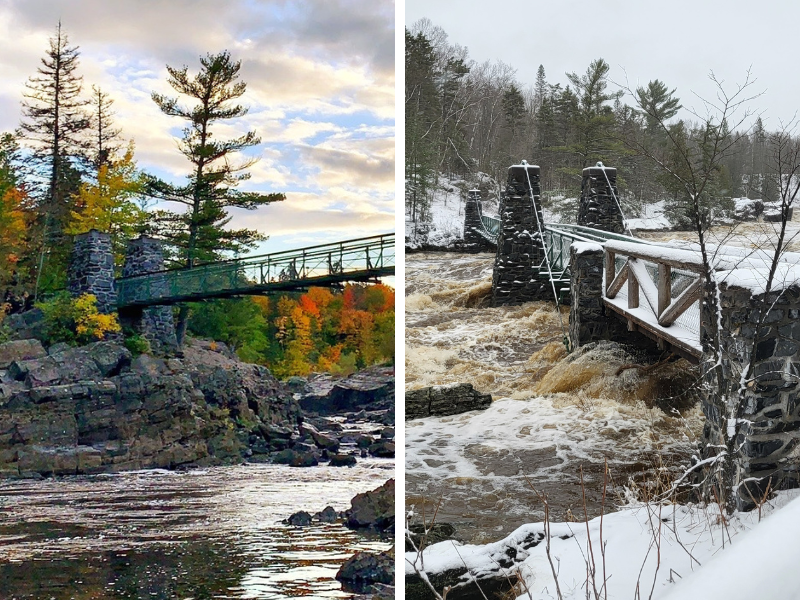
Left: Calm water flows under the swinging bridge at Jay Cooke State Park in September 2020. Photo credit: Peng Li. Right: Water is high and rushing under the same bridge in April 2023.
The Jay Cooke State Park Suspension Bridge, nicknamed the "Swinging Bridge," is closed due to high water. As of April 16, the bridge was measuring the third highest flow rate on record. The bridge will remain closed until it is deemed safe for visitors again.
|