|
Staff Newsletter | Minnesota Department of Natural Resources |
|
|
April 7, 2023
In This Issue
|
|
EagleCam nest falls, but EagleCam will continue
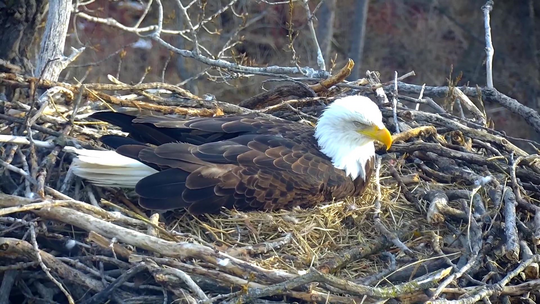 While the eagle nest on the popular DNR EagleCam has fallen, the territorial eagle pair are still in the area and may build a new nest nearby. Whether at this location or another, EagleCam coordinator and Nongame Wildlife Program Information Officer Lori Naumann says the DNR EagleCam will continue.
"Whether or not they build right in this area remains to be seen,” Lori told the Star Tribune. “We certainly hope so, and that is what all the fans are hoping, of course. We'll keep the camera on and pan the area watching their movements and behavior. We'll just have to see."
The 20-year-old nest, estimated at 2,000 pounds, fell April 2 following a heavy, wet snowfall. The recently hatched chick in the nest did not survive the fall. Social media and a quickly assembled Teams meeting for media that Sunday helped the public receive accurate and timely information, which spread across the country and around the world, garnering attention from the BBC, Reuters and other international services.
The Nongame Wildlife Program relies heavily on donations, especially through the “checkoff” on Minnesota tax forms. The EagleCam has played a significant role in donations to the program over the years. An FAQ about the nest falling and a new webpage detailing the first 10 years of the DNR EagleCam recently went live, to provide the large international audience with the history of this fascinating project. A dedicated team of DNR staff are already at work setting the course for the DNR EagleCam’s second decade.
|
|
Attend upcoming Wednesday well-being webinars

|
|
|
Take time to focus on your health by attending a well-being webinar. All sessions are held on Wednesdays from noon to 1 p.m. Links and instructions to join can be found on the Minnesota Management and Budget well-being webinar recordings page. All employees are welcome.
Upcoming webinars include:
April 12: Working effectively
with your manager
April 19: Post Traumatic
Stress Disorder
April 26: Wellbeats web portal orientation (registration required)
May 3: Art of decision making
Check out the webinar recordings page for archives of past sessions. Topics include self-care and resilience, loneliness and connection, and youth mental health.
|
Earn well-being program points after you attend
Report that you attended the webinar in Virgin Pulse to earn 100 points (up to four times). Track 300 points by Oct. 31 to earn the reward, a $70 reduced deductible next year.
Employees enrolled in the State Employee Group Insurance Program (SEGIP) are eligible for the reward. All benefit eligible employees have access to the Virgin Pulse well-being platform.
Visit the state wellbeing program website to learn more about the reward and how to get started using Virgin Pulse. Learn more about eligibility, data security and data privacy in the FAQ.
For more information about DNR Wellbeing, visit the well-being page on the Intranet.
|
|
Recognize, avoid voice phishing and SMS phishing
 Phishing emails continue to be one of the most popular methods of attack used by cybercriminals, but emails aren't the only method. Additional methods of attack include voice phishing (vishing) and SMS phishing (smishing).
-
Vishing: scammers use phone calls or voice messages to impersonate legitimate businesses and trick you into giving them money or personal information. These calls can be made by actual people or robocalls. Scammers can also spoof real phone numbers to trick you.
-
Smishing: scammers send phishing messages via text message or messaging apps to your smartphone or tablet. Like emails, you might be prompted to open a malicious link.
Common vishing and smishing tactics include demands for payment, account verification, program enrollment, order confirmation, winning a prize and tech support.
To protect yourself from phishing (including vishing and smishing):
- Take your time to think about what you're being asked to do and why before you do it.
- Don't answer the phone or respond to texts from unknown numbers.
- Never give out personal information such as account numbers, social security numbers, passwords, or multi-factor authentication codes.
- Verify the source.
- Create strong and unique passwords to protect your information.
Report all suspicious emails, texts or calls to the MNIT Security Operations Center at spam.reporting@state.mn.us or 651-201-1281.
|
|

March 21, 2023
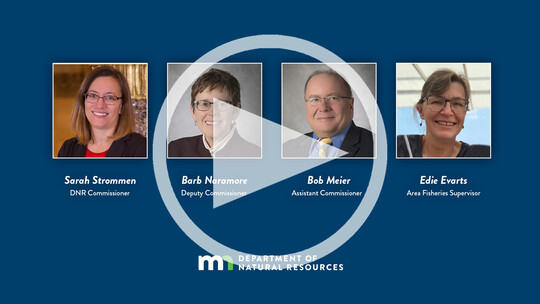 Commissioner Sarah Strommen, Deputy Commissioner Barb Naramore, Assistant Commissioner Bob Meier, and Area Fisheries Supervisor Edie Evarts were on the March 21 Wireside Chat to discuss legislative updates, Records Management Month and Red Lake fisheries management.
To watch previous Wireside Chats, including the March 21 edition, head to the Wireside Chats Intranet page.
|
|
It’s no joke! April is records management month

This year, the focus of Records Management Month is digital record clean-up — and we have several challenges for you. Complete one or both and submit by April 21. Winners will be announced the week of April 24.
Challenge 1: will your drive(s) be the biggest loser?
Take a "before" snapshot of your personal (H:) drive. Review your files and clean out the redundant, obsolete and transitory documents. When you're done cleaning up, take an "after" snapshot to measure your results.
To do this, highlight the drive you are measuring, right click and select "properties." Send your before and after snapshots to Sue Dickens. If you want to take the challenge a bit further, review files in the I: or other shared drives.
Challenge 2: records management awards
Nominate an individual or team who exemplified best records management guidelines on a project completed in the last year. It could be a 5S project, new project file creation, file naming project, etc. The sky is the limit. Tell us what was done, how it was done and why the individual or team should win the award.
Since the focus is on digital files, Central Office will not have additional recycling bins on each floor. However, there are recycling bins as well as a secure shredding bin on the lower level.
Keep an eye out for training and Records Management Month activities on the Records Management page of the Intranet.
|
|
|
Accounts payable intranet page updated
 The Accounts Payable intranet page is sporting a refreshed look with updated sections and new content. The Office of Management and Budget Services has made it easier and faster to find documents and links on the page. Here are some of the changes:
NEW section:
- Accounts payable contact information
- Mindy Kelm recently joined the accounts payable team – welcome Mindy!
NEW documents:
- PDF basics – accounts payable
- Dates – accounts payable
- Invoice search and payment information
- Preparing an invoice for accounts payable
- DNR relocation workbook
UPDATED documents:
- Submitting documents to accounts payable and file naming conventions
- Affidavit of no receipt for business expenses
- DNR relocation expense reimbursement form
- Request for refund of sales tax form
|
For the most up-to-date forms and documents, MNIT suggests clearing your web browser cache to remove previous versions of documents.
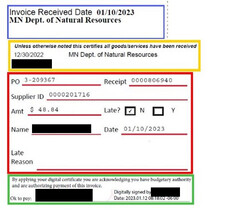
Please check the Accounts Payable Intranet page for the most recent stamps to use as these updated stamps save file space.
Check back frequently for additional items to be updated and added.
|
|
 |
|
|

Run over deer, heavy metal enthusiasts,
duck school and more
Some conservation officers already are working from their boats, checking open water anglers, while others remain in the throes of winter, checking anglers who still are drilling through thick ice. It’s a busy time, too, for firearms safety classes.
The following are several highlights from the weekly Conservation Office reports.
March 27, 2023
CO Anthony Bermel (Babbitt) investigated a case with a St. Louis County deputy and an Ely police officer in which an individual hit three deer in the city of Ely with his vehicle. The driver was identified and admitted to hitting them on purpose. A citation was issued for running over the deer with a motor vehicle and restitution was charged for each deer. He also investigated non-resident bear hunters with two or more years of tooth non-compliance, leading to enforcement action taken on several hunters as well as a two bear guides for records violations.
CO Alexander Birdsall (Waconia) responded to an emergency call on state land for person in distress. Officers found the person in question to simply be a heavy metal music enthusiast practicing lyrics in the woods.
CO Mason Bulthuis (Madison) attended “duck school” training at Whitewater State Park. Conservation officers from throughout the state attended to share their knowledge on subjects including waterfowl species identification, waterfowl laws, and numerous other topics.
|
April 3, 2023
CO Mitch Lawler (Alexandria) reported a decrease in angling activity with recent snowfalls. He continued to address registration and illegal exhaust violations.
CO Curtis Simonson (International Falls #2) worked the Rainy River this past week. With open water and warm weather, many people were out in boats. He issued violations for expired registration, no life jackets, no fire extinguishers and angling with extra lines.
CO Tom Hemker (Winona) reported fishing on the Mississippi River was limited by the weather, but anglers on the water caught good numbers of walleye and some perch. There were many people around the river taking in the spring migration.
|
|
R3 area fisheries supervisor recognized with conservation award at UMRCC annual meeting
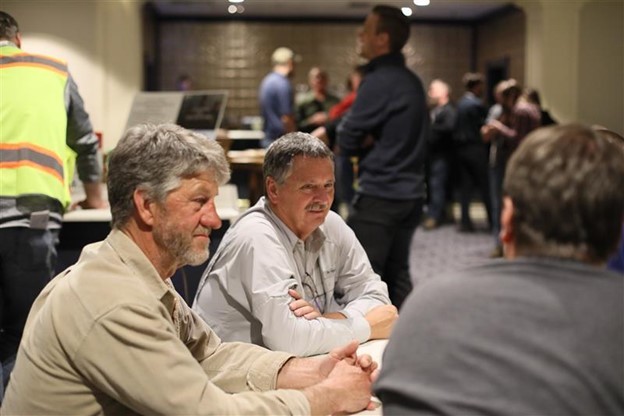 R3 Area Fisheries Supervisor Kevin Stauffer (center) discusses the Mississippi River with other Upper Mississippi River Conservation Committee participants at the 78th Annual Meeting in Red Wing. Photo credit: Nicole Ward
R3 Area Fisheries Supervisor Kevin Stauffer was awarded a conservation award for his career contributions toward the betterment of the Mississippi River at the annual meeting of the Upper Mississippi River Conservation Committee (UMRCC). Stauffer has more than 20 years experience as the area fisheries supervisor in Lake City.
The committee includes natural resource managers from Illinois, Iowa, Minnesota, Missouri, and Wisconsin as well as federal agencies working on the river. UMRCC was collaboratively formed by the five states in 1943 to coordinate the preservation and wise utilization of natural and recreational resources of the Upper Mississippi River and promote resource management through cooperative surveys, studies, and communication.
The UMRCC Conservation Award is intended to recognize individuals for their contribution to meeting UMRCC goals. Selection is based on a single outstanding contribution or several significant contributions made over a period of time. The contributions must be of interstate significance. Kevin's contributions included:
- Being a consistent voice for issues on the river as a prominent member of the agency's Mississippi River Team and advising member of the Mississippi River Steering Team.
- Leading the creation of a new position at the DNR to lead river habitat projects and to work with partners such as the U.S. Army Corp, U.S. Fish and Wildlife Service and the Wisconsin and Iowa DNRs to provide input and support on projects being led by other entities.
- Serving on numerous interagency teams, including the Fish and Wildlife Working Group that he chaired for two years. These teams planned and implemented numerous projects over time, such as the drawdown of Pool 5 that created significant improvements in aquatic vegetation within the pool.
- Leading the first significant revision of fishing regulations within the Wisconsin/Minnesota/Iowa border waters in more than 50 years.
- Serving in multiple leadership roles at the UMRCC, including Fisheries Technical Committee Chair and chair of the planning committee for annual meetings.
Congratulations to Kevin for this well-deserved honor!
Congratulations also to the team from DNR who hosted the UMRCC annual meeting this year, including Planning Chair Janine Kohn and the planning team: Rob Burdis, Chris Dawald, Steve Delian, Eric Lund, Brian Nerbonne, Madeline Pletta, Neil Rude, Nick Schlesser, Kevin Stauffer and Nicole Ward.
|
|
School Trust Lands Asset Management Plan Phase One complete
 By Cheri Zeppelin, regional information officer
The Minnesota Office of School Trust Lands (OSTL), working in conjunction with the Minnesota Department of Natural Resources, has finalized phase one of the first-ever asset management plan for Minnesota’s school trust lands, as required by state law. Phase one of the plan is available to read or download here. When complete, the plan will serve as a 25-year framework for the management of 2.5 million acres of school trust lands and an additional one million acres of school trust severed mineral rights.
Outreach to seek input on the plan’s development included six Tribal nations with school trust lands within ceded territories and tribal reservation boundaries, Permanent School Fund beneficiaries, and more than 200 stakeholders including conservation and recreation organizations, forestry and minerals industry representatives and others.
Phase one provides foundational information about school trust lands, recommended systems to improve strategic decision-making and facilitate robust management, a situational and risk analysis, and recommendations designed to help OSTL and DNR complete a comprehensive asset management plan. These recommendations do not prescribe land management changes nor change public access to school trust lands. DNR and OSTL do not yet know whether changes to on the ground management will be called for in the final plan.
Phase One Priority Recommendations
- Fully identify, routinely compile, and consistently track all revenues, expenses, management costs, and appropriations for school trust lands management.
- Develop and operationalize a comprehensive performance measurement system.
- Increase net proceeds deposited into the Permanent School Fund.
- Adapt the portfolio to address climate change-related risks and opportunities.
- Increase understanding within DNR on how the agency defines and operationalizes “sound natural resource conservation and management principles.”
Three additional recommendations include reclassifying school trust land parcels into asset classes that align with current sources of revenue, adopting a tiered ranking system to classify parcels by productivity, and developing asset class business plans for each asset class and type.
The completed plan will increase transparency of school trust land management and performance, and, through regular reporting, create a platform for more robust and regular conversations regarding DNR’s and OSTL’s school trust land management with legislators, Tribal partners, beneficiaries, and stakeholders.
School trust lands comprise about 45 percent of the lands managed by the DNR and provide an important source of funding for Minnesota’s K-12 public schools. Staff and the public can learn more about them on DNR’s school trust lands pages and on the Office of School Trust Lands website.
|
|

Cloquet Area Assistant Wildlife Manager
Josh Koelsch
 Cloquet Area Assistant Wildlife Manager
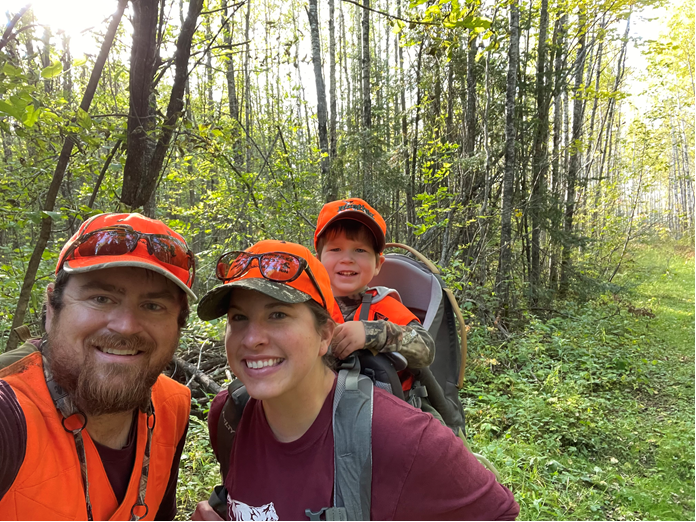
Josh Koelsch, wife Melissa, and son Jackson out for a walk in the grouse woods.
|
|
Working and recharging in nature
By Cheri Zeppelin, regional information officer
When Josh Koelsch began his career path, he planned to become an engineer. He didn’t know a person could have a career in natural resources other than being a conservation officer. But when friends went off to college at the University of Wisconsin-Stevens Point and he became more familiar with natural resource degrees, he made a course correction that would take him to much wilder places — including the mountains of Colorado and the Pacific Northwest.
Growing up as a military kid meant Josh’s family moved often, but time spent waterfowl hunting with his dad was grounding and fostered his love of the outdoors. Those early experiences grew into a passion for fishing, spearing, and hunting upland birds, small and big game. Annual spring turkey hunting trips to the Black Hills and summer trips to Voyageur’s National Park are some of his favorite ways to unplug from work and recharge with his family.
|
 Education: 2010
B.S. in Wildlife Management from University of Wisconsin -
Stevens Point
Joined the DNR: 2013
Family: Wife Melissa, 3-year-old son Jackson, and
lab Gadwall.
Outlook: Find the humor in every day
|
|
|
At work, Josh may be tucked away in a relatively quiet field office at the General Andrew’s Nursery, but the job is busy outdoors, and he enjoys the variety and seasonality of the changing job demands. As part of the Cloquet area staff, the team’s work area covers Carlton, Pine and the southern third of St. Louis County. Josh spends much of his time focusing on Pine County, where the team manages 6,750 acres of land across 17 wildlife management areas for game and non-game wildlife habitat.
Prescribed fire is one of the tools wildlife managers use to manage some types of habitats. Josh is a Type 2 Burn Boss, serves the DNR’s initial attack response for wildfire, and recently returned from a trip to Florida coordinated by The Nature Conservancy and hosted by Florida Parks Service to train in different fuel types, understand fire behavior in a different environment, and work on interagency crews. R4 burn staff and The Nature Conservancy staff also attended the training that was like any other fire assignment – 14-hour days of physical work in hot, smoky conditions.
When summarizing his career experience thus far, Josh said, “I’ve been fortunate to have some great early career mentors who encouraged me to take risks and try new opportunities. Working with different natural resource agencies has helped me see how other agencies work similarly on many things, but also how we can bring new ideas back to Minnesota to better ourselves and each other.”
|
|

When life gives you sap, make syrup
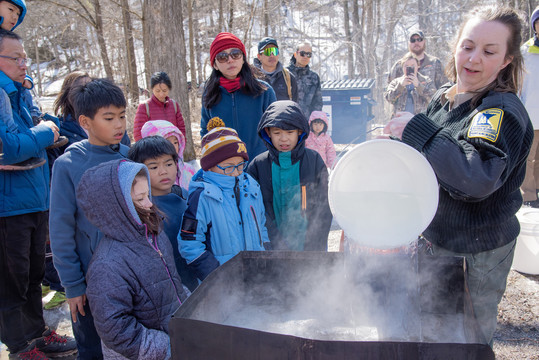 Sara Holger, Whitewater State Park naturalist, pours a bucket of sap into the boiler during the last maple syrup event of the year. The park collected about 150 gallons of sap, ending up with approximately four gallons of syrup. Although more sap could have been collected as temperatures have remained cold at night and warm during the day for a continued sap run, taps are pulled after the last program. “It was a good sap season in our area this year!” Sara said.
|
|
Submit to Spotlight
Send Spotlight articles and photos to newsletter.dnr@state.mn.us.
Next Spotlight is scheduled for April 21. Deadline for content is April 19.
|
|
|
|
|