It's fair time!
Minnesota State Fair
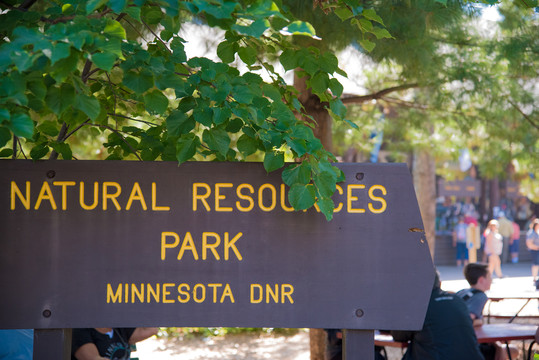 The Minnesota Department of Natural Resources’ building and surrounding grounds at the Minnesota State Fair (which runs from Aug. 25 to Sept. 5) will feature new musicians, presentations and activities in addition to its popular attractions from previous years.
The activities and entertainment will coincide with the DNR’s theme for 2022, which is “Connecting People to the Outdoors.”
“We’re thrilled to connect with Minnesotans again at the State Fair to promote getting outside and enjoying all the amazing natural resources of our state,” DNR Commissioner Sarah Strommen said. “Whether you are an outdoor enthusiast or are considering your first visit to Minnesota’s public lands, you can find the DNR at the Fair to celebrate and learn more about the great outdoors in Minnesota.”
The DNR’s iconic State Fair log building opened 88 years ago in 1934, and its park-like location provides fairgoers with a unique opportunity to experience the outdoors among State Fair carnival rides and food stands.
Some of the activities visitors can enjoy at the DNR building and surrounding grounds include:
- Visiting an outdoor fish pond and listening to a talk about Minnesota fish
- Asking DNR staff questions
- Learning about outdoor recreation opportunities
- Enjoying music or a presentation at an outdoor stage
- Taking a picture in front of giant butterfly wings
The DNR’s State Fair building and surrounding grounds are located at the corner of Carnes Ave. and Nelson St. in Falcon Heights. The main building is open 9 a.m. to 9 p.m. daily during the fair.
For more information and to find a complete schedule of DNR attractions and activities at the fair, visit the DNR website. If you would like to work at the fair, reach out to Dawn Bahajak.
County fairs
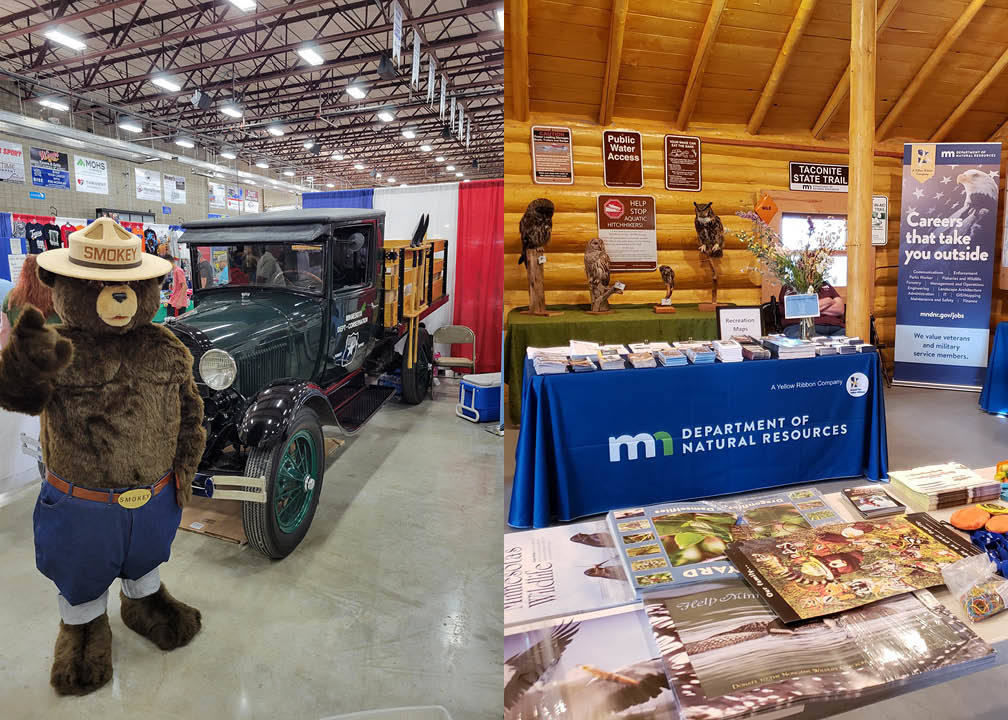 Left: Smokey Bear makes an appearance at the Steele County Free Fair in Owatonna and right: the DNR booth at the Itasca County Fair in Grand Rapids.
DNR staff are getting out and interacting with Minnesotans at the Steele County Free Fair, Aug. 16-21, in Owatonna and the Itasca County Fair, Aug. 17-21, in Grand Rapids.
The Steele County Free Fair is the largest county fair in Minnesota. It began in 1918 and receives hundreds of thousands of visitors each year. Visitors are able to see DNR attractions like Smokey Bear, native fish and the Turn in Poachers Wall of Shame.
The Itasca County Fair was first held in 1892. The fair features Grandstand events, carnival rides, free entertainment and of course — fair food.
DEI champions cohort share key takeaways
 The Fish and Wildlife and Parks and Trails divisions have worked together during the past year to pilot a diversity, equity and inclusion (DEI) focused cohort opportunity for staff who are passionate about advancing DEI.
Members of the cohort worked with the DEI coordinator and intercultural development inventory coaches to complete cultural competence assessments, receive training, and engage in group conversations and coaching designed to help support individual growth and increased cultural competence. Each participant also worked on a project related to their job duties or division needs.
The following reflections highlight key takeaways from the cohort learning sessions. These individuals in the cohort will help champion DEI in the divisions and make changes to have a more inclusive work culture and serve all Minnesotans more effectively.
NOTE: These key lessons have been edited for grammar, length, and clarity.
|
Name
|
What did you learn from the sessions?
|
|
Hannah Anema
|
The DNR still has a lot of work to do so that everyone feels welcome in outdoor spaces.
|
|
Jason Abraham
|
I work with a lot of people who value learning outside of their comfort zone. Approaches and opinions around DEI work vary; listening is helpful.
|
|
Tom Burri
|
Differences exist — it's OK to acknowledge, embrace and discuss the differences.
|
|
Alicia Kelly
|
Each of us carries with us the biases that were given to us by society during our upbringing. Choosing to acknowledge, examine and understand those biases is a decision we each must make to become better citizens of humanity and better advocates for DEI.
|
|
Jen Westlund
|
In order to be effective, DEI efforts can and should be a part of all employees' work. The field is evolving quickly and there's a lot of room for creativity and partnerships.
|
|
Melody Webb
|
The pursuit of perfection can't be allowed to get in the way of progress. True progress takes time and will feel, at times, frustratingly slow. We must perservere.
|
|
Matt Ward
|
I need to work on my intercultural competence and we need to emphasize
the people and the processes as much as the products.
|
|
Deb Vermeersch
|
DEI work is about asking questions and questioning assumptions and these questions might be uncomfortable.
|
|
Stacy Smith
|
For many people, incorporating and prioritizing DEI can take a lot of work. To increase competency in DEI, it often involves getting out of your comfort zone and trying new things.
|
|
Linda Radimecky
|
Learning requires one to step outside of their comfort zone and what they know, and also to have conversations because that is where and how we learn to place new information into our own matrix.
|
|
Dean G. Paron
|
Everyone starts the journey from their own place; be aware of bias and how it can impact decision making, as well as the importance of being intentional about being inclusive.
|
|
Nicholas Snavely
|
I must be open and recognize the privilege or lack thereof in certain segments of society, as well as how that has impacted each group and individuals' opportunities to ensure I am an effective advocate
for DEI and accessibility within
and outside the DNR.
|
|
Darin Newman
|
Positive change in DEI, individually and organizationally, requires dedicated time and resources. We should not expect change without intention. It can't be something "extra" or "on top"
of other job duties.
|
|
Kristine Hiller
|
Identity is hidden beneath the surface. I found out that many of my coworkers navigate DEI issues in their day-to-day life.
|
|
Blane Klemek
|
My fellow champions' commitment to making our world a better place.
|
|
Jim Levitt
|
DEI is very diverse and can be seen and interpreted from many different views. My beliefs don't need to match someone else's and at the same time, I am able to see, hear and understand theirs
in a professional manner.
|
|
Jamie McBride
|
I need to be open to my blind spots and how they impact my work to make sure I am an effective advocate for inclusion.
|
Applications open for Increasing Diversity in Environmental Careers fourth cohort
 The Minnesota Department of Natural Resources, Conservation Corps Minnesota and Iowa, the Minnesota Pollution Control Agency, and the Minnesota Board of Water and Soil Resources are partnering to provide the Increasing Diversity in Environmental Careers program.
The IDEC program allows college students from diverse backgrounds to:
- Access resources to ensure academic success.
- Receive a yearly academic stipend.
- Get hands-on experience through paid summer experiential learning and internship positions.
- Learn more about environmental or natural resources careers.
- Enhance personal and professional development.
- Be a more competitive job applicant after graduation.
The program consists of three parts: a fellowship with stipends to ensure financial and academic success, a mentorship to connect students with professionals in the field, and an internship to ensure the students have experience in the field before graduation.
Applicants must be:
- A racial/ethnic minority, a woman, or an individual with a disability.
- Accepted to or enrolled in a full-time program (four- or two-year) at an accredited state, community, private or tribal college or university
- A college sophomore or junior as of fall 2022, pursuing a STEM major with a desire to work in a natural resource or environmental career after graduation.
- Willing to commit to the entire program.
- Authorized to work in the United States.
Application instructions and more information about the program are on the Conservation Corps Minnesota and Iowa website.
The application deadline is Oct. 7 for entry into the program, starting in January 2023.

A tip of the hat

Minnesota Conservation Volunteer felt the love at this year’s Northern Lights Awards ceremony, hosted by the Minnesota Association of Government Communicators to honor the
best communications work by
government entities in Minnesota.
MCV snagged two “Creative Achievement” awards for written communication: a bronze for “Casting into the Past” by Youa Vang and an award of merit for “Flight Plan” by Emily Sohn. Read on to learn more about the award-winning articles.
|
September–October 2021
For many Hmong American anglers in Minnesota, the white bass is a link to their Southeast Asian roots.
May–June 2021
Drones can be high-tech helpers in the natural resource world, but they also pose potential threats to wild places and wildlife. The DNR is preparing for both scenarios. Congratulations to the writers, editors, and photographers who brought these stories to life!
Minnesota Conservation Volunteer is the magazine of the DNR. Supported by reader donations, its mission is to encourage conservation and sustainable use of Minnesota’s natural resources. For more info, visit mndnr.gov/MCV or subscribe.

When the weather you love is a lie
(or a misunderstanding)
 By Kenny Blumenfeld, State Climatology Office
After learning from the audience, once again, that winter is a polarizing topic that people love, hate, and love hating, the climatologist changed the subject.
“Okay, think warmer. What is your favorite kind of summer weather?”
“Heat lightning,” shouted someone in the back. Others agreed loudly.
But the climatologist flinched, and looked terrified. The challenge would be breaking it to the audience that there’s no such thing as heat lightning because, truly, there is no such thing as heat lightning.
“Heat lightning” is not a real phenomenon and therefore has no true definition. Usually, it is meant to describe lightning that occurs without thunder, typically on warm summer nights — but even part of that distinction is incorrect. All lightning produces thunder, because, in our atmosphere, it is physically impossible to heat the air to tens of thousands of degrees Fahrenheit instantaneously without producing the explosive shockwaves we experience as thunder.
It is possible, however, to be so far away from the lightning that you cannot hear the thunder. That is something many Minnesotans have experienced, almost always in the evening or night, when lightning stands out easily in the falling darkness.
If you see lightning skittering around the edges of a large, far-away cloud near or after sunset, while the skies are mostly clear overhead, you are actually seeing a distant thunderstorm. That storm absolutely is producing audible thunder in its vicinity, though perhaps not in yours. Powerful thunderstorms can produce lightning flashes that are visible to viewers well over the horizon, at distances in excess of 150 miles.
“So that’s what’s happening,” explained the climatologist. “It’s not heat lightning, it’s just regular lightning, at a distance.”
“Thank you,” said the person in the audience who had brought it up originally. “Thank you for taking the magic out of the weather. I liked it better when heat lightning was real.”
“Yeah,” shouted someone else. “I suppose next you’re going to say that it doesn’t snow on the Fourth of July in Minnesota.” Groans and boos wafted out from the seating area.
The door was just 30 feet away, and the climatologist thought it might come in handy because, indeed, there was no evidence of snow falling anywhere in Minnesota on any Fourth of July.
Commissioner Sarah Strommen featured on Minnesota Bound
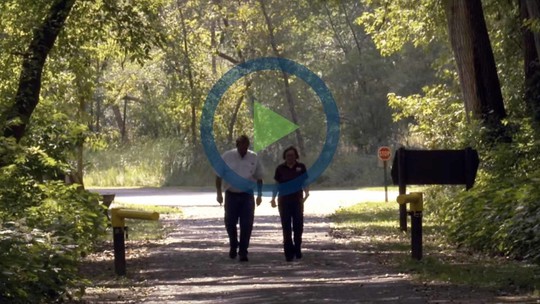 DNR Commissioner Sarah Strommen was featured in the Aug. 7 episode of Minnesota Bound, a show that shares stories from the great outdoors.
The episode, which you can watch on the Minnesota Bound website, highlights Strommen's work as the first female commissioner of the DNR.
"I applied for it because it's an incredible honor to serve in this role," Strommen said in the episode. "It's an agency of amazingly dedicated public employees, who are very committed to their mission, Minnesota's resources and the people of Minnesota."
Strommen said when she took the role of commissioner, there were a lot of people — even in 2019 — who believed the DNR would never have a female commissioner. She said it's about looking at who is not represented at the table and trying to include them.
There are so many roles the DNR plays, Strommen said, that a lot of Minnesotans might not even know all the DNR encompasses.
"All of that works together, and I think that's true of our natural world and our environment," she said. "Those things are all connected."
Unlocking the mystery of rock snot
 By Abbey Carter, intern, Office of Communications and Outreach
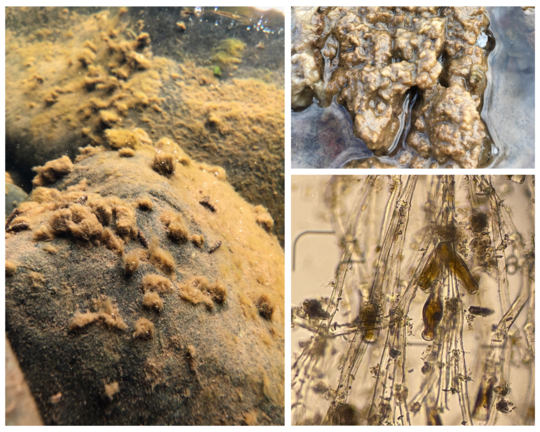
Minnesota scientists are trying to figure out if didymosphenia geminate (also known didymo), a complicated alga that is globally invasive, is native to Lake Superior.
Didymo is a brownish-yellow color and tends to cover rocks, which is how it gets its nickname “rock snot.”
“We think it’s native to Lake Superior, but we don’t know if the populations that are creating mats are a native strain or if it’s a non-native strain that’s been introduced,” said Heidi Rantala, a research scientist in fisheries whose work focuses on didymo.
Scientists at the DNR are partnering with the Science Museum of Minnesota to find out more about the species. Divers from Ecological and Water Resources find the rock snot, then scientists gather the samples and divvy up the work to figure out how didymo is affecting the environment of the Lake Superior basin. The team started to incorporate animal samples and stream insects, and have begun researching how the algae may also impact the lake’s trout population.
“We want to understand didymo’s impact on the streams and why it’s happening in this area,” Rantala said.
Rock snot is also quite different from other algae in the Lake Superior basin. Most of the time people think of algae flourishing in the summer, but rock snot tends to thrive in cold water, with lots of movement, and few nutrients. This makes them a good competitor with the other algae and scientists have been trying to figure out how this could affect the food web.
Rantala uses her Twitter account to highlight the achievements of her team and their research about didymo.
“I hope my social media can raise awareness of the issue and can amplify the great work the DNR does," Rantala said. "The people I work with are so amazing and do awesome work!”
The Science Museum of Minnesota is conducting genetic testing associated with rock snot and is regularly working with DNR scientists to find more information about didymo. Both have noticed the algae increasing in Lake Superior. The team wants more people to be aware of the research being conducted so they can get involved if they see rock snot.
“If you suspect you see it, you can report it on iNaturalist or by using the invasive species EDDMapS," Rantala said. "The best way to report it is to send in pictures and a description, and our team will communicate with you back."

Tribal Relations Director Bradley E. Harrington
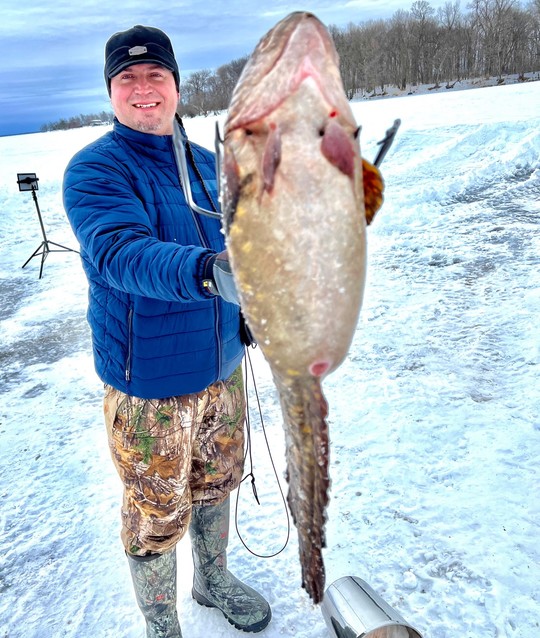 Bradley E. Harrington shows off a catch while ice fishing.
Sharing, expanding indigenous knowledge
By Maggie Snyder, news release and media specialist
If he felt sad when growing up, Minnesota DNR Director of Tribal Relations Nazhike-awaasang – Bradley E. Harrington – would go to his elders in the Mille Lacs Band of Ojibwe. The elders told him to spend time in the trees and that the trees had agreed to take his sadness. Later, Harrington learned research shows spending time around trees can reduce stress, lower blood pressure, and improve moods.
“The Anishinaabe people knew that – they just knew it in a different way,” he said.
It is this intersection of indigenous knowledge and natural resource management (known as Traditional Ecological Knowledge, or TEK) that Harrington is interested in, he said.
“I started taking courses for natural resources and, about the same time, I was also learning about Ojibwe language, history and customs," Harrington said. "A lot of what I was learning about the environment in college was different from what I was learning about the environment from my elders."
For example, in college he was learning about how to look at a stand of trees and determine their monetary value, but from his elders, he was learning that trees were spirits who had agreed to help the Anishinaabe people by providing food, medicine, and materials.
He began to talk to his tribal leaders about his idea of Anishinaabe natural resources management with three criteria: it must be given by the spirits, it must enhance or sustain life, and it must be supported by and support a spiritual belief system.
In 2017, Harrington was sworn in as the Mille Lacs Band of Ojibwe Department of Natural Resources Commissioner. His work there focused on implementing TEK and starting a cultural resource program to document and expand this knowledge.
In 2019, Gov. Tim Walz and Lt. Gov. Peggy Flanagan issued Executive Order 19-24, which required state agencies to create a tribal liaison position and include tribal consultation in their decision-making processes. Harrington applied to this position at the Minnesota DNR because the agency has the a lot of interaction with tribes.
“I felt I needed to put my money where my mouth was,” he said. “I could sit back and say, ‘the state needs to do this and the state needs to do that,’ but at the same time, I knew this was going to be an opportunity to have impact.”
He joined the DNR in January 2020 with two main directives: to redraft Operational Order 129 (Tribal Nations Consultation) and to create a full-time tribal relations position. He restarted a Tribal Relations Working Team to help with these goals. The team edited the operational order and created the job description for the tribal relations director position.
Once the position was posted, Harrington applied and was hired in May 2022. His goals for his current position are to get Operational Order 129 officially adopted, and to get coordination plans and tribal contact lists created as a reference for staff doing business with tribes.
In 2022, Harrington was also named a Bush Fellow. The fellowship is a flexible grant of up to $100,000 to help strengthen and develop leadership. Harrington said he will use the grant to take organizational leadership and user interface courses and build his Ojibwe fluency.
Harrington said he is the youngest male Ojibwe speaker in the Mille Lacs Band, so he has a lot of responsibility to help with ceremonies. According to Anishinaabe beliefs, the Ojibwe language is a gift from the spirits, who shared their own language with the Anishinaabe people to help them communicate. As such, all spiritual ceremonies such as namings, sweat lodges, funerals and more must be done in Ojibwe.
To help revitalize the Ojibwe language, Harrington has helped with projects such as recording elders’ stories in Ojibwe and helping Rosetta Stone create its Ojibwe course.
“I’ve taken on multiple roles with Rosetta Stone as an actor, so I’ll be in some of the scenes," he said. "Then I also record elders to get certain words down and certain audio lessons available."
|
 Name: Nazhike-awaasang – Bradley E. Harrington
Title: Director of Tribal Relations
Joined the DNR: Jan. 27, 2020
Work location: Central Office
Education: Certificate of Tribal Administration and Governance out of the University of Minnesota – Duluth, Certificate from the Native Nations Institute at the University of Arizona – Tucson.
Fun fact: “I’ve been playing guitar for a very long time, since I was about 12 years old, and I recently started making songs in the Ojibwe language and I’ve translated some songs into the Ojibwe language.”

You can tune a piano, but you can't tuna fish...
or a giant muskie
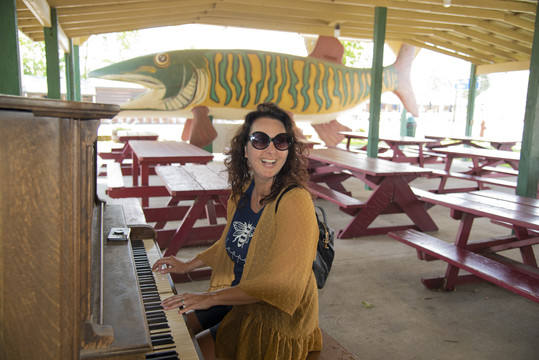 Parks and Trails Cartographer and Special Event Coordinator Amy Ellison sits a spell and plays a piano next to the "World's Largest Tiger Muskie" in Nevis.
"Side note: There’s also a fantastic ice cream place next door. It’s important to map all the attractions along the trail, right? (We recommend the huckleberry.)" — Deb Rose
|