The mighty mussel lab of Minnesota
By Abbey Carter, media unit communications intern
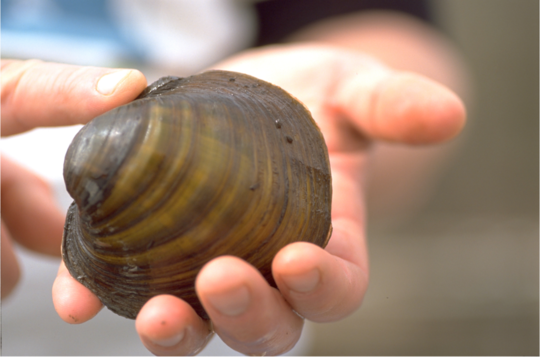 Minnesota is home to 52 mussel species, and the Center for Aquatic Mollusk Programs (CAMP) in Lake City is at the forefront of all things mussel-related. The lab focuses on surveying, monitoring, researching, and propagating mussels in hopes that Minnesota rivers will be restored.
“Native mussels are awesome and beautiful, they are our ecosystem engineers,” said Madeline Pletta, a freshwater mussel propagation biologist at CAMP.
Although the invasive zebra mussel can be harmful to Minnesota lakes and rivers, it’s the only mussel species that poses a threat. Native mussels help our river’s ecosystems by filtering and cleaning the water and their waste serves as a food source for other animals.
Mussels are dependent on host fish to survive. Larvae mussels attach to fish gills, where they transform into juvenile mussels. Some mussels accomplish this by disguising themselves as rocks to attract log perch, while others may resemble fish food, like minnows, to attract walleye. In the summer months, CAMP retains several species of fish to keep mussels alive and thriving, including about 180 walleye and several log perch collected out of Lake Pepin.
“My favorite part about working in the lab is the excitement with being able to raise juvenile mussels that are going to better Minnesota," Pletta said. "When we release them and do a survey, it’s like I’m a mussel mom, and I get to look at them doing their job. It’s really exciting to see that full-circle aspect [with] something so small that will make a big difference."
In 2018, lab staff discovered the host fish for the federally endangered Spectaclecase Mussel: Mooneye and Goldeye fish. Staff discovered this in the lab, then confirmed the finding in nature. CAMP is the only successful lab across the nation to accomplish this feat.
If you would like to visit the lab, please contact the team in advance to schedule a tour. Both the public and DNR staff are welcome.
“We encourage anyone and everybody to come,” Pletta said.
DNR receives land donation along St. Croix River
 Video by Nick Frantzen, DNR videographer
The DNR has received a 729-acre land donation from Trust for Public Land. The donated land stretches for 3 miles along the St. Croix River east of Rush City and will be managed by the DNR as part of the Chengwatana State Forest.
The donated land includes forests, grassland, and several creeks, streams, and ponds. Donating the land to the DNR safeguards the diversity of native ecosystems, improves connectivity between natural lands, protects drinking water, and provides public access for recreational activities.
“The benefits of public land projects like this are tremendous, providing clean water and air, high quality habitat, and recreational opportunities,” Commissioner Sarah Strommen said. “We look forward to managing this land to meet Minnesotans’ recreation, conservation and economic needs into the future.”
Xcel Energy owned the land for roughly a century and TPL led the effort to purchase it using a grant funded by the Minnesota Outdoor Heritage Fund. The Fund is part of the Clean Water, Land, and Legacy amendment passed in 2008 to increase the sales tax by 3/8 of one percent to, among other things, protect, enhance, and restore wetlands, prairies, forests, and fish, game, and wildlife habitat.
“For generations to come, this place will be protected and treasured by countless hikers, hunters, and wildlife viewers,” said Susan Schmidt, Minnesota state director for Trust for Public Land. “Spending time outdoors is critically important for our mental and physical health, and with about 3 million people in the Twin Cities an easy day-trip away, this is a big win for our people and our planet.”
Trust for Public Land is a national nonprofit that works to connect everyone to the benefits and joys of the outdoors. As a leader in equitable access to the outdoors, TPL works with communities to create parks and protect public land where they are needed most. Since 1972, TPL has protected more than 3 million acres of public land, created more than 5,000 parks, trails, schoolyards, and iconic outdoor places, raised $84 billion in public funding for parks and public lands, and connected more than 9 million people to the outdoors. To learn more, visit Trust for Public Land.
Be safe on the water during July Fourth weekend
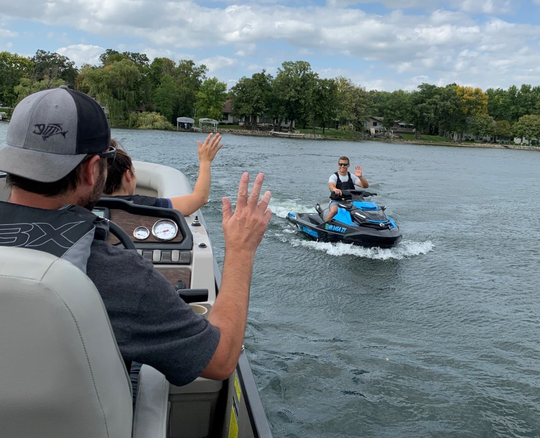 Leave the alcohol on shore
Minnesota waterways will be busy over the long Fourth of July weekend. While forecasted warm weather will make the water an appealing place to be, DNR officials warn boaters to choose something other than alcohol when they get thirsty. Across the nation, including in Minnesota, boating while intoxicated is the leading contributing factor in boating accidents and fatalities.
“Planning ahead can alleviate all of the issues associated with boating under the influence — make sure you’ve lined up a sober ride, both on the boat and on the way home,” said Lisa Dugan, recreation safety outreach coordinator.
Boaters can have varying experiences and skill levels on Minnesota lakes and rivers, so it is important to be responsible on the water. Having a safety-focused mindset while having fun is the best way to ensure a successful trip out on Minnesota waters.
Following these simple safety tips will help make your holiday weekend safer:
- Life jackets should be on at all the times. Don’t just bring one, wear one! In Minnesota, 90% of boating fatality victims are not wearing a life jacket. The law requires children younger than 10 years old to wear one, but it’s the easiest step for boaters of all ages to ensure they get home safely.
- Drinking and boating do not mix. Boating under the influence is illegal and is the greatest factor in fatal boating accidents. Keep the alcohol on shore for the safety of your family, friends, and everyone else on the water.
- Check your safety equipment. That includes making sure life jackets are in good condition and fit everyone on the boat. Checking your navigation lights, sound-producing device, fire extinguisher, and carbon monoxide detectors are also essential before getting on the water. Do not forget to use your engine cut-off device.
- Own your wake. This means you understand that all boats produce wakes, so all boaters need to be aware of the potential impact their wake is causing on the water.
“All boaters share the responsibility of being safe on the water,” Dugan said.
In addition to the proper equipment, make sure you are knowledgeable about the boating laws and regulations in Minnesota. An online education course can help increase your knowledge and hopefully prevent more boating fatalities.
Check out this video to hear from Dugan on how to choose the best-fitting life jacket:
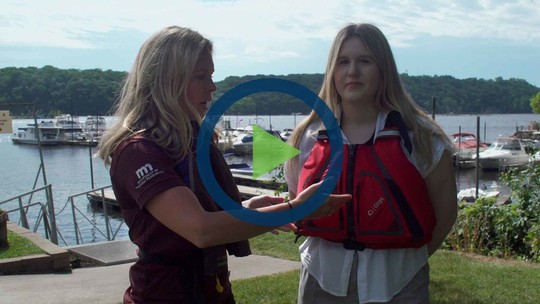 Video by Nick Frantzen, DNR videographer
 With the summer season in full swing, and the Fourth of July holiday upon us, conservation officers have been devoting much of their time to the water. Calls about “abandoned animals” continue as well, and more and more riders are on their off-highway vehicles.
The following are several highlights from the weekly Conservation Office reports.
June 21, 2022
CO Jake Swedberg (Detroit Lakes) spent the week checking ATVs and anglers. He worked an ATV detail with Hubbard County-area conservation officers to target high-use areas. Swedberg also worked a TIP call of an individual taking fish using a net at an area dam. Thanks to the TIP call, Swedberg was able to find the group of people and found there were several more issues on top of the netting violation.
CO Vinny Brown (Northome) checked anglers, monitored ATV and OHM activities, and responded to TIP reports and animal-related calls. While at a local resort checking anglers, Brown noticed that a fishing rod over the back of an unoccupied boat was moving. Brown walked over and picked up the rod and reeled in a large crappie. The owner came down to the harbor and enforcement action was taken for the unattended fishing line.
CO Nicholas Klehr (Litchfield) spent the majority of the week checking anglers and boating safety along with working AIS enforcement. A pair of kayakers decided to go out onto a lake on a windy day with whitecaps. Both kayakers ended up in the water and a person on shore called 911. The kayakers were wearing life jackets. Klehr responded and was able to spot the kayakers in the water and knew they were OK at that point. The kayakers were rescued by the Litchfield Rescue Squad airboat.
|
June 27, 2022
CO Jeremy Woinarowicz (Thief River Falls West) reported that while checking anglers in Thief River Falls he noted two juvenile females joyriding on a department store-type electric scooter. When they saw him, they jumped from the machine and started to walk away. Finding this odd, Woinarowicz pretended to leave the area and returned shortly to find them back on the machine. This time, they jumped from the scooter and hid in some trees. Woinarowicz contacted the hiding juveniles and learned they had stolen the scooter from a local grocery store. Local authorities were contacted and loss-prevention personnel arrived to retrieve the stolen scooter.
CO Anthony Bermel (Babbitt) worked a busy week of ATV, boating, and angling enforcement. A detail was worked at the International Falls Port of Entry with CO Simonson. Plenty of enforcement action to report, including no PFDs, unregistered boat, possession of fish unlawfully taken or possessed in Canada (including several overlimits), AIS violations, ATV passenger under 18 without a helmet, litter, and blocking a public access.
CO Annette Kyllo (Rochester #1) contacted an individual this week who had all the drain plugs still in the boat as he drove down the road. There was enough water in the boat that every time the individual accelerated, a significant amount of water would shoot out the bilge outlet hose. The trailer also had a brake light out, one transom strap was completely missing and the other was held together with a single knot. The individual admitted he was aware of the issues, but he had been fishing in a tournament all weekend, so he hadn’t taken the time to address any of the issues. Enforcement action was taken.
South region staff help get kids fishing
in Worthington
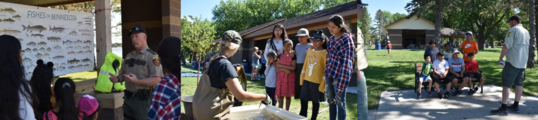 Twenty children between the ages of 6-13 spent the morning of June 22 learning about the area’s natural resources and fishing opportunities.
The perfect summer morning involved learning what kinds of fish were in Lake Okabena, getting the opportunity to see fish and turtles close-up, and hearing more about the state’s angling regulations.
While the fish didn’t quite cooperate, the kids had a great time fishing off the public fishing piers and docks at Worthington’s Centennial Park. The event was organized by regional staff in partnership with the Worthington School District’s Enrichment Program along with the Nobles County Integration Collaborative.
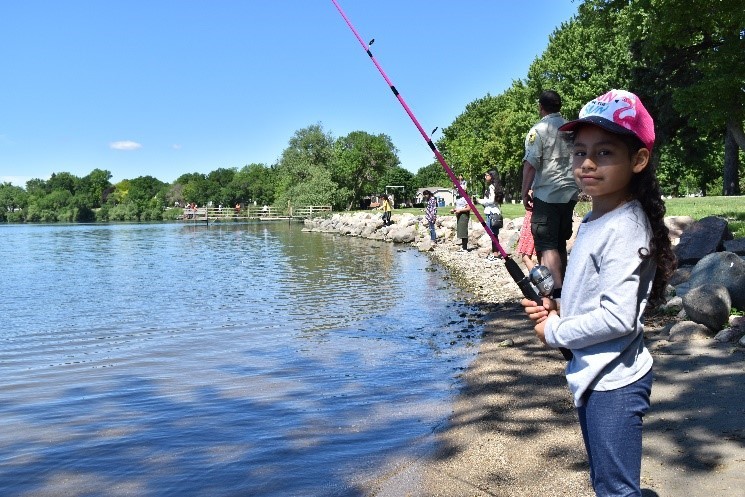 Photo credit: Dan Ruiter, southern region information officer
Special thanks goes out to Hannah Anema, Hutchinson fisheries technician; David Petersen, south region outreach intern; Jim Robinson, conservation officer; Nate Hodgins and Jonah Dagel from Windom fisheries along with their intern Noah Schlueter; regional safety administrator Trevor McMartin; regional planner Brooke Hacker; and regional information officer Dan Ruiter.
DNR celebrates grand opening of Walter F. Mondale Visitor Center at St. Croix State Park
The Walter F. Mondale Visitor Center at St. Croix State Park has undergone renovation to upgrade and modernize the facility, while providing innovative and accessible learning opportunities that showcase the stories of the land and its inhabitants over time.
The DNR partnered with the Mille Lacs Band of Ojibwe and the local community to tell the stories of those who have lived and worked on the land that St. Croix State Park now encompasses.
The grand opening was celebrated on June 29. Check out this video to see the renovations:
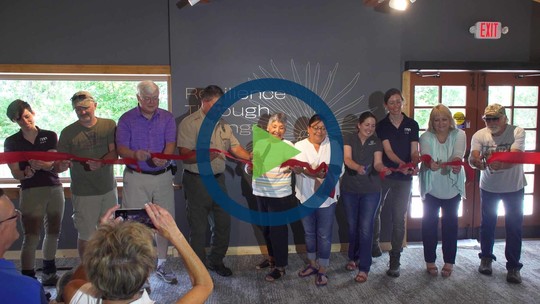 Video by Nick Frantzen, DNR videographer

Inventory Control Supervisor Tom Staydohar
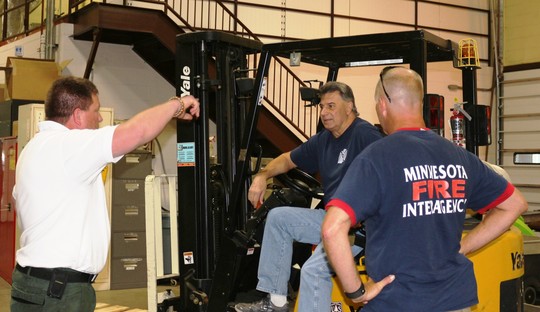 Tom Staydohar coordinates with a MNICS Type 2 Initial Attack Crew as they prepare for an assignment out west during the 2016 season.
Distributing wildland fire supplies to Minnesota and beyond
By Leanne Langeberg, Minnesota Interagency Fire Center public information officer
Did you know Minnesota is home to a unique national distribution hub supplying wildland firefighting equipment?
The Northeast Interagency Supply Cache (NEK), located in Grand Rapids has become a staple of the DNR's wildland fire program and the Minnesota Incident Command System (MNICS).
Long-time DNR employee Tom Staydohar has supervised the NEK distribution operations for most of his career. He was instrumental in the progression from individual agency supply caches to the centralized interagency warehouse supplying more than $6.3 million in wildland fire equipment annually. NEK even shares a home with the iconic Smokey Bear and the National Symbols program.
NEK is known to many in the wildland fire community as the Fire Cache. It's one of 15 supply caches strategically located throughout the United States. It's also the only national fire supply cache co-managed as a state (DNR) and federal (U.S. Forest Service) partnership. It services the northeast United States and coordinates with the other 14 supply caches assuring national demands are met during high wildfire activity. Staydohar, the inventory control supervisor (also known as the assistant fire cache manager), has been with the NEK cache since its beginning in 1991. He has observed and implemented many changes that make the system run smoothly.
Staydohar started with the DNR in 1987 as a smokechaser. At that time, the DNR operated two small fire supply warehouses in Grand Rapids and St. Paul, where Staydohar picked up and delivered supplies to firefighters in the field. After a couple of hectic wildfire seasons smoke-chasing, Staydohar accepted a full-time position as a general maintenance worker for the Northeast Region Headquarters in Grand Rapids.
"I was brought in through DNR's Bureau of Field Services, which has since reorganized into other divisions," Staydohar said. "I never stopped supporting wildfire during that time and delivered supplies for the fire program during my off hours."
After MNICS was organized in 1984, a deliberate effort was underway to centralize an interagency cache and streamline supply distribution to all MNICS partners responding to wildland fires throughout Minnesota. By the early 1990s, a plan was in place. Staydohar was part of the interagency search with the USFS to locate a large enough warehouse facility to accommodate all the supplies and equipment. The search led them to the former Anheuser-Busch wild rice processing plant, which had ample warehouse space and was ideally located near the Grand Rapids UPS distribution site.
"We couldn't have asked for a better facility and location," Staydohar said.
The USFS purchased the building, and Staydohar was sure that MNICS agencies would never be able to fill the large warehouse during his career. However, looking at the NEK cache today, he admits that the current warehouse may not be large enough with the ever-changing advancements and the ongoing need for fire equipment and supplies.
Around the same time the NEK warehouse facility was purchased by the USFS, Staydohar's position was reassigned to the Minnesota Interagency Fire Center. He stepped into his official role managing the daily operations and the cache workers who fill the steady orders and also perform fire equipment maintenance.
Staydohar's expansive knowledge of warehouse distribution, along with his dependable NEK team, have built a program that ensures DNR fire management programs and all MNICS partners have what they need to complete their job safely and efficiently.
 Work location: Minnesota Interagency Fire Center – Northeast Supply Cache, Grand Rapids.
Job title: Inventory control supervisor/assistant fire cache manager
Years of Service: 35 years
Education: Forestry Technician Program – Itasca Community College
What’s something my colleagues don’t know about me? “I always wanted to be a teacher, but my career went in another direction. Before joining the DNR, I spent 10 years working for a mining company in Nashwauk, Minnesota.”

Family swim
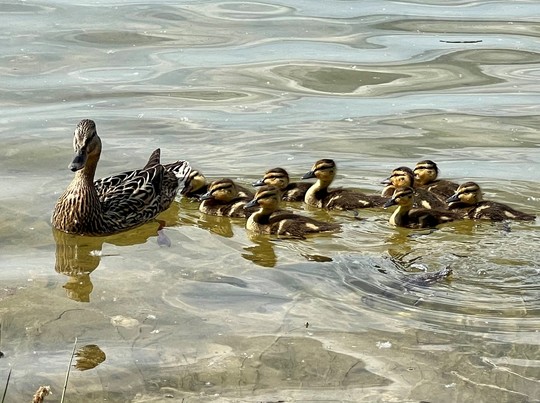 Photo credit: Steve Carroll
Ducks swimming at Webb Lake near Hackensack.
Editor's note: If you have a photo you would like to submit to the Minnesota Moment section, please send it to newsletter.dnr@state.mn.us. The editor will make the final decision on which photos appear in this section.
|