New accessible recreation opportunities in Minnesota state parks and trails unveiled
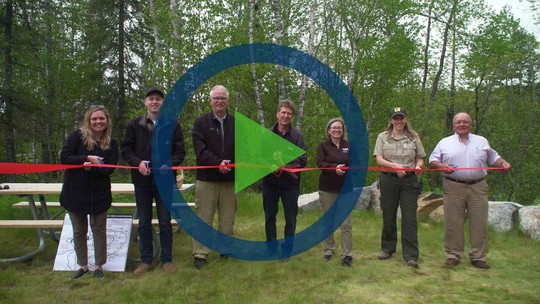 DNR Commissioner Sarah Strommen was at the grand opening of the Shipwreck Creek Campground at Split Rock Lighthouse State Park.
The Minnesota Department of Natural Resources is celebrating the opening of new accessible features in state parks and trails as part of its effort to connect all Minnesotans to the outdoors.
In addition to the all-terrain track chairs and an adaptive beach chair that were introduced at the beginning of the month, the new recreation amenities include:
- A 4.5-mile segment of the Gitchi-Gami State Trail that connects Cut Face Creek Wayside to Grand Marais and the city of Grand Marais municipal trail system. This state trail is a fully accessible, non-motorized trail.
- The Shipwreck Creek campground at Split Rock Lighthouse State Park has accessible, drive-in electric sites, an accessible bathroom and shower building and direct access to Lake County’s Split Rock Wilds mountain bike trail system and the paved, accessible Gitchi-Gami State Trail.
- The Sagamore Unit at Cuyuna Country State Recreation Area features 15.1 miles of mountain bike trails, including 7.4 miles of adaptive trails for hand-bike and other assistive bikes and a 1.4-mile accessible walking trail.
- The new St. Croix State Park visitor center exhibit (opening June 28) is designed to be accessible to people with cognitive, physical, visual and hearing disabilities. The exhibit includes audio description that allows visitors to easily interact with and move around the interpretive exhibit.
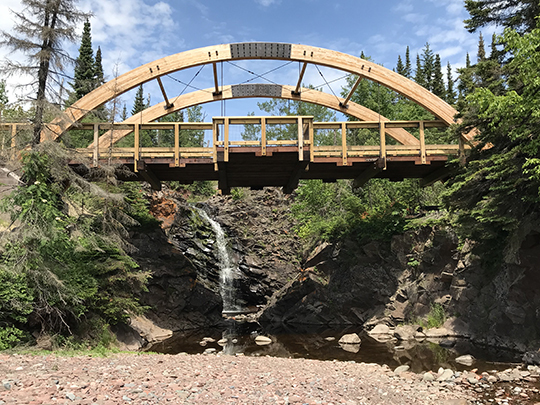 The Fall River Bridge along Gitchi-Gami State Trail.
Juneteenth has been added as a paid holiday
for most Minnesota state agency employees
Juneteenth commemorates the freedom of an estimated 250,000 enslaved African Americans on June 19, 1865. Although President Lincoln signed the Emancipation Proclamation ending slavery on Jan. 1, 1963, many people who were enslaved were not aware of their freedom until more than two years later.
The holiday is a time to celebrate the immense contributions African American people have made throughout history – and continue to make today.
Juneteenth is a federal holiday, but not an official state holiday in Minnesota. However, on June 20, most state agency employees will enjoy an additional paid holiday. For DNR employees, this means:
- Some agency services will remain open and some employees will be required to report to work. For example, state parks and trails will remain open to the public; our Conservation Officers will be on duty; the Central Office, Regional Offices, and co-located offices will also remain open with minimal staffing available to respond to residents.
- Employees who are required to work on the holiday will receive work-on-a-holiday pay as provided by the applicable labor contract or plan. This applies to employees covered by the AFSCME, MAPE, MMA and MLEA labor contracts and the Managerial and Commissioner’s Plans. Employees covered by the MGEC contract do not have this as a paid holiday and are therefore required to report to work.
- Because Juneteenth is not an official state holiday, the day counts as a business day for filing deadlines and other transactions with deadlines provided in state law.
A special thanks to those of you who will need to work on June 20. The hope is that state lawmakers will act on legislation to make Juneteenth an official state holiday in the future.
Madelia research team using drones, GPS collars to track fawns
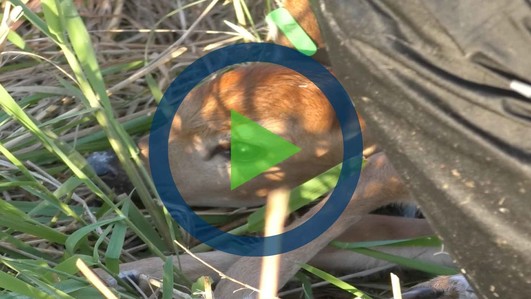 As a drone whirred high in the early morning air, a team of wildlife researchers walked stealthily through dew-soaked grass. One member carried a kit that resembled a large tacklebox and another was glued to a smartphone using GPS coordinates provided by that drone overhead.
It was a real-life geocache of sorts, in search of a newborn fawn spotted on the drone’s camera.
Once they found the days-old fawn, the team from the Madelia farmland research station quickly and quietly drew blood samples, took body measurements, and then slipped on an expandable collar with a GPS transponder. The device allows the team to track deer movement, habitat preferences and causes of mortality.
“This is the first study of fawns in southern Minnesota in more than 20 years,” said Eric Michel, farmland wildlife research scientist based out of the DNR’s Madelia wildlife research station. “It’s important because a lot has changed during that time, including predator populations and land use.”
With the aid of a contracted drone pilot, the research team located fawns and completed the work in about four minutes to minimize stress on the animal. Currently in the second year of a three-year study, the team has collared 80 fawns each year.
If all goes well with the study, it could be replicated in other areas around Minnesota’s farmland region.
For more information about DNR wildlife research across the state, visit the DNR website.
Engage with DNR platform helps wolf plan engagement project win Tech Trailblazer Award
The Minnesota Department of Natural Resources won the Tech Trailblazer Award in the 2022 Granicus Digital Government Awards for the wolf plan online public engagement project. According to the Granicus website, the Tech Trailblazer Award was “for an organization charging forward with digital transformation.”
The project team used Engage with DNR (also known as Bang the Table or Engagement HQ) to broaden opportunities for feedback and create a destination for Minnesotans throughout the state to participate in the wolf plan update – receiving more than 4,500 responses about respondents’ attitudes toward wolves, management preferences, information sources and demographic information.
“Online engagement comes with new opportunities but also challenges – especially during COVID when we didn’t have in-person options,” said Kelly Wilder, a policy and planning supervisor with Fish and Wildlife who worked on the wolf plan update. “Engage with DNR is a new tool we have access to, and it helped us expand our toolbox.”
Engage with DNR offers a variety of online tools to communicate with the public and get feedback on DNR work, including forums, Q&As, surveys and polls, and more. Teams can choose one or more of the tools to best suit their projects. Currently, Engage with DNR features four projects – future funding, Electronic License System modernization, fisheries and wildlife public input, and the all-terrain vehicle master plan.
If you think Engage with DNR might be helpful for a project you’re working on now or in the future, check out the Engage with DNR Resources page of the Intranet. The page has more information about the Engage with DNR tools, the request procedure for getting a project on the platform, a step-by-step process on how to post projects, and more. If you have questions about the platform, contact Caleb Werth or Jed Becher.
Register for the 2022 Natural Areas Conference
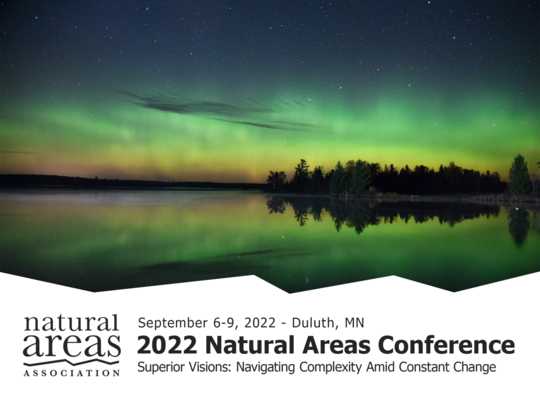 The 2022 Natural Areas Conference, Superior Visions: Navigating Complexity Amid Constant Change, will be held in Duluth from Sept. 6-9. The Natural Areas Association has been organizing this event with assistance from Minnesota Department of Natural Resources staff and they are excited to see it coming to fruition.
The conference agenda features more than 100 presentations developed by and for natural areas practitioners, including keynotes and plenary sessions; concurrent breakout sessions; half-day, hands-on workshops; posters; and field workshops.
During this national conference, you'll hear from professionals on wide-ranging topics that include plant community restoration, environmental communications strategies, climate resilience, trends in ecological monitoring as well as field visits to see first-hand some of northeastern Minnesota's premier natural areas. This conference has something for everyone.
Register today on the Natural Areas Association website. Early bird rates are available through July 31.
 The mysterious July 4th snows of Minnesota
By Pete Boulay, State Climatology Office
Of all the questions that the State Climatology office receives, the ones about 4th of July snowstorms are among the strangest.
Most of the time it’s an event someone witnessed or heard about. The cities vary, sometimes as far south as Brainerd, but Ely seems to be a favorite.
The weird part is the date. It’s always snowing on the 4th of July in the town they mention. Few can remember what year it was except to usually narrow it down within a decade or so. Many reports are from people visiting the area. Somehow there aren't any cameras handy to record such a rarity. Requests of a scrap of newspaper that recorded the momentous event have gone unfulfilled.
Upon receiving a new report of July snow, the State Climatology Office investigates each one to see if it is plausible. The year is approximated and a search through paper records from the nearest National Weather Service Cooperative Station is performed. The temperatures found are almost universally too mild to support snow. The few cases where snowflakes could be plausible, the conditions associated with the date were under a large dome of high pressure with clear skies.
We're sure these people saw snowflakes according to the vivid descriptions, usually while sitting watching a parade in a place like Ely. While it is possible that it has snowed somewhere in northeast Minnesota sometime in July, we have not, as of yet, found an official record of it.
As it stands right now the latest recorded measurable snow in Minnesota remains at 1.5 inches at Mizpah in Koochiching County on June 4, 1935.
Spotlight information available on intranet
Spotlight is the employee newsletter for the Minnesota Department of Natural Resources. It is distributed on the first and third Fridays of the month to current DNR employees and alumni.

Spotlight information, including the 2022 schedule and deadlines, guidelines and ideas for submissions, and past editions are now available on the Spotlight page of the intranet.
Submissions are due the Wednesday before distribution. Send Spotlight articles and photos to newsletter.dnr@state.mn.us.
|
Guidelines and ideas for Spotlight submissions
- Writing should be friendly, concise, conversational, and plain language.
- Try to keep articles to less than 400 words, maximum 600 words.
- Submit photos or graphics with articles. The DNR staff photographer might be able to help you find a photo, or you might be able to find options on copyright-free photo websites.
- Pick stories that you think might be interesting or informative for DNR staff or to highlight the important work of the DNR.
- Focus on what is most compelling about the story and include any key accomplishments, goals and background.
- Have your division or regional information officer review the article before submitting it to Spotlight.
- The Spotlight editors edit and review all articles for grammar, length, clarity, context and more.

Edie Evarts, Bemidji area fisheries supervisor
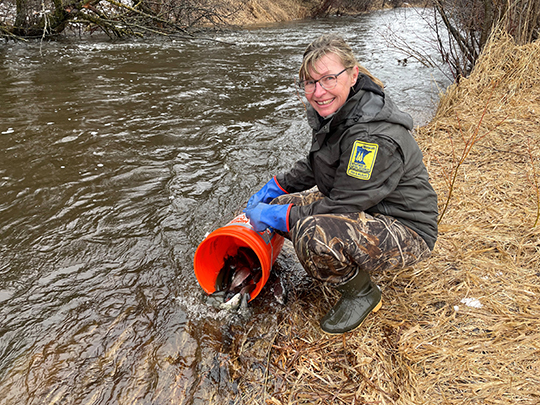 Edie Evarts stocking fish.
Enjoying her freshwater take on a fisheries career
By David Schueller, information officer, Fish and Wildlife Division
Edie Evarts oversees the Bemidji fisheries area that includes Upper Red Lake — a destination for anglers who enjoy phenomenal walleye populations and huge northern pike — and other waters popular with anglers including Cass Lake, Lake Bemidji and the lakes in Itasca State Park.
Evarts started in the Bemidji area a year ago, continuing an enjoyable 24-years of Minnesota fisheries work and adding to a fascinating career journey that included a childhood on the East Coast, early interest in ocean sailing, and waiting tables after college with hopes of becoming a filmmaker.
“I wanted to be Jacques Cousteau when I was a kid. And I wound up as far away from the ocean as possible working on freshwater fish,” Evarts said.
For work these days, Evarts looks out for fish populations and habitat, supervises the Bemidji fisheries crew, evaluates fishing regulations, manages area fish rearing and stocking, and provides environmental review. She also makes time to connect with Tribal communities, angling and lake interest groups, and individual anglers.
“I enjoy the challenges of figuring out management decisions in fisheries. I enjoy the science of it. And I enjoy the people part of it, helping them understand what we’re doing and why we’re doing it,” Evarts said.
Before the Bemidji area, Evarts supervised the Tower area fisheries that include Lake Vermilion and BWCAW lakes, was assistant supervisor in Park Rapids, fisheries specialist in the Baudette area and worked a temporary stint in the Lake Superior fisheries office.
Evarts enjoys working on large lakes, where crews collect extensive fisheries sampling data for use in management decisions. In these waters, it’s commonplace to encounter large fish. Her introduction to Minnesota fish was working on fish survey crews in Baudette, waters inhabited by some of the state’s largest fish.
“My perspective of what a large fish is was warped from the very beginning,” Evarts said.
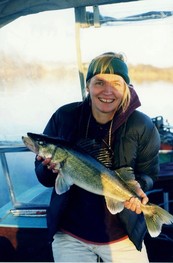
Understanding varying perspectives, including her own, was part of her college studies long before she considered a move to Minnesota. Evarts graduated from Johns Hopkins University with a double major in humanities and biology, starting with an interest in marine biology but graduating with hopes of becoming a filmmaker. She found work in environmental education, and almost a decade later went to graduate school at the University of Maryland to study fish management, eventually landing a DNR fisheries job.
When Evarts came to Minnesota, her husband, Bill Evarts, followed and he also was hired by DNR fisheries. Bill recently retired after being a fisheries specialist out of the Walker area office. The two enjoy some of the same hobbies, like fishing, travel and hockey.
“I’ve really enjoyed my fisheries career here, and Minnesota ended up being a wonderful choice for both me and my husband,” Evarts said.
Looking at the list of Minnesota DNR area fisheries supervisors and assistant supervisors, Evarts is one of only a handful of women among the 30-plus fisheries work areas statewide.
“Besides being one of the few women in fisheries, I’m also a late entry. So not a typical path to fisheries,” Evarts said.
Through diversity, equity and inclusion efforts, the DNR has been more vocal about goals to have DNR employee demographics reflect those of Minnesota’s population in general. Disparities remain to varying degrees in DNR staff rosters. Evarts noted as a positive that once women start in DNR Fisheries, they tend to stay with the agency.
“I hoped after 20 years, there would be a higher portion of women in Fisheries. I’ve seen progress but we still don’t see a lot of diversity in our recruitment pool to bring those hires on,” Evarts said.
Evarts tries to be a mentor to fisheries students and those early in their careers, regardless of gender, especially through her membership with the American Fisheries Society. She makes an effort to connect with young DNR fisheries employees, reaching out to women especially, because she said it helps to have someone looking out for those at the start of their careers.
For something fun to do in Tower, she played on a women’s hockey team that included DNR colleagues. “I started playing in nearby Ely, because there’s not a lot to do in Tower when it’s 20 below. There was a great group of women there,” Evarts said. “Now I miss it, but I get to play hockey with my husband.”
|
 Work location: Bemidji area fisheries, covering 113 fishing lakes and 220 miles of rivers and streams in Beltrami, Clearwater, northern Cass and northern Hubbard counties.
Job title: Bemidji area fisheries supervisor
Joined DNR: 1998
Education: Double major in humanities and biology, graduate degree in fish management
Hobbies: Traveling, gardening, cross-country skiing and downhill skiing. And especially fly-fishing, in fresh and saltwater.
Something that might surprise your colleagues: I sailed with my dog on a traditional Chesapeake Bay schooner from Maine all the way through the St. Lawrence Seaway to Lake Huron when working with an environmental education organization. We were part of a tall ships tour that visited ports on Lake Ontario, Erie, and Huron in the U.S. and Canada.

Tree planting in Apple Valley
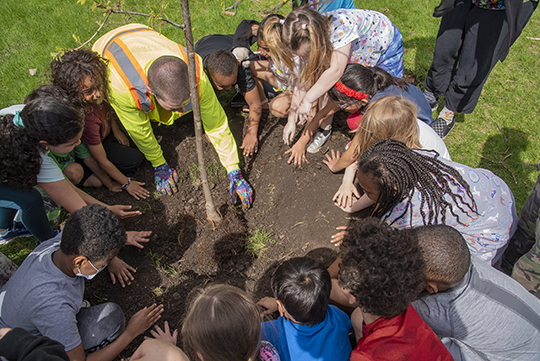 First graders at Cedar Park STEM Elementary School in Apple Valley recently planted a Heritage Oak tree.
- Deb Rose, DNR photographer
Editor's note: If you have a photo you would like to submit to the Minnesota Moment section, please send it to newsletter.dnr@state.mn.us. The editor will make the final decision on which photos appear in this section.
|