DNR introduces all-terrain track chairs to Minnesota state parks
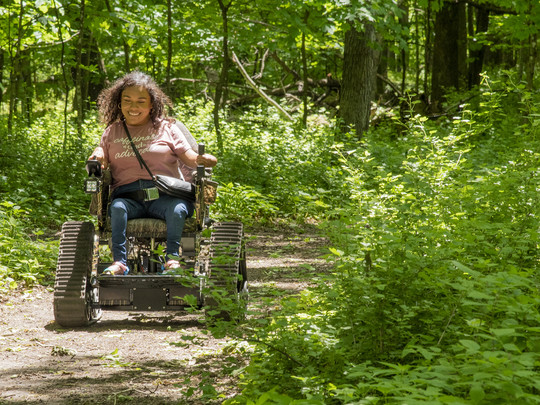 Photo credit: Deb Rose
"Being in the chair a couple of minutes, you really gain
an understanding of what it's like to have your body
go places that it has never been able to before."
— Brittanie Wilson,
Minnesota Council on Disability communications officer
On June 1, all-terrain track chairs were introduced at Minnesota state parks and are now available to reserve. The introduction of these chairs was celebrated at Myre-Big Island State Park in Albert Lea with brief remarks and light refreshments. Track chairs are off-road, electric-powered chairs that can be used on designated trails within the park.
Brittanie Wilson, an MCD communications officer and an electric wheelchair user said, “being in the chair within a couple of minutes, you really gain an understanding of what it’s like to have your body go places that it has never been able to go before.”
Camden State Park, Crow Wing State Park, and Myre-Big Island State Park have all-terrain track chairs available after June 1. Lake Bemidji State Park will have these track chairs available in mid-June and Maplewood State Park will have them available in late summer or early fall. There is no charge to use the chair, however, a state park vehicle permit is required for all vehicles entering the park.
“Providing adaptive equipment like the track chairs for visitors to use is critical to ensuring all Minnesotans have access to these outdoor opportunities and furthers our work to ensure Minnesotans with disabilities can live, work, and play in the communities they choose,” MCD Executive Director David Dively said.
Check out a video from the June 1 event to see the track chairs in action.
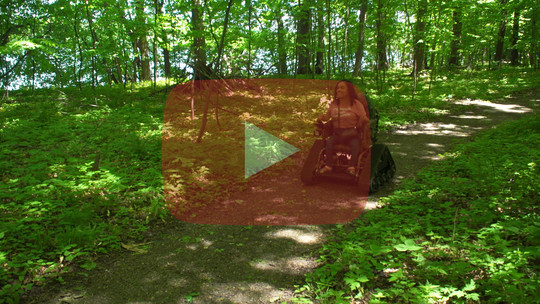 Video credit: Nick Frantzen
Bison at Minnesota state park produce
record number of calves
 By Deborah Locke, Parks and Trails information officer.
For reasons that are not entirely clear, a record number of bison calves have been born at Minneopa State Park, located near Mankato, Minnesota.
And the moms are not finished yet: the calf number is expected to increase throughout June as the last of the females give birth. Sixteen new calves have been born at Minneopa, with another one due soon said Ashley Steevens, park supervisor. Last year at this time the herd had increased by 12 calves.
It’s possible there are only 14 calves, but it’s hard to count because “the problem with calves is they never want to lie or stand in one area,” said Scott Kudelka, the Minneopa area park naturalist for the Department of Natural Resources.
The increase could be due to the addition of twins, or the pregnancy of a very young female known as a yearling, Steevens said. The bison herd at Minneopa now numbers 47. Typically, females come into heat at the age of two and can have 10 or more calves throughout their lifetime. A pregnant cow will walk a distance from the herd to give birth to the calf that weighs from 30 to 70 pounds, and stays with the calf for a few days before returning to the herd, Steevens said.
Bison also roam at Blue Mounds State Park in southeastern Minnesota, where 25 new calves were born this spring, said Tom Sawtelle, assistant park supervisor. Those additions bring the total number of bison to 92. Sawtelle added that the number of calves could be higher since a few may be hidden by tall grass when they were counted or were blocked from view by the adult bison. It is expected that five more calves will be born through June, which is about the same number of calves born in 2021.
Female bison are very protective, Steevens said, so park visitors on the bison drive are warned to be especially vigilant about staying at least 75 feet from the animals. Sometimes the wiry, small calves will squeeze through the park fence, which tempts visitors to walk over and pet the animal, she said. Park staff emphasize that these are unpredictable wild animals who will protect their young.
“We are excited to welcome the baby bison this spring, along with the visitors who arrive to appreciate their beauty,” Steevens said. “There is beauty in a bison. From a distance they look big and dumb and slow, but the reality is, bison are very intelligent and very fast.”
She added that bison can run up to 35 miles per hour and if threatened, they could become aggressive quickly.
Bison at Minneopa and Blue Mounds State Parks are part of the Minnesota Bison Conservation Herd, which means that genetically, they are very similar to the bison that roamed the Minnesota prairies freely 200 years ago. The Minnesota Zoo also has members of the conservation herd; zoo staff oversee the genetic component of the animals. The entire population of bison was nearly shot to extinction in the 1800s, and today’s bison are descendants of the 100 or so that remained after the slaughters.
The partnership between the Minnesota Zoo and the DNR was started in 2012 with an aim to breed and maintain a herd of 500 of the genetically rare bison that have not been significantly cross bred with cattle.
Visitors are welcome to Minneopa and Blue Mounds State Parks for a view of the bison. The animals often shy away from the public, so there is no guarantee of seeing one. Those using binoculars from the observation deck at the Blue Mounds State Park are likely to see the herd. More information is available on each park’s webpage.
Do your part to prevent the spread of
invasive species

As DNR employees, we are high risk for moving invasive species because we move from site to site, go off trail, visit some areas with lots of invasive species, and visit other areas with very few invasive species.
Invasive species can hitchhike along with us and our equipment in mud, plant fragments, water, and wood. By being mindful and spending some time cleaning, we can reduce the spread of invasive species and protect our natural resources.
As the field season is in full swing, it is a good time to refresh yourself with these resources:
Remember to follow these standard DNR practices:
- Before you arrive at a worksite and before you leave:
- Inspect all equipment (boats, trucks, gear, machinery, etc.) for and remove all visible plants, seeds, mud, soil, and animals from your equipment, boots, etc.
- Drain water from any equipment, tanks, or water-retaining components of boats such as motors, live well, bilge, or transom wells onto dry land.
- Plan your day. Visit the highest quality sites (fewest invasive species) first and save the most invaded for last.
- Minimize disturbance (stay on trails, prevent rutting, etc.).
- Consider whether the source of materials like gravel or soil is invasives-free.
- When loaning out equipment, loan it out clean. Expect that it will be returned clean.
|
Picture perfect: DNR photo library now available
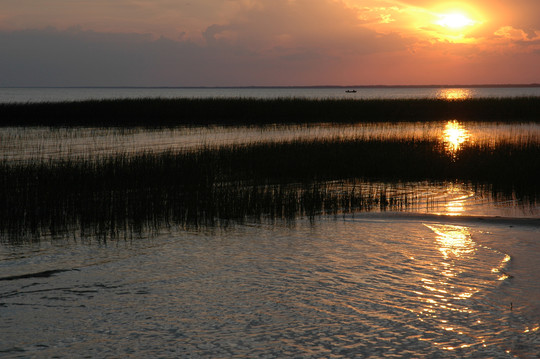 Photo credit: Deb Rose
Need a photo for your PowerPoint or that report you’re working on? Photos are an effective way to engage your audience and help convey your message. To make using photos easier, all staff now have read-only access to images in the Creative Services Unit photo collection.
To access images in the CSU photo collection:
For PC users:
- Navigate to the shared drive (I: drive)
- Then go to this location: I:\OSD\_OCO
- Locate the DNR_Photo_Library folder
- Right click on folder then select “Send to” and “Desktop”
For Mac users:
- Press “Command + K” on keyboard
- Type in: “smb://10.76.226.21/oco/csu/photography/dnr_photo_library/” (without the quotes)
- Log in as registered user using your credentials that you use to log into the computer.
- Note: Connecting for the first time will prompt you to log in, sequential connections “may” not necessary prompt for credentials; if it does prompt for login, just login the same way.
If you need assistance with photos or have questions about the DNR Photo Library contact Photographer Deb Rose or Creative Director Shamiah Specht.
DNR back at State Fair in 2022
The Minnesota DNR will be back at the Minnesota State Fair in August. We're planning on having everything open and bringing the outdoor adventure back with the theme: "Connect people to the outdoors." The State Fair was canceled in 2020, and in 2021 only the DNR grounds were open because of the COVID-19 pandemic.
Activities hosted by the DNR this year will include:

- Climbing a 65-foot-tall fire tower for a bird’s eye view of the fairgrounds.
- Entering the DNR’s iconic log building to tour wildlife and land and minerals exhibits.
- Purchasing hunting and fishing licenses.
- Visiting the outdoor pond that holds Minnesota native fish species.
- Listening to fisheries experts at pond talks throughout the day.
- Watching musicians, entertainers, and the Last Chance Forever bird show.
- Engaging in Facebook live events that begin at 1 p.m. at the DNR Volunteer Outdoor Stage each weekday with naturalists and other wildlife experts.
These activities would not be a success without the help of volunteers and more than 350 DNR staff at the fair. In 2019, before the pandemic began, 480 non-employee volunteers contributed more than 5,964 hours of their time, which was valued at $178,000. Volunteers are not required to wear a mask at the Minnesota State Fair this year.
If you are a staff member and would like to work the fair, please connect to your division contact or contact Dawn Bahajak.
Hope to see you there this year working, volunteering, or visiting!
|
 Conservation officers have been spending lots of time on the water as people get out boating and fishing. In addition, they’ve been fielding high numbers of calls from people who are worried about so-called “abandoned” animals – primarily fawn deer.
The following are several highlights from the weekly Conservation Office reports.
May 23, 2022
CO Adam Seifermann (Staples) reports anglers are having some luck on local lakes catching crappies and walleyes. He received several calls, some of which included nuisance-bear issues, nuisance-beaver problems, injured wildlife and reports about shoreline/aquatic plant management work. He also participated with local law enforcement agencies and Lions Club with the “Hooked on Fishing, Not Drugs” program, where approximately 60 fourth-grade students went fishing on Lake Shamineau.
CO John Slatinski IV (Ray) reports most activity in the area has surrounded the ongoing flooding. As the water has continued to rise people have stepped up to assist friends and neighbors. Although the rise has slowed in some areas, others are still expected to see additional increases for extended periods of time. Angling activity has been lower than usual for the time of the year, but those people who have made it out have reported success.
CO Jeremy Henke (Albert Lea) worked angling, ATV and AIS enforcement this week. Angling activity continues to pick up in the area, and anglers are reminded to check out the regulations prior to going fishing. Henke took several calls of “abandoned” young animals this week. Remember these animals are not abandoned and the best thing you can do is leave them alone.
|
May 31, 2022
CO Nicholas Prachar (Blackduck North) reports good fishing on Upper Red Lake. Time was spent working angling, AIS and boat/water safety. While working on Upper Red Lake, Prachar encountered three Wisconsin anglers who had limited out on walleyes for the day. Through interviews, it was learned the trio had additional walleyes at their camper in Squaw Lake. Prachar worked with CO Vincent Brown to investigate and subsequently seized 67 walleyes from the three anglers. Charges are pending.
CO Chris Vinton (Perham) reports assisting Wadena County, along with multiple jurisdictions and other COs, with a large commercial fire that was impacting traffic on Highway 10 through town. During that emergency, tornado warnings sounded and all emergency responders evacuated to the courthouse until the weather cleared.
CO Eric Schettler (Fairmont) checked anglers and boaters. High winds prevented many people from boating on area lakes. ATV activity was monitored. A TIP call was investigated in regards to a person taking a newly born whitetail fawn from property owned by the Fairmont High School. The suspect and vehicle was observed and video recorded by students and a staff member, which resulted in the recovery of the fawn by Schettler. The fawn was reunited with its mother and welcomed back. The mother was patiently waiting where the fawn was originally located.
Consider phone type when dialing 911

In an emergency, call 911 from the nearest desk phone, cell phone, or Teams softphone. The type of phone you use will influence the information you need to provide the dispatcher.
The preferred phone for dialing 911 is a desk phone. It provides your detailed location information and phone number to emergency services. Please remember, you do not need to dial “9” before 911 to reach emergency services from a desk phone.
Cell phones are also a good option for dialing 911. They provide your approximate location (within 150-900 feet) to emergency services. However, you must inform the dispatcher of your floor location if you are in a multi-story building.
Softphones on Teams are less desirable for dialing 911, but still effective in an emergency. Calls to 911 from a softphone may be directed to the State or Federal 911 Call Center. You will need to give dispatchers your detailed information, including your street address, phone number, and GPS location (if applicable).
Final note, immediately call 911 if you are involved in or witness an emergency. Your safety and the well-being of others depend on the services of emergency personnel (police, fire, medical) in any emergency.
|
We Are Water MN host site application
open through July 22
The We Are Water MN partners are seeking applications from a new host communities, to be a part of the program September 2022 through December 2023.
We Are Water MN builds networks of people who protect and affect water, hosts a traveling exhibit that shares messages about water in Minnesota, and designs public programming that builds relationships with and responsibilities to water.
We Are Water MN is led by the Minnesota Humanities Center in partnership with the Minnesota Pollution Control Agency; the Minnesota Historical Society; the Minnesota departments of Agriculture, Health, and Natural Resources; and the University of Minnesota Extension.
Minnesota-based organizations (nonprofits or those with a nonprofit fiscal sponsor), tribal nations, and state/municipal public agencies are eligible. Please spread the word in your networks! Program and application details are available on the We Are Water MN website. For more information about We Are Water MN, feel free to contact Pooja Kanwar.
|

It's a wrap!
The 2021 Commissioner’s Awards concluded today with the final virtual awards presentation for award recipients in the Natural Resources Conservation category. Check out the Commissioner's Awards Intranet page for a list of all recipients and nominees, to see the recorded virtual presentation sessions from the first three sessions (today’s session will be uploaded later), or to view the special video that was created to celebrate the resilience and ingenuity of staff in meeting challenges and seizing opportunities in each division.
This year, we received 96 nominations. From those nominations, the Commissioners selected 15 individuals and 18 teams to receive 2021 Commissioner’s Awards. All told, 153 awards were presented to 143 individuals.
Thank you to all of you who worked behind the scenes to present the awards virtually again this year, as well as to all of you who took the time to nominate your colleagues for this recognition. And of course, congratulations to the recipients!

Natural Resource Specialist Margaret Dexter
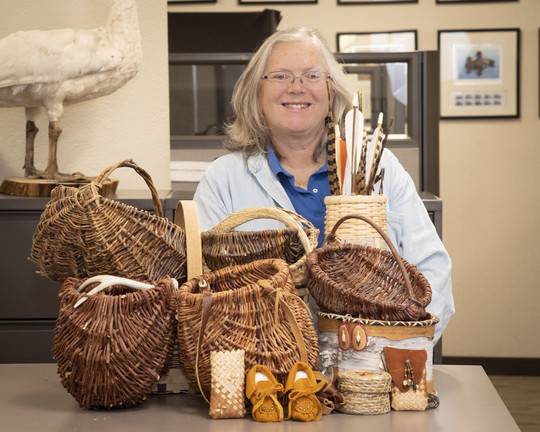 Reveling in the outdoors life
By Julie Forster, Minnesota Conservation Volunteer magazine associate editor
When she’s not out tracking and monitoring animal disease such as Chronic Wasting Disease that has been found in wild and farmed deer in Minnesota, or keeping track of hunter harvests, you’ll find Margaret Dexter outside wild ricing, maple syruping, hunting, or taking classes to learn artisan crafts and outdoor skills.
Dexter, a natural resource specialist in the wildlife health program, is part of a team that tracks and monitors animal disease. She helps plan and organize CWD sampling projects in the fall and collects hunter and trapper data for the hunting seasons.
Though the focus lately is on CWD, in the past she has worked on efforts to curb bovine tuberculosis and was assigned to help with the moose mortality study from 2013 to 2017. The moose study used GPS radio-collars to get notifications when a project moose died prompting a team response within 24 hours, which in turn would sometimes result in Dexter taking a drive up north to assist in necropsy work that provided valuable data for the study. She’s the boots-on-the-ground wildlife specialist who is often working in the field — just where she prefers to be.
Dexter’s appreciation of the outdoors was nurtured by her grandfather as she grew up in west-central Illinois. He cultivated a love of the outdoors for her and her brothers through fishing, hiking, tracking and foraging. They gathered blackberries in the summer, hickory nuts in the fall and morels in the spring. She helped with the chickens and tended a large garden. In school she enjoyed science and graduated from Illinois State University with a degree in biology and a minor in chemistry.
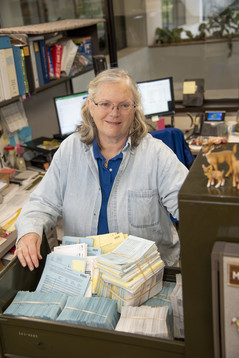
Since 2016 she has been helping with lymph node extraction and hunter data collection at one station or another to test for CWD in the fall. In recent years, CWD monitoring has become a growing part of her job.
“We used to get a break but now it seems like we’re starting to plan for the next season before we finish the present season," she said. "There’s not the break anymore that we used to have to think about other things or go ice fishing or maple syruping.”
A few years ago, she became a deer hunter herself. Along with a friend, Dexter completed the DNR’s Becoming an Outdoors Woman archery series.
“I’ve attempted turkey and deer hunting," she said. "I especially like turkey hunting. You’re sitting in your blind and hearing the world wake up and the birds singing. I’ve had hummingbirds right outside the blind at the honeysuckle I’m sitting next to.”
In late summer she joins a group of DNR colleagues that goes out together in their spare time to harvest wild rice at Carlos Avery Wildlife Management Area.
“The leaves are changing, there is lots of bird activity in the rice beds and you’re on the water," she said. "You use a canoe and a push pole and some flailing sticks.”
Her first ricing adventure was with DNR colleagues from the Grand Rapids research group. Since then she has also attended a multi-day workshop on wild ricing taught by tribal elders of the Fond du Lac Band of Lake Superior Chippewa. She also made her own ricing sticks and push poles with cedar from her parents’ Illinois farm.
Dexter makes it a habit to learn new crafts and skills that involve natural resources.
“It’s satisfying to know you can depend on yourself," she said. "You can grow your own food or harvest your own food and make the utensils you need or could use.”
She made moccasins at a class at the Mille Lacs Indian Museum. And she’s woven baskets out of willow, birch bark and sweet grass, and made earrings out of birch bark and porcupine quills. At a weekend workshop in Wisconsin, she learned how to tan a deer hide. And, during a pottery class at Mille Lacs, she dug her own clay.
“I’m not Native American but I appreciate the fact that the elders teach to keep these skills and crafts alive," she said. "There is a sense of accomplishment in it and the fact that what you’ve made comes from what you’ve gathered, and it’s not manufactured, is meaningful.”
Watch for a full Q&A with Dexter in the July-August issue of Minnesota Conservation Volunteer magazine.
|
 Work Site: Central Office, St. Paul
Job title: Natural resources specialist
Joined the DNR: 1991 as a permanent employee after Conservation Corps
Education: Illinois State University, bachelor’s degree in biology; minor, chemistry
Something coworkers might not know: Spent a year working at Disney World as a bus driver.

Stroll at Jay Cooke State Park
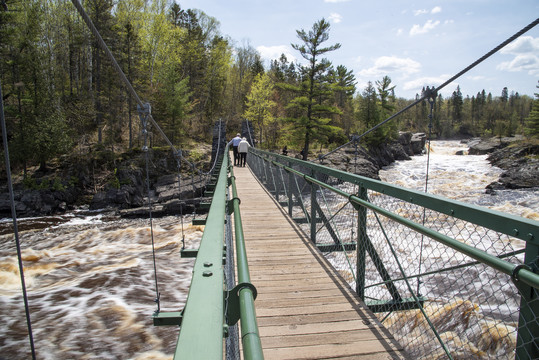 Photo credit: Deb Rose
Editor's note: If you have a photo you like to submit to the Minnesota Moment section, please send to newsletter.dnr@state.mn.us. Editor will make final decision which photos appear in this section.
|