
Mindfulness challenge,
wellbeing webinars and financial health
Support your health goals by participating in our employee wellbeing program and employee assistance program.
-
Join the Mindfulness challenge. Mindfulness is about slowing down and paying attention. It’s being aware of where you are and what you’re doing so you don’t overreact or get overwhelmed by what’s happening around you. The first statewide well-being challenge of the year launched Feb. 28. Sign up for an account now and work toward your reward. Log into your Virgin Pulse account and follow the prompts to set a mindfulness goal. Report your minutes throughout the month. If you reach your goal minutes by the end of the challenge you will earn 100 points. Each year staff in the Minnesota Advantage Health Plan are eligible for a $70 reduced deductible the following year when they complete activities to earn 300 points by Oct. 31. Visit the state employee health and wellbeing website for a video and instructions to create a Virgin Pulse account.
-
Attend a weekly webinar to build resilience. Our Employee Assistance Program offers weekly webinars to help enhance your personal and professional resilience. All webinars take place from noon to 1 p.m. No registration required. March topics include Depression Awareness (March 9) and Emotional Eating (March 23). Access the full calendar of well-being webinars and instructions for accessing recordings on the SEGIP wellbeing webinar website. After the webinar, report that you attended and you’ll earn 25 points for our well-being program. To report your attendance, log in to Virgin Pulse, and select "Rewards" under the Home tab.
-
Get support for your financial wellbeing. Login to Life Matters using the sign in “stmn1” for resources to support your financial wellbeing. Scroll to the “Financial” icon for topics including budgeting, paying for college, identifying sources for financial aid, estate planning, retirement planning, home buying, mortgage refinancing, taxes, protecting your identity, and preparing a will.
Additional resources
Visit the State Employee Group Insurance Program (SEGIP) Health and Wellbeing website for details and information on additional benefits. Head to the MMB EAP Work/Life Counseling website for counseling help for your personal wellbeing or the Organizational Health website for leadership coaching to support workplace health and team collaboration. You can email our DNR organizational health contact directly to request support: Landyn Prescott-Miles.
Contact Laura Grunloh or Chrissy Eck with questions or visit the wellbeing page on the intranet.
Future Funding Framework project update
The DNR’s project to identify a future funding framework for conservation and outdoor recreation in Minnesota continues to move along.
Through feedback from Minnesotans and staff on the project’s Engage with DNR page as well as through research, small group discussions, and consultation with staff and external advisors, we have created a shared vision for the project.
Key elements include:
- Future generations benefit from sustained and improved outdoor recreation experiences and conservation of natural resources.
- Minnesotans work together to support both diverse outdoor recreation opportunities and conservation of our state’s natural features.
- Conservation and outdoor recreation opportunities equitably meet the needs of all Minnesotans.
- Conservation and outdoor recreation align with and are integrated into Minnesota state priorities of strong educational systems, equitable access to health resources, thriving economy, and reliable infrastructure.
We will now launch the next phase of the effort, which is focused on solutions building.
Your input will be invaluable in this critical project phase. Visit the Engage with DNR Intranet page or the main project website to submit ideas and connect with others on the project.
 Editor's note: Every Monday, DNR conservation officers document how they spent the previous week and highlight some of the most important issues in their areas. The Enforcement Division posts these weekly reports and sends them to media outlets and other people who sign up to receive them. This Spotlight feature highlights a few of those reports in the first issue of the month.
Conservation officers are spending a lot of time ensuring snowmobile operators are being safe and working to ensure anglers meet the March 7 fish house removal deadline in the southern two-thirds of the state.
Feb. 22
CO John Slatinski IV (Ray) reports snowmobilers are experiencing superb conditions in the area. Fresh snow is allowing regular trail grooming to keep up with the increased traffic. The only complaints heard this past week were from those people who had to shovel snow.
CO Vinny Brown (Northome) conducted snowmobile enforcement and checked anglers on area lakes. Enforcement action was taken on different anglers for possession of marijuana, possession of drug paraphernalia, and possession of a slot walleye on Lake Winnibigoshish. A group of three anglers was checked on Lake Winnie. The three anglers were found with nine lines in the water. Enforcement action was taken for possession of slot pike and fishing with extra lines.
CO Brittany Hauser (Red Wing) spent the week patrolling for area fishing activity. While she was patrolling ice anglers by airboat with Goodhue County deputies, an angler in the area called Hauser and stated that a truck had just broken through the ice near where the officers were. Hauser and the deputies were able to quickly arrive to the location of the vehicle and found that the truck was now three-quarters submerged but the sole occupant had managed to exit the vehicle and get onto better ice. Ice anglers should keep in mind that ice is never 100 percent safe and ice conditions can vary greatly over short distances.
|
Feb. 28
CO Mitch Lawler (Alexandria) patrolled both Douglas and Todd county snowmobile trails this week after a large snowfall brought riding conditions to a peak. Numerous snowmobilers were contacted for going off-trail. Lawler reminded them that most trails are allowed by landowners but can be removed if they feel disrespected. Angling activity took a nosedive as most wheelhouses came off the lakes before the large snowfall.
CO Stephen Westby (Little Falls) worked area lakes for angling activity. Westby and Morrison County deputies were able to assist someone who was stuck on an island on the Mississippi River after breaking through thin ice and slush. With the warming weather, the river is very dangerous and unpredictable.
CO Arnaud Kpachavi (Mound) focused on angling activity during the week. Multiple vehicles have gone through the ice on west metro lakes during the past two weeks and some spots through channels, near streams/rivers and near springs have little to no ice left.
DNR hosts media event to remind anglers
about upcoming fish house removal deadlines
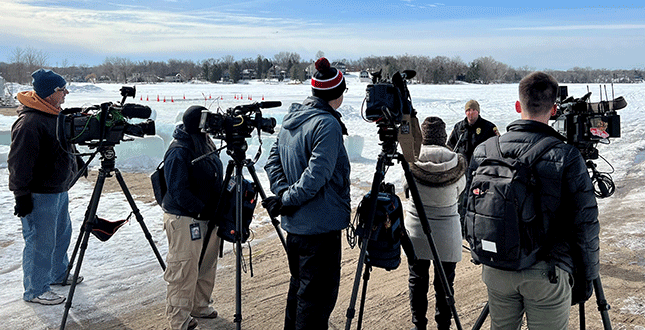 Four Twin Cities TV stations were at a DNR media event March 3 at Crystal Lake in Burnsville where Conservation Officer Garrett Thomas discussed the upcoming deadlines to remove ice fishing shelters.
The fish house removal deadline for inland waters in the southern two-thirds of the state is by 11:59 p.m. on Monday, March 7. In the northern one-third of the state—north of the east-west line formed by U.S. Highway 10, east along Highway 34 to Minnesota Highway 200, east along Highway 200 to U.S. Highway 2, and east along Highway 2 to the Minnesota-Wisconsin border — the deadline is by 11:59 p.m. Monday, March 21.
In addition to ensuring shelters are removed by the deadline, Minnesota Department of Natural Resources conservation officers will be watching closely to make sure people don’t leave trash behind.
Commonly left items include bait, blocking material, bottles, cans, cigarette butts and plastic bags filled with waste. As wheelhouses have proliferated across the state, there also have been increasing instances of people dumping sewage atop the ice.
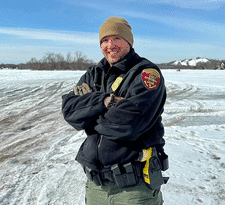
“Some of the things people leave behind are downright disgusting, and anything people leave on the ice has the potential to be an eyesore at best and an environmental concern at the worst,” said DNR Conservation Officer Garrett Thomas, who is stationed in Eagan (pictured above). “The message is simple: Don’t leave anything behind when you leave the ice, and make sure to dispose of it properly. It’s not any different than the lessons we’ve been taught since we were kids.”
For more information: deadline just days away to remove fish houses in much of Minnesota.
|
Green Belt training upcoming
Do you work with a clunky process with waiting, confusion, errors or duplication of work?
Green Belt training prepares staff to lead process improvement projects. Enrollment is open until April 5 for the next DNR green belt training cohort that will run from April to July. The cohort will consist of seven to 14 DNR staff and is hosted by St. Cloud State University.
Trainees learn how to improve existing processes by following a structured improvement method called “DMAIC.” The acronym stands for the five steps in the method: Define, Measure, Analyze, Improve and Control. Trainees learn how to scope and define a project, gather and analyze process data, map a process, lead and conduct root cause analysis, develop and test solutions, and create and implement standards and controls to sustain a new level of process performance.
Trainees will participate in 10 half-days of training (approximately 40 hours) via Microsoft Teams and complete a process improvement project. The time commitment for learning and applying the methods to a project throughout the course of the training is about eight hours per week. A certificate will be provided after final project presentations and passing the course exam. Cost per person is $3,000. This training is best for employees who will be supported to lead process improvement projects after the training, so they can continue to apply the methods.
If interested, please talk with your supervisor first, then contact Laura Grunloh to learn more about what to expect from the training and for tips on selecting a project that will provide a good opportunity to practice the DMAIC method. You may also review this previous Spotlight article about our most recent Green Belt cohort. Visit the Continuous Improvement intranet page for more information on CI or details on Green Belt dates and enrollment instructions.
Attend the Tick Talk on March 15

As the weather gets warmer and snow disappears from the ground, it’s the perfect time to prepare yourself for tick season.
Ticks and the diseases they can carry pose a significant outdoor occupational threat to all DNR employees, but especially those who are outside often.
The annual “Tick Talk” presentation to help DNR employees prepare for tick season will be held on March 15 from 9-10 a.m.
The presentation will cover:
- An overview of the Tick Protection policy
- Policy requirements and steps you can take to ensure compliance
- Tick-borne disease transmission and how to protect yourself
- How to order Permethrin-treated clothing
For more information, email Joni Akerson or visit the Tick Awareness page of the Intranet.
|
What every Minnesotan should know about
tick-borne diseases
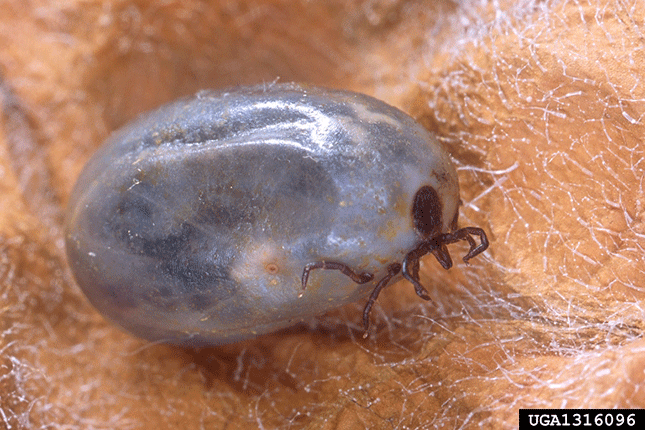 A female deer tick engorged after a big meal, resting on a leaf. Photo credit: Scott Bauer, USDA Agricultural Research Service, www.bugwood.org
Description: This presentation discusses various aspects of Lyme disease that Minnesotans should be aware of. Lyme disease is spread through the bites of infected blacklegged (deer) ticks and the lecture provides information regarding where people might encounter a tick, and who is at risk for being bitten.
Strategies for reducing the risk of a bite are highlighted. The presentation discusses Lyme disease in detail, including potential symptoms and signs of the infection, diagnosis, and treatment.
A brief look at other infections that are spread by blacklegged ticks is also included. In partnership with The Minnesota State Horticultural Society (MSHS) and the Minnesota Women’s Woodland Network (MNWWN). Many thanks to the event sponsor, Tri-Lakes Sportsmen’s Club.
Date: Tuesday, March 29
Time: 6:30 to 7:30 p.m.
Admission: Free
Instructor: Dr. Elizabeth Maloney, MD
Registration: https://tinyurl.com/545v96bh
DNR Purchasing Card Log improvement project
A collaborative improvement project is underway for the purchasing card log form.
The team is working on various enhancements to automate the form to be more user friendly.
Currently, a statewide pilot team is testing the new log in order to go live by July 1. Purchasing cardholder should stay tuned for more communication!

Parks and Trails Resource Specialist Liza McCarthy
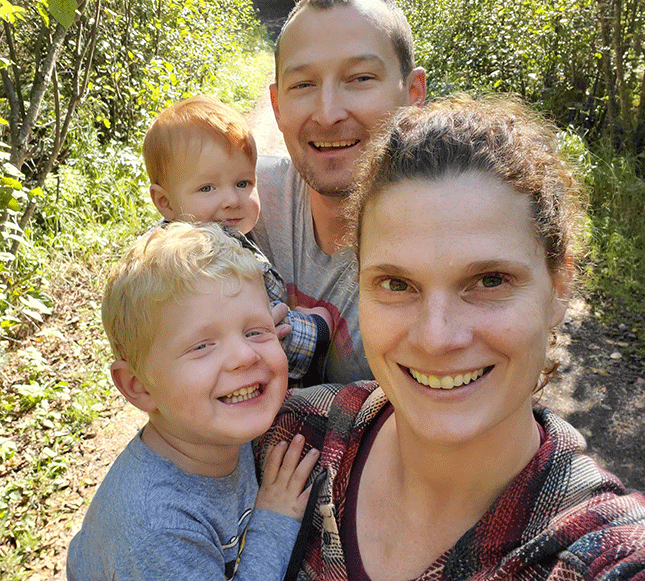 Parks and Trails resource specialist, Liza McCarthy, enjoying a hike with her husband and two young boys.
Conserving parkland forests in a changing climate
By Cheri Zeppelin, northeast regional information officer
State parklands, trails, waysides and recreation areas cover some 234,500 acres in Minnesota and include a wide variety of diverse types of habitats and resources from prairies to wetlands, to forests. To manage those resources, the Parks and Trails division has a team of passionate land managers to ensure those lands are managed for pre-settlement conditions in accordance with division’s statutory charge, but also with today’s understanding of climate change and a growing population of diverse users. One of those passionate land managers is North Shore resource specialist Liza McCarthy.
Liza grew up in St. Paul’s Midway neighborhood but always enjoyed spending time outdoors. In high school, lessons in environmental sciences piqued her interest and led her the University of Minnesota. There, an overnight trip to the Cloquet Forestry Center for a forestry component lit the fuse and reoriented her career compass to forestry.
Like many college graduates in that decade, a state hiring freeze prompted young talent to leave the state for whatever jobs were available. The day after her last college final exam, Liza did the same — taking a U.S. Forest Service forester job in the Boise National Forest timber program. The seasonal nature of the job meant a few months off each winter to be a ski bum. After three seasons, Liza and her husband landed back in Minnesota in 2011 when Liza accepted a DNR forester position in Finland and then Grand Marais, before moving to Parks and Trails in 2017.
Resource specialists like Liza perform a wide range of management activities such as prescribing tree planting projects, identifying and managing treatments for invasive species, prescribed burning, native plant community restorations, providing technical assistance and identifying wetlands for park and trail development projects, and working with others to ensure cultural resources are considered.
If you’ve ever talked with Liza about her work, her passion and enthusiasm for forest management in our parks is evident. A recent project to plant climate-adapted trees with the Nature Conservancy at three state parks along the north shore was one of her favorite projects because the partnership allowed them to do great work on a large scale.
“Ensuring that we have healthy forests in our parks for future generations to enjoy – I’m really proud that I get to do that work, and it makes me hopeful for the future,” Liza said.
She has good reason to look forward to the future. With two young boys and her husband who is an ICU nurse, time outdoors as a family helps keep them recharged and connected. Family hikes and an annual trip to the Gunflint Trail each summer are high on their list of favorite things.
 Name: Liza McCarthy
Job title: Parks and Trails District 4 resource specialist
Work location: Two Harbors
Joined the DNR: 2011
Education: Bachelor’s degree in Forestry; minor in Environment & Natural Resources from the University of Minnesota.
Favorite vacation or trip: Scotland and Ireland – even though it was cold and rainy.

Mille Lacs Lake in winter
 The shore of Mille Lacs Lake in winter. Photo credit: Deb Rose.
"I think that I shall never see
A poem lovely as a tree."
— Excerpt from Trees by Alfred Joyce Kilmer
|