Workplace diversity, equity and inclusion
 Creating an inclusive workplace and serving all Minnesotans requires us to develop our diversity, equity and inclusion skills. The Equal Opportunity, Diversity and Inclusion Office has created a number of new resources to help DNR employees incorporate diversity, equity and inclusion into their workplace.
Do not hesitate to contact Rowzat Shipchandler or Sarah Spence-Koivisto if you have any questions. If you have suggestions about additional resources, contact
Erica Brown.
DNR employee profile: Rick Barta
 Maintaining our recreational resources in all seasons
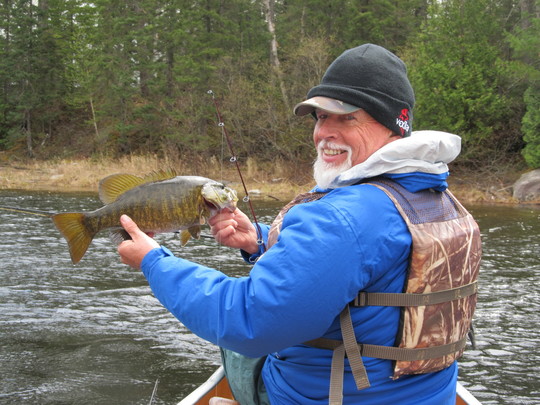
The abundant public land base and thousands of lakes in northeastern Minnesota make it an ideal location for outdoor recreation. But who maintains all of those public water accesses, recreational trails and other amenities our public is so accustomed to using? For those resources under the DNR’s responsibility, it’s Rick Barta and the natural resource technicians like him.
After serving in the Coast Guard, Rick’s career aspirations took their own winding trek before landing him at the DNR. While studying forestry at Itasca Community College, Rick worked for the DNR as a temporary creel clerk on Lake Vermilion, as a smoke-chaser for Deer River district forestry and on several fires out west. He then worked for a private tree service, and had a brief three-day stint with the U.S. Forest Service before coming to the DNR Parks and Trails Division (then Trails and Waterways).
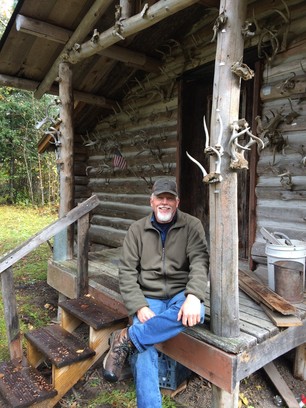
As a technician, Rick covers a large area and works outdoors in all seasons. He and his coworkers maintain 133 public water accesses, installing and removing docks and fishing piers seasonally. They maintain the Thistledew and Stony Brook horse trails, groom the Cowhorn and Golden Anniversary cross-country ski trails, groom the southern portion of the Taconite Snowmobile Trail, and work with local clubs on ATV trail issues. Occasionally, there is a need to replace trail signage destroyed by a moose. (Yes, that happens.) The work involves many types of equipment from small hand tools for clearing brush to large diesel trail groomers and there is always something to clean, oil or maintain.
While grooming overnight on remote stretches of snowmobile trail, Rick has seen some interesting things, including moose, bobcats, wolves and lots of deer – but never a sasquatch. He never broke down on the trail, but once needed to use his fire extinguisher in the groomer to snuff out a snowmobile ablaze on the trail. On quieter nights, he listens to audio books of outdoor adventures and whodunnit mysteries.
He was active with the Itasca County Search & Rescue Team for 13 years, and scouting since 1991.
His personal goals this fall are to find his 200th geocache before the snow flies, and he tries to bag one ruffed grouse a year – but admits he’s going into fall one bird behind.
-- Cheri Zeppelin, information officer, northeast region
|

Bio Box: Rick Barta
Job title: Natural resource technician in Parks and Trails
At the DNR: 29 ½ years
Education: Associate of Applied Science in forestry, Itasca Community College
Interests: fishing, hunting, geocaching, spending time with his family, which includes five grandchildren
Most meaningful DNR work project: Working with the DNR team to complete the 13-mile Solana Loop of the Soo Line ATV trail that included seven boardwalks and two bridges. The trail is now part of the Aitkin County Grant-In-Aid system.
|
COs to the rescue!
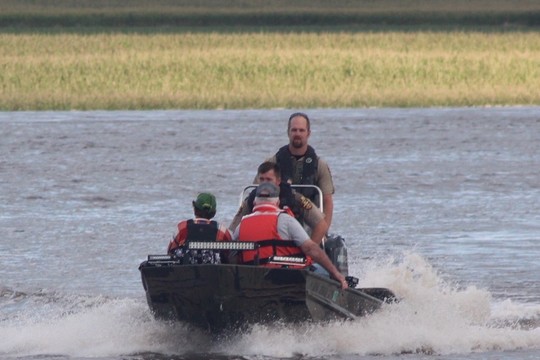 Conservation officers Andrew Dirks and Derek Daniels rescued an elderly couple Sept. 12 after floodwaters left the couple trapped in their home in northwestern Rock County. Knee-deep water inundated the main level of their home, while their driveway was 6 feet under the water’s surface. Dirks and Daniels pulled up to the couple’s front door in a jet boat, helped them out of the house, and gave them a ride to safety.
Know where the defibrillators are located. You could save a life.
 Do you know where the closest automated external defibrillator (AED) is located in your workplace? It's important to know. A coworker could suffer sudden cardiac arrest while on the job.
Waiting for the arrival of emergency medical personnel may be too late. Studies on immediate defibrillation have shown up to 60% survival one year after sudden cardiac arrest.
The DNR has 87 AED units in buildings throughout the state. Central Office AEDs are located on each floor, just outside of the elevators' lobby. Workers outside Central Office should check with their site coordinator to find out where the AED in their building is located.
An AED is a medical device designed to restore the heart rhythm to normal. Ventricular fibrillation is the uncoordinated heart rhythm most often responsible for cardiac arrest.
Sudden cardiac arrest occurs when ventricular fibrillation takes place or when the heart stops beating altogether. Without medical attention, the victim collapses, loses consciousness, becomes unresponsive, and dies. Many victims have no prior history of heart disease and are stricken without warning.
Questions? Email COBuildingMaint.DNR@state.mn.us.
Coming soon - Rainbow trout fishing in southern Minnesota
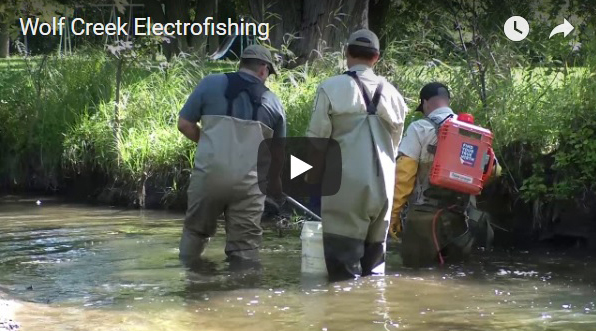 DNR Fisheries staff teamed with Mower County Soil and Water Conservation District to survey Austin’s Wolf Creek, a spring-fed stream cool enough to support trout. Crews not only studied the makeup of the stream, but also its biology, which they did by electrofishing. Electrofishing uses a small electric surge to stun fish so they’re easily netted. About 600 rainbow trout will be stocked in Wolf Creek ahead of the 2020 opener, and if all goes well, each year after that.
Central Office: Find out about Rush Line Bus Rapid Transit
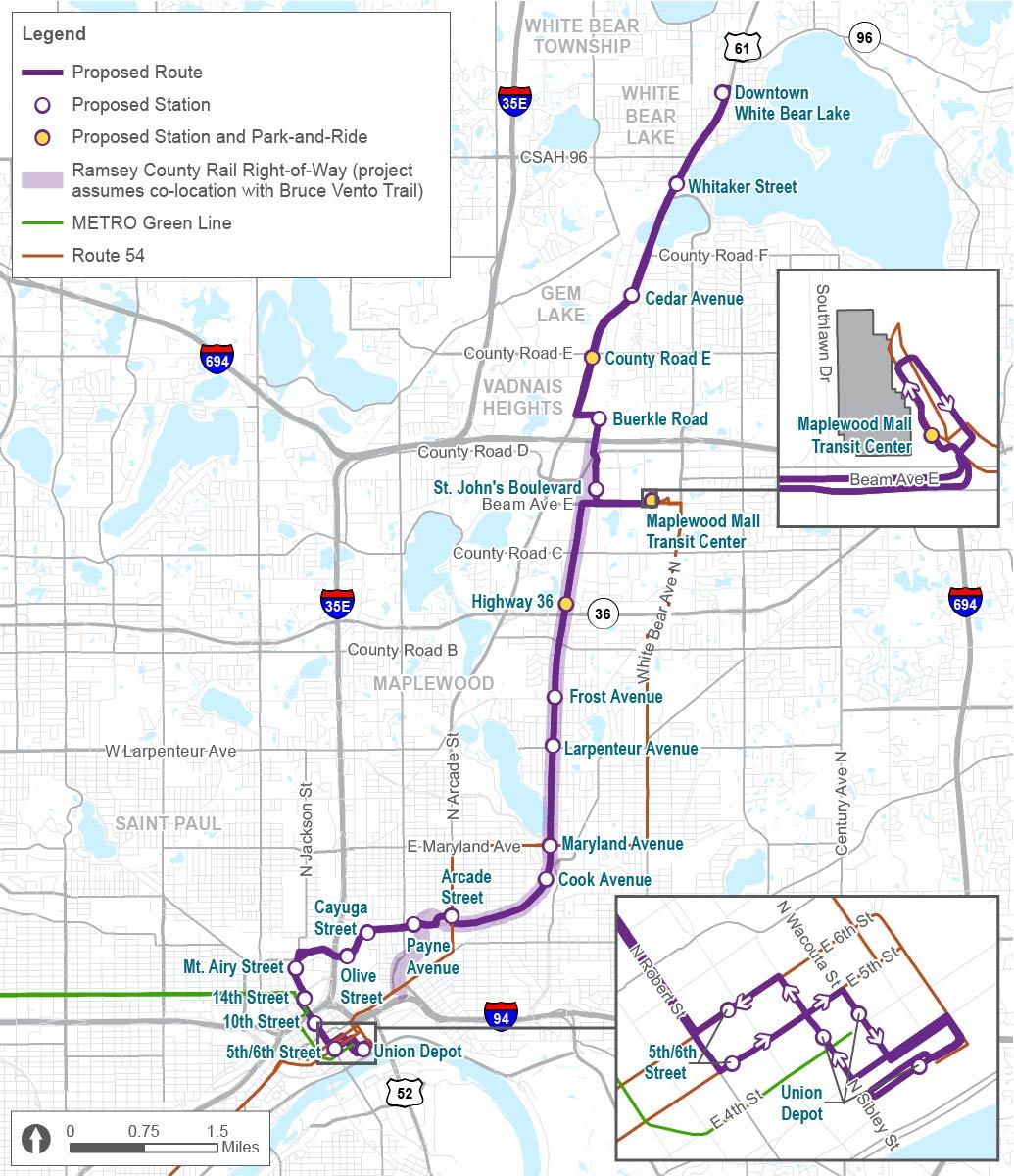
The Rush Line Bus Rapid Transit (BRT) Project is a future 14-mile transit route with 21 stations between Union Depot in Lowertown Saint Paul and downtown White Bear Lake.
BRT is a form of transit service featuring state-of-the-art buses that travel mostly in dedicated lanes, serving well-lit stations with amenities such as heating, fare payment machines and real-time departure information. Expected to be constructed between 2024 and 2026, Rush Line BRT will run seven days a week from early morning to late at night, arriving every 10 minutes during rush hours and every 15 minutes other times.
One of the planned Rush Line BRT stations will serve Lafayette Park, giving employees a new way to get to work. The Olive Street station, located near the intersection of Phalen Boulevard and Olive Street, will give Lafayette Park employees easy access to frequent, high-quality transit.
Stop by the PCA/DNR cafeteria between 11:30 a.m. and 1 p.m. on Tuesday, Oct. 15 to chat with staff from Ramsey County for more information about the Rush Line BRT and the future Olive Street station that will serve Lafayette Park.
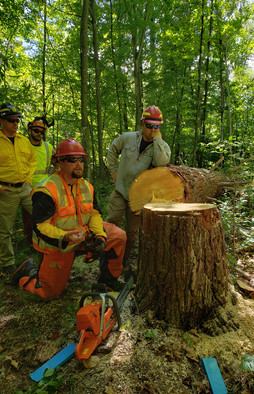
Resources for updated chainsaw training policy available
Training to operate chainsaws is streamlined, cost effective and clear due to the creation of a unified chainsaw policy for the entire Department of Natural Resources.
Previously, the agency had two policies pertaining to chainsaw use and training – one for forestry and wildfires, and one for the rest of the divisions. Now, all tree fallers and power saw operators are under one umbrella and training standard.
Chainsaw operators can be “grandfathered in,” if they can demonstrate the appropriate skillsets. Even for those who are grandfathered in, the completion of the National Wildfire Coordinating Group S212 course is recommended.
With the new policy, the statewide saw coordinating group is being expanded to include additional members who will be a contact point for all divisions guided under the policy. The purpose of the group is to ensure the chainsaw and brush saw operation and training program is managed in an efficient, safe manner which complies with all relevant rules and regulations.
The group will field questions and comments about chainsaw safety, as well as keep the policy and training current and relevant to tasks at hand.
The resources for the policy – including supporting procedures and documents, training materials, a training matrix, an updated policy and manual, a list of who is on the statewide saw coordinating group, a video testimonial about a chainsaw accident, and more – can be found on the Chain Saw and Brush Saw Operation page of the Intranet.
|
Combined Charities campaign to begin Oct. 1
October is almost here (yes, already) which means it's time to renew or begin charitable deductions through Self Service.
State employees are able to go the Self Service website, select “other payroll” and then select “charitable deductions” to contribute part of their paycheck to one or more charities of their choice.
However, pledges need to be done each year, as the system resets on Oct. 1. So to encourage new contributors to donate and established contributors to renew pledges (as well as solicit one-time donations for the charities), the DNR will be hosting a number of events throughout October.
-
All month: candy grams
- Kick-off event on Oct. 1 from 11:30 a.m. to 1:30 p.m. in the Central Office lobby.
- Buy candy for one person, five people or heck, buy them for your whole floor – and be sure to include a message. Combined charities coordinators will deliver these candy grams throughout the month.
-
Oct. 10 from 11:30 a.m. to 1:30 p.m. in the Central Office lobby: sucker draw
- Win any number of fabulous prizes depending on the color of lollipop you draw.
-
Oct. 14: virtual pet costume contest (open to all employees)
- Send in a picture of you and your pet, but here’s the kicker – at least one of you needs to be in costume. Animals could be stuffed, so do with that information what you will.
-
Oct. 15-18: virtual pet costume contest voting in the Central Office lobby
- Come put a sticker on the picture of the best pet and human costume combo. The photo will the most stickers at the end of the voting period wins!
-
Oct. 30: chili cook-off from 11 a.m. to 2 p.m. in the Central Office lobby
- Bring the heat or make it unique with the annual chili cook-off. Esteemed judges will taste all the chili and pick the favorite, the creator of which will win a prize. The winner will go on to be entered in the statewide contest.
All money raised during the events will go toward the charities. Employees at Central Office who pledge in Self Service on or after Oct. 1 and show that they have pledged will get special VIP privileges during these events.
More information, as well as a full list of charities, can be found on the Minnesota Combined Charities website.
From the field...
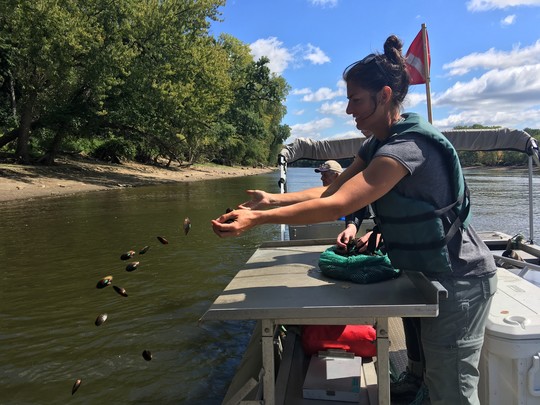 Staff with DNR’s Center for Aquatic Mollusk Programs (CAMP) recently released young freshwater mussels into the Mississippi River at Hidden Falls in St. Paul. The mussels were propagated at CAMP’s Lake City lab in 2018, then allowed to grow for a season in structures placed into the St. Croix River near Lakeland before being moved. The mussel stocking is part of a multi-year project to restore native mussel species in the metro Mississippi now that water quality there has improved.
|