Manufacturers Should See and Seize Export Opportunities
 Like lots of Minnesota manufacturers, Erick Ajax hadn’t given much thought to selling his products in foreign markets.
Exporting sounded too complicated. Too risky. And EJ Ajax, a Fridley-based precision metal-forming company, was too busy taking care of its U.S. customers to go prospecting in unknown and uncertain territory abroad.
But things changed quickly when an Ajax customer, National Presto Industries Inc. in Eau Claire, Wis., made a foray into China, and his company went along for the ride.
At the time, Ajax produced about 60,000 components a year for Presto’s pressure cookers. Today, it’s 100,000 components a month as Presto broadens its sales in Asia and the Pacific Rim.
“The beauty of that, of course, is that it expanded our market dramatically,” says Ajax, whose company has waded even deeper into the global marketplace since then. Today, the company exports about one-third of its product to India, Mexico, Vietnam, China, South Korea and Europe.
“We’ve been able to grow a lot of our international market because our customers have expanded their footprint globally,” says Ajax. “And we went right along with them as a valued supplier.”
A Wider Economic Impact
From a macro economic standpoint, the positive impact of exporting extends well beyond any individual company’s profit-and-loss statement.
Manufactured exports generate nearly 137,000 jobs in Minnesota. About half are manufacturing jobs, while the other half support industries such as sales, marketing, transportation and logistics. Exports also raise a considerable amount of tax revenue for the state.
“Everyone benefits from increased exports. We need more manufacturers to seize those opportunities,” says executive director Kathleen Motzenbecker, of the Minnesota Trade Office, the state's official export promotion office.
“And they don’t have to wait until it happens by accident. They can and should actively seek them out.”
That said, you don't just wake up one morning and dive in head first. Getting your company export-ready and entering a market is a deliberate process that requires time, evaluation and some careful planning.
“The first step is for more Minnesota manufacturers to consider the possibility – to see the full potential – of exporting their products to foreign markets,” says Motzenbecker. “The next step is to call us at the MTO. We’ll help you assess your export potential, help you get ready, and help you make your first entry into the international marketplace a success.”
Learn more about exporting opportunities in Minnesota here.
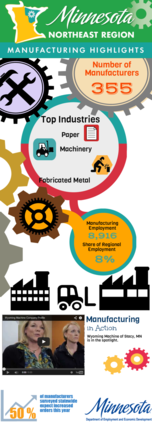
Select the infographic below for a larger image.
 |
Scott County Career Fair Attracts Hundreds
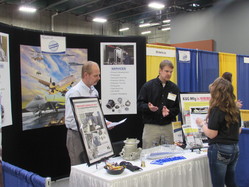 Over 85 exhibitors were on hand at Thursday’s
Scott County Career Fair, celebrating Manufacturers Week. Around 700 job seekers met with employers and discussed new career possibilities.
Paper's Still on a Roll in Northeast Minnesota
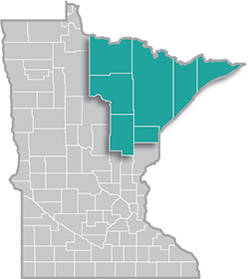 Even though Northeast Minnesota has the smallest number and lightest concentration of manufacturing jobs statewide, it remains a dominant player in a key industry.
And what the region lacks in job quantity is offset by high quality.
Paper manufacturing is a regional strong suit and (despite some significant job losses over the past few years) is still ripping right along in this part of the state.
Altogether, there are about 8,905 manufacturing jobs at 355 companies in the Arrowhead, which accounted for 6.3 percent of total regional employment in 2013.
But while the northeast accounts for just 3 percent of manufacturing jobs statewide, it is a major presence when it comes to making paper products.In fact, the region has nearly one-fourth of Minnesota’s total employment in the paper manufacturing sector.
With 2,321 jobs at nine establishments, paper manufacturing is easily the largest sector in Northeast Minnesota, accounting for 23.6 percent of the 9,855 jobs in paper manufacturing statewide.
While the region's paper manufacturers cut jobs by 4.1 percent from 2010 to 2013, job losses were less than half of those experienced elsewhere throughout the industry. Statewide, jobs in paper manufacturing fell 10.2 percent during the same period.
Though not as high in quantity, these jobs are still high in quality. Average annual wages in manufacturing are more than $15,000 higher than the total of all industries, making it one of the highest-paying industries in the region.
Paper manufacturing has the highest average annual wages of any manufacturing sector in Northeast Minnesota, at $76,856 in 2013. And though employment was declining, wages were increasing, climbing 26.5 percent from 2003 to 2013.
Not surprisingly, many occupations in demand in the paper manufacturing sector have higher median wages in Northeast Minnesota, including several that pay $20 or more per hour. General and operations managers and industrial production managers both pay around $35 per hour. Industrial machinery mechanics earned nearly $32 per hour.
Learn more about Northeast Minnesota manufacturing here.
Today's Manufacturing Video:
Wyoming Machine Company
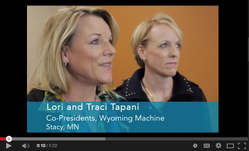
Lori and Traci Tapani, co-presidents of Wyoming Machine in Stacy, MN, talk about their company.
Select the image above to view the video. |