DEED Commissioner Promotes Manufacturing Supply Chain
St. Cloud Times
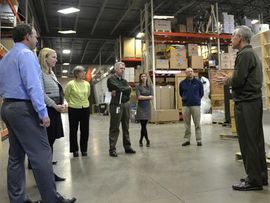 Neil Crocker, right, president of Schaefer Ventilation Equipment in Sauk Rapids, shows a stack of fan housings sourced from Litchfield during a visit Tuesday from DEED Commissioner Katie Clark-Sieben (second from left) and others on Tuesday. (Photo: Kimm Anderson, kanderson@stcloud)
Katie Clark-Sieben, commissioner of the Minnesota Department of Employment and Economic Development, was in Sauk Rapids on Wednesday.
She and a couple other DEED officials stopped at Schaefer Ventilation Equipment to get a look at how a Minnesota manufacturer uses a supply chain of goods made within the state.
Exactly one year earlier, a Made in Minnesota directory went live on DEED's web site at www.mn.gov/deed. It wouldn't have come about if not for DEED's involvement more than two years ago in helping Geringhoff decide to put its U.S. headquarters in St. Cloud.
"We realized then the amount of effort it takes to reach out and get information from all these manufacturers to encourage companies to get their resources as close as possible in Minnesota," Clark-Sieben said. "It took so much work, we decided there was an opportunity to host a web site with all the data. It's biased to businesses in Minnesota, but otherwise it's open to all and free."
Manufacturers can answer a few questions and find their contact information, business profile and web links in the directory at no cost. As of Wednesday, 87 companies in the seven-county Central Minnesota area are among those in the listings. And among, them, naturally, is Schaefer Ventilation, which has used local contacts to supply about 30 percent of the parts used in its products.
Neil Crocker, president of Schaefer Ventilation, said Minnesota suppliers account for about $3 million of the $10 million the company spends on parts and supplies each year. That business is worth more than $100,000 to nine state manufacturers.
"The quality is good and the delivery is obviously good," said Crocker, whose company employs about 50 people and supplies ventilation equipment in 42 countries. "We'd love to get more of what we need close to home."
He showed fiberglass housings made for a 57-inch fan that come from Carstens Industries in Melrose. In an assembly area for smaller fans were stacked dozens of plastic housings that came from GVL Poly in Litchfield. Schaefer Ventilation uses about 100 housings per day before shipping products out in boxes from Liberty Carton in Minneapolis and on pallets from Backes Wood Products in Richmond.
"It's a competitive advantage for us to get products from Carstens Industries and GVL Poly," Crocker said. "What they produce is world-class and they're reliable. To be able to get those things locally is convenient but it also saves us money."
Read more about the commissioner's visit here.
Select the infographic below for a larger image.
 |
High-Tech, Precision are Leaders in Metro Manufacturing
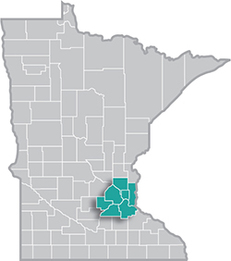 It's fair to say that the seven-county Twin Cities metropolitan area is the epicenter of manufacturing in Minnesota.
The 4,105 manufacturing companies in the region supply 162,716 jobs. That's about 53 percent of all manufacturing jobs statewide.
In the metro region, the average annual wage in manufacturing was $69,680 in 2013 - 17 percent higher than the industry’s average annual wage for the state as a whole ($59,540).
With 34,675 jobs, computers and electronics make up the largest manufacturing industry in the Twin Cities. The subsector also happens to have among the highest annual wage, at $95,628.
Employment in fabricated metal products accounts for nearly 15 percent of metro manufacturing jobs, with 848 establishments supplying 23,665 jobs.
Miscellaneous manufacturing, which mostly includes medical equipment and supplies, (one of Minnesota's internationally recognized strong suits) accounts for 10.6 percent of total manufacturing jobs, with 578 establishments supplying 17,222 jobs.
In addition, machinery manufacturing accounts for just more than one-tenth of all manufacturing jobs in the metro, with 390 establishments supplying 17,025 jobs. Printing and related support activities and food manufacturing account for 9 percent and 7 percent of jobs, employing 14,418 and 11,553 workers, respectively.
Manufacturing in the region has shown modest growth since the low point of the recession, adding 6,146 jobs from 2010 to 2013, an increase of 3.9 percent. During the same period, total employment increased by 5.3 percent, adding 80,954 jobs.
Despite constrained growth overall since 2010, certain manufacturing industries have done very well. Fabricated metal products added 2,222 jobs between 2010 and 2013, growing by 10.4 percent. Other industries adding large numbers of jobs include food manufacturing (1,455 jobs); machinery manufacturing (1,402 jobs); and electrical equipment, appliance and component manufacturing, which added 707 jobs and grew by a remarkable 18.3 percent.
Learn more about manufacturing in the metro here.
Today's Manufacturing Video:
Spotlight on EJ Ajax Company
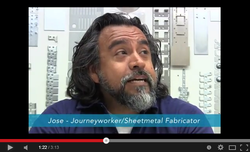
EJ Ajax employees talk about their company and their industry.
Select the image above to view the video.
DEED Awards Grant to Train Metro Mold & Design Workforce
The
Minnesota Department of Employment and Economic Development (DEED) has awarded
Anoka-Ramsey Community College a $375,311 Minnesota Job Skills Partnership
(MJSP) grant to train hundreds of employees at Metro Mold & Design.
Headquartered in Rogers, MN, MMD started out in 1973 as a family owned, privately held mold shop.
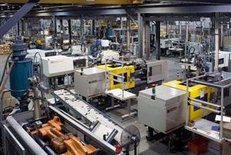
Today its manufacturing capabilities include mold manufacturing, precision
machining, assembly and finishing for markets in general manufacturing,
surgical instruments/medical devices, fuel cell manufacturing, printer
components, and custom plastic products.
MMD will
partner with Anoka-Ramsey Community College to develop 10 new, customized
courses. The workforce of 432 current and new employees will receive
entry-level and advanced training and retraining, depending on their
occupation. Six employees will participate in train-the-trainer sessions to
create in-house trainers for the business.
Read more about the grant here. |