June 2025
Grant Application Writing Training Sessions
Would you like to learn more about writing applications for DEED’s competitive grants? DEED is offering virtual training sessions, which would be useful for any workforce development organization seeking funding, regardless of the organization’s level of experience in grant writing.
State Grant Ready: Building Stronger Applications One Step at a Time Training Sessions:
June 11
1 - 2:30 p.m. WHAT WORKS: Real Tips to Strengthen Your Grant Narrative Align proposals with funder priorities and scoring rubrics. Write clear, compelling narratives that address evaluation criteria. Craft effective work plans and outcome strategies.
June 25
1-2 p.m. BUILDING BETTER BUDGETS: Why it Matters Understand the connection between project budget, scope of work, and outcomes. Develop a budget using allowable, allocable and reasonable costs. Create a basic budget justification/narrative
Please complete and submit this form to register for one or both of the trainings.
If you have questions or require accommodations to participate, please reach out to Sonji.Davis@state.mn.us.
 Request for Proposals
The ACP team have received questions from grantees around the next cycle of Request for Proposals (RFPs) for SFY 26-27. We would like to remind everyone of a few items:
File Management Update Reminder: Electronic Document Storage
Effective July 1, 2025, all local state and federal Employment and Training Program Partners must transition from paper (hard) copy participant files to maintaining electronic participant records using Workforce One (WF1), which includes the upload of all required participant source documentation (including all participant eligibility documents, employment plans, and support services documentation) into Electronic Document Storage (EDS) also known as Document Summary within WF1.
Contracts Ending June 30, 2025 – Reminders
For contracts ending June 30, 2025, please keep in mind the following:
- All data entry must be completed 45 days from the end date of the contract
- All participants must be exited in Workforce One by Tuesday, July 15, 2025. For participants exited after June 30, 2025, you will need to use the exit date of June 30, 2025.
- Your Final Grant Report is due July 30, 2025. Please use the “Final Grant Report Closeout” template found on the ACP Webpage under Forms.
Contracts Being Extended – Reminder
For any contracts receiving an extension, please remember that any MOUs or contracts you hold with partners/subgrantees will also need to be extended. MOUs and contracts must be valid for the full duration of your contract with DEED or for the duration of the service the partner is providing. If an MOU/contract is revised, please send an updated version to your ACP Program Coordinator.
Nonprofit Exempt Status - Sales Tax
DEED does not reimburse nonprofit organizations for sales taxes, that would otherwise be exempt, billed to DEED grants. Nonprofit organizations may purchase some items exempt from sales tax if they apply and are approved for Nonprofit Exempt Status – Sales Tax. To be exempted from sales tax, nonprofit organizations must give vendors a completed Form ST3, Certification of Exemption. If you have questions on sales taxes as they relate to DEED reimbursement, please reach out to your ACP Coordinator.
Adult Career Pathways Webpage
Quarterly Provider Meeting notes (Competitive and Drive for 5) are now posted on our webpage. Check out the ACP home page for resources and tools to assist in the management of ACP Grants.
Success Stories
We'd love to learn about the amazing work you're doing and how it is positively impacting the lives of participants throughout the State of Minnesota! To submit a success story, please fill out this brief ACP Success Stories Form.
Grantee Spotlight
The Redemption Project (TRP) was founded by formerly incarcerated individuals with a mission of reducing recidivism by providing education, mentorship, support, and employment opportunities to those impacted by the justice system. TRP believes that addressing basic needs and offering meaningful employment upon release plays a critical role in breaking the cycle of incarceration. To support successful reintegration, TRP offers a comprehensive four-part program (Educate, Mentor, Advocate, and Support) designed to meet the diverse needs of individuals during the reentry process.
What contributes to the success of The Redemption Project? One key element of TRP’s success is education through the “Virtues of Success” training program. This training is based on Aristotle’s four cardinal virtues: wisdom (prudence), courage, self-control (temperance), and justice. Participants are guided to reflect on their values and thought patterns, develop critical thinking and problem-solving skills, and cultivate strong moral character, all essential qualities for professional and personal long-term growth.
The second key component of The Redemption Project’s (TRP) success is its mentorship program, which provides life-mentorship to individuals both during incarceration and after release. 70% of TRP’s staff are formerly incarcerated, which fosters trust and credibility with participants. Participants form relationships with mentors who understand their experiences and are committed to their success. These mentors serve as consistent, reliable guides, especially in times of crisis; they assist individuals in overcoming reentry challenges and build the resources necessary for long-term stability.
The third pillar of TRP’s program is advocacy. TRP advocates for its participants within the corrections system, with potential employers, and throughout the broader community. This advocacy encourages others to view justice-involved individuals by their potential, rather than their past mistakes.
The final component of TRP’s model is direct support. Within 48 hours of release, each participant meets with a TRP staff member to assess immediate needs and develop a 60-day reentry plan. TRP provides essential resources, such as a cell phone, clothing, and other basic necessities, to help individuals establish stability from the outset of their release. In addition, TRP also actively partners with 68 second-chance employers who offer meaningful employment opportunities at a livable wage, reinforcing long-term self-sufficiency.
By addressing immediate needs, fostering meaningful relationships, and advocating for second-chance opportunities, The Redemption Project helps break the cycle of recidivism and empowers participants to build stable, fulfilling lives post-incarceration.
Please contact your Adult Career Pathways Grant Coordinator directly with any questions regarding Adult Career Pathways Programs.

WIOA Adult, WIOA DW and State DW
- Reminders
- PY22 Reallocations must be expended by June 2025, there will be no extension for reallocations.
- PY23FY24 funds must be spent out by June 30, 2025.
- Cost category adjustment is allowed on the final Reimbursement Payment Request (RPR) if the total expended does not exceed the total approved budget. However, the Admin cost category cannot exceed 10% of total reimbursed.
- Remaining funds will be reallocated to Local Areas that have spent out their PY23 funds.
- PY24 Carry Forward Requests - Providers may request a waiver to carry forward more than 20% of their allocated PY24 funds into the second year of the grant. Providers who expend or obligate at least 80% of their PY24 funds by the end of the 4th quarter do not need a waiver.
- Carry Forward Requests pertain to all formula grants: WIOA Adult, WIOA Dislocated Worker, and State Dislocated Worker.
- Waivers must be submitted by May 30, 2025, to allow enough time for leadership approval and processing.
- Read recent blog post about helping participants navigate job automation displacement risk.
Quarterly Progress Report (QPR) Form Updated for Dislocated Worker and Federal Adult Programs
The Quarterly Progress Report (QPR) form for WIOA Adult, WIOA DW, State DW, and Mass Layoff Projects has been updated. The new form is available on the DWFAP webpage under the “Forms” button.
The following changes were made:
- Column added for “Total Planned for the Reporting Quarter”
- Letter headings (A,B,C,D) added to columns to help clarify instructions
- References to the MN Statute cost category limitations for State DW grants were removed
In addition, we now have two QPR forms to choose from. One allows you to report on a single grant and the other allows you to report on two grants. The combined form can be used by grantees who have two active program years of the same grant running at the same time. For example, PY23 and PY24 State Dislocated Worker grants. This allows reporting on the participant plan and budget separately and a combined narrative. The single form allows reporting on one grant and program year at a time. This way grantees have the option to choose what works best for them.
Senior Community Service Employment Program (SCSEP)
- Grantee Performance Management System (GPMS)
- Action Items and Post-Exit Follow-Ups: Providers must ensure that all past due Action Items are updated, and that all pending and overdue follow-ups are completed and recorded in GPMS. Timely and accurate updates are required to receive credit for performance outcomes achieved.
For more information and resources, visit the SCSEP webpage.
Policy Updates
- USDOL published two ETA Advisories:
Retaining Employment and Talent After Injury/Illness Network (RETAIN)
Enrollment is ongoing for MN RETAIN, individuals with an illness/injury that need support to stay-at-work or return-to-work can contact MN RETAIN at worker@mnretain.com or through the contact for on www.mnretain.com. Please type your paragraph information here using these margins. It is important to follow the layout for the most consistent version of Partner Express for all areas.
Minnesota Job Skills Partnership Board Meeting
The next Board meeting will be held on Monday, June 16, 2025. More information can be found on the MJSP Board webpage.
Reminders
- Quarter Progress Narrative Reports (QPR): QPN Reports are to be submitted by the 30th date of the month following the end of the quarter. Please note the specific deadlines: October 30th, January 30th, April 30th, and July 30th.
- Requests for Reimbursements (RPRs) or Financial Status Reports (FSRs): Providers are reminded that RPRs or FSRs are due every 20th date following the month of expenditure. To ensure timely processing and avoid payment delays, it is essential for providers to submit RPRs/FSRs promptly, even if they do not have any expense claims for that period.
Questions from the Field: Capturing Credential More than 365 Days After Program Exit Date
Workforce One (WF1) disallows credential capturing if it has been more than 365-days after the participant’s program exit date. This, for the most part, does not cause many problems. However, if you do not receive a copy of the completed credential until 366 days or longer after program exit, the system will not allow the user to capture that credential even if the attainment date is within the 365 days allowed.
A WF1 change request was submitted to allow capturing of credential details if the attainment date entered is within the 365 days allowed. The ticket processing for this request will take some time to be implemented. Therefore, we recommend case managers submit helpdesk tickets (using the link at the bottom of any WF1 screen), requesting the WF1 team capture credentials and their attainment date details that are outside of the 365-day window.
Reach the DW team
You can find additional information and resources on the Office of Dislocated Worker and Federal Adult Programs website.
Please email all requests, reports, and technical assistance questions to the Dislocated Worker Federal Adult Programs general email at dwfaprograms.deed@state.mn.us.

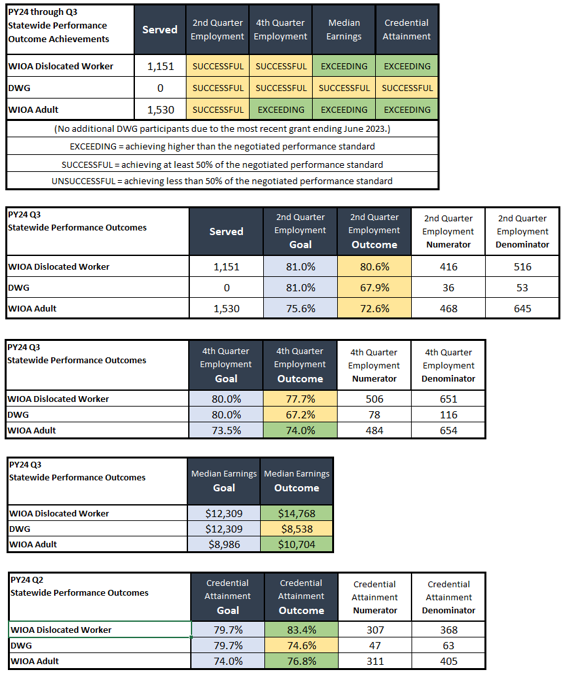
Program Year (PY) 2024 Quarter Three (Q3) Performance Outcomes Compared to Negotiated Goals
Attached you will find the performance outcome spreadsheets for WIOA Dislocated Worker, DWG, and WIOA Adult programs. These are best when printed landscape, in color, and on 11x17 size paper.
 If needed in an alternative format, please contact performanceap.deed@state.mn.us
- Performance goals are based on negotiated standards for PY2024.
- Color Key:
- Blue are the negotiated performance standards.
- Green means the set goal was met or exceeded.
- Yellow means at least 50% of the goal was met.
- Red means less than 50% of the goal was met.
- Served are all participants accessing the program during the actual program year (real-time).
- Getting a Job results based on participant exits July 1, 2023 – March 31, 2024, except those exited with exclusion. This indicator measures each participant’s employment status during the 2nd quarter after exiting the program. Formula: Percent of employed exits divided by all exits during the reporting period.
- Keeping a Job results based on participant exits January 1, 2023 – September 30, 2023, except those exited with exclusion. This indicator measures each participant’s employment status during the 4th quarter after exiting the program. Formula: Percent of employed exits divided by all exits during the reporting period.
- 2nd Quarter Median Earnings results based on participant exits July 1, 2023 – March 31, 2024, except those exited with exclusionary reason and those showing zero earnings. This indicator measures the median earning during the 2nd quarter after exiting the program.
Credential Attainment results based on participant exits January 1, 2023 – September 30, 2023, except those exited with exclusionary reason and those who did not attend credential type training. This indicator measures the percent of participants who received a credential after attending training.
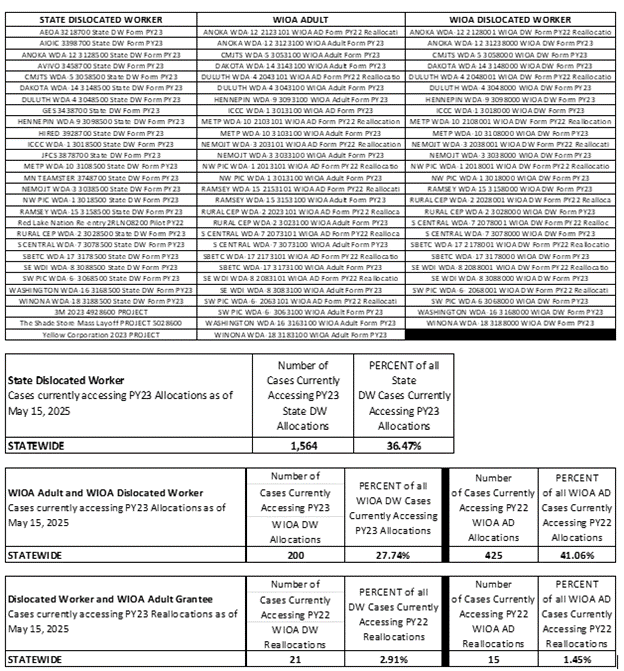
PY2023 Allocation and PY2022 Reallocation Closeout for the Dislocated Worker (DW) and WIOA Adult (AD) Programs.
Reminder: PY2023 allocations and PY2022 reallocations will be expiring on June 30, 2025.
All Workforce One (WF1) cases showing these funding streams within an open activity will need your attention.
 If needed in an alternative format, please contact performanceap.deed@state.mn.us
If the participant will continue receiving a service currently supported by PY2023 allocations or PY2022 reallocations after June 30, 2025, a new activity will need to be opened for each continuing service the participant will move forward receiving.
Reminder: All Dislocated Worker and WIOA Adult program year formula allocations (small layoff grants/WIOA Adult allotments) remain active for two years.
- PY2023 = July 1, 2023 – June 30, 2025
- PY2024 = July 1, 2024 – June 30, 2026
- PY2025 = July 1, 2025 – June 30, 2027
This means, their new activity will need a PY2024 or PY2025 formula grant selected within them depending on your agencies budget. PY2025 allocation funding streams will be activated as soon as those contracts are executed through DEED’s Fiscal team.
IMPORTANT PY23 ALLOCATION & PY22 REALLOCATION WF1 CLOSEOUT INFORMATION
- All activities with a PY2023 allocation or PY22 reallocation selected within them cannot have a start date after June 30, 2025. They must also have an end date no later than June 30, 2025.
- If any participant will continue receiving a service captured in an activity that is currently showing a PY2023 allocation or PY22 reallocation supporting that service financially, that activity needs to be copied within the participant’s WF1 activity detail screen.
- The new activity will need a start date of July 1, 2025.
- An active funding source (PY2024 or PY2025) will need to be selected within them as the grant financially supporting the continued service.
- To help in this funding source transition
- Mohamed Farah will mass close all currently open PY2023 funded activities with an end date of June 30, 2025, which means you will only need to open/copy the old activities.
- If you want to close the old activities yourself with a date no later than 06/30/2025, that is perfectly fine.
- If you choose not to close them yourself, it will be taken care of for you.
- This mass activity closure will begin August 1, 2025.
- If there are cases without open activities on record showing an active grant as the funding source, the mass closure will not work for those cases.
- Any cases that show they cannot be included in the PY2023 activity closure will be emailed to the management team for the COFFR funding the case.
- This communication will include directions on how the case manager will need to correct their data.
- Shortly after July 1, 2025, new funding streams will be added to your dropdown lists for PY2025 allocations.
- The date these new funding streams will be available is dependent on when PY2025 contracts are in place.
- Your management teams will be alerted as soon as your agency’s PY2025 funding streams are available in WF1.
Research and Technical Assistance Corner:
- Jobs at Risk – U.S. Employment in the New Age of Automation
Requests for Technical Assistance: Please email the performance team’s general email address with your technical assistance needs: performanceap.deed@state.mn.us
Should you have any performance or data entry questions, please email the performance team’s general email addresss: performanceap.deed@state.mn.us

Gratitude:
Thank you for your work and collaboration with the TAA team! We value your partnership and appreciate your continued work to help TAA eligible individuals to access services and obtain their educational/employment goals.
Should you need assistance from the TAA Supervisor, please contact Amy Carlson at amy.carlson@state.mn.us.
TAA Informational Meetings:
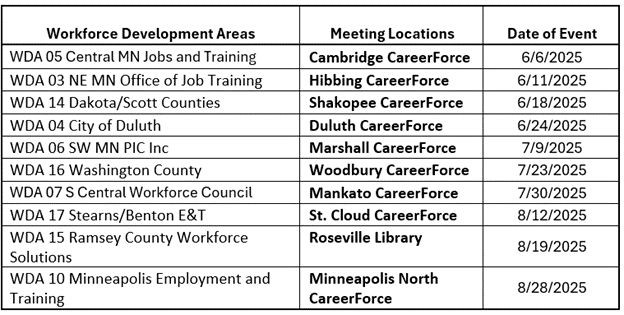
- The Great 2025 TAA Outreach Events have started.
- We were in Hutchinson on 4/29/25, Monticello on 5/7/25, Bemidji on 5/13/25, and Rochester on 5/20/25.
- The team also responded to the mass layoffs at the mines in Minnesota’s northeast region. On 5/6/25, the team was stationed in Virginia and on 5/7/25, they met with worker in Hibbing.
Next up:
 If needed in an alternative format, please contact deed.taa@state.mn.us
- If you have any questions about these events, please contact the TAA team at taa@state.mn.us.
Petitions
Petitions can still be filed, but DOL’s investigation is paused until program restoration or reauthorization. Here’s the link to check the status of petitions with U.S. Department of Labor: https://www.doleta.gov/tradeact/petitioners.
Please email all questions and customer applications to the Trade Adjustment Assistance general email at deed.taa@state.mn.us.
 Key Tips for Grant Compliance
Each month, the Compliance Unit will feature common monitoring questions from the field.
Electronic Document Storage (EDS) Requirement
Question: Do I need to use Workforce One (WF1) for my organization’s Electronic Document Storage (EDS)?
Answer: Yes. As of July 1, 2025, all federal and state adult and youth Employment and Training Workforce Development Program Grantees are required to utilize EDS in the Workforce One (WF1) System for participant file management even if they have their own storage system in place.*
*Capital grants, SCSEP, other Employment and Training Programs that do not track case management services via WF1 are exempt from this requirement, however, this exception must be noted within the DEED grant contract.
Important Reminders:
- Sensitive documents such as medical information should be labeled as “private”. This privacy level allows only assigned WF1 users and users with higher access levels to view the document.
- Ensure participant documents are complete and legible.
- Screenshots are acceptable for uploading to WF1, as long as the document is clear, readable, and includes all pages.
- You can edit uploaded documents by selecting the Tags and Comments link. On the Document Tags and Comments page, select the “Edit Tags” button to update, add, or change the tags related to the document.
- Add a date to the document name to ensure that the most recent version is easily identifiable and will allow users to quickly determine the latest update.
- For additional information, review the Electronic Document Storage (EDS) Policy, watch the Electronic Document Storage Webinar, or see the Presentation Slides.
If you have questions about Compliance content, please email shannon.rolf@state.mn.us.
  June 3: CareerForceMN.com changes to CareerForce.MN.gov
CareerForceMN.com will be changing to CareerForce.MN.gov on Tuesday, June 3. A redirect will be in place for all pages on the old site to the new site for some time, but if you have links on your site to CareerForceMN.com make plans to update them as soon as possible after the change on June 3. The change to CareerForce.MN.gov is being made to make the site more secure and is in line with best practices for websites maintained by government agencies.
June 5: What's New with CareerForce
DEED staff, Local Workforce Development Area staff and staff from workforce development grantees and other partner organizations are all invited to attend What’s New with CareerForce, which is typically held the first Thursday of the month (barring holidays) from 10-11 a.m. on Teams.
The June 5 What's New with CareerForce is focused on health care and social assistance employment opportunities, with great resources for anyone who works with Minnesota job seekers or employers in any health care or social assistance setting, from long term care to acute care to home care.
Thursday, June 5
10-11 a.m.
On Teams
Join the meeting
Join for insights on helping people explore caring careers, connecting job seekers with employers and much more!
Sign up to stay in the loop on CareerForce resources for workforce development professionals
Every Thursday, barring holidays, we send out the Weekly CareerForce Update GovDelivery email full of info about upcoming events, useful graphics, helpful flyers and many other resources for serving job seekers and employers.
Select this link to sign up for the Weekly CareerForce Update email for DEED staff, LWDA staff and workforce development staff at DEED grantees and other partners throughout the state! https://public.govdelivery.com/accounts/MNDEED/subscriber/new?topic_id=MNDEED_759
Contact the CareerForce Information and Assistance line at 651-259-7500 or careerforce@state.mn.us if you have questions.
 Every quarter, the Labor Market Information (LMI) Office of the Minnesota Department of Employment and Economic Development (DEED) publishes research articles that offer insights into important labor market trends. The March issue of Minnesota Economic Trends includes articles that explore the contributions of foreign born workers and estimates of undocumented immigrants in Minnesota's workforce, look at the surge in self-employed workers since the pandemic, describe our work helping high school students think about post-graduation plans, and introduce two new data tools to help with this, one that helps students choose a major based on a career of interest and the other that helps students be realistic about the cost of college compared to earnings post-graduation.
When considering which college to attend and what to major in, it’s important to determine if expected earnings post-graduation are enough to cover both the cost of living and the cost of a standard student loan. The new Graduate Earnings and Cost Calculator tool compares the likely cost of college to the potential earnings in a major, helping users determine the affordability of various school types and program options. The tool calculates the periodic payments owed on a loan, allowing users to input their own loan amount. Interactive filters allow users to slice the data by six Minnesota regions, 567 majors, six types of schools, and two age groups.
The College Major to Career Connector tool allows students, counselors and educational planners to search for majors starting from a career of interest and vice-versa, to explore the full range of careers a specific major can prepare for. Interactive filters allow users to slice the data by 563 majors and connect them to 505 occupations.
Career exploration events like the Southwest Minnesota Career Expo and Central Minnesota's EPIC Student Day engage thousands of high schoolers each year, offering hands-on experiences and labor market insights that help students better understand their career options and educational paths. While many students remain uncertain or focused on a narrow range of interests—especially in Health Sciences—recent data shows a shift toward more realistic post-graduation plans, including increased interest in entering the workforce directly, and a growing openness to diverse work environments and career pathways.
If you have questions about Labor Market Information, please email deed.lmi@state.mn.us.
This newsletter is meant for DEED Grantees, Providers, and Employment Counselors. We want this e-Newsletter to meet your needs! We encourage you to send your comments and suggestions to deed.taa@state.mn.us.
Past issues of the Partner Express
Subscribe to the Partner Express
|