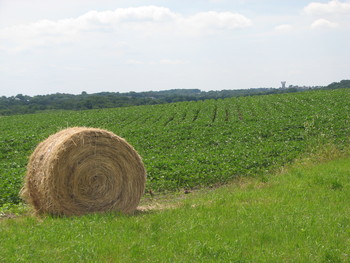
This spring, U of MN Extension is offering an eight week education series about living on the land which will provide you with a solid background in all aspects of land management.
The basic agricultural information will help you be a good steward of your land and prepare you for more advanced learning opportunities.
Weekly topics are listed below.
- Taking stock: What do you have and what do you want.
- What can I do with my land?
- The living soil - don't treat it like dirt.
- We all live in a watershed.
- Woodlands, wildlife and weeds.
- How grown fruits and vegetables.
- Animal care and management.
- Tour and goals.
For more information or to sign up contact Colleen Carlson at 952-492-5386 or traxl042@umn.edu.
 |
|
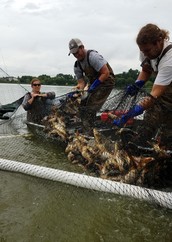
CCWMO staff will present an
update and next steps at the
Cologne Lions Club meeting.
December 11th
7:00pm
Cologne Fire Station 110
Louis St. W. Cologne, MN
55322
RSVP via phone or e-mail so they can prepare seating. 952-201-8630 or tdmkstuewe@aol.com
|
 Minnesotans value lakes and rivers. No less in Carver County. With 35 lakes and 365 miles of streams, Carver County has a wealth of good fishing spots, beaches, wildlife habitats and boating opportunities. Carver County is also one of the fastest growing counties in Minnesota. As we grow, we build roads, houses, playgrounds, businesses, schools and other structures. All are necessary, but the change on our land from natural to developed affects our lakes and rivers.
Changes in land, changes in water
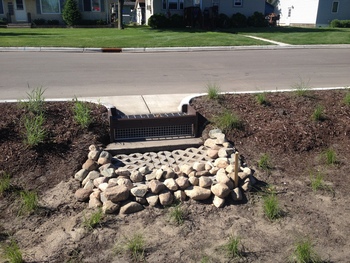
Development adds hard surfaces, known as impervious surfaces, to the land. These include driveways, roofs, streets, and parking lots. Impervious surfaces don’t let rainwater soak into the ground, so the water runs off. This is called stormwater runoff. Often, that runoff flows into the nearest storm drain, which then drains to a nearby lake, river or pond.
Also, pollutants accumulate on impervious surfaces and when the next rain comes they are washed away into lakes and rivers. Unlike the wastewater from our home sinks and bathrooms, stormwater runoff does not go to a wastewater treatment facility.
Read more
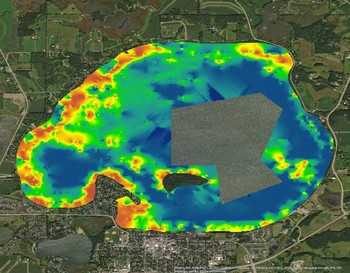
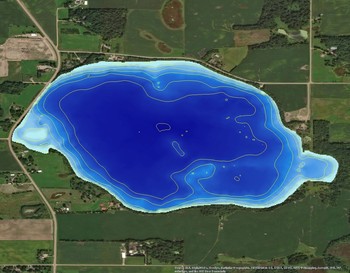 Bathymetric map onf lake depth contours
Field staff has been using a new type of survey to improve data collection. Using a fish finder. staff can conduct sonar surveys.
Sonar surveys will help staff members
- map depth contours on lakes and river where this information is not known,
- observe changes in depth over time and determine if the lake is getting filled in or if there are areas of the lake changes,
- observe how plant populations and density are changing throughout the year and over time,
- locate spots with high amounts of aquatic plants,
- determine the most abundant type of plants in the lake,
- and map the lake bottom substrate throughout the lake. The hardness of the substrate can be used to determine the successful of aquatic invasive species like zebra mussels if the lake gets infested.
To conduct a sonar survey, staff members travel around a lake by boat and record their path on a fish finder. This links the data collected to the location on the lake. Then staff members upload data to software that produces three maps: lake depth contours (bathymetry), vegetation density, and bottom hardness. All three variables are important in an aquatic environments and lake management.
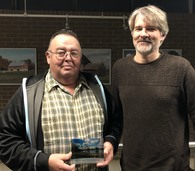 One of our advisory committee members had his last meeting in November. Virgil Stender served 10 years on the committee, serving as chair for the last three. Thank you Virgil for your guidance and dedication to protecting lakes, rivers and wetlands.
Photo left to right: Virgil Stender and Paul Moline, Planning & Water Management Manager
|
With Virgil leaving, there is one opening on our advisory committee, a group of citizens that provides input to staff and makes recommendations to the County Board on water resource policies, projects and programs.
Positions open:
Citizen representative from Commissioner District 5 which includes the following townships, Benton, Camden, Dahlgren, Hancock, Laketown, San Francisco and Young America, and the following cities, Carver, Cologne, Hamburg, New Germany, and Norwood Young America.
Figure out which district your are in.
The Advisory Committee meets monthly, the last Tuesday of each month at the Carver County Government Center in Chaska. Learn more and apply here.
Interested candidates can apply online or contact Madeline Seveland at mseveland@co.carver.mn.us or 952-361-1026 to request a paper application be mailed to them. Appointments are made by the County Board.
|