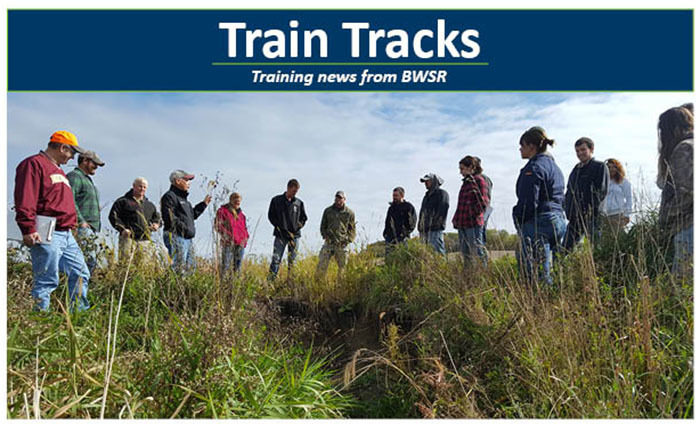
Basic Soils and Landscapes for Conservation Planners
Soils form the foundation of effective conservation planning. The Basic Soils and Landscapes for Conservation Planners training is a comprehensive, hands on course designed to strengthen your understanding of Minnesota soils and how to apply soil survey information in real-world planning.
This immersive three day (May 26–28), training in/around Duluth blends classroom learning with field experience to build confidence in evaluating soils, landscapes, and conservation limitations and opportunities.
Key topics include:
- Soil formation, properties, and classification
- Soil survey program and mapping concepts
- Web Soil Survey analysis for conservation planning
- Field methods and hands on soil pit evaluations
This training counts toward Level 1 Planner Certification – Soils Basics (NRCS-NHQ-000009) and can be used in place of the web based AgLearn course (NRCS-NEDC-000416). If you’re involved in conservation planning, resource assessment, or technical assistance, this course provides essential, practical soil knowledge you can immediately apply in the field.
Don’t miss this opportunity to strengthen your soils foundation — where landscapes meet planning success! For more information and a link to register visit the Basic Soils and Landscapes page.
Native Plant Community Training
The Minnesota Department of Natural Resources and your Technical Training and Certification Program are offering a series of Regional Plant Ecology trainings focused on Minnesota’s native plant communities. These courses are largely field-based and emphasize plant identification, giving participants hands-on experience recognizing species and interpreting plant communities across the landscape.
Participants will strengthen their ability to apply ecological knowledge to conservation planning, habitat management, and site assessment. Class sizes are limited and these trainings fill quickly, so early registration is strongly encouraged.
For additional information and a link to register please visit the Native Plant Community page.
Feed and Forage Management
Join TTCP in Howard Lake on May 28 for a Feed and Forage Management training which aims to provide participants with practical knowledge and hands-on experience to improve forage systems and livestock feeding outcomes. Attendees will explore forage harvest equipment at a local dealership followed by in depth instruction on forage quality. The training will highlight annual and grass-based forage systems, with a focus on selection, management, and productivity in grazing operations. Participants will then travel to a field site to observe live harvesting demonstrations and conduct pest sweeps, connecting classroom concepts to real world application. Emphasis will be placed throughout the day on operational safety and biosecurity to ensure best practices in both equipment use and field activities.
Additional information and a link to register can be found on the Feed and Forage Management page.
Save the Dates: Grazing Facilitating Practices and Livestock Pipeline Design
Returning this year is Grazing Facilitating Practices training, which is an introduction to the many practices often needed for a functional grazing management system: different types of fence, heavy use areas, watering systems, stream crossings, and more. This will be paired with Livestock Pipeline Design training, a classroom training focused on (you guessed it) designing livestock watering systems. We encourage attendance at both trainings, but you can take just one of them.
The first set of trainings will be held during early June in southeastern Minnesota, with the field session for Grazing Facilitating Practices near Rushford on June 3, and the classroom session for Livestock Pipeline Design in Rochester on June 4. Additional sessions are being planned for the central part of the state in the last week of July, and north central Minnesota during the middle of August.
Registration isn’t open yet, but be sure to add it to your Individual Development Plan (i.e. Practice Specific, Engineering, Livestock Pipeline) if you want to be notified right away!
Conservation Planning Course
Conservation planning is the process used to identify and evaluate resource concerns, analyze information, and recommend conservation alternatives to treat identified problems. Conservation plans provide a sound foundation for technical and financial assistance to local landowners and managers looking to treat their resource concerns.
Registration is now open for the 2026 Conservation Planning Course, which will be held July 20 to 24 at the West Central Research & Outreach Center in Morris. Course attendees are required to be a Level 1 Conservation Planner before attending, and it is expected that those attending this course will complete the additional requirements to become Level 3 Conservation Planners. The requirements for each designation can be found on the Conservation Planning page.
In addition to being a Level I Conservation Planner, all attendees need to complete the Core Competency modules before attending. The prerequisites for this course take approximately 55 hours to complete, and it is recommended that attendees have at least one year of experience before attending. At this time we are planning to hold this course again in 2027, so get started now but if you aren’t ready by July that’s ok!
Additional information and a link to register can be found on the Training Calendar. If you have completed this course in the past and you are still interested in pursuing a Conservation Planner credential, get in touch with us to figure out where to go next.
Minnesota Agroforestry Institute
Join experts, practitioners, and fellow conservation professionals for the Minnesota Agroforestry Institute, a two-and-a-half-day training focused on integrating trees and perennial systems into working agricultural landscapes. Through classroom sessions, field tours, and hands-on design exercises, participants will explore agroforestry practices such as alley cropping, silvopasture, forest farming, riparian buffers, and windbreaks.
This interactive institute, planned for September 15-17 at the Sherburne National Wildlife Refuge in Zimmerman, will help technical staff and educators understand how agroforestry can improve farm profitability, water quality, wildlife habitat, soil health, and climate resilience, while providing practical tools to support landowners interested in adopting these practices.
For more information and a registration link visit the Agroforestry Institute page.
Minnesota Core Competency Conservation (MNC3) Training Website
The MNC3 website contains a collection of self-paced training modules that can be accessed at any time. The platform will save your progress, track your completion, and it provides a certificate for each training completed. If you complete an entire set of modules you can earn a badge recognizing your achievement! All of the trainings are free – create your account today to access them!
The Core Competency training, which provides the foundational knowledge of soil and water conservation in Minnesota, is intended for all employees, regardless of position. The 19 modules cover three overarching topics: Soils, Water Quality, and Conservation Planning.
The Soil Erosion training covers the factors that cause and influence soil erosion, the models used to predict soil erosion, and the conservation practices used to mitigate soil erosion. The four modules include Soil Erosion 101, RUSLE2, WEPS, and Conservation Practices.
Agronomy Technical Note #31 contains the seeding specifications for herbaceous plantings including pollinator habitat, pasture, tall grass prairie, and many other practices. The training is broken down into four modules covering plant species, seed quality and origins, seedbed preparation, seeding equipment, seeding methods, companion crops, fertilizer amendments, and stand evaluations.
Six modules are available in the Habitat Management training. In addition to the principles of habitat management and invasive species considerations, the training focuses on the four primary tools for managing habitats: prescribed fire, mechanical treatments, chemical treatments, and grazing.
The Continuous Living Cover training was developed by Green Lands Blue Waters. This training is focused on integrating farms with the five types of continuous living cover cropping strategies: agroforestry, cover crops, perennial biomass, perennial forage, and perennial grains.
Interested in learning more? The May 18 Tech Talk will go in depth on the MNC3 website and the trainings available.
Tyler's Three Things: Conservation Practice Standard (CPS) 528
CPS 528 has changed from Prescribed Grazing to Grazing Management.
CPS 528 now has greater alignment with resource concerns and adaptive management.
New tools to support better planning, documentation, and certification are available in the Field Office Technical Guide.
Want to learn more? Check out the CPS 528 Grazing Management Updates Tech Talk.
2026 Shared Training Calendar
An updated working version of the 2026 training calendar is now available. This 12 month view of training offerings is regularly updated and provides information about upcoming training events, including potential dates and locations. Please see the legend at the top and note that the further out a training is proposed the more likely adjustments will need to be made. The dates, locations, and other details are always tentative until the event is posted on the Training Calendar.
 |
|
Minnesota Wetland Professional Certification Program |
Upcoming Minnesota Wetland Professional Certification Program Course Schedule:
April 23 & 24 - Hydrogeomorphic Method of Classifying Wetlands - Baxter
April 28 & 29 - Hydrogeomorphic Method of Classifying Wetlands - Rochester
May 20 & 21 - Soils on the Landscape - North Branch
June 8-12 - Introduction to Wetland Delineation & Regulation - Shoreview
July 7 - Plant ID & Rapid FQA - Cloquet
July 21 - Plant ID & Rapid FQA - Lino Lakes
Aug. 31 - Sept 4 - Introduction to Wetland Delineation & Regulation - Cloquet
Sept. 14-18 - Introduction to Wetland Delineation & Regulation - Brainerd
Oct. 13 & 14 - Functional Assessment Method - Shoreview
Nov. 18 - WCA Rule Virtual Training (registration opens summer 2026)
Dec. 8 - New Normal?: Emerging Topics in the Wetland World -St Paul
MWPCP Registration Information:
Registration for Introduction to Wetland Delineation & Regulation opens March 9: Registration Link
Registration for all remaining courses opens March 16 (unless noted otherwise): Registration Link
Technical Training & Certification Program Trainings
Tech Talk Webinars: Mondays at 1 p.m.
- April 20, Soil Fertility Management on Pasture
- May 4, Stream and Oxbow Restoration in Minnesota
- May 11, Farm Economics – Crops
- May 18, Minnesota Core Competency Conservation Training
- June 15, Farm Economics – Livestock
- July 13, Job Approval Authority
- Sept. 21, Individual Development Plan Tool
- Nov. 16, Technical Training Resources
April
- April 17, Native Seed Mix Design and Evaluation for Wet Sites, Detroit Lakes
- April 22, Native Seed Mix Design and Evaluation for Wet Sites, Farmington
- April 22-Sept. 24, 2026 Native Plant Community Trainings, Multiple locations
- April 29, Native Seed Mix Design and Evaluation, Marshall
- April 30, Basic ArcGIS Pro, Online
May
June
July
August
- Jan. 13-Oct. 13, SFEC's 2026 Webinar Series, SFEC, Online
- Jan. 30-April 24, Fridays with a Forester, UMN Extension, Online
- Feb. 9-Oct. 29, Livestock 101 Webinar Training Series - Part II, Conservation Webinars, Online
- April 7-29, Weed 'Em Out Workshops, SFEC, Multiple locations
- April 30, Improving Restorations: Stream Improvement, Planning & Collaborations, UMN Extension, Online
- May 28, Field Applications to Fire Dependent Forest Ecosystems, SFEC, Cloquet Forestry Center
- June 2, Northern hardwoods silviculture: What's next after creating gaps?, SFEC, Aitkin
- June 3, MN Forest Management Guidelines Field Workshop, SFEC, Hackensack
- June 9, Cover Crop Academy, UMN Extension, Multiple locations
- June 17, Ecological Silviculture Applications to Mesic Hardwood Forests, SFEC, Grand Rapids
- June 18, Field Silviculture Application to Wet and Ash Dominated Forests, SFEC, Cass Lake
- June 25, Forest Pest First Detector Training, UMN Extension, Cloquet Forestry Center
- July 28, Recognizing and Managing Oak Wilt, SFEC, St. Croix State Park
- July 29-30, Field School for Ag Professionals, UMN Extension, St. Paul
Not all training takes place in a classroom. Check out the links below to learn at a time and place of your choosing.
We’ve also put together a searchable library of recorded modules, webinars, videos and other resources to help our staff and partners find professional development information on a variety of topics. You can visit BWSR's Online Learning page to find web-based technical training resources sorted by category
New:
Program Contacts
|