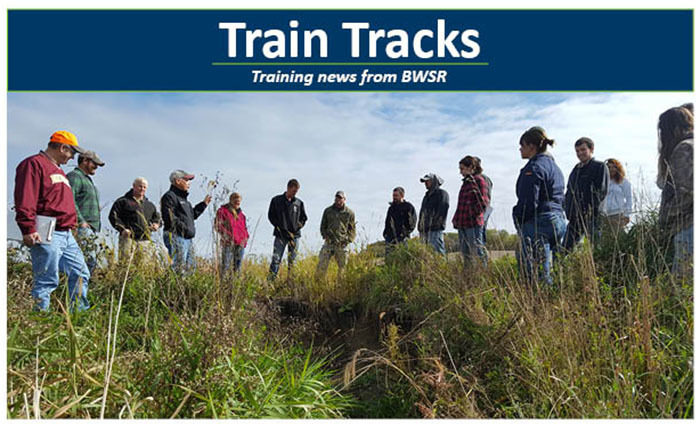
Conservation Crop Systems Cohort
The 2026 Conservation Crop Systems Cohorts will provide regional, hands on training designed to strengthen skills in cover crops, tillage management, and conservation crop rotation. Participants will work directly with peers and technical experts to plan, design, and certify real conservation practices throughout the year. Each cohort will meet regularly, either virtually or in person, to collaborate on real-world projects tailored to local resource concerns. Training will be led by Area Resource Conservationists, TTCP Training Conservationists, and partner specialists who bring deep field experience. Core practices featured in the cohort include Conservation Crop Rotation (328), No-Till (329), Reduced Till (345), and Cover Crop (340). The program’s goal is to build participant confidence and competence so they can independently plan, design, and certify at least one practice by the end of the cohort. Group leads will help participants identify knowledge or skill gaps and provide targeted coaching throughout the training. Cohort members will also have opportunities to coach one another as they work through planning and certification processes. A set of prerequisites ensures participants arrive prepared, including core competency modules, Tech Talks, and prior cover crop training. Attendees are encouraged to bring at least one project for each practice they seek JAA delegation, allowing them to apply new skills directly to their fieldwork.
Interested? Find more information and a link to register on the Conservation Crop Systems Cohort page. Not sure if you are ready? This and other cohorts will be offered again in the future, but you can get started on the prerequisite trainings today!
Basic Hydrology
The Technical Training and Certification Program is offering Basic Hydrology training as an online webinar on Jan. 29. Attendees should attend both sessions to complete the course. This course was given virtually in January 2025 and in person in August 2024. This will be a repeat of both those courses.
This training will cover the basic concept of determining hydrology for common conservation practices. We will review concepts such as runoff, curve numbers, peak discharges, and hydrographs. Students will learn about reading contour maps and delineating watersheds through example problems. By the end of the two sessions students should be able to delineate a watershed as well as obtain the values needed to determine a peak discharge from the delineated watershed using EFH2.
There is a prerequisite video as well as practice homework to be completed between the two sessions. For additional information please visit the Basic Hydrology page.
GIS Pro Basics
Back by popular demand, TTCP is offering an ArcGIS Pro training. This is the same class that was offered in several locations last winter. This is for staff still afraid to transition into GIS Pro, so we’ll start with the basics. We’ll give an overview of the differences between ArcMap and Pro and give a short tour of the new layout. There will be classroom examples on editing feature classes (e.g. shapefiles), labeling, making layouts for map printing, and other common procedures. Much of the day is hands on! There are three in person sessions in February and two virtual sessions in March. Please try to attend an in person session if it’s within commuting distance!
Tyler's Three Things: Filter Strips
Filter Strips are more than a grass buffer.
Conservation Practice Standard 393 requires watershed and RUSLE2 metrics.
Species selection and management based on numerous factors are critical.
Want to learn more? Check out the CPS 393 Filter Strip Training Series.
2025 Shared Training Calendar
An updated working version of the 2025 training calendar is now available. This 12 month view of training offerings is regularly updated and provides information about upcoming training events, including potential dates and locations. Please see the legend at the top and note that the further out a training is proposed the more likely adjustments will need to be made. The dates, locations, and other details are always tentative until the event is posted on the Training Calendar. Coming soon: In January, get your first look at the 2026 training calendar.
Technical Training & Certification Program Trainings
January
- Jan. 14, 2026 Forestry and Wildlife Practice Review, SFEC, Cloquet Forestry Center
- Jan. 14-15, Soil Management Summit and DIRT Conference, UMN Extension, Fargo
- Jan 15, 2026 Minnesota Neonic Forum, UMN Extension, Waseca
- Jan. 28-29, MECA Annual Conference & Trade Show, Minnesota Erosion Control Association, Mankato
- *Jan. 28-29, Tribal-State Relations Training, Fond du Lac Band of Lake Superior Chippewa, Carlton
- Feb. 10-11, Soil Management Summit, University of Minnesota Extension, Dubuque, IA
- *Feb. 25-26, Tribal-State Relations Training, Mille Lacs Band of Ojibwe, Hinckley
- *March 25-26, Tribal-State Relations Training, Prairie Island Indian Community, Welch
*LGUs need to identify in their requests that they work with BWSR.
Not all training takes place in a classroom. Check out the links below to learn at a time and place of your choosing.
We’ve also put together a searchable library of recorded modules, webinars, videos and other resources to help our staff and partners find professional development information on a variety of topics. You can visit BWSR's Online Learning page to find web-based technical training resources sorted by category
New:
Program Contacts
|