 Thank you for your interest in the developing Lawns to Legumes program. Read below for program details and upcoming workshops. This update is intended for experienced gardeners interested in acting as coaches for the program, and for local governments interested in applying for the upcoming demonstration neighborhood Request for Proposals (RFP) that will be issued by the Minnesota Board of Water and Soil Resources (BWSR) later this fall. An update geared toward interested residents is also being distributed simultaneously.
What does this program do?
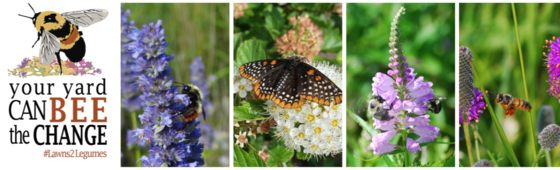
Lawns to Legumes will offer workshops, coaching, planting guides and cost-share funding for installing pollinator-friendly native plantings in residential lawns. The program will also include a public education campaign to raise awareness for pollinator habitat projects and will establish demonstration neighborhoods that showcase best practices.
Why does this matter?
Minnesota is home to more than 450 native bee species. Pollinators also include butterflies, moths, beetles and native flies. All play a key role in pollinating many food crops and native plants, but populations have significantly declined worldwide in recent years. Population decline can be attributed to habitat loss and lack of related nutrition for pollinators, as well as pesticide use and pathogens.
The program aims to protect the federally endangered state bee, the rusty patched bumblebee, and other at-risk pollinators. Even relatively small plantings of native flowers can help create conditions that are highly valuable to pollinators and can help build important habitat corridors.
Program Components
-
Demonstration Neighborhoods: High-profile community-wide projects located in important pollinator pathways that will raise awareness. A Request for Proposals (RFP) will be issued by BWSR between Nov. 15 and early December inviting local government units to apply to establish a demonstration neighborhood.
-
Individual Support: Lawns to Legumes will offer a combination of workshops, coaching, planting guides and cost-share funding for installing pollinator-friendly native plantings in residential lawns. Applicants who live in areas with a high potential for the rusty patched bumblebee to be present will be given priority.
-
Public Education Campaign: Promote public adoption of residential pollinator habitat.
When will the Request for Proposals (RFP) for Demonstration Neighborhoods Open?
BWSR’s target date for issuing the Demonstration Neighborhoods RFP is between Nov. 15 and early December. Stay tuned for updated information on exact timing.
When will interested residents be able to apply for cost-share funding?
In December 2019, Blue Thumb will begin accepting applications from residents for the individual support component of Lawns to Legumes. The program divides the state into different priority areas based on the presence of the rusty-patched bumblebee. Check this map to determine which priority area you live in:
Applicants who are accepted into the Lawns to Legumes individual support program can receive up to $350 of funding through a reimbursement process. Funding decisions will be made and all notifications emailed in February for spring 2020 installations.
Resources
Partners
The Minnesota Board of Water and Soil Resources (BWSR) will administer the program with the assistance of Metro Blooms and the Blue Thumb — Planting for Clean Water Partnership, which will manage the individual support program. Students at the Minneapolis College of Design are offering communications support.
 |
|
Minnesota Board of Water and Soil Resources (BWSR)
BWSR is a state agency that works with private landowners and local government partners to improve and protect Minnesota’s water and soil resources. Since its founding in 1987, BWSR has helped install 17,500 conservation practices across the state and has supported more than 1,615 Clean Water Fund projects estimated to reduce more than 168,500 tons of sediment per year and prevent more than 178,150 pounds of phosphorus per year from entering Minnesota waters.
|
 |
|
Metro Blooms
Metro Blooms is a Twin Cities-based nonprofit organization whose mission is to promote and celebrate gardening, to beautify our communities and help heal and protect the environment. They provide ecological design, installation, maintenance and education services to create resilient landscape, protect clean water and provide wildlife habitat. Metro Blooms coordinates the Blue Thumb program.
|
 |
|
Blue Thumb — Planting for Clean Water
Blue Thumb Partners are a collection of public organizations and private companies committed to helping landowners create landscapes that contribute to a healthy ecosystem and clean water.
|
 |
|
Minneapolis College of Art and Design
Students from three classes at the Minneapolis College of Art and Design (MCAD) are assisting the Lawns to Legumes program by creating original illustrations, copywriting materials and strategic communications and social media plans.
|
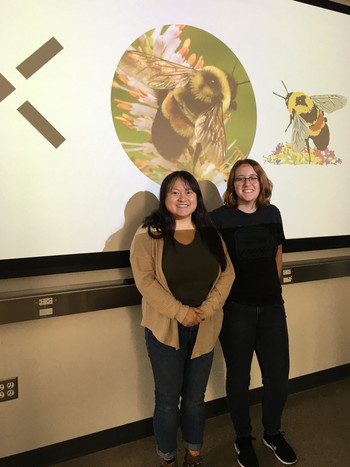 MCAD Entrepreneurial Studies students Amy Yang (left), Sam Ballis (right) and Nathan Malischke (not pictured), are coordinating MCAD student contributions to the Lawns to Legumes program.
|