| |
|
October 2026
We publish our Constellations newsletter to share ways that Assistive Technology can be life-changing for people with disabilities and raise awareness of the services offered through the STAR Program and our partners.
|
|
From the Director
Fall is a busy time at the MN STAR Program, and this issue highlights one of the things we value most: giving Minnesotans opportunities to explore technology and find solutions that work for them.
Inside, you’ll learn about our AAC Consideration Toolkit, explore our device loan program, meet one of the newest additions to our lending library, and read a success story that reminds us that sometimes the right solution is already built into the technology we use every day.
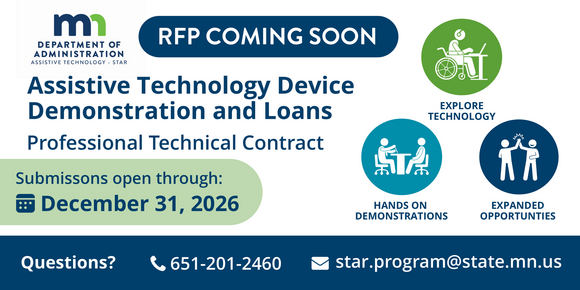
We’re also excited to share that our STAR Partner Request for Proposals (RFP) will soon be open. Our STAR Partners play an important role in helping us provide access to assistive technology throughout Minnesota. Through these partnerships, organizations in communities across the state provide device demonstrations and loans, helping people explore AT closer to where they live, work, and learn.
As a small statewide program, we rely on these partnerships to extend our reach and connect more Minnesotans with the tools and information they need. We are grateful for the work of our current STAR Partners and look forward to strengthening and expanding our network through this RFP. Organizations interested in becoming a STAR Partner will be able to submit proposals through December 31, once the RPF is live. You’ll find more information about the opportunity later in this issue.
With Election Day approaching, we’ve also included resources on accessible voting in Minnesota. Accessibility and informed choice matter in every part of community life, including participating in our elections.
As always, thank you for staying connected with STAR. We hope you find something in this issue that you can use, share, or explore further.
Amy Perron, Program Director
|
|
|
Do you like the Constellations Newsletter? Don’t miss an issue!
|
|
|
Assistive technology (AT) is something that can help you do things that might otherwise be difficult or impossible to do on your own. It is an item or device that can help you speak, walk, talk, remember, see, hear, learn and more.
Take a look at the video on channel.
|
|
|
Did you know? There is no cost to borrow equipment from the STAR Program or our partners! You can schedule a time to pick up the equipment or we can ship the device at no cost to the borrower. The borrower is responsible for returning the item back to the program they borrowed it from at the end of the six-week period by scheduling an appointment to return the device or by paying to ship the equipment back to the program.
|
|
Device Loans: Try Before You Buy
Device loans give Minnesotans an opportunity to try assistive technology before making a purchasing or funding decision. Whether AT is needed for school, work, independent living, or participation in the community, borrowing a device can help determine whether it is the right fit.
Why borrow a device?
For school: A student may need to try different AT options to determine what best supports access to learning before a school, family, or other funding source purchases a device.
For independent living: Someone moving into their own home may want to try an alarm clock with a bed shaker to see whether it effectively helps them wake up independently.
For work: An employee may benefit from trying different ergonomic mice or other computer-access tools to determine which option works best for their needs and work environment.
Trying a device first can help people make more informed decisions and avoid purchasing technology that may not meet their needs.
Devices can be found through the Minnesota AT4ALL website. STAR has also created two short tutorials to help you get started:
STAR’s device loan services are free. STAR pays the cost of shipping devices to borrowers; borrowers are responsible for return shipping.
Ready to explore AT? Visit MN AT4ALL or contact the STAR Program at star.program@state.mn.us or 651-201-2640.
|
|
|
Check out our online lending library at MN AT4ALL where you can see many of the devices hosted by STAR and our partners. You can check out a loan online and a staff member will reach out regarding next steps.
For more information, contact STAR. We look forward to hearing from you!
|
|
Our Partners Help Broaden Our Reach State-wide
The federal 21st Century Assistive Technology Act, requires programs like STAR to provide the following services: assistive technology demonstrations, loans, and reutilization services. In order to support the entire state with a small team, STAR has broadened their ability to meet people where they are, closer to their communities where possible.
|
|
What's New at STAR: Partner RPF
Coming soon, the Minnesota STAR Program will issue a Request for Proposals (RFP) for Assistive Technology Device Demonstrations and Device Loans. Once live, applications will be accepted through December 31, 2026.
STAR partners help provide assistive technology (AT) services throughout Minnesota, including:
- Short-term device loans
- Open-ended device loans
- Device demonstrations
Because STAR has a small team based in St. Paul, our partners play an important role in expanding access to AT across Minnesota. These partnerships help us reach more communities, provide services closer to where people live, and meet our responsibilities under the federal Assistive Technology Act.
We appreciate our current STAR partners and the important role they play in helping Minnesotans access and explore assistive technology.
Want to know when the RPF is live?
Subscribe to our Press Release email list where we let you know when the submission period opens and how to apply. Applications will be due by December 31, 2026.
Contact star.program@state.mn.us for more information.
|
|
|
STAR Partners are listed on our Device Loan page. Individuals can search for a device by product type and location by accessing the MN AT4ALL online lending library. If there are questions, we encourage people to check with STAR first.
|
|
|
Election Day is Tuesday, November 3, 2026, and Minnesota voters with disabilities have several options to support accessible, private, and independent voting.
State and federal laws require polling places to be physically accessible. Minnesota polling places also provide ballot-marking machines that can assist voters who cannot—or choose not to—mark a ballot with a pen. Depending on the equipment, accessibility features include large print, high contrast, audio through headphones, a Braille keypad, touchscreen, and compatibility with sip-and-puff devices. Any voter may choose to use a ballot-marking machine.
Voters can also:
- Bring someone of their choice to assist them, with some exceptions.
- Ask election judges for assistance.
- Request curbside voting if they cannot easily leave their vehicle to enter the polling place.
- Request an accessible absentee ballot if they have a print disability.
Accessible Voting & Voter Assistance
Learn about assistance at the polls, curbside voting, ballot-marking machines, and accessible absentee ballots. Get Help Voting – Minnesota Secretary of State
Polling Place Accessibility
Learn about Minnesota's accessibility requirements for polling locations. Polling Place Accessibility – Minnesota Secretary of State
Find Your Polling Place
Enter your home address to find your Election Day polling location, precinct information, and what's on your ballot. Minnesota Polling Place Finder
Additional Resources
-
REV UP is a voting campaign of the American Association of People with Disabilities (AAPD). It builds the power of the disability vote through a national network of coalitions and organizations. REV Up’s Minnesota branch can found on Facebook.
- If you live in a group home, assisted living facility, or shelter for domestic abuse victims, or else have difficulty getting to your polling place due to incapacitating health reasons you may qualify for Agent Delivery of your ballot
- Local election officials send teams of poll workers to nursing homes and hospitals during the 35 days before an election with applications and ballots. Contact facility management or your local election official to find out when that will happen.
- Should you encounter issues that you believe violate state or federal election laws you can find information on how to report the problem also on the Secretary of State’s website.
Questions about voting? Contact the Minnesota Secretary of State at 1-877-600-VOTE (8683).
|
|
 |
|
Note to readers: in each issue, we feature a device from our lending library or a useful AT app we have found. There are many devices that can be demonstrated or trialed through our loan program at no charge to you. Check out our inventory of devices at the MN AT4ALL website. We also feature promising apps that help improve the lives of people with disabilities.
|
Captify Pro Captioning Glasses
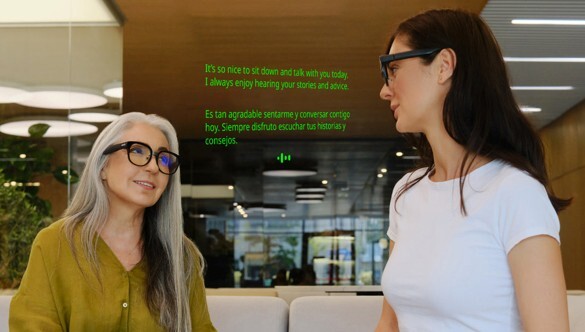
The MN STAR Program recently added Captify Pro captioning glasses to our lending library, and we’re excited to give Minnesotans the opportunity to try this technology.
The Captify Pro are lightweight, assistive smart glasses designed for deaf and hard-of-hearing individuals that project real-time transcriptions and sound descriptions directly onto the lenses. This allows you to read spoken conversations while continuing to look at the person speaking. The captions are visible only to the wearer.
Captify Pro can also provide descriptions of environmental sounds, such as alarms or laughter, and support multiple languages and translation. The glasses connect to a smartphone via Bluetooth and can accommodate a variety of prescription lenses.
The stylish frames look and feel like normal eyeglasses while using a monochrome green waveguide display to turn spoken conversation and ambient noises, such as alarms or laughter, into readable text. They offer a discreet and portable way to navigate noisy or everyday environments with greater confidence.
Want to see if Captify Pro might work for you? Check them out through the MN STAR lending library on AT4All, or schedule a device demonstration at our office by calling 651-201-2640 or emailing star.program@state.mn.us.
|
|
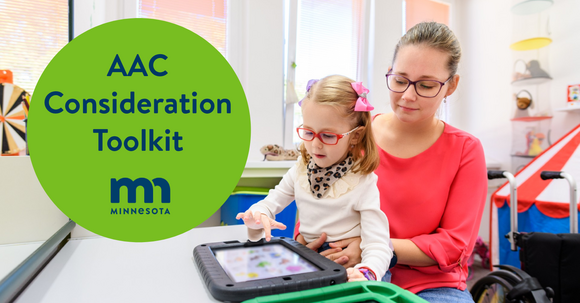
Determining whether a student may benefit from augmentative and alternative communication (AAC) can feel overwhelming. The MN STAR Program’s AAC Consideration Toolkit gives school professionals a structured, hands-on way to explore AAC options and gather information to help determine next steps.
Developed in collaboration with the Minnesota Department of Education and school professionals, the toolkit is designed for PreK–12 professionals and IEP (Individualized Education Plan) teams supporting students who may benefit from additional ways to communicate.
The toolkit includes non-electronic, light-tech, and high-tech AAC options, along with a guidebook and resources to support an eight-week trial period. Using the SETT framework—Student, Environments, Tasks, and Tools—teams can identify communication needs, explore helpful features, try different approaches in everyday settings, and document what they learn.
AAC is not one-size-fits-all
The toolkit gives teams an opportunity to explore multiple communication options with a student in their everyday environments before determining next steps. It helps move the conversation from “Does this student need AAC?” to “What supports help this student communicate most effectively?”
The toolkit supports AAC consideration and trial but is not a comprehensive AAC evaluation. If the trial indicates AAC may be beneficial, the information gathered can help inform next steps with the student’s SLP (Speech Language Pathologist) and IEP team.
Borrowing the toolkit is free, and kits are available statewide.
Learn more about the AAC Consideration Toolkit!
|
|
Assistive Technology: The Power to Connect
A mother reached out to the MN STAR Program in urgent need of support. Her son, a young man in his late teens who just finished high school, had recently suffered a stroke—something no family expects at such an early age. As a result, he was struggling to read text and communicate clearly, with his speech becoming jumbled and inconsistent. Despite these challenges, he was determined to begin college in the fall, and they were searching for assistive technology that could help him continue pursuing his academic goals.
We quickly scheduled a demonstration, and when they arrived, we were ready with a wide range of tools and applications to explore together. Throughout the session, he identified several devices that he felt would truly help, and we set up a device loan so he could continue trying them at home and in his daily life.
After the demonstration, his mom shared something deeply personal: his social life had nearly disappeared because he couldn’t read the messages his friends sent, nor respond in a clear way. She wished he could simply read his texts and ensure his responses were understandable before sending them. We went through the accessibility features on his phone and enabled tools that would read messages aloud and let him preview his drafted responses.
By the end, he was visibly overwhelmed—in the best way. Through his expressions and body language, you could see how relieved and hopeful he felt. His mom began to cry tears of joy, saying how grateful she was that the STAR Program existed and that they were able to find us during such a difficult chapter.
Sometimes the STAR Program provides the tools needed to pursue a career; other times, it helps people reconnect with the ones they love. When we meet with individuals, we strive to understand their whole story, because doing so allows us to help them stay connected—to their dreams, their communities, and the future they’re working so hard to build.
|
|
There are several events and learning opportunities that may be of interest about assistive technology. More information about upcoming events is available from the links. All events are in Central Time unless otherwise indicated. If you want to hear more about future events, subscribe to our Upcoming Events list!
|
|
|
October 7 – 8
Duluth Entertainment Convention Center
350 Harbor Drive
Duluth, MN
|
|
St. Louis County Health & Human Services Conference
Bringing together hundreds of professionals from across the region, this year’s conference centers around the theme "Grit, growth, and grace." Attendees can look forward to inspiring keynote presentations and a diverse lineup of breakout workshops focused on the latest strategies, trends, and collaborative solutions in public health, social services, and community support.
|
|
|
October 20 – 22
Doubletree Bloomington Minneapolis South
7800 Normandale Blvd.
Minneapolis, MN
|
|
44th Annual Closing the Gap Conference
Closing the Gap centers on assistive technology in special education, rehabilitation, and everyday living, covering tools for people across a wide range of disabilities. Now in a 3-day format, it starts with an expert-led, full day workshop then moves into two days of more than 160 sessions and hands-on labs, an exhibit hall, and an AT Maker Fair. The conference is catered to educators, clinicians, AT specialists, and families.
|
|
|
Unity Day is Wednesday, October 21
Celebrate the signature event of National Bullying Prevention Month and help us to encourage #UnityEveryDay! Each year, Unity Day sends a powerful message and brings communities, families, schools, and businesses together to prevent bullying. The call to action is simple: wear and share the color orange to make a vibrant statement and show support. Discover creative ways to get involved.
|
|
|
October 28
9am – 4pm
Online Event
Click to edit this placeholder text.
|
|
Next Tech: Technology Solutions for Providers and People Served
This full day learning experience from ARRM focuses on practical, real world use of technology in disability services. Throughout the year, sessions will explore topics such as how and when to use AI, safety and security considerations, remote support and assistive technology options, and how technology can support staff, service delivery, and quality outcomes without losing sight of people first values.
|
|
|
Election Day is November 3rd. Every citizen has a right to vote regardless of ability, make sure your voice is heard!
|
|
Credits
Images in this newsletter used icons from:
|
|
We have many device and educational videos. STAR posts videos often, so consider subscribing to our channel! Here are also two playlists on the channel:
Find Recent Issues of Constellations on our website Media page.
|
|
|
|
|