|
|
April 2025
We publish our Constellations newsletter to share ways that Assistive Technology can be life-changing for people with disabilities and raise awareness of the services offered through the STAR Program and our partners.
|
|
From the Director

National Assistive Technology Awareness Day is on April 30. This day recognizes the transformative role AT plays in the lives of people with disabilities and older adults. It’s a moment to celebrate the tools, services, and support systems that help people live, learn, work, and thrive independently.
Assistive technology is not optional—it’s essential. Whether it’s communication devices, mobility aids, or adapted tools for daily living, AT empowers inclusion in classrooms, workplaces, homes, and communities. AT Awareness Day also highlights the crucial role of federal support in making these tools accessible and available to all who need them.
As we mark this important day, the Minnesota STAR Program is proud to be part of the nationwide effort to expand AT access. We’re celebrating with stories, stats, and resources that show how AT changes lives.
Also in April, we recognize Parkinson’s Awareness Month, shining a light on a progressive neurological condition that impacts movement. In this issue, we highlight several devices in our Lending Library that support individuals with motor and movement challenges—including those living with Parkinson’s disease.
In this issue:
- Meet our newest Advisory Council member, David Shaw, a representative from a Center for Independent Living.
- Explore our latest Adaptive Living video series on YouTube, where Minnesotans with disabilities share their stories and the AT that makes a difference in their daily lives.
- Check out the partner spotlight on the ALS Association, an organization helping individuals with neurodegenerative diseases access the tools they need.
- Don’t miss the calendar of upcoming events and webinars and explore helpful links and resources.
Amy Perron, Program Director
|
|
|
|
Do you like the Constellations Newsletter? Don’t miss an issue!
|
|
|
Assistive technology (AT) is something that can help you do things that might otherwise be difficult or impossible to do on your own. It is an item or device that can help you speak, walk, talk, remember, see, hear, learn and more.
|
|
Did you know? There is no cost to borrow equipment from the STAR Program or our partners! You can schedule a time to pick up the equipment or we can ship the device at no cost to the borrower. The borrower is responsible for returning the item back to the program they borrowed it from at the end of the six-week period by scheduling an appointment to return the device or by paying to ship the equipment back to the program. |
|
|
Working for Minnesotans
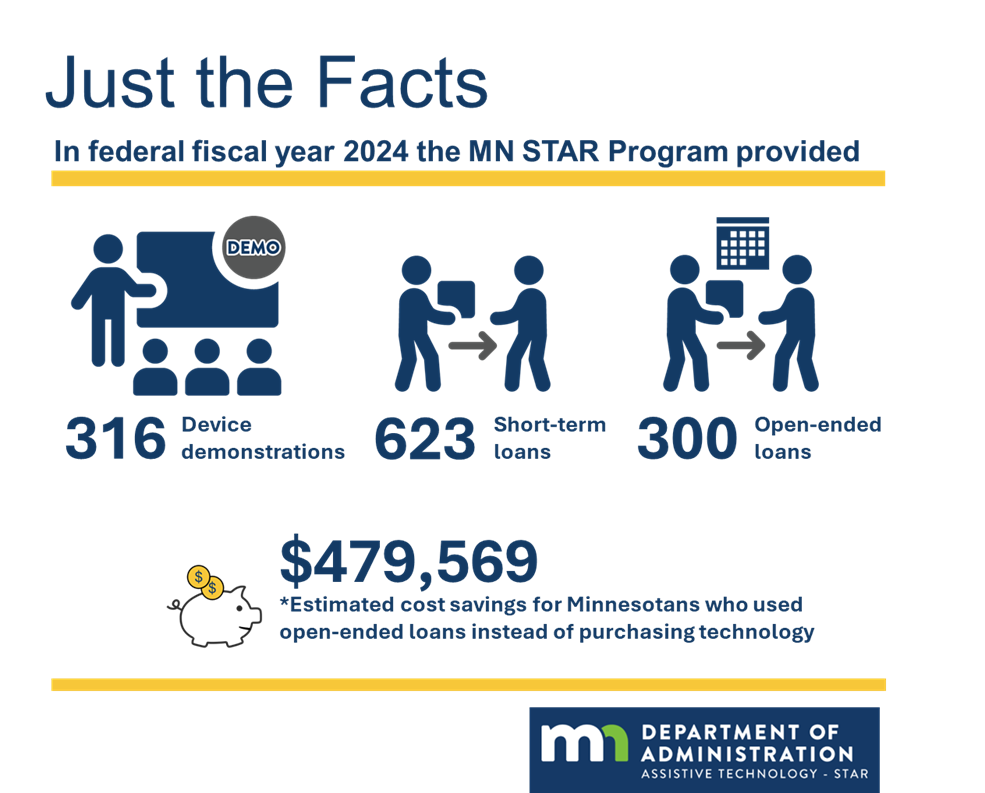
For the federal fiscal year of 2024, we are highlighting the services that the STAR Program provides by the numbers that reflect our level of activity, as well as the cost savings realized by Minnesotans who took advantage of the open-ended loans instead of purchasing technology.
 We encourage you to check out the STAR Program Information Assistance webpage
OR
Contact Us
|
|
|
Check out our online lending library at MN AT4ALL where you can see many of the devices hosted by STAR and our partners. You can check out a loan online and a staff member will reach out regarding next steps.
For more information, contact STAR. We look forward to hearing from you!
|
|
Our Partners Help Broaden Our Reach State-wide
The federal 21st Century Assistive Technology Act, requires programs like STAR to provide the following services: assistive technology demonstrations, loans, and reutilization services. In order to support the entire state with a small team, STAR has broadened their ability to meet people where they are, closer to their communities where possible.
|
|
Featured STAR Contract Partner: The ALS Association

Amyotrophic lateral sclerosis (ALS) is a progressive neurodegenerative disease that affects nerve cells in the brain and spinal cord. There is no cure for ALS yet.
We recently talked with the ALS Association’s Kate Nilson, Care Services Manager and Valerie Bombardier, Communication and Assistive Technology Equipment Manager about the work of this nonprofit.
Kate Nilson is a resource for speech therapists working with ALS clients. A speech therapist herself, Kate answers questions about Augmentative-Alternative Communication and Assistive Technology. She has years of experience as a Speech Therapist including her continued work at the University of Minnesota ALS Clinic. About the work of the ALS Association, Kate said, “We want to make life as easy and livable as possible.”
Valerie Bombardier manages the ALS Association communication equipment loan program. Funded by grants and donations, new or used communication devices, as well as durable medical and adaptive equipment are loaned at no charge to people with ALS for as long as needed. Valerie wears many hats, from supporting families to ordering, maintaining inventory, and prepping equipment. 25-35 pieces of equipment are loaned out weekly. Valerie explained, “My goal is to gather all the pieces together based on the therapist’s recommendations and send the equipment out quickly to those in need.” In cases where insurance will not cover the expense, the ALS Association may be able to help. Kate added, “Often, insurance will only fund one device every 5 years, so the loan program is a big benefit for families in managing costs.”
The two value their connection to MN STAR and attend quarterly partner meetings where information is shared about technology, especially what might be a good fit for ALS. They also refer to the MN AT4ALL lending library for information on devices. All MN STAR partners share data on the technology used and success stories, which helps MN STAR make technology choices for the MN STAR lending library. The reimbursement the ALS Association receives by participating helps fund the ALS equipment loan program.
“We want people to know that we are here and that we understand,” offered Kate, “When first diagnosed, the information feels overwhelming and is not always accurate. We can answer questions, and we know others who can help.” The local office of the ALS Association has a staff person in each of 5 clinics across Minnesota, listed on their website.
Many other support programs are also available from the ALS Association and listed on the website. “It is so important for people to have connections and not feel so isolated by this disease. It’s about quality of life,” explained Kate. Some of their programs include the Creative Pursuits group where people can share their art. They also offer support groups, with one of the largest being the Bulbar Support Group for those with ALS affecting their speech and swallowing muscles. “We meet online with people using their AT devices or the chat function to communicate and it works fabulously!” related Kate.
For caregivers, the Senator Tomassoni Caregiver Support Program may help cover some costs and education associated with in-home care. Caregivers who need extra support may apply for funds that are available through June 2026.
Assistive technology continues to evolve, and one area of promise is voice preservation. Today, a person with ALS who currently can speak may use a voice preservation program to capture and save their words in their own voice, unique intonations and inflections. Then when speaking becomes difficult or is not possible, augmentative communication can use the recorded voice when communicating with others. Kate shared a success story of a woman who was able to continue a daily ritual of reading a bedtime story to her child in her own voice because of voice preservation.
If you or a loved one has been diagnosed with ALS, contact the ALS Association to learn more.
|
|
|
STAR Partners are listed on our Device Loan page. Individuals can search for a device by product type and location by accessing the MN AT4ALL online lending library. If there are questions, we encourage people to check with STAR first. |
|
The Minnesota STAR Program is federally funded by the Department of Health and Human Services, Administration for Community Living in accordance with P.L. 117-263 Division E:21st Century Assistive Technology Act. This law requires that the STAR Program have an Advisory Council. The purpose of the Minnesota Technology Advisory Council is to provide consumer-responsive and consumer-driven advice to STAR.
Getting to Know Council Member: David Shaw
Advisory Council member David Shaw began serving on the STAR Program Advisory Council in 2024 as a Center for Independent Living representative. David is the Engagement Supervisor at the Metropolitan Center for Independent Living (MCIL) which serves the seven-county metro area. He brings a valuable perspective to the Council about independent living.
David feels the Council helps strengthen and enhance the partnerships with other disability services organizations, and enables him to learn more about Assistive Technology, which is an important element in his own success as a person with a disability.
About Centers for Independent Living
Federal legislation was passed in 1978 that provided funding to establish centers for independent living (Title VII of the Rehabilitation Act).
The National Council of Independent Living (NCIL) states that there are now over 400 Centers for Independent Living (CILs) in virtually every state and U.S. territory. “Independent living” emphasizes consumer control, the idea that people with disabilities are the best experts on their own needs. Millions of people with disabilities rate independent living higher than a life of dependency, narrow opportunities and unfulfilled expectations.
CILS in Minnesota
Minnesota Association of Independent Living (MACIL) was established to be an advocate for a statewide network of independent living services and supports, for Minnesotans with disabilities. There are 8 CILs in Minnesota, which offer core services, including:
- Information and Referral
- Independent Living Skills Training
- Peer Mentoring
- Advocacy (consumer and community)
- Transition
Centers have substantial involvement from people with disabilities in making policy decisions and delivering services. At MCIL, 65% of employees and 70% of MCIL board members are individuals with disabilities.
The Metropolitan Center for Independent Living (MCIL) is the largest CIL in the state, serving the 7-county metro area. MCIL’s mission is “To advance the independent living of people with disabilities by removing barriers and promoting choices.” David shared, “We want people to know we are here for them and can help them connect to the resources they need.” Every day, inquiries are made by people advocating on their own behalf, or their responsible parties. In David’s experience, individuals have varied levels of urgency and needs: “It’s non-stop; each day is different, and the work is very rewarding. It feels good to have a job where my disability is an asset.”
MCIL offers a variety of services and will start in-person classes in 2025. All people are welcome to visit the St. Paul office and to check the MCIL website for more information.
To learn more about the Minnesota Technology Advisory Council and the work they do, email STAR: star.program@state.mn.us.
|
|
 |
|
Note to readers: in each issue, we feature a device from our lending library or a useful AT app we have found. There are many devices that can be demonstrated or trialed through our loan program at no charge to you. Check out our inventory of devices at the MN AT4ALL website. We also feature promising apps that help improve the lives of people with disabilities. |
Support for People with Parkinson’s: Addressing Motor and Movement Disorders
For Parkinson’s Awareness Month, we’re highlighting several assistive technology devices that help people with motor and movement disorders. These devices are available in our lending library MN AT4ALL.
AdMouse
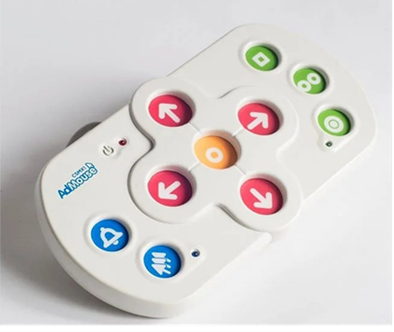
AdMouse replaces a traditional mouse
People with motor and movement disorders often are deprived of using a computer if it has a traditional mouse. However, there is a possible solution: the AdMouse. This device is designed to help users improve the accuracy and autonomy of their computers and mobile devices, allowing them to access any application or information with greater ease and control.
This device is designed with a built-in keyguard with recessed buttons, which makes the AdMouse an excellent choice for those who suffer from involuntary hand movements, tremors, or paralysis of the upper limbs for example, such as Parkinson's ataxia, dystonia, essential hand tremor, and cerebral palsy.
Features include:
- Plug and play with a hard-wire USB connection
- Special keys for double clicking and click-and-drag functions
- Lights and audio signals to help orient individuals to specific mouse actions
- Configurable speed and sound
Check out the Admouse!
Standard Keyboard USB with Keyguard
Keyguard ready to attach to a keyboard
The keyguard is made of clear acrylic material that will not bend or crack and is easy to lay over a traditional keyboard. The keyguard creates a hole that recesses the key, which helps prevent pushing multiple keys at once while tremoring and provides a nice platform to rest the finger before committing to press a key. Most keyguards are customized to your specific keyboard and can be purchased through various vendors such as Keyguard Assistive Technology.
Checkout a Keyboard with a Keyguard!
AMAneo USB Steady Mouse
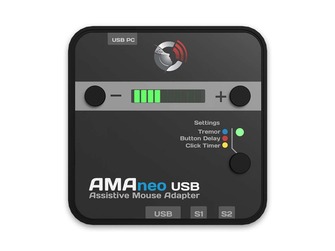
AMANeo USB Anti-Tremor Assistive Mouse
The AMAneo USB Anti-Tremor Assistive Mouse Adapter enables people with a hand tremor to use a computer mouse. It electronically filters the trembling of the hand so that the mouse pointer on the display moves smoothly. This device also has the ability to adjust for varying tremor intensities. External switches can be added to help with mouse clicks. A built-in auto-click (i.e., Dwell Click) feature alleviates the need to even click the button. Just hover the mouse pointer over what you want to open for a few seconds, the program or file automatically opens without having to click.
Please note: this product is not compatible with the iPad or iPhone. The AMAneo BTi is compatible with the iPhone or iPad.
Check out the AMAneo!
GYENNO Steady Spoon
GYENNO Steady Spoon
For those who have tremors that affect eating, the Gyenno Steady Spoon stabilizes the attached utensil and allows the person to worry less about spilling and focus more on enjoying the meal. In fact, the GYENNO Steady Spoon electronically stabilizes so that the attached utensil shakes 85% less than the hand.
GYENNO portable tableware includes two parts: a stabilizing handle and a utensil attachment. Switch it on and off automatically. Turn it to sleep mode automatically when a person stops using it. The device:
- Has an ergonomic design that can be used with either hand.
- Is lightweight and easy to hold, which prevents slipping.
- GYENNO is made of Tritan medical grade, antibacterial, silicone and is approved by the U.S. Food and Drug Administration FDA.
- Includes a spoon and fork in the kit.
Check out the GYENNO Spoon!
|
|
Adaptive Living Videos
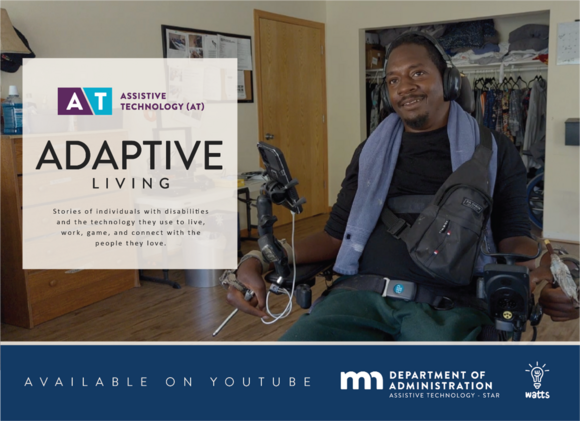 In our last issue, we announced our new Adaptive Living video series, featuring people with disabilities who use assistive technology (AT) daily. Our stars generously share their unique, real-life stories. Be sure to check out the Adaptive Living series on the STAR Program YouTube channel, with new videos premiering today!
|
|
Support for Parkinson’s Tremors
A woman with Parkinson’s reached out to our MN STAR team in hopes of finding assistive technology that would allow her to keep using her computer. The tremors she experienced with Parkinson’s were worsening and contributing to computer errors, making it nearly impossible to edit any typed text she produced. She also was unintentionally opening documents or programs with her mouse. She values using email to connect with family and friends and felt defeated in her ability to respond to email messages.
Together, we talked about her challenges with tremors and reviewed the assistive technology in our AT4All.com library that could address her needs. We also showed her a device that assists with eating, which was something that she hadn’t considered before. Armed with this information, she decided to try the Admouse and Clevy Keyboard with her computer, and the Gyenno Steady Spoon for use when eating.
After using the loaned devices for 45 days, she told us she was thrilled with her success! Now, she could navigate the mouse with better accuracy because the recessed buttons of the Admouse allowed her to rest her finger on the base before committing to a button she wanted to click. The Clevy Keyboard helped her prevent errors with typing, with larger keys and more surface area for her to select the right key. The Gyenno Steady Spoon smoothed out her tremors when eating so she was spilling less food and doing less laundry. Convinced the devices were making a positive difference, she worked with her support system to obtain her own devices and plans to use them for as long as she can.
She thanked the STAR Program for the services provided that assist people with disabilities in Minnesota and is grateful to live in a state that has this program.
|
|
There are several events and learning opportunities that may be of interest about assistive technology. More information about upcoming events is available from the links. All events are in Central Time unless otherwise indicated. If you want to hear more about future events, subscribe to our Upcoming Events list!
|
|
Parkinson's Awareness Month is dedicated to raising awareness about Parkinson's disease, a progressive neurological disorder that affects movement and to foster understanding and support those living with Parkinson's Disease. |
|
|
April 22 5-8 p.m.
Discovery Center
214 1st Ave. NE, Buffalo, MN
|
Disabilities Resource Fair: This free event provides resources and support to families of individuals with disabilities of ALL ages (birth to adulthood). All are welcome to attend, including those who do not live in the Buffalo-Hanover-Montrose School District. Sponsored by Autism Allies and the Special Services Department of BHM Schools. |
|
|
April 28 – 30
3-Day, in-person event
Madden’s on Gull Lake, Brainerd
|
Conference: Charting the Cs Main Conference 2025: To Literacy and Beyond is a state-wide professional development event featuring Minnesota practitioners who implement evidence-based practices, practical strategies, and innovative instruction to meet the unique needs of students with disabilities. Delve deep into the world of reading support for students with low-incidence disabilities 3-day, in-person event |
|
National AT Awareness Day - ATAP It commemorates the importance and vital role AT plays in the lives of people with disabilities and older adults. This day reinforces the necessary support and funding the federal government provides to ensure people receive the assistive technology necessary to engage in education, employment, and community living. Assistive technology allows individuals with disabilities and older adults to be included in their communities and in inclusive classrooms and workplaces and these devices are necessities, not luxury items. |
|
|
Various dates
Refer to website
|
Resource: Minnesota Department of Education has ongoing FREE information sessions about assistive technology (AT) products, services, resources and processes to support the selection, acquisition and use of AT for individuals. |
|
We have many device and educational videos. STAR posts videos often, so consider subscribing to our channel! Here are also two playlists on the channel:
|
|
|
|
|