First state scorecard on environmental sustainability
highlights state successes and improvement opportunities for waste, energy, and
water usage reduction
New Office of
Enterprise Sustainability report scores state’s progress in meeting 2027 sustainability
goals in fleet, energy, water, solid waste, procurement, and greenhouse gas
emissions
Saint Paul —Minnesota’s state agencies are making good progress towards
ambitious sustainability goals put in place last year by Governor Mark Dayton,
according to a newly-released report by the Department of Administration’s
Office of Enterprise Sustainability.
The 2017 Annual Sustainability
Report is the first collection of data that documents the progress
that Minnesota is making on cutting costs and increasing efficiency through
sustainable practices.
“This report demonstrates
that our smart, sustained commitment to conservation is paying off,” said Governor Mark Dayton. “Reducing waste,
increasing our reliance on renewable energy, and using less energy overall, is saving
money and contributing to the betterment of our environment. Still, there is
more work to do, and much more to gain, by building upon these improvements
across state government.”
Governor Dayton established six sustainability goals for
state agencies to meet or exceed by 2027:
-
15% reduction in water use,
-
30% reduction in vehicle fossil fuel
consumption,
- 30% reduction in energy intensity per square
foot,
- 30% reduction in greenhouse gas emissions
- 25% increase in sustainable purchasing, and
- 75% combined recycling and composting rate.
To prepare the report, state agencies gathered water and
energy data for more than 3,000 buildings, logged fuel consumption for 13,401
vehicles, and tallied 32 million pounds of recycling, organics, and trash to
establish agency level baselines. From those baselines, agencies measured
progress towards the 2027 goals.
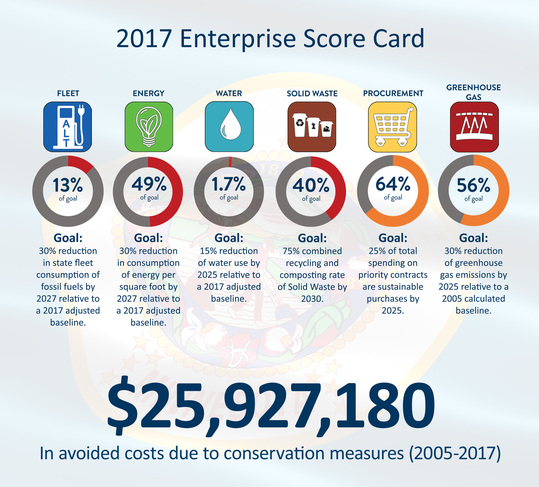
According to the report, Minnesota state
government is already more than halfway towards meeting its goals in reducing greenhouse gases and in
state purchasing, and is 49% towards the 2027 goal of cutting energy use by
30%.
“Coming out of the gate, that’s a great start,” said Minnesota
Department of Administration Commissioner
Matt Massman, “and the report shows where there are opportunities to improve. We’re
following best practices that have been used successfully in the private
sector. Our aim is to fully incorporate
sustainability into the way we work and do business.”
“Look at energy use.
As we are able to replace lighting and air handling systems in state buildings,
we’ll improve efficiency and save money. We are also greatly expanding the use
of solar arrays on building rooftops and other locations. This has a big effect
on cutting costs, especially during peak rate hours, and helps us reduce our
carbon footprint.”
Progress toward the 2017 goal for other areas included 1.7%
for water consumption, 13% for fuel reduction in vehicles, and 40% for solid
waste.
Larry Herke, Director of the Office of Enterprise
Sustainability at the Department of Administration said, “All these track well towards the
2027 sustainability goals, with the exception of water usage. Landscape
watering on many campuses accounts for a great deal of water use, sometimes due
to automated systems that apply water even after a recent rain. We need to
improve these systems so that we’re making more use of collected rainfall and
watering at proper amounts and intervals.”
Minnesota’s sustainability efforts are also getting a boost from a
newly deployed tool that allows state agencies to track their progress towards
meeting sustainability goals.
The Sustainability Reporting Tool (SRT), funded in part by a
$200,000 grant from the McKnight Foundation, is an online dashboard that lets
state agencies track progress toward improving vehicle and building energy
efficiency, reducing water use, maximizing
reuse and recycling, as well as track costs, implement work plans and increase employee
and public engagement around sustainability.
“The SRT is giving agencies and managers a one-glance look at their
progress, and insights on what they need to focus on,” said Herke. “We’re
excited about how this new tool will help agencies meet their sustainability
goals.”
“2017 was a year for setting baselines, strengthening
accountability and providing transparency concerning the impact of government
operations on the environment and society,” said Herke. “Now the real work begins. In
the coming year we’ll complete our action plans and focus on making
sustainability a core principle of how every state agency is managed.”
Additionally,
Minnesota recently became just the seventh state to U.S. Environmental
Protection Agency’s Green Power Partnership, a voluntary program that helps increase
green power use among U.S. organizations to advance the American market for
green power and development of those sources as a way to reduce air pollution
and other environmental impacts associated with electricity use. The Department
of Administration’s vehicle fleet was also reaccredited in September as a
Sustainable Fleet by the National Fleet Management Association.
The report can be viewed online at https://mn.gov/admin/assets/2018%20annual%20report_web_tcm36-355173.pdf
Office
of Enterprise Sustainability - In August of 2016, Admin created the Office of
Enterprise Sustainability (OES), modeled after similar initiatives in
Minnesota’s major companies, to partner with state agencies to reduce state
government’s carbon footprint, leverage industry expertise and best practices,
and increase accountability in sustainable operations. With the help of OES,
Admin plans to reduce greenhouse gas emissions 80% by 2050. Learn
more about OES: mn.gov/admin/government/sustainability
###
 For additional information, contact:
Assistant Commissioner Curt Yoakum at (651) 201-2771 or curtis.yoakum@state.mn.us
About the Minnesota
Department of Administration
The
Minnesota Department of Administration (Admin) provides best value
administrative services to Minnesota's state agencies and other governmental
organizations, as well as various other services to diverse audiences across
the state. The department was established in 1939 by Governor Harold Stassen as
part of an effort to reform state government’s administrative functions. Today,
the department strives to meet that mission and continues to act as a leader in
government administration and operations. With $176.5 million in annual
operating costs and 475 full-time employees, Admin oversees $2.1 billion in
state purchases, maintains 4.4 million square feet of owned space and leases an
additional 3.6 million square feet of space for over 100 state agencies, boards
and councils. The agency also insures $12 billion in property and 13,400
vehicles, and manages over 400 building projects and $166 million in capital
appropriations.
|




