Volume 34, Issue 4, Fall 2026

As we welcome the fall season, I want to take a moment to recognize the employers, workers and safety and health professionals across Michigan who continue to make workplace safety and health a priority. Every day, their efforts help prevent injuries and illnesses and ensure that workers return home safely to their families.
At MIOSHA, our mission remains clear: to help assure the safety and health of Michigan workers. We accomplish this through our enforcement efforts, education and outreach and partnerships with employers and labor organizations. Each of which plays an important role in preventing workplace injuries, illnesses and fatalities.
This summer, MIOSHA continued its longstanding commitment to helping employers identify and address workplace hazards through our annual Take a Stand for Workplace Safety and Health event. For more than 20 years, this initiative has provided employers with an opportunity to work directly with MIOSHA safety and health professionals in a voluntary, penalty-free setting. This year, 208 employers participated, demonstrating a continued commitment to identifying hazards, strengthening safety practices and protecting their employees.
We also continue to build partnerships that extend our reach and strengthen workplace safety across Michigan. By working collaboratively with employers, labor organizations, industry associations and other stakeholders, we can share knowledge, promote effective safety practices and address emerging hazards before they result in serious injuries or fatalities.
Preventing workplace fatalities remains a critical priority. We are continuing our efforts to raise awareness of hazards that can result in workers being struck by objects or vehicles, caught in equipment or struck against objects. These incidents reinforce the importance of situational awareness, effective hazard recognition, and appropriate safeguards. Through initiatives such as our Contact Fatalities State Emphasis Program, we are working to encourage employers and workers to recognize these hazards and take action to prevent tragedies.
As we look ahead, I encourage every employer and worker to take time this fall to review workplace safety and health programs, identify potential hazards and reinforce safe work practices. Effective safety programs should be shared, communicated and continually improved. A strong safety culture depends on everyone understanding their role and taking responsibility for protecting themselves and those around them.
Together, we can continue making meaningful progress toward preventing workplace injuries, illnesses and fatalities. Thank you for your commitment to workplace safety and health.
|
 |
By Michael Maddux, Workplace Safety Representative, General Industry Safety and Health Division
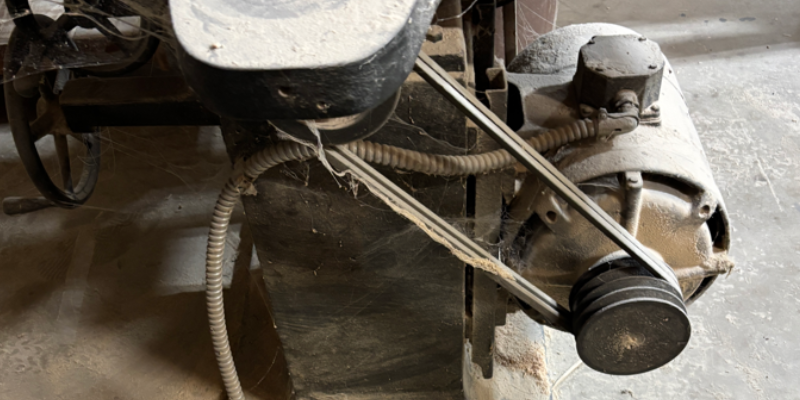 Unguarded belt and pulley on a table saw observed during the inspection.
Wood Product Manufacturing (North American Industry Classification System code 321) is one of 10 high-hazard industries targeted by MIOSHA in its 2024–2028 strategic plan for reductions in injury and illness rates.
Employees in this sector can be exposed to a wide range of safety and health hazards from manufacturing processes that include sawing, planing, shaping, laminating and assembling wood products starting from logs that are cut into bolts or lumber that then may be further cut or shaped by lathes or other shaping tools. The wood products manufacturing subsector ranks as the tenth largest high-hazard industry in Michigan, with approximately 560 employers and 9,900 workers, accounting for about 1.6% of the state's manufacturing jobs.
In October 2025, MIOSHA conducted a comprehensive safety inspection at a randomly selected facility that manufactures wood trusses. The employer had 10 employees at the time of the inspection.
The inspection resulted in 13 citations, including nine serious and four other-than-serious citations, involving multiple MIOSHA standards. Several violations were identified on more than one piece of equipment or grouped into a single citation.
The violations included:
Act 154. Michigan Occupational Safety and Health Act, Act 154 of 1974
-
Section 11(a): There was no dead-end stop device on an overhead hoist.
General Industry Standard Part 7, Guards for Power Transmission
-
Rule 408.10727(1): There were unguarded belts and pulleys on various pieces of equipment.
General Industry Standard Part 12, Welding and Cutting
-
Rule 408.11222(1): Oxygen cylinders were stored together with acetylene cylinders.
-
Rule 408.11222(5): The names of the individual gases stocked and a warning against tampering by unauthorized employees were not posted.
-
Rule 408.11223(1): Acetylene and oxygen compressed gas cylinders were not restrained.
General Industry Standard Part 21, Powered Industrial Trucks
-
Rule 408.12152(1): Training was not provided to employees who operated powered industrial trucks.
-
Rule 408.12153(1): Testing was not completed for employees who operated powered industrial trucks.
-
Rule 408.12154(1): Permits were not provided to employees who operated powered industrial trucks.
General Industry Standard Part 27, Woodworking Machinery
-
Rule 408.12723: A spreader was not utilized while rip cutting lumber on a circular table saw.
-
Rule 408.12724: Non-kickback fingers or dogs were not utilized while employees rip cut lumber on a circular table saw.
General Industry Standard Part 33, Personal Protective Equipment
-
Rule 408.13370(1): Head protection was not required to be worn by employees lifting objects over five feet with overhead hoists.
-
Rule 408.13312(1): Eye protection was not required to be worn by employees operating a radial arm saw.
-
Rule 408.13308(3): There was no written certification that a hazard assessment was performed.
General Industry Standard Part 39, Design Safety Standards for Electrical Systems
-
Paragraph 1910.305(b)(1)(ii): There was a missing breaker in an electrical cabinet.
-
Paragraph 1910.305(b)(2)(i): There was a missing faceplate for an electrical outlet.
General Industry Standard Part 49, Slings
-
Rule 408.14912(1): Daily pre-use inspections were not performed on alloy steel chain slings being utilized on overhead hoists.
-
Rule 408.14921: There was no permanently affixed, durable identification, stating the size, grade, rated capacity and reach on the alloy steel slings used at the facility.
-
Rule 408.14923(1): A thorough inspection was not performed at least annually on the alloy steel chain slings being utilized at the facility.
General Industry Standard Part 75, Flammable Liquids
-
Paragraph 1910.106(d)(5)(ii): Diesel fuel was not stored in a safety can.
General Industry Standard Part 85, The Control of Hazardous Energy Sources
-
Paragraph 1910.147(c)(1): There were no documented machine-specific procedures, and the control of hazardous energy was not being utilized. In addition, training pertaining to the control of hazardous energy was not provided to authorized and affected employees. Periodic inspections were not performed for each piece of equipment that authorized tasks are performed on and each authorized employee. Verification of energy isolation was not performed prior to performing authorized tasks on equipment.
General Industry Standard Part 92, Hazard Communication
-
Paragraph 1910.1200(e)(1): There was no written hazard communication program and training was not provided to employees as to the hazards related to the chemicals that they are exposed to in the workplace, locating safety data sheets and the new label elements and safety data sheet format changes. Additionally, there was no list of hazardous chemicals that were utilized at the facility and safety data sheets were not available for chemicals that were used.
Resources for Employers
MIOSHA offers resources to help employers address workplace hazards:
MIOSHA's Consultation Education and Training (CET) Division provides onsite consultation, hazard surveys, and training at little to no cost to employers. For free safety and health consultative assistance complete an online request for assistance at Michigan.gov/cetrca.
By John Bott, Construction Safety Supervisor, Construction Safety and Health Division
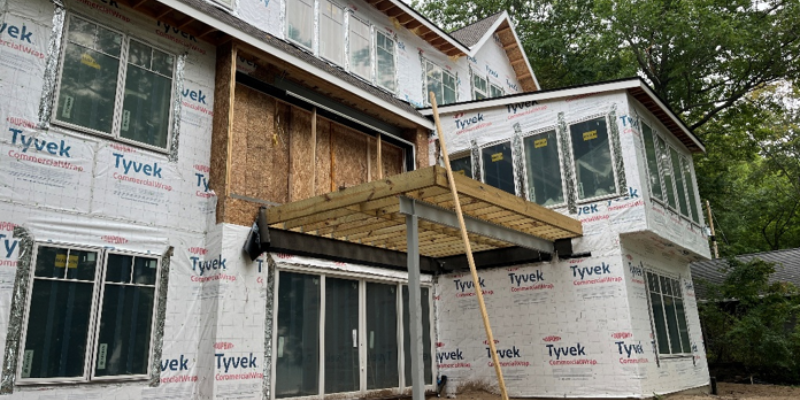 MIOSHA investigated this residential construction site in Bridgman after a worker fell while installing a new roof on Sept. 22, 2025. The worker later died from the injuries.
A contractor was ordered to pay $28,000 in penalties following a fatal fall at a residential construction site in Bridgman.
On Sept. 22, 2025, workers were installing a new roof on a residential property while exposed to a fall of approximately 30 feet without using fall protection. One worker fell and died from their injuries the following day.
Employer Non-Compliance
A MIOSHA safety officer arrived at the work site on Sept. 24, 2025, to conduct an opening conference for the incident and initiated an inspection with the contractor.
During the inspection, MIOSHA found that fall protection equipment was available at the site but was not being used.
Citations and Penalties
MIOSHA issued one serious citation and one repeat serious citation, totaling $28,000 in penalties for violations of the following standards:
Construction Standard Part 45, Fall Protection
-
Rule 1926.501(b)(13): There was a lack of residential fall protection.
Construction Standard Part 1, General Rules
-
Rule 408.40132(3): No person with valid first aid training was on site.
At the conclusion of the inspection, the employer acknowledged that fall protection should have been utilized and would have prevented the incident.
To find additional information related to residential construction hazards, visit our Residential Construction webpage.
How the Safety Pyramid Helped Cintas Midland Become Michigan’s
First MVPP STAR Industrial Laundry
By Todd Mengeu, General Manager, Cintas Midland Facility
 When our Cintas Midland facility earned Michigan Voluntary Protection Program (MVPP) Star status as the first industrial laundry in Michigan, it wasn't the result of a single initiative or one major accomplishment. It was the outcome of thousands of small actions taken every day by partners committed to protecting one another and creating a safer workplace. At Cintas, our employees are known as “partners,” reflecting a culture of shared responsibility, teamwork and commitment to protecting one another.
The Safety Pyramid is built on a simple but powerful principle: serious injuries rarely occur without warning signs. At the base of the pyramid above it shows Unsafe Behaviors but we train one level below that focuses on Upset Conditions. As we believe Upset Conditions are where all injuries start. By identifying and correcting these opportunities early, organizations can prevent incidents before injuries occur.
Our partners understand this concept well. As service supervisor Bob Wolschon explains, “Because when you take care of the small things, the big things will take care of themselves.” Many partners share the belief that minor concerns can quickly develop into significant hazards when left unaddressed. This prevention-focused mindset has become a cornerstone of our safety culture. One of the key reasons our MVPP journey has been successful is that safety is not owned by one department or one group of leaders. At our Midland Cintas location, safety belongs to everyone.
From production and service to administration and leadership, partners are encouraged to identify hazards, raise concerns and help implement solutions before someone gets hurt. Utility Partner Nick Yarmuth describes it best: “Everyone is involved in safety here, not just leadership. Every position and every role.” This level of engagement creates an environment where safety conversations happen naturally every day. Safety is not reserved for meetings, audits or inspections. It is woven into the way we work.
Near miss reporting is one of the strongest tools supporting that culture. Every near miss provides an opportunity to learn, improve and prevent future incidents. By openly discussing these events, partners help strengthen awareness and reinforce safe behaviors across the facility. As Wash Alley Partner Alex Tacey shared, “If it is talked about, it can be prevented and help teach others.” This willingness to communicate openly about potential hazards allows lessons learned by one partner to benefit everyone.
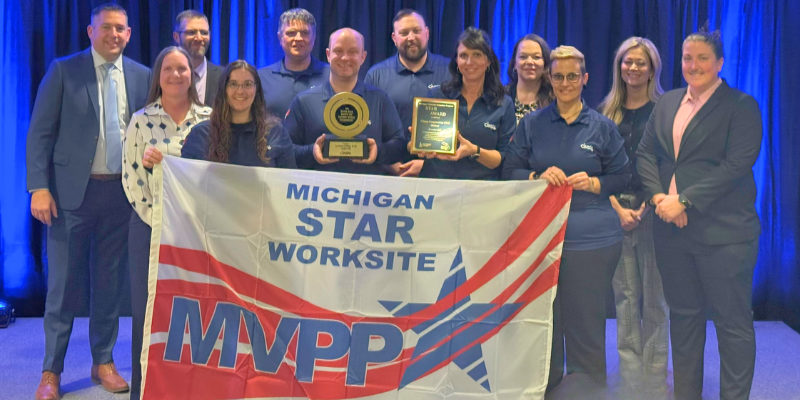 Cintas Midland employees and MIOSHA representatives celebrate the facility’s designation as Michigan’s first MVPP STAR industrial laundry.
While MVPP Star status is an achievement our partners are extremely proud of, the designation represents much more than an award. It reflects the daily commitment our team makes to protect one another and continually improve workplace safety. Harold Smith described that feeling by saying, “It makes me feel proud to work here because it is so rare. It makes me feel safe. Other people around me are looking out for my safety.”
Maintaining MVPP Star status requires the same dedication that helped us achieve it. Identifying upset conditions, reporting near misses, participating in Safety Improvement Committee activities, engaging partners and having the courage to speak up when something is not right continue to remain essential to our success. Intern Ava Orlando summarized the importance of this approach: “The small things add up to serious injuries when they are gone unchecked.” That statement captures the essence of the Safety Pyramid. When organizations focus on addressing risks at the base of the pyramid, they reduce the likelihood of injuries at the top. More importantly, they create a culture where every employee understands that safety is a shared responsibility.
At our facility, safety is not simply a program or a set of procedures. It is part of who we are. By focusing on the small things, encouraging open communication and empowering every partner to take ownership of safety, we continue to strengthen our culture and ensure that every partner has the opportunity to return home safely at the end of every shift. When the foundation is strong, everyone benefits. That is the power of the Safety Pyramid, and it is the reason our safety culture continues to thrive.
Join the Ranks of Michigan’s MVPP Star Sites
MIOSHA established the MVPP in 1996 to recognize employers with exemplary safety and health management systems that go beyond state requirements. The program is open to Michigan employers with injury and illness rates below the industry average for the past three years.
To earn MVPP Star status, companies complete a rigorous application process that includes a comprehensive safety and health program review, on-site evaluations and employee interviews to verify that MIOSHA’s criteria are met. MVPP participation reflects a strong commitment to continuous improvement, employee involvement and proactive hazard prevention.
Learn more about MVPP and how to apply at Michigan.gov/MVPP.
|
By Mike Krafcik, MIOSHA Communications Specialist
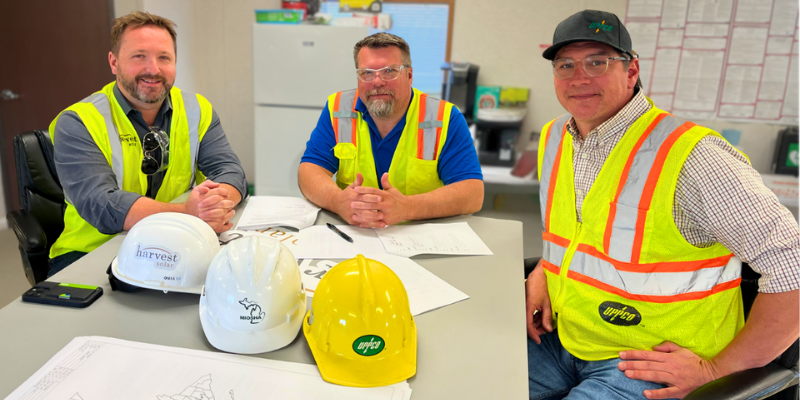 MIOSHA and Solar Harvest representatives gather for the Aug. 6, 2026, partnership signing.
MIOSHA has entered into a construction partnership with Harvest Solar, participating employers and labor representatives to promote worker safety and health during construction of the Republic Solar Project in Marquette County.
Through the partnership, MIOSHA, Harvest Solar and participating employers and labor representatives will work together to identify and address workplace hazards, share safety and health best practices and provide training and outreach throughout construction of the project. The partnership emphasizes proactive hazard prevention and open communication to help protect workers on the job site.
The 89-megawatt solar energy facility in Republic Township and is scheduled for completion in 2028.
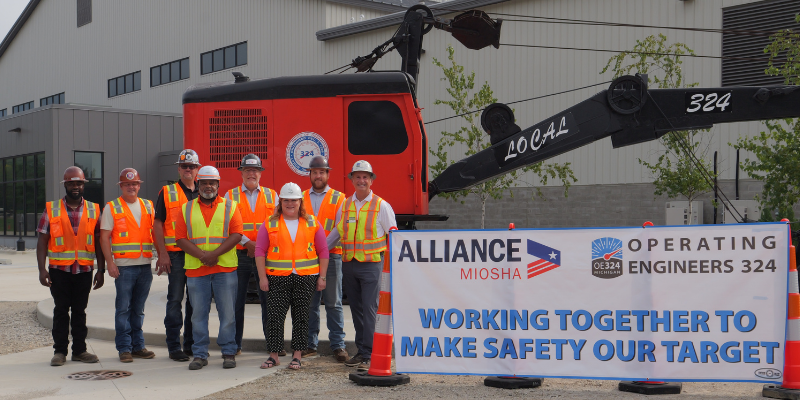 MIOSHA and Operating Engineers 324 representatives mark the renewal of their workplace safety and health alliance on Aug. 12, 2026.
MIOSHA and OE 324 have worked together through the alliance since 2014 to promote safe work practices, provide training and increase awareness of workplace hazards. The renewed agreement continues that collaboration and the organizations’ shared commitment to protecting Michigan workers.
Associated General Contactors of Michigan: Alliance Renewal
MIOSHA and the Associated General Contractors of Michigan (AGC Michigan) renewed their workplace safety and health alliance on Aug. 19, 2026.
The renewed alliance continues the organizations’ collaborative efforts to promote workplace safety and health throughout Michigan’s construction industry. Through training, outreach and the sharing of safety resources, MIOSHA and AGC Michigan work together to help employers and workers recognize and prevent workplace hazards.
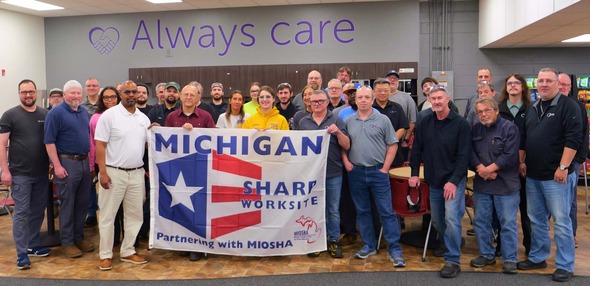 Norgren Automation Solutions LLC employees and MIOSHA representatives celebrate the company’s MSHARP recognition in Saline on June 22, 2026.
Norgren Automation Solutions LLC in Saline was recognized as a Michigan Safety and Health Achievement Recognition Program (MSHARP) worksite during a ceremony June 22, 2026.
MSHARP recognizes small employers that operate exemplary workplace safety and health programs. Participating employers work cooperatively with MIOSHA’s Consultation Education and Training Division to identify and correct workplace hazards and establish systems designed to prevent injuries and illnesses.
The recognition reflects Norgren’s ongoing commitment to workplace safety and employee involvement.
TSS Inc. Earns MIOSHA CET Silver Award
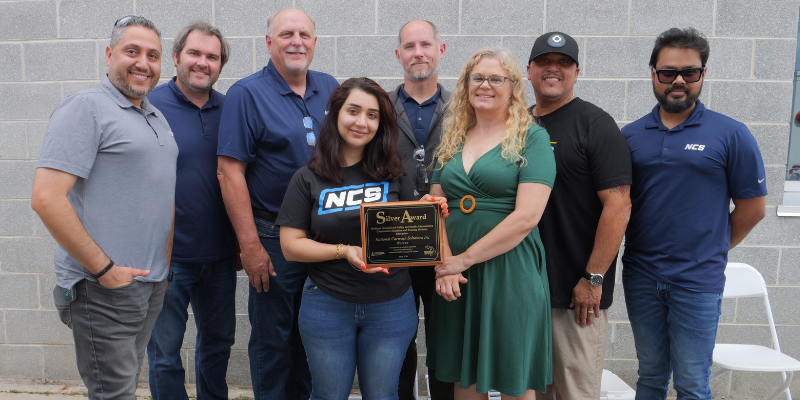 TSS Inc. employees celebrate the company’s CET Silver Award during a July 30, 2026 ceremony in Warren.
TSS Inc., a National Carwash Solutions Company in Warren, received a MIOSHA CET Silver Award on July 30.
The company recorded zero workplace injuries or illnesses in 2024 and 2025, with employees working a combined 291,460 hours without a recordable incident. TSS also completed a MIOSHA CET hazard survey and corrected all identified serious hazards.
The Silver Award recognizes employers that work with MIOSHA to strengthen workplace safety and health programs and maintain injury and illness rates below industry averages.
 MIOSHA encourages employers to prioritize workplace safety with the message “Educate Before We Regulate.” Resources are available at Michigan.gov/CET.
Quick Links
Agency/Division Instructions
Air Contaminants Initiative
Asbestos Program
CET Request for Consultative Assistance Services (RCA)
CET Training Calendar
Construction Safety and Health Division (CSHD)
Video Streaming Service
Employee Safety, Health, and Discrimination Complaint Forms
Fall Prevention Campaign (STOP FALLS. SAVE LIVES.)
General Industry Safety and Health Division (GISHD)
Hazard Communication/GHS
Laboratory and Equipment Services
Michigan Alliances
Michigan Safety and Health Achievement Recognition Program (MSHARP)
Michigan Voluntary Protection Program (MVPP)
MIOSHA FOIA Request
MIOSHA News
MIOSHA Publications
MIOSHA Recordkeeping
MIOSHA Standards
MIOSHA Training Institute (MTI)
MIOSHA Updates
MIOSHA Variances
Radiation Safety Section
Residential Construction
Strategic Plan and Initiatives
Telephone, Mailing and Email Addresses
|