Volume 34, Issue 3, Summer 2026

Summer brings longer days, busy schedules, seasonal projects and well-earned vacations. But it can also bring changing workplace hazards.
Research from the Bureau of Labor Statistics has shown that more nonfatal workplace injuries involving lost work time occur during the summer months than at other times of the year.
While there is no single explanation for this trend, it is a good reminder for employers and workers to reassess hazards as temperatures rise, schedules shift and seasonal work increases.
Heat is one of the most visible summer risks. MIOSHA’s Heat State Emphasis Program encourages employers to evaluate conditions at their worksites and take steps to reduce heat-related hazards. Employers can also use MIOSHA’s Sample Heat Illness Prevention Plan to help address water, shade or cooling areas, heat tolerance, emergency response and worker training.
Summer can also affect workplace routines. Vacation schedules, temporary workers, longer hours and busy jobsites can all create opportunities for hazards to be missed. A quick safety conversation before work begins can help identify what is different that day and what controls are needed.
As we move through the summer months, MIOSHA encourages employers and workers to stay alert, communicate clearly and take time to recognize changing hazards.
For heat illness prevention resources, visit Michigan.gov/heat. To learn more about MIOSHA’s free consultative assistance, visit Michigan.gov/CET.
|
 |
By Eric Seedorf, Workplace Safety Representative, General Industry Safety and Health Division
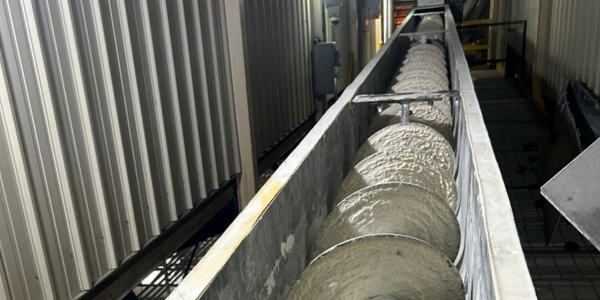 The auger conveyor system employees were attempting to clear at the time of the incident.
An employee suffered a hand amputation after an auger conveyor unexpectedly energized during maintenance activities at a food manufacturing facility in March 2025. MIOSHA’s investigation identified multiple failures involving the employer’s lockout/tagout program, employee training, hazardous energy control procedures and supervisory oversight.
The case resulted in one serious citation and eight willful-serious citations, totaling $357,700 in proposed penalties. Based on the inspection findings, the employer was also placed in MIOSHA’s Severe Violator Enforcement Program (SVEP), which focuses enforcement attention on employers that have demonstrated indifference to their obligations under the MIOSH Act.
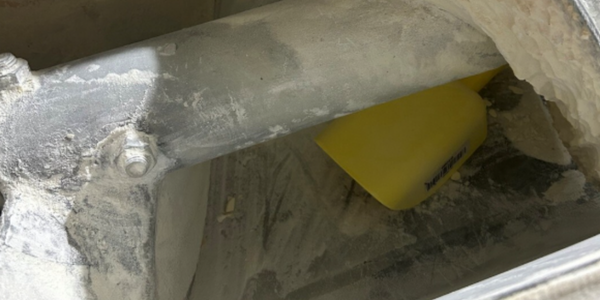 Employees used a yellow hand scoop to remove the clogged product from the auger conveyor system.
The incident occurred while four employees were manually clearing accumulated product material from a clogged auger conveyor. Employees removed guarding from the conveyor and placed their hands and arms inside the confines of the equipment to manually remove material from inside the conveyor trough. During the task, the conveyor restarted while employees' appendages were inside the equipment. One employee’s left arm became caught in the rotating auger, resulting in the amputation of the employee’s left hand and a portion of their forearm.
The investigation determined employees had locked out the incorrect electrical disconnect associated with an adjacent conveyor. Employees also failed to verify that hazardous energy had been isolated before beginning work. Additionally, required group lockout procedures were not followed because employees participating in the servicing activity did not individually apply personal lockout devices. The investigation also revealed deficiencies in employees' understanding of lockout/tagout procedures, including energy isolation, verification of de-energization and group lockout requirements.
Citations and Penalties
On April 8, 2026, MIOSHA issued one serious citation and eight willful serious citations totaling $357,700. The employer appealed the citations and the case remains open. A summary of the citations is listed below with some citations grouped into single citations.
General Industry Standard Part 85, The Control of Hazardous Energy Sources (Lockout/Tagout)
- Rule 1910.147(c)(5)(i): Locks, tags or other hardware were not properly provided or utilized for isolating, securing and blocking equipment from energy sources while employees performed servicing activities on the auger conveyor system. $7,000
- Rule 1910.147(c)(6)(i): Periodic inspections of energy control procedures were not conducted or documented to ensure employees understood and followed their responsibilities under the employer’s lockout/tagout program. $70,000
- Rule 1910.147(c)(7)(i): Authorized employees did not receive effective training regarding hazardous energy control procedures, energy isolation methods, verification procedures, and group lockout requirements. $70,000
- Rule 1910.147(d)(1): Authorized employees did not have the knowledge or understanding of the type and magnitude of hazardous energy associated with the auger conveyor system prior to performing servicing activities. Grouped
- Rule 1910.147(d)(2): The auger conveyor system was not shut down using established procedures before employees began servicing activities. $70,000
- Rule 1910.147(d)(3): Energy-isolating devices were not properly located and operated to isolate the auger conveyor system from hazardous energy sources prior to employees performing servicing work. Grouped
- Rule 1910.147(d)(4)(i): Employees participating in a group lockout activity did not individually apply personal lockout devices while servicing the auger conveyor system. Grouped
- Rule 1910.147(d)(6): Employees failed to verify that hazardous energy had been isolated and the auger conveyor system was in a zero-energy state before beginning servicing activities. $70,000
- Rule 1910.147(f)(3)(ii)(D): Employees participating in a group lockout activity did not attach personal lockout devices to the group lock box controlling the hazardous energy source. $70,000
Severe Violator Enforcement Program
The employer has a history of safety and health violations. Prior to this inspection, 22 inspections were conducted between 2020 and 2025. Those inspections resulted in 60 citations, with total initial penalties of $441,400. Of the 60 citations, 30 were classified as serious, 12 as repeat-serious, two as willful, 14 as other-than-serious and two as repeat-other.
Based on the inspection findings, the employer was placed in MIOSHA’s Severe Violator Enforcement Program due to the issuance of at least two willful citations based on high-gravity serious violations.
SVEP cases include mandatory follow-up inspections and, where appropriate, communication of findings to the corporate level and enhanced settlement agreement provisions. These provisions may include requirements such as hiring a qualified safety and health consultant, developing or improving safety and health management systems, and implementing additional measures to address hazards across related worksites.
This case demonstrates the importance of effective hazardous energy control procedures. Employers must ensure equipment is properly shut down, locked out and verified as de-energized before employees perform servicing or maintenance activities. Training, supervision and employee understanding of lockout/tagout procedures are also critical to preventing serious injuries and fatalities.
By Jeremy Hildago, Safety and Health Supervisor, Construction Safety and Health Division
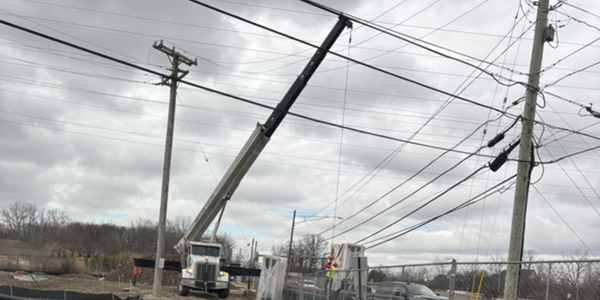 A crane operating near energized overhead power lines during a commercial construction project. MIOSHA cited the employer for failing to maintain required clearance distances from energized electrical lines and ensure workers received required training before crane operations began.
During a programmed inspection at a commercial construction site in March, a MIOSHA construction safety officer observed a crane's load line operating dangerously close to energized overhead power lines.
During the inspection, the foreman, who was also operating the crane, acknowledged that the power lines were energized. The crew was installing a new sign in the area.
The inspection found that the employer failed to determine the minimum approach distance required for crane operations near energized power lines, as required by Construction Standard Part 10, Cranes and Derricks. In addition, employees working within the minimum approach distance had not received the required electrical hazard training. MIOSHA also observed employees working beneath suspended loads without hard hats, contrary to Construction Standard Part 6, Personal Protective Equipment.
As a result, MIOSHA issued multiple serious citations related to the hazardous work operation.
Citations and Penalties
MIOSHA issued three serious citations totaling $1,100 in penalties. In May, the employer entered into a Penalty Reduction Agreement (PRA) with MIOSHA and paid $550 in penalties. The employer provided suitable abatement for all cited hazards.
Violations involved:
Construction Standard Part 6, Personal Protective Equipment
-
Rule 1926.100(a): Employees working in areas where there is a possible danger of head injury from impact, or from falling or flying objects, or from electrical shock and burns, shall be protected by protective helmets. $400
Construction Standard Part 10, Cranes and Derricks
-
Rule 1926.1408(a): Hazard assessments and precautions inside the work zone. Before beginning equipment operations, the employer must: $700
(1) Identify the work zone by either:
(1)(i) Demarcating boundaries (such as with flags, or a device such as a range limit device or range control warning device) and prohibiting the operator from operating the equipment past those boundaries, or
(1)(ii) Defining the work zone as the area 360 degrees around the equipment, up to the equipment's maximum working radius.
(2) Determine if any part of the equipment, load line or load (including rigging and lifting accessories), if operated up to the equipment's maximum working radius in the work zone, could get closer than 20 feet to a power line. If so, the employer must meet the requirements in Option (1), Option (2), or Option (3) of this section, as follows:
(2)(i) Option (1) --Deenergize and ground. Confirm from the utility owner/operator that the power line has been deenergized and visibly grounded at the worksite.
(2)(ii) Option (2) --20 foot clearance. Ensure that no part of the equipment, load line, or load (including rigging and lifting accessories), gets closer than 20 feet to the power line by implementing the measures specified in paragraph (b) of this section.
(2)(iii) Option (3) --Table A clearance.
(2)(iii)(A) Determine the line's voltage and the minimum approach distance permitted under Table A (see § 1926.1408).
(2)(iii)(B) Determine if any part of the equipment, load line or load (including rigging and lifting accessories), while operating up to the equipment's maximum working radius in the work zone, could get closer than the minimum approach distance of the power line permitted under Table A (see § 1926.1408). If so, then the employer must follow the requirements in paragraph (b) of this section to ensure that no part of the equipment, load line, or load (including rigging and lifting accessories), gets closer to the line than the minimum approach distance.
-
Rule: 1926.1408 Training (g)(1): The employer must train each operator and crew member assigned to work with the equipment on all of the following:
(i) The procedures to be followed in the event of electrical contact with a power line. Such training must include:
(i)(A) Information regarding the danger of electrocution from the operator simultaneously touching the equipment and the ground.
(i)(B) The importance to the operator's safety of remaining inside the cab except where there is an imminent danger of fire, explosion, or other emergency that necessitates leaving the cab.
(i)(C) The safest means of evacuating from equipment that may be energized.
(i)(D) The danger of the potentially energized zone around the equipment (step potential).
(i)(E) The need for crew in the area to avoid approaching or touching the equipment and the load.(i)(F) Safe clearance distance from power lines.
(ii) Power lines are presumed to be energized unless the utility owner/operator confirms that the power line has been and continues to be deenergized and visibly grounded at the worksite.
(iii) Power lines are presumed to be uninsulated unless the utility owner/operator or a registered engineer who is a qualified person with respect to electrical power transmission and distribution confirms that a line is insulated.
(iv) The limitations of an insulating link/device, proximity alarm, and range control (and similar) device, if used.
(v) The procedures to be followed to properly ground equipment and the limitations of grounding.
Working near energized power lines remains one of the most serious hazards in construction. Employers must ensure required clearances are maintained, employees receive appropriate training and all necessary protective equipment is worn before crane, or other operations begin.
MIOSHA's Consultation Education and Training (CET) Division provides free onsite consultations, hazard surveys and training services to help employers identify and correct workplace hazards. To request assistance, visit Michigan.gov/CET or call 517-284-7720. Employers can also access safety and health courses through the MIOSHA Training Institute (MTI).
By Nathan Raby, General Manager, Cintas Westland Facility
 Cintas has been utilizing a near-miss reporting practice for years at our Cleanroom facility in Westland. The program met all compliance standards; however, our leadership team saw the potential to make this program more impactful for our employee partners. These are the steps we took to elevate our near miss reporting to the next level.
Knowing that the active engagement of every partner was essential to making this initiative a success, we started with communication. We held rollout meetings to review what constitutes a near miss and share our plans to enhance the current program. We outlined the process change with a focus on the benefits of near-miss reporting.
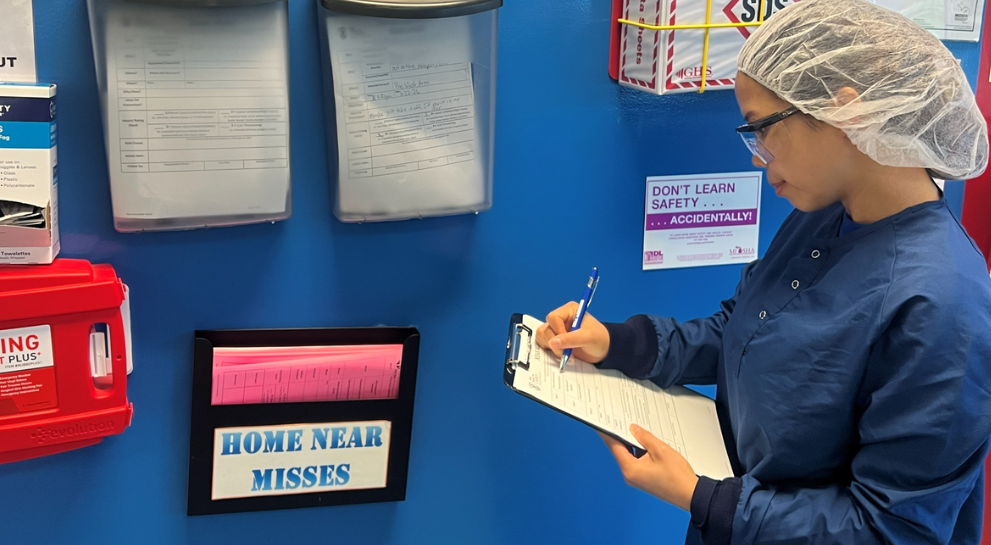 Cintas Westland uses a near-miss reporting board to help employees identify and address hazards before injuries occur.
Next, we implemented the program changes. We knew that providing a quick response was key to ensuring our employee partners felt heard and understood that their feedback was critical to our safety program. Therefore, we began collecting completed near-miss forms from the submission box multiple times per day, with the manager or supervisor collecting the forms immediately following up on the submission. We also began scanning and emailing the completed forms to our entire leadership team.
While we empower our employee partners to act or find a supervisor to resolve any near-miss concern, our responsibility is to trust but verify that no hazard exists and that all steps have been taken to remove the risk of injury, harm, illness or property damage.
This increased sense of urgency drove a surge in near-miss submissions. Now that we had positive momentum, we set out to identify trends and root causes. To accomplish this, we started tracking our near-miss submissions in greater detail. We now track total submissions, impacted areas, incident categories, severity level and date.
Our Safety Improvement Committee is composed of frontline employee partners and location leadership. We meet monthly to proactively manage our safety program. We review the near-miss reporting from the previous month and implement targeted strategies to address or eliminate unsafe practices or identified hazards.
For example, our production area uses many rolling carts, which can sometimes be moved into areas where they block fire extinguishers or emergency exits. We identified an opportunity to improve organization by establishing designated cart storage areas. To support this effort, we appointed Safety Champions on first and second shift to walk the plant floor daily looking for blocked exits or fire extinguishers. These champions work with their supervisors to correct issues and log monthly feedback. Each month, the Safety Improvement Committee reviews this feedback along with near-miss submissions to evaluate effectiveness and adjust our approach as needed.
Finally, all the information is shared with our entire team. Meeting minutes from our Safety Improvement Committee are posted at our safety center. Near-miss reporting trends are posted for all employee partners to review.
The results are outstanding. Our near miss program submissions have increased. Our employee partners are more engaged in our safety culture, and our proactive approach to incident prevention is keeping us all safe.
Join the ranks of Michigan’s MVPP Star sites
MIOSHA established the MVPP in 1996 to recognize employers with exemplary safety and health management systems that go beyond state requirements. The program is open to Michigan employers with injury and illness rates below the industry average for the past three years.
To earn MVPP Star status, companies complete a rigorous application process that includes a comprehensive safety and health program review, on-site evaluations and employee interviews to verify that MIOSHA’s criteria are met. MVPP participation reflects a strong commitment to continuous improvement, employee involvement and proactive hazard prevention.
Learn more about MVPP and how to apply at Michigan.gov/MVPP.
|
By Mike Krafcik, MIOSHA Communications Specialist
MIOSHA recently recognized several Michigan employers for their continued commitment to workplace safety and health, including a new Michigan Voluntary Protection Program (MVPP) Star site, a Michigan Safety and Health Achievement Recognition Program (MSHARP) site and a Consultation Education and Training (CET) Gold Award recipient.
Marathon Petroleum Romulus MI LP Terminal Joins Elite Group of MIOSHA MVPP Star sites
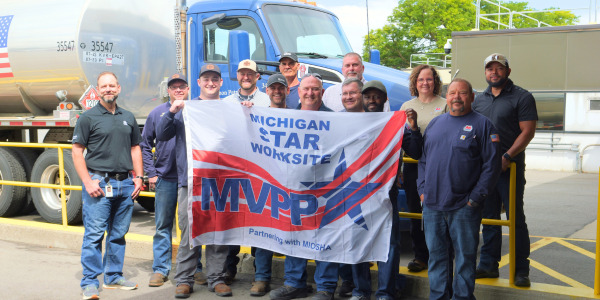 Employees at Marathon Petroleum's Romulus LP Terminal celebrate the facility's designation as an MVPP Star site.
MIOSHA recently recognized Marathon Petroleum's Romulus MI LP Terminal with Michigan Voluntary Protection Program (MVPP) Star status — the agency's highest designation for workplace safety and health.
The recognition marks Marathon’s sixth MVPP Star worksite in Michigan, giving the company the most MVPP Star sites statewide. Only 29 worksites across the state currently hold MVPP Star status, reflecting the program’s rigorous standards and Marathon’s continued commitment to workplace safety and health.
The Romulus terminal, located in metro Detroit, earned MVPP Star recognition for its strong safety culture and commitment to continuous improvement. The 27.5-acre facility receives, stores and distributes gasoline, diesel fuel and ethanol products. During MIOSHA’s onsite evaluation, employees demonstrated strong involvement in the site’s safety and health management system, including participation in hazard identification, safety meetings and employee-led safety initiatives.
MIOSHA identified several areas of excellence, including the facility’s A.W.A.R.E. (Analyzing Ways Around Risky Environments) employee-led safety program, its “Big 3” hazard assessment tool and its valve line-up procedures used to ensure safe product movement throughout the terminal. The facility reported zero recordable injuries and illnesses from 2022 through 2025.
Norgren Automation Solutions LLC — Saline
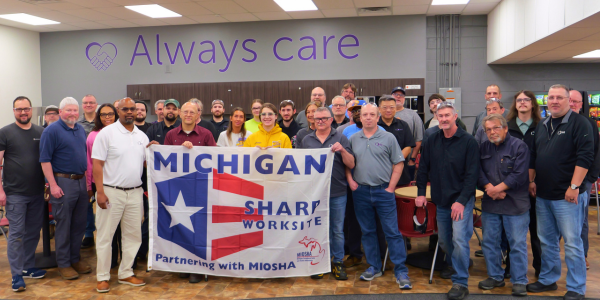 Employees at Norgren Automation Solutions LLC in Saline celebrate the facility's achievement of MSHARP status.
MIOSHA recently recognized Norgren Automation Solutions LLC (IMI Industrial Automation) in Saline for achieving Michigan Safety and Health Achievement Recognition Program (MSHARP) status.
This recognition marks the company's second MSHARP-certified facility in Michigan, joining its Rochester Hills location, which earned MSHARP status in December 2025. MSHARP recognizes employers that develop and maintain exemplary workplace safety and health management systems through strong leadership commitment, employee involvement and continuous improvement.
Avient Colorants USA, LLC Earns CET Gold Award
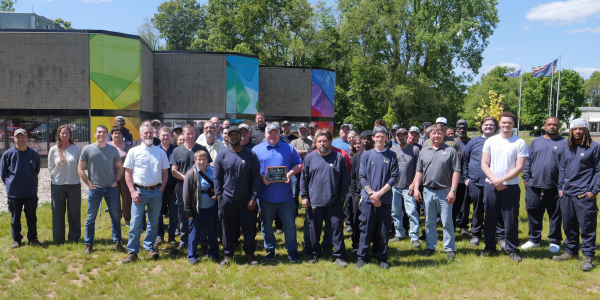 Avient Colorants in Albion was recognized for earning MIOSHA’s CET Gold award.
Avient Colorants USA, LLC in Albion was recently recognized with the MIOSHA CET Gold Award for its commitment to workplace safety and health.
The CET Gold Award recognizes employers that demonstrate a strong commitment to developing and maintaining effective safety and health management systems. Participating employers work proactively to identify and correct hazards, involve employees in safety efforts and continuously improve workplace safety and health performance.
Avient is a global manufacturer of advanced composites, specialty polymers, color and additive systems and thermoplastic and polymer compounds that enhance the performance, appearance and sustainability of customer products. The company's Albion facility produces material solutions used across a variety of industries.
Wagner-Meinert LLC Recertified as MSHARP Participant
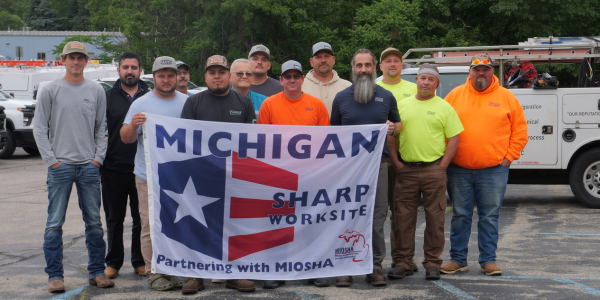 Wagner-Meinert LLC employees celebrate the company’s MSHARP recertification.
MIOSHA recertified Wagner-Meinert LLC as a Michigan Safety and Health Achievement Recognition Program (MSHARP) participant in April, marking the company’s third MSHARP certification. The company provides services in refrigeration, food process, aquaponics, mechanical, HVAC contracting, industrial and building automation.
The recognition reflects the company’s continued commitment to maintaining an effective workplace safety and health management system through leadership commitment, employee involvement and continuous improvement.
MSHARP is designed to assist small employers and is limited to companies with fewer than 250 employees at the worksite and fewer than 500 employees companywide. Participating employers work with MIOSHA’s CET Division to identify hazards, strengthen safety and health programs, and maintain injury and illness rates below industry averages.
Learn how your workplace can participate at Michigan.gov/MSHARP.
 MIOSHA encourages employers to prioritize workplace safety with the message “Educate Before We Regulate.” Resources are available at Michigan.gov/CET.
Quick Links
Agency/Division Instructions/Memorandums
Air Contaminants Initiative
Asbestos Program
CET Request for Consultative Assistance Services (RCA)
CET Training Calendar
Construction Safety and Health Division (CSHD)
DVD/Video Library Service
Employee Safety, Health, and Discrimination Complaint Forms
Fall Prevention Campaign (STOP FALLS. SAVE LIVES.)
General Industry Safety and Health Division (GISHD)
Hazard Communication/GHS
Laboratory and Equipment Services
Michigan Alliances
Michigan Safety and Health Achievement Recognition Program (MSHARP)
Michigan Voluntary Protection Program (MVPP)
MIOSHA FOIA Request
MIOSHA News
MIOSHA Publications
MIOSHA Recordkeeping
MIOSHA Standards
MIOSHA Training Institute (MTI)
MIOSHA Updates
MIOSHA Variances
Radiation Safety Section
Residential Construction
Strategic Plan and Initiatives
Telephone, Mailing and Email Addresses
|