Volume 34, Issue 2, Spring 2026

As spring arrives in Michigan, it marks the start of a busy season for many of the industries we serve. Construction projects ramp up, agricultural work resumes and outdoor operations expand across the state. With this increased activity comes increased risk, making it more important than ever to focus on workplace safety and health.
Seasonal transitions often bring changing conditions that can introduce new hazards. From excavation and trenching work to heat exposure and heavy equipment operation, employers and workers must remain vigilant in identifying and addressing risks before they lead to injury or illness. Planning ahead, evaluating jobsite conditions and reinforcing safe work practices are critical steps in protecting Michigan’s workforce.
At MIOSHA, our approach remains rooted in our mission: to help protect the safety and health of Michigan workers. Central to that mission is our commitment to “Educate Before We Regulate.” We believe the best way to prevent workplace injuries is by working alongside employers to build strong safety and health programs that proactively address hazards.
Our Consultation Education and Training Division continues to offer free, confidential services to help employers identify risks and implement effective solutions. Through training opportunities offered by the MIOSHA Training Institute, as well as partnerships and alliances across industries, we are equipping employers and workers with the tools and knowledge they need to succeed.
We encourage employers to take advantage of these resources, especially as they prepare for the demands of the spring and summer months. Whether it’s reviewing safety procedures, conducting refresher training or requesting a consultation visit, proactive steps taken today can prevent incidents tomorrow.
Workplace safety and health is a shared responsibility. By working together and maintaining a strong focus on education, we can continue to make meaningful progress in reducing injuries and illnesses across Michigan.
Thank you for your continued commitment to protecting Michigan workers.
|
 |
By Matthew Macomber, Industrial Hygiene Specialist, General Industry Safety and Health Division
Workplace violence remains one of the most serious safety and health hazards in healthcare settings — but targeted efforts in Michigan are making a measurable difference.
Healthcare workers face elevated risks due to factors such as working directly with patients who may have a history of violence, experience delirium or are under the influence of drugs or alcohol. According to federal OSHA, the rate of serious workplace violence incidents in healthcare has historically been more than four times higher than in private industry overall, with many incidents believed to go unreported. The risk is especially high at state-run psychiatric hospitals across the United States.
At one state psychiatric hospital in Michigan, recent improvements have led to a significant reduction in workplace violence-related injuries. In 2025, the facility reported 85 recordable cases, a 30% decrease from 120 cases in 2023. Lost workdays dropped from 4,745 to 3,568 — a 25% reduction — while days involving restricted duty fell from 183 to just six, a 97% decrease.
These improvements were achieved through a collaborative effort between MIOSHA and the Michigan Department of Health and Human Services (MDHHS). The facility implemented a range of measures to reduce workplace violence risks, including enhanced employee training, updated therapy and treatment protocols and investments in environmental controls.
New policies also require the use of personal protective equipment in situations where staff work in close proximity to patients who may exhibit aggressive or violent behavior. Together, these efforts have strengthened both worker protection and patient care.
While progress is clear, the data underscores the continued risk facing healthcare workers. For comparison, the general industry total case incidence rate is 2.7 cases per 100 workers per year, with a days away, restricted or transferred rate of 1.5. In state hospitals, those rates rise to 7.4 and 4.2, respectively. At one Michigan state hospital, a six-month rolling average showed a days away, restricted or transferred rate as high as 28.9, with a range from 17.2 to 41.4.
Recent data shows continued improvement. From January 2024 through December 2025, the facility’s days away, restricted or transferred rate declined to 20 overall, with patient-related cases at 18.2. While these rates remain elevated, the downward trend reflects meaningful progress.
The financial impact of these improvements is also significant. The average hourly cost for a residential care aide, including wages and benefits, is $45.10. When accounting for replacement staffing, that cost doubles to $90.20 per hour or more if overtime is required. Reducing 1,177 lost workdays translates to an estimated $849,323 in avoided costs — resources that can be reinvested into training, treatment and equipment.
Workplace safety and health improvements are not only critical for protecting workers, but also for strengthening operations and care delivery. These efforts demonstrate that effective safety and health programs are both a moral responsibility and a sound investment.
There is still work to be done. Healthcare remains one of the most hazardous industries, particularly in environments where workplace violence risks are present. However, these results show that progress is possible through collaboration, commitment and a focus on prevention.
By Rob Kimble, Senior Safety Officer, Construction Safety and Health Division
In December 2025, the MIOSHA Construction Safety and Health Division (CSHD) responded to an employer-reported referral involving an injured employee at a residential worksite in Marquette. One worker fell while stepping from a ladder onto an icy rooftop during fascia and soffit installation.
The worker fell approximately 9 feet onto the guardrail of the decking below and then to the deck, resulting in a total fall distance of about 11 feet. The fall resulted in a broken vertebra and required hospitalization.
During the inspection, MIOSHA determined the employer’s Accident Prevention Program (APP) did not include instruction for ladder use or weather-related hazards. Additionally, the worker had not been trained on proper ladder usage by a competent person, and the ladder was used at an unsafe pitch.
The employer also did not have a fall protection training program in place. While some fall protection equipment was available, the anchorage point the employer planned to use may not have been capable of supporting 5,000 pounds. The worker was not tied off at the time of the fall.
Residential construction safety measures are often overlooked but are no less hazardous. Although icy weather conditions contributed to the incident, proper training, hazard recognition, fall protection measures, and correct ladder pitch may have prevented the fall.
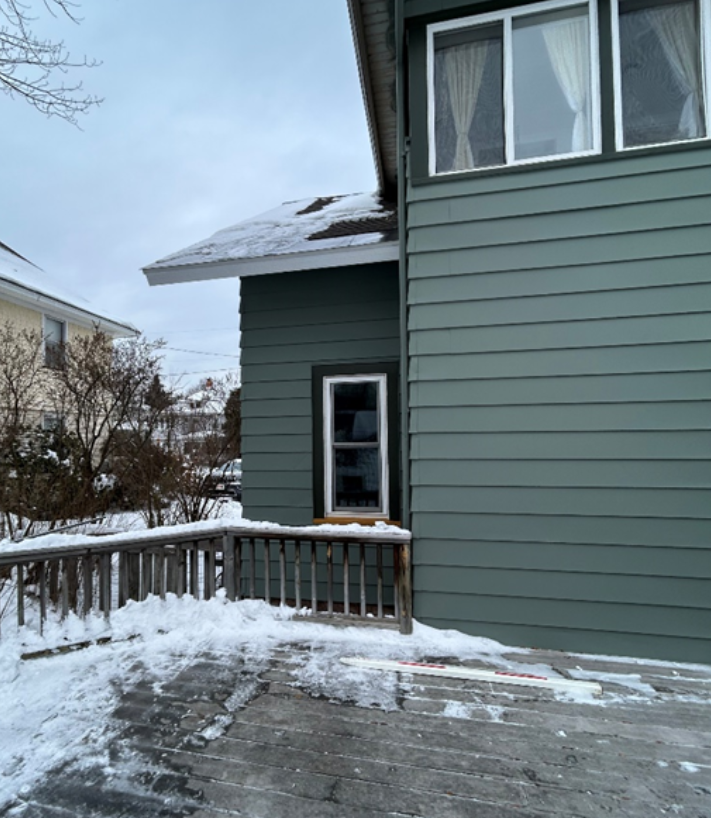 Jobsite where employee fell and sustained injury.
Citations and Penalties
MIOSHA issued the employer six serious citations totaling $18,800 in penalties.
Construction Standard Part 1, General Rules
- Rule 408.40114(2): An accident prevention program shall, at a minimum, provide for all of the following:
- Instruction to each employee regarding the operating procedures, hazards and safeguards of tools and equipment when necessary to perform the job.
- Inspections of the construction site, tools, materials and equipment to assure that unsafe conditions which could create a hazard are eliminated.
- Instruction to each employee in the recognition and avoidance of hazards and the regulations applicable to his or her work environment to control or eliminate any hazards or other exposure to illness or injury.
- Instruction to each employee who is required to handle or use known poisons, toxic materials, caustics and other harmful substances regarding all of the following:
- The potential hazards
- Safe handling
- Use
- Personal hygiene
- Protective measures
- Applicable first aid procedures to be used in the event of injury
- Instruction to each employee if known harmful plants, reptiles, animals, or insects are present regarding all of the following:
- (i) The potential hazards
- (ii) How to avoid injury
- (iii) Applicable first aid procedures to be used in the event of injury
Construction Standard Part 11, Fixed and Portable Ladders
- Rule 408.41112(2): An employer shall ensure that each employee has been trained by a competent person in all of the following areas, as applicable:
- The nature of fall hazards in the work area.
- The correct procedures for erecting, maintaining and disassembling the fall protection systems to be used.
- The proper construction, use, and placement of, and care in handling, ladders.
- The maximum intended load-carrying capacities of ladders that are used.
- The rules contained in this part.
- Rule 408.41124(1): A portable ladder must be used at such a pitch that the horizontal projected distance from the top support to the base is not more than 1/4 of the vertical distance between these points.
Construction Standard Part 45, Fall Protection
- Rule 1926.501(b)(13): Each employee engaged in residential construction activities 6 feet (1.8 m) or more above lower levels shall be protected by guardrail systems, safety net system or personal fall arrest system unless another provision in paragraph (b) of this section provides for an alternative fall protection measure. Exception: When the employer can demonstrate that it is infeasible or creates a greater hazard to use these systems, the employer shall develop and implement a fall protection plan which meets the requirements of paragraph (k) of 1926.502.
- Rule 1926.502(d)(15): Anchorages used for attachment of personal fall arrest equipment shall be independent of any anchorage being used to support or suspend platforms and capable of supporting at least 5,000 pounds (22.2 kN) per employee attached, or shall be designed, installed, and used as follows:(i) As part of a complete personal fall arrest system which maintains a safety factor of at least two; and (ii) Under the supervision of a qualified person.
- Rule 1926.503(a)(1): The employer shall provide a training program for each employee who might be exposed to fall hazards. The program shall enable each employee to recognize the hazards of falling and shall train each employee in the procedures to be followed in order to minimize these hazards
The employer entered into a Penalty Reduction Agreement (PRA) with MIOSHA and paid $9,400.00 in penalties.
MIOSHA’s Consultation Education and Training Division offers free, confidential on-site consultations, hazard surveys and training to help employers identify hazards and strengthen workplace safety and health programs. Employers can request assistance online at Michigan.gov/CET.
By Mike Krafcik, MIOSHA Communications Specialist
MIOSHA recently recognized two Cintas Corporation facilities with Michigan Voluntary Protection Program Star status — the agency’s highest designation for workplace safety and health.
Cintas — Midland
MIOSHA recently recognized Cintas Corporation facility #346 in Midland with Michigan Voluntary Protection Program (MVPP) Star status — the agency’s highest designation for workplace safety and health.
Cintas Corporation #346 in Midland earned MVPP Star recognition for its strong safety culture and outstanding performance. The facility, which employs 98 workers, processes, launders and delivers garments across Michigan. During MIOSHA’s onsite evaluation, employees demonstrated a clear understanding of hazard identification, near-miss reporting and corrective action processes. The site reported zero recordable injuries in 2025 and maintains a strong focus on ergonomics, fleet safety, heat stress and machinery safety.
Read the full press release from the Cintas Midland MVPP Star recognition.
|
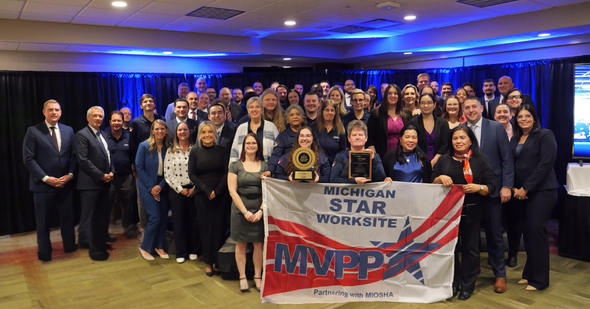 Employees at the Midland Cintas facility celebrate the company’s designation as a MVPP Star Site
Cintas — Westland
Cintas Corporation’s K15 facility in Westland also earned MVPP Star recognition. The site employs 95 workers and supports pharmaceutical and biotechnology customers through garment processing and distribution. MIOSHA observed strong employee engagement and leadership commitment, with safety and health integrated into daily operations. Recent improvements include ergonomic redesigns, enhanced heat controls, improved walking-working surfaces and strengthened job hazard analyses and training.
“MVPP represents the highest level of recognition for workplace safety and health in Michigan,” said MIOSHA CET Division On-Site Safety and Health Program Manager Kristin Osterkamp, “This program is about building a culture where safety is part of everyday operations and employees are actively engaged in protecting themselves and their coworkers.”
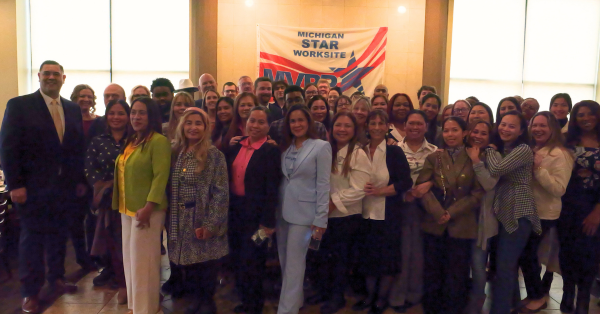 Employees at Westland Cintas facility celebrate the company’s designation as a MVPP Star Site
IDIDIT LLC
MIOSHA recently recognized IDIDIT LLC, located in Tecumseh, for achieving Michigan Safety and Health Achievement Recognition Program (MSHARP) status.
This recognition reflects a strong partnership between employees, management and MIOSHA to build an effective workplace safety and health program that goes beyond basic compliance.
The company demonstrated a proactive approach to hazard identification, including conducting job safety analyses before introducing new equipment and implementing a ventilated booth with a water-wash filtration system to control employee exposure during belt polishing operations.
|
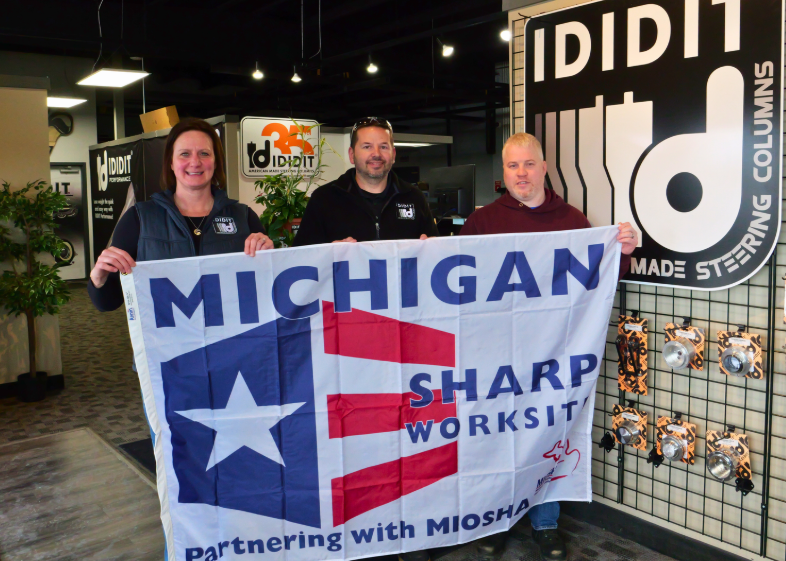 IDIDIT LLC in Tecumsh was recognized for achieving Michigan SHARP status through MIOSHA.
RK Davis, Inc. — Grand Ledge Water Treatment Plant Improvements Project
MIOSHA recently entered into a partnership with RK Davis, Inc. for the Grand Ledge Water Treatment Plant Improvements Project. The partnership, signed March 5, brings together MIOSHA, RK Davis, Inc., partnering employers and unions to enhance worker safety and health throughout the construction project.
The partnership emphasizes proactive hazard identification, safety training, coordination among contractors and a shared commitment to zero injuries. Project goals include strengthening communication, promoting near-miss reporting, reinforcing safe work practices and ensuring all workers return home safely each day.
Through collaboration and continuous monitoring, the partnership aims to reduce workplace hazards, improve safety performance and demonstrate leadership in construction safety and health.
Interested in a MIOSHA Partnership?
These voluntary agreements bring together employers, unions and MIOSHA to proactively identify hazards and improve worker safety. Learn more at Michigan.gov/mioshapartnerships.
|
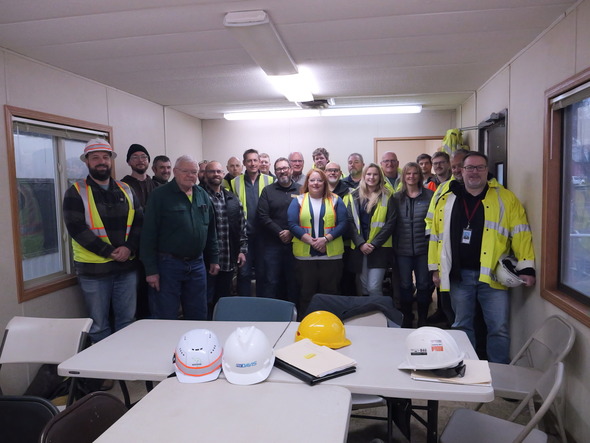 Project partners join MIOSHA to mark the construction partnership for the Grand Ledge Water Treatment Plant Improvements Project.
 MIOSHA encourages employers to prioritize workplace safety with the message “Educate Before We Regulate.” Resources are available at Michigan.gov/cet.
Quick Links
Agency/Division Instructions/Memorandums
Air Contaminants Initiative
Asbestos Program
CET Request for Consultative Assistance Services (RCA)
CET Training Calendar
Construction Safety and Health Division (CSHD)
DVD/Video Library Service
Employee Safety, Health, and Discrimination Complaint Forms
Fall Prevention Campaign (STOP FALLS. SAVE LIVES.)
General Industry Safety and Health Division (GISHD)
Hazard Communication/GHS
Laboratory and Equipment Services
Michigan Alliances
Michigan Safety and Health Achievement Recognition Program (MSHARP)
Michigan Voluntary Protection Program (MVPP)
MIOSHA FOIA Request
MIOSHA News
MIOSHA Publications
MIOSHA Recordkeeping
MIOSHA Standards
MIOSHA Training Institute (MTI)
MIOSHA Updates
MIOSHA Variances
Radiation Safety Section
Residential Construction
Strategic Plan and Initiatives
Telephone, Mailing and Email Addresses
|