Volume 34, Issue 1, Winter 2026

The start of a new year is a natural time for employers to take a fresh look at their workplace safety and health program. Even programs that are well-established benefit from an annual review to make sure they reflect current operations, hazards and workforce needs.
A good place to begin is by reviewing your injury and illness records from the past year. OSHA logs and internal incident reports can help identify patterns, recurring hazards or tasks that may need additional controls or training. Employers should look beyond compliance and ask how this information can be used to prevent future injuries and illnesses.
January is also a smart time to review written policies and procedures. Changes in staffing, equipment, processes or materials may mean existing policies need updates. Make sure hazard communication programs, emergency procedures and personal protective equipment requirements accurately reflect current conditions in the workplace.
Training is another key component to revisit at the start of the year. New hires, job changes and refresher training for existing employees should all be part of an annual plan. Supervisors play a critical role in reinforcing expectations and identifying hazards early, so ensuring they are trained and engaged is especially important.
Employee involvement is often what separates a program that looks good on paper from one that works in practice. Employers should encourage workers to report hazards, participate in safety discussions and share ideas for improvement. When employees see their input taken seriously, safety and health become part of the workplace culture rather than a checklist item.
Employers do not have to tackle this process alone. MIOSHA’s Consultation Education and Training Division services are available to help employers review programs, identify hazards and strengthen their overall approach to workplace safety and health. These confidential services are separate from enforcement and focus on education, prevention and practical solutions.
Taking time early in the year to assess and strengthen your safety and health program can help reduce injuries and illnesses, improve employee morale and set a positive tone for the months ahead
|
 |
By Emily McPhail, Workplace Safety Supervisor, General Industry Safety and Health Division
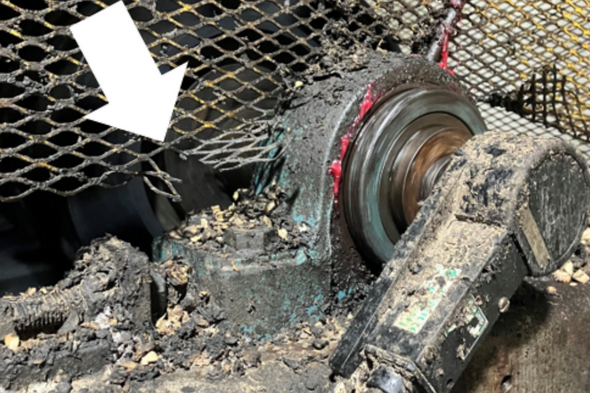 Inadequate guarding exposed employees to conveyor nip points and sharp edges, creating a caught-in hazard.
In March 2024, MIOSHA conducted two inspections at a food manufacturing facility that processes sugar beets into refined sugar and employs approximately 200 workers. The inspections identified a combined total of 29 violations that exposed employees to serious safety and health hazards.
The first inspection was initiated in response to a reported burn injury. The second was a comprehensive, wall-to-wall inspection conducted as part of MIOSHA’s reinspection program for workplaces with a history of significant violations.
Citations and Penalties
Together, the inspections resulted in 15 serious violations, seven repeat serious violations, six other-than-serious violations and one repeat other-than-serious violation. Several violations were grouped into single citations.
Act 154. Michigan Occupational Safety and Health Act, Act 154 of 1974
- Section 11(a): Employees allowed the wire rope of an underhung monorail crane to contact a structural I-beam while lifting an approximately 2,000-pound load. The contact caused the rope to sever, resulting in the load falling.
- Section 14j(a): The facility’s Right-to-Know poster did not identify the location of safety data sheets or the individual responsible for providing them.
Administrative Standard Part 11, Recording and Reporting of Occupational Injuries and Illnesses
- Rule 408.22141(1): The employer did not electronically submit the 2023 MIOSHA Form 300A to OSHA’s Injury Tracking Application by the March 2, 2024, deadline.
General Industry Standard Part 1, General Provisions
- Rule 408.10034(2): The guard on a conveyor was bent, exposing employees to the sharp edges of the guard.
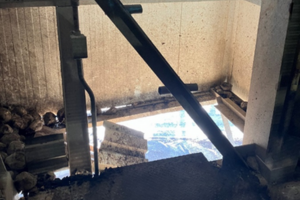 Unguarded openings in the third-floor walking-working surface exposed employees to fall hazards.
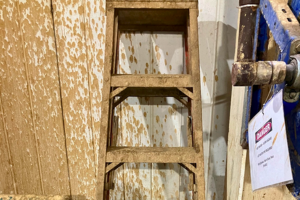 Mud-coated ladder steps reduced the effectiveness of skid-resistant surfaces.
General Industry Standard Part 2, Walking-Working Surfaces
- Rule 1910.22(a)(2): The floor was not maintained in a clean and dry condition resulting in an employee slipping and falling in heated standard liquor that had accumulated on the floor and receiving second- and third-degree burns to their feet.
- Rule 1910.22(a)(3): The walking-working surface was not maintained free of hazards including protruding and loose floor drain grates, missing concrete, and accumulation of standard liquor.
- Rule 1910.23(c)(1): The steps of a portable metal ladder were coated with mud, thus reducing the effectiveness of the skid-resistant surface of the ladder steps.
- Rule 1910.28(b)(2)(ii): Employees on a platform were not protected from falling four feet or more to a lower level by a guardrail system while pulling a load onto the platform floor from an underhung monorail crane.
- Rule 1910.28(b)(3)(i): Unguarded holes in the walking-working surface on the third floor of the building exposed employees to a fall hazard.
- Rule 1910.28(b)(3)(iv): At the top of fixed ladders, there were no self-closing gates or offsets on the adjacent landing to prevent falls.
- Rule 1910.28(b)(6)(ii): Employees performing maintenance on top of dangerous equipment were not protected from falling approximately seven feet to a lower level.
General Industry Standard Part 7, Guards for Power Transmission
- Rule 408.10731(1): Employees were exposed to unguarded chains and sprockets.
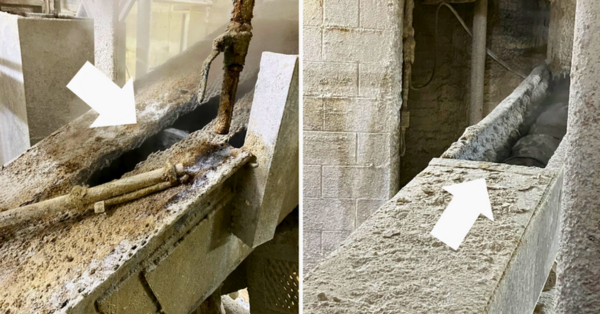 Openings in the guarding system of an auger conveyor exposed employees to rotating shafts and entanglement hazards.
General Industry Standard Part 14, Conveyors
- Rule 408.11421(4): Employees were exposed to the hazards of being caught or trapped between an operating conveyor and stationary equipment due to inadequate guarding.
- Rule 408.11441: There were multiple openings in the guarding system of the auger conveyor exposing employees to the entanglement hazard of the rotating shaft of an auger conveyor.
- Rule 408.11442(2): There were exposed nip points on multiple conveyors.
General Industry Standard Part 20, Underhung Cranes and Monorail Systems
- Rule 408.12012(1): The rated capacity was not marked on the underhung monorail crane.
- Rule 408.12015(2): The pendant for the underhung monorail crane did not have a positive stop device to disconnect all motors on the crane.
- Rule 408.12023: Prior to operating the crane, crane operators were not tested in their knowledge and ability to operate the underhung monorail crane.
- Rule 408.12034(1): There was no warning device on the underhung monorail crane to warn employees of crane activation and movement.
- Rule 408.12042(1): Monthly to quarterly inspections and yearly inspections for the underhung monorail crane were not documented.
General Industry Standard Part 33, Personal Protective Equipment
- Rule 408.13395a(14): The fall protection worn by employees and tied off to a guardrail system was not capable of supporting at least 5,000 pounds.
General Industry Standard Part 39, Design Safety Standards for Electrical Systems
- Rule 1910.305(g)(1)(iv): Flexible cords were used as permanent wirings in multiple areas.
General Industry Standard Part 49, Slings
- Rule 408.14965(1): A sling used to lift a 2,000-pound container was discolored, had tears, and was covered with mud.
General Industry Standard Part 85, The Control of Hazardous Energy Sources
- Rule 1910.303(b)(1): Two 460-volt electrical cabinets were left open without having a standard barrier to surround the perimeter to create awareness of the electrical hazard.
- Rule 1910.147(c)(5)(i): Locks, tags, or other hardware were not provided to employees for isolating, securing, and blocking of equipment from energy sources while they performed service and maintenance tasks on that equipment.
- Rule 1910.147(c)(7)(i)(A): Lockout training did not include the proper application of locks by each individual in a group lockout effort.
- Rule 1910.147(f)(3)(ii)(D): During a group lockout activity, each authorized employee did not affix a separate, personal lockout device to a group lock box.
General Industry Standard Part 90, Permit-Required Confined Spaces
- Rule 1910.146(f): There were multiple paperwork deficiencies on various permit-required confined space entry permits.
- Rule 1910.146(g)(1): Employees did not have the understanding, knowledge, and skills necessary for the safe performance of the duties assigned while working in permit-required confined spaces.
Why Food Manufacturing is a High-Hazard Industry
Food manufacturing (North American Industry Classification System code 311) is one of 10 high-hazard industries targeted in MIOSHA’s 2024–2028 strategic plan to reduce workplace injury and illness rates. Employees in this sector may be exposed to a wide range of hazards, including machinery, conveyors, electrical systems, confined spaces and hazardous energy sources.
Manufacturing remains a critical component of Michigan’s economy. While the state is widely recognized for automotive manufacturing, Michigan also has a strong food manufacturing presence. The food manufacturing subsector includes approximately 1,750 establishments and employs an estimated 42,500 workers statewide.
At the conclusion of the inspection, the employer acknowledged that utilizing fall protection could have prevented the worker from falling and sustaining injuries.
Resources for Employers
MIOSHA’s Consultation Education and Training Division offers free, confidential on-site consultations, hazard surveys and training to help employers identify hazards and strengthen workplace safety and health programs. Employers can request assistance online at Michigan.gov/CET.
By Scott Thelen, Industrial Hygiene Supervisor, Construction Safety and Health Division
In January 2025, MIOSHA responded to a report involving two employees injured at a worksite in Almont in Lapeer County. Both employees were exposed to elevated levels of carbon monoxide resulting in one employee’s death and the hospitalization of the second employee for several days. The surviving employee may have sustained long-term neurological damage.
While the dangers of carbon monoxide overexposure are well documented, investigations into workplace fatalities often uncover contributing factors that are not immediately apparent. In this case, the investigation revealed several critical details that were not widely known.
During the inspection, MIOSHA determined the employees were operating a propane-powered floor grinder with an attached vacuum collection system to prepare a concrete floor for the application of a decorative or protective surface. Both the grinder and the vacuum were powered by internal combustion engines fueled by propane.
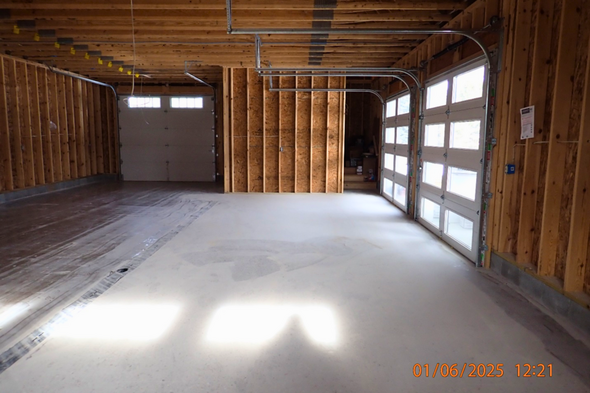 Work area inside a pole barn where floor polishing was underway.
Propane is commonly used as a fuel source, but not all propane-powered engines operate the same way. Some engines are designed to use vapor propane, while others require liquid propane. This investigation found that the employees inadvertently connected liquid propane tanks to equipment designed for vapor propane use.
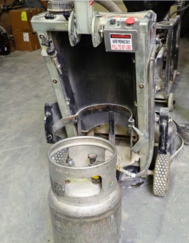
The floor grinder was labeled “Vapor Only,” but the vacuum had no labeling to indicate the required fuel type. Externally, liquid and vapor propane tanks appear nearly identical. The primary differences are internal and not visible without close inspection. Although the location of the connection port can indicate whether a tank supplies vapor or liquid propane, the valve fittings are the same for both types. Unlike gasoline and diesel fuel systems, there are no physical safeguards to prevent the wrong propane tank from being connected.
The only reliable way to distinguish between vapor and liquid propane tanks is by checking the stamped markings on the top of the tank.
Interviews with employees and a review of manufacturer documentation showed that, when supplied with the incorrect fuel, the grinder and vacuum would operate, but inefficiently. This improper operation resulted in incomplete combustion and significantly higher emissions than anticipated by the manufacturer.
As a result, the deceased employee was exposed to carbon monoxide at an estimated eight-hour time-weighted average of 717 parts per million (ppm). The surviving employee was exposed to 193 ppm as an eight-hour time-weighted average. The deceased employee also experienced a peak exposure of 1,435 ppm, exceeding the National Institute for Occupational Safety and Health’s immediately dangerous to life or health (IDLH) limit of 1,200 ppm.
Following the incident, MIOSHA conducted testing at the exhaust of the vacuum system and measured carbon monoxide levels of 64,300 ppm.
For reference, MIOSHA Construction Standard Part 601, Air Contaminants for Construction, establishes an eight-hour maximum allowable concentration of 50 ppm for carbon monoxide. MIOSHA Construction Standard Part 301, Air Containments for General Industry, sets an eight-hour time-weighted average limit of 35 ppm. Employers should be aware that applicable exposure limits depend on the specific work activity and the standards that apply to their worksite.
This investigation underscores the importance of a comprehensive safety and health management system that fully evaluates all workplace hazards. Although the employer had a written hazard communication program and an accident prevention program, neither adequately addressed the hazards associated with propane-powered equipment used indoors.
Employees were not trained on carbon monoxide monitoring, ventilation requirements or warning devices associated with the grinder and vacuum systems, despite this information being included in the manufacturer operator manuals. Employees were also unaware that a cut-off device with a warning light on the equipment was an emissions sensor, not a carbon monoxide monitor, as some had assumed.
Citations and Penalties
MIOSHA issued four serious citations totaling $28,000 in penalties.
General Duty Citation, Act 154, Michigan Occupational Safety and Health Act
- Rule 408.1011(a): An employer shall furnish to each employee, employment and a place of employment that is free from recognized hazards that are causing, or are likely to cause, death or serious physical harm to the employee. Employees were exposed to carbon monoxide levels exceeding both ceiling limits and IDLH thresholds. Corrective measures may include providing calibrated carbon monoxide monitoring equipment, establishing ventilation procedures for indoor use of propane-powered equipment, and providing recurring training on carbon monoxide hazards and prevention. $7,000 (Serious)
Construction Standard Part 601, Air Contaminants for Construction
- Rule 325.60153(1): Employees were exposed to carbon monoxide concentrations exceeding the maximum allowable concentration. $7,000 (Serious)
Construction Standard Part 42, Hazard Communication
- Rule 1910.1200(h)(1): Employees were not provided effective training on hazardous chemicals present in the work area. $7,000 (Serious)
Construction Standard Part 1, General Rules
- Rule 408.40114(1): The employer’s accident prevention program did not adequately address hazards, safeguards and safe operating procedures associated with the equipment in use. $7,000 (Serious)
The MIOSHA Consultation Education and Training (CET) Division provides onsite consultation, hazard surveys and training to employers.
To take advantage of free consultative assistance, submit your request online or call 517-284-7720. The agency also offers a variety of safety and health training courses through the MIOSHA Training Institute.
For more excavation and trenching safety resources, visit Michigan.gov/mioshatrenching.
|
|
 Holly Construction Company, based in Melvindale, is a mechanical and storage tank contractor serving industrial clients throughout the Midwest. Founded on integrity and performance, the company delivers complex construction and maintenance services at refineries, pipelines, terminals, power plants, wastewater facilities and aviation infrastructure.
MVPP Participation
Holly Construction joined the Michigan Voluntary Protection Program (MVPP) in 2010, earning Rising Star status in its first year. Through continuous improvement and strong employee involvement, the company achieved Star status in 2013, reflecting a long-standing commitment to safety excellence and partnership with MIOSHA.
Best Practices
Workdays at Holly Construction begin with structured start-of-shift meetings led by supervisors. These discussions focus on daily tasks, potential hazards, mitigation strategies and required permits, while reinforcing stop-work authority and open communication. Meetings often include hands-on demonstrations such as equipment inspections and reviews of recent near-miss incidents, helping ensure hazards are identified and addressed before work begins.
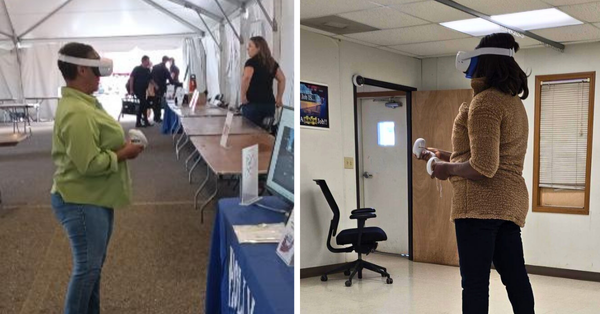 Holly Construction uses virtual reality training in both classroom and field settings to simulate high-risk tasks and reinforce hazard recognition.
Holly’s leadership team maintains an open-door management approach that encourages employees to raise safety concerns, share improvement ideas and ask procedural questions without fear of retaliation. Employees are actively involved in joint safety committees, job hazard analysis development, field audits and safety observations. This level of engagement builds ownership and accountability for workplace safety and health across all operations and has contributed to increased near-miss reporting and timely corrective action.
Leadership Message
Chuck Janovsky, president of Holly Construction Company, often reminds employees:
“Every day, bring your passion and your focus — not one without the other.”
This message reflects the company’s emphasis on dedication, awareness and teamwork on every jobsite.
Through structured daily communication, innovative training methods, open leadership and strong employee involvement, Holly Construction Company continues to lead by example within Michigan’s MVPP community. Its commitment to shared responsibility helps ensure every worker goes home safe at the end of the day.
Join the ranks of Michigan’s MVPP Star sites
MIOSHA established the MVPP in 1996 to recognize employers with exemplary safety and health management systems that go beyond state requirements. The program is open to Michigan employers with injury and illness rates below the industry average for the past three years.
To earn MVPP Star status, companies complete a rigorous application process that includes a comprehensive safety and health program review, on-site evaluations and employee interviews to verify that MIOSHA’s criteria are met. MVPP participation reflects a strong commitment to continuous improvement, employee involvement and proactive hazard prevention.
Learn more about MVPP and how to apply at Michigan.gov/mvpp.
|
|
By Mike Krafcik, MIOSHA Communications Specialist
MIOSHA recently recognized several Michigan employers for achieving Michigan Safety and Health Achievement Recognition Program (MSHARP) status. This recognition reflects strong partnerships between employees, management and MIOSHA to build effective workplace safety and health programs that go beyond basic compliance.
|
IMI Norgren Automation Solutions — Rochester Hills
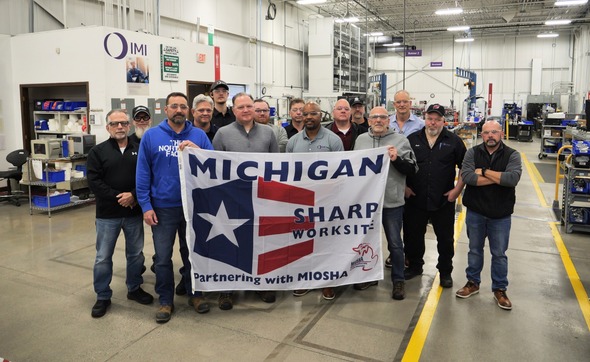 Employees at IMI Norgren Automation Solutions in Rochester Hills celebrate the company’s designation as a Michigan SHARP Worksite through MIOSHA’s MSHARP program.
IMI Norgren Automation Solutions in Rochester Hills was recognized as an MSHARP site for its sustained commitment to workplace safety and health and its collaborative approach to hazard prevention.
Leonard Jeffries, senior Health Safety and Environmental specialist at Norgren Automation Solutions, said the MSHARP process helped reinforce a positive working relationship with MIOSHA and strengthened the company’s safety efforts.
“A lot of people hear OSHA and immediately get nervous, but that hasn’t been my experience,” Jeffries said. “Working with MIOSHA has been very enlightening and personable. They helped identify areas where we could improve, and I’ve taken that guidance to heart.”
Jeffries said the partnership approach has helped employees see safety conversations as an opportunity to learn and improve rather than something to fear.
“It’s been a positive experience for us,” he said. “I welcome the help and the resources.”
Maple Valley Plastics LLC — Brown City
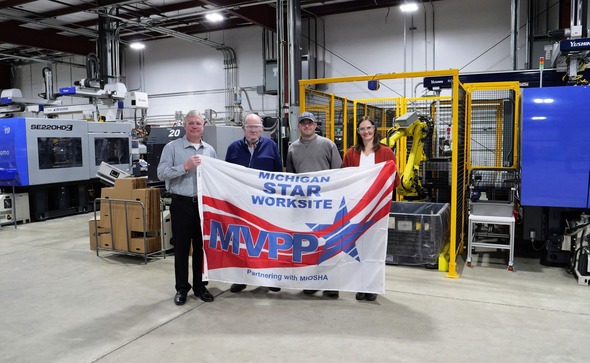 Team members at Maple Valley Plastics LLC in Brown City mark the company’s approval as a Michigan SHARP Worksite through MIOSHA’s MSHARP program.
Maple Valley Plastics LLC, a 26-employee plastics manufacturing facility in Brown City, was approved as an MSHARP participant effective Oct. 13, 2025.
One area of particular strength at the site is the company’s proactive approach to noise reduction. Engineering controls implemented by Maple Valley Plastics successfully reduced employee noise exposure levels below the 85-decibel action level.
The company also maintains a layered safety inspection system that includes daily, weekly, monthly, quarterly and annual inspections, helping ensure hazards are identified early and corrected promptly.
Bill Woodall, plant manager at Maple Valley Plastics LLC, said achieving MSHARP status was the result of years of teamwork and steady improvement.
“This has been a long process, and it was definitely a team effort,” Woodall said. “Over time, we’ve gone from one or two people trying to make sure everyone follows the rules to everyone holding themselves and each other accountable. That teamwork is what helps make sure people go home safe.”
Apollo Heat Treating and Processing LLC — Oak Park
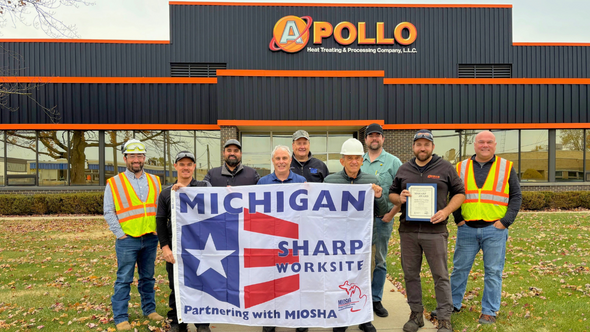 Apollo Heat Treating and Processing LLC in Oak Park was recognized for achieving Michigan SHARP status through MIOSHA.
Eaton Steel Corporation DBA Apollo Heat Treating and Processing LLC, located in Oak Park, was approved as an MSHARP site effective Oct. 3, 2025. The union facility employs 14 workers and supplies quench-and-tempered steel bars.
One of the company’s best practices includes a web-based system used to track injuries, incidents, near misses and reported hazards from initial report through corrective action. Apollo Heat Treating has also implemented a “No Falls” system to help protect employees, visiting workers and truck drivers during loading and unloading operations.
Learn More About MSHARP
The Michigan Safety and Health Achievement Recognition Program helps employers strengthen their safety and health management systems while recognizing those that demonstrate a strong commitment to injury and illness prevention.
Michigan currently has 10 approved MSHARP sites.
Learn how your workplace can participate at Michigan.gov/msharp.
 MIOSHA encourages employers to prioritize workplace safety with the message “Educate Before We Regulate.” Resources are available at Michigan.gov/cet.
Quick Links
Agency/Division Instructions/Memorandums
Air Contaminants Initiative
Asbestos Program
CET Request for Consultative Assistance Services (RCA)
CET Training Calendar
Construction Safety and Health Division (CSHD)
DVD/Video Library Service
Employee Safety, Health, and Discrimination Complaint Forms
Fall Prevention Campaign (STOP FALLS. SAVE LIVES.)
General Industry Safety and Health Division (GISHD)
Hazard Communication/GHS
Laboratory and Equipment Services
Michigan Alliances
Michigan Safety and Health Achievement Recognition Program (MSHARP)
Michigan Voluntary Protection Program (MVPP)
MIOSHA FOIA Request
MIOSHA News
MIOSHA Publications
MIOSHA Recordkeeping
MIOSHA Standards
MIOSHA Training Institute (MTI)
MIOSHA Updates
MIOSHA Variances
Radiation Safety Section
Residential Construction
Strategic Plan and Initiatives
Telephone, Mailing and Email Addresses
|