By Naomi Starks, MPH, senior industrial hygienist, MIOSHA
 Plan ahead, equip employees and train workers to stay safe during winter weather.
Protecting employees during cold weather is not just about reacting to storms. It requires preparation, clear communication and consistent follow-through. Winter conditions can introduce hazards such as cold-stress illnesses, including hypothermia and frostbite, as well as slippery roads and walking surfaces that increase the risk of vehicle crashes and slip-and-fall injuries.
Outdoor work requires proper preparation, particularly during severe winter weather conditions. While MIOSHA does not have a specific standard addressing work in cold environments, employers still have responsibilities under the general duty clause. Employers are required to provide employment and a place of employment that are free from recognized hazards, including winter weather-related hazards, that are causing or are likely to cause death or serious physical harm to employees.
Here are some general tips to make workplaces safer:
Maintain walking and working surfaces
- Clear snow and ice promptly from sidewalks, entrances, parking lots, loading docks and work areas.
- Apply salt, sand or other de-icing agents before and during icy conditions.
- Repair uneven pavement, loose mats and damaged steps before winter begins.
- Use slip-resistant mats at building entrances and replace them when saturated.
- Install and maintain handrails on stairways and elevated platforms.
- Ensure ladders, handrails and steps are sturdy and free of ice.
Improve visibility
- Ensure outdoor areas are well lit, especially where employees arrive early or leave late.
- Mark curbs, steps, ramps and elevation changes with high-visibility paint or tape.
- Keep exits and walkways free of snow piles that may block sightlines.
Provide appropriate personal protective equipment
- Provide insulated clothing and gear to protect employees from the elements.
- Encourage or require slip-resistant, weather-appropriate footwear.
- Consider traction aids, such as ice cleats, for employees who work outdoors.
Adjust work practices
- Allow extra time for employees to move between locations safely, as rushing increases fall risk.
- Modify tasks when conditions are especially hazardous and postpone nonessential outdoor work when necessary.
- Rotate duties to limit prolonged cold exposure, which can reduce balance and reaction time.
Train and communicate
- Educate employees on recognizing cold-weather hazards and safe walking techniques, including shorter steps and a slower pace.
- Encourage reporting of icy areas, poor lighting and near-miss incidents.
- Share weather alerts and site-specific safety reminders before storms and cold snaps.
- When working outdoors, implement a buddy system so workers can monitor one another.
- Encourage frequent or scheduled breaks in warm areas.
- Train employees to recognize cold-related illnesses, including:
-
Hypothermia: Symptoms may include shivering, confusion and fatigue.
-
Frostbite: Warning signs include numbness, discoloration and swelling in the extremities.
-
Chilblains: Painful inflammation of small blood vessels in the skin, with symptoms such as redness, itching, swelling, blisters and, in severe cases, ulcers.
Plan ahead
- Develop a winter weather safety plan that outlines responsibilities for snow removal, inspections and emergency response.
- Assign accountability so employees know who to contact when hazards appear.
Additional winter weather safety resources are available from federal OSHA at osha.gov/winter-weather.
 Employers face a March 2 deadline for submitting MIOSHA Recordkeeping Forms 300, 300A and 301.
January marks an important time of year for employers covered by MIOSHA recordkeeping requirements. Many employers must review their injury and illness records, prepare annual summaries and, in some cases, electronically submit data.
Accurate recordkeeping is more than a compliance exercise — it helps employers identify injury trends, evaluate workplace hazards and measure the effectiveness of workplace safety and health programs.
Posting the MIOSHA 300A summary
Employers required to keep injury and illness records must post the MIOSHA Form 300A Summary of Work-Related Injuries and Illnesses from Feb. 1 through April 30 each year. The summary must be posted in a visible location where employee notices are typically placed, even if the employer had no recordable injuries or illnesses during the year.
The 300A summary must be reviewed and certified by a company executive to confirm its accuracy.
Electronic submission requirements
Certain employers must electronically submit injury and illness data to MIOSHA by March 2 each year. This includes:
- Establishments with 250 or more employees that are required to keep records
- Establishments with 20–249 employees in designated high-hazard industries
Reporting serious incidents
In addition to recordkeeping, employers must report certain serious incidents directly to MIOSHA:
-
Work-related fatalities within eight hours
-
Inpatient hospitalizations, amputations or loss of an eye within 24 hours
Timely reporting helps MIOSHA respond quickly and supports prevention efforts statewide.
CET can help with common recordkeeping questions
MIOSHA’s Consultation Education and Training (CET) Division offers free, confidential assistance to help employers understand recordkeeping requirements and avoid common mistakes. CET consultants can:
• Answer recordability questions
• Review logs for accuracy
• Provide training on completing the MIOSHA 300 and 300A forms
• Explain reporting and submission requirements
CET can also help employers navigate common questions, including:
• Is an injury or illness work-related?
• Does medical treatment make a case recordable?
• How should restricted duty or days away from work be counted?
• What cases must be reported directly to MIOSHA?
Understanding these distinctions can help prevent errors and ensure compliance with MIOSHA Administrative Rules, Part 11 — Recording and Reporting of Occupational Injuries and Illnesses.
Free help is available online at Michigan.gov/CET or by calling 517-284-7720.
By Kristin Osterkamp, MIOSHA on-site consultation program manager
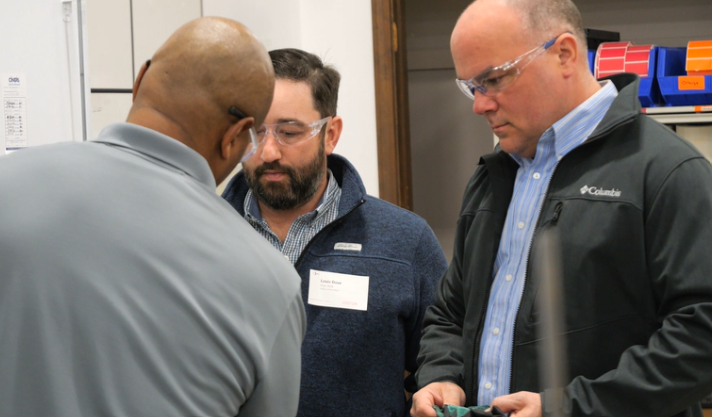 MIOSHA Consultation Education and Training (CET) consultants work directly with employers during an on-site visit to help identify hazards and strengthen workplace safety and health programs.
Many employers are familiar with MIOSHA’s enforcement divisions but may not realize the wide range of free services available through the Consultation Education and Training (CET) Division.
If you know Michigan employers looking to prevent workplace injuries and illnesses, strengthen safety and health programs, or earn recognition for exceptional performance, encourage them to take advantage of these free CET services:
-
Request a free hazard survey. Get a fresh set of eyes on your workplace to help identify and correct hazards with no citations or penalties. Request one at Michigan.gov/CETRCA.
-
Request free air or noise monitoring. Proactively assess employee exposures or evaluate engineering or administrative controls.
-
Schedule free on-site training. Learn about MIOSHA standards and best practices for strengthening safety and health programs.
-
Explore MIOSHA cooperative programs. Learn whether your organization may be a good candidate for a MIOSHA Alliance or Construction Partnership.
-
Apply for the Michigan Challenge Program (MCP). Designed for employers working to reduce injury and illness rates or build a safety and health program from the ground up.
-
Pursue recognition through Michigan Safety and Health Achievement Recognition Program (MSHARP) or the Michigan Voluntary Protection Program (MVPP). These programs recognize employers with exemplary safety and health management systems.
Wherever an employer is in developing a safety and health program, CET will meet them there and help them reach their goals. CET consultants work across a wide range of industries and regularly share best practices and lessons learned during on-site visits.
To learn more or share CET resources with employers — including how to request free consultative visits, earn awards and recognition, complete MIOSHA Training Institute certificates, apply for grant funding and more — visit Michigan.gov/CET.
 Coffee with MIOSHA: Your chance to connect and strengthen workplace safety!
MIOSHA and the Lakeland Care Network invite employees to join us for an informal networking event focused on workplace safety and health.
Coffee with MIOSHA events are designed for safety professionals, offering a unique opportunity to:
- Network with MIOSHA administrative, enforcement and consultative staff.
- Ask questions and discuss workplace safety challenges.
- Learn about MIOSHA’s programs and services to enhance safety and health.
Event details
Date: Wednesday, Jan. 21, 2026
Time: 8-10:30 a.m.
Location:
Corewell Health Lakeland Hospital
Frederick S. Upton Education Center
1234 Napier Ave.
St. Joseph, MI 49085
Register: Please RSVP by Jan. 16.
There were 42 work-related fatalities reported to MIOSHA in 2025. The information below shares preliminary details about those fatalities, which are believed to be covered by the MIOSH Act. The description reflects information provided to MIOSHA at the initial report of the incidents and are not the result of any official MIOSHA investigation.
Preliminary summaries of all fatalities are available at Michigan.gov/mioshafatalities.
Preliminary summaries of recent incidents
A 59-year-old maintenance worker was operating a tractor while clearing snow when a vehicle struck the tractor from behind. The victim was hospitalized and later died in the hospital 12 days later.
74-year-old part-time fire chief was responding to a medical emergency and was struck by a vehicle while at the scene. The victim was hospitalized and later died in the hospital two days later.
A 54-year-old owner was working with other employees attempting to stand a gable-end wall to frame a new residential home. After asking for help with the lift, the wall fell onto the victim.
A 25-year-old journeyman lineman was preparing a jobsite by placing wire for set up. The victim was chaining down a wire reel on a trailer connected to a digger truck about six feet off the road. A vehicle crossed the white edge line, struck the passenger side of a digger truck and struck the victim at the back of the trailer.
A 60-year-old truck driver was fatally crushed while attempting to lift a loading ramp and secure it on a utility trailer. The employee had gone to a nearby worksite the previous afternoon to pick up a roller. The company owner went to the worksite after observing the victim’s personal vehicle at the office and the company truck missing. The victim was found on the ground behind the trailer with one of the loading ramps on top of him.
Variances from MIOSHA standards must be made available to the public in accordance with Part 12, Variances (R408.22201 to 408.22251). MIOSHA variances are published online at:
Michigan.gov/mioshavariances.
Quick Links
Agency/Division Instructions/Memorandums
Air Contaminants Initiative
Asbestos Program
CET Request for Consultative Assistance Services (RCA)
CET Training Calendar
Construction Safety and Health Division (CSHD)
Contact MIOSHA (phone and email)
DVD/video Library Service
Employee Safety Health and Discrimination Complaint Forms
Fall Prevention Campaign (Stop Falls. Save Lives)
General Industry Safety and Health Division (GISHD)
Hazard Communication/GHS
Laboratory and Equipment Services
Michigan Alliances
Michigan Safety and Health Achievement Recognition Program (MSHARP)
Michigan Voluntary Protection Program (MVPP)
MIOSHA FOIA Request
MIOSHA News
MIOSHA Publications
MIOSHA Recordkeeping
MIOSHA Standards
MIOSHA Take a Stand Week
MIOSHA Training Institute (MTI)
MIOSHA Updates
MIOSHA Variances
Radiation Safety Section
Residential Construction
Strategic Plan and Initiatives
|