
Winter is fully here, and the MPSC wants Michiganders to know there are wintertime protections and other resources to help you keep your household safe and warm.
Among the resources are:
- The Winter Protection Plan shields seniors 65 and older and low-income customers from having their electricity or natural gas disconnected between Nov. 1 and March 31.
- The Home Heating Credit provides income-eligible customers with a credit to help pay winter heating bills.
- The Michigan Energy Assistance Program, which provides financial assistance and self-sufficiency services for low-income households.
For more information, go to www.michigan.gov/mpsc/gethelp, check out our Be Winterwise webpage, or check out our Energy Assistance & Shutoff Protection consumer tip sheet.
If you need help with your home energy bills, contact Michigan 211, a free, confidential service that connects Michiganders with a range of assistance programs and services including help with food, housing, transportation and home energy bills. Contact Michigan 211 by calling 211 or go to www.mi211.org.
|
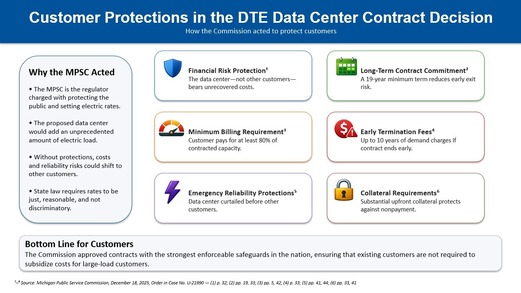 |
Exercising its role in consumer protection the MPSC on Dec. 18 conditionally approved two energy special contracts for DTE Electric Co. with the strongest protections in the nation against other ratepayers having to bear any costs associated with the Washtenaw County data center facility.
During a public hearing Dec. 3 and through written public comments, the Commission heard from thousands of Michiganders concerned about the risk of higher utility bills and other potential impacts of the 1,383-megawatt data center in Saline Township to be built by Green Chile Ventures, a subsidiary of the tech company Oracle Corp. Oracle, Open AI and Related Digital announced plans for the data center Oct. 30, and DTE Electric subsequently filed an application for approval of the special contracts in Case No. U-21990.
The MPSC’s sole jurisdiction in the case is over electric or natural gas rates a data center customer is charged and the terms governing the services provided by regulated utilities. The Commission does not have legal authority over the siting or construction of data centers or their water use.
The Commission conditionally approved the special contracts, with additional mandatory safeguards to protect residential and other customers from costs associated with the development and continued operation of the data center.
Among the conditions, DTE Electric must agree to be responsible for any costs it is unable to recover from the data center developer. DTE Electric also must agree to update its emergency procedures so that, in the unlikely event of an energy emergency that requires the utility to involuntarily shed electricity load — interrupting service to customers in times of high demand to prevent catastrophic power grid failure — the utility will ensure that the data center’s load is reduced or interrupted before interrupting service to other DTE Electric customers.
Terms of the primary supply agreement between DTE Electric and the data center also included additional requirements above and beyond standard terms for customers in the utility’s D11 tariff:
- A minimum contract duration of 19 years, compared to the standard agreement of five years for a new customer of 1 MW or more of peak demand taking service under the general D11 tariff that would otherwise have applied to this customer.
- A minimum billing demand of 80%, compared to 50-60% in the otherwise applicable general D11 tariff. The data center operators will have to pay a minimum of 80% of the contracted electricity use even if their actual usage is lower.
- A termination payment of up to 10 years’ worth of minimum billing demand if the facility stops operating earlier than contracted to operate. There is no explicit reference to a termination payment included in the general D11 tariff.
“These protections will ensure that Michigan is able to reap the benefits of adding a significant new energy user to the grid while keeping any related costs off the utility bills of other customers,” MPSC Chair Dan Scripps said. “The Commission’s order in this case recognizes the utility’s obligation to serve this customer under Michigan law while requiring the strongest consumer protections for a data center power contract in the country — protections that would not be available under existing tariffs without the Commission’s approval of these contracts.”
The Commission noted that the data center project will provide an affordability benefit to other customers because it will contribute significantly to fixed system costs that would otherwise be recovered solely from DTE Electric’s existing customers. In filings with the Commission, DTE Electric calculated the net benefit to other customers of approximately $300 million.
Learn more about the matter in the MPSC’s issue brief on the case.
The MPSC on Jan. 15 issued an order requiring cable company Comcast Corp. to show cause why it should not be held in violation of Michigan’s safe digging law.
MPSC Staff received multiple complaints about a lack of response by Comcast and its affiliates to one call MISS DIG 811 tickets requiring owners and operators of operators of underground facilities to expeditiously mark buried utility lines. An initial investigation by MPSC Staff found good cause that the company has failed its statutory obligation to mark facilities as required under Public Act 174 of 2013, the MISS DIG Underground Facility Damage Prevention and Safety Act.
MISS DIG 811 response statistics indicate Comcast failed to respond to 35,721 dig notice requests between Sept. 10 and Nov. 24 of 2025. Under Act 174, violators of the act may be ordered to pay a civil fine of up to $5,000 per violation. The Commission also may require violators to obtain reasonable training to assure future compliance, in addition to or as an alternative to civil fines.
Following MISS DIG 811 rules is critical for public safety. Michigan law requires anyone planning a project that involves digging to contact MISS DIG 811 at least three days in advance so that crews can mark the location of underground utilities — including gas, electric, telecommunications, water and sewer lines — to prevent costly damage, outages of critical services, and potential injury and death.
Learn more about how to prevent damage to buried utilities at the MPSC’s Safe Digging webpage and the MPSC’s 5 Steps to Safe Digging tipsheet.
The schedule of the MPSC’s regular Commission meetings has been set for the coming year. The Commission will meet:
|
Jan. 15, 1 p.m.
|
April 17, 1 p.m.
|
July 16, 1 p.m.
|
Oct. 15, 1 p.m.
|
|
Jan. 29, 1 p.m.
|
April 30, 1 p.m.
|
Aug. 6, 1 p.m.
|
Nov. 5, 1 p.m.
|
|
Feb. 19, 1 p.m.
|
May 14, 1 p.m.
|
Aug. 20, 1 p.m.
|
Dec. 8, 1 p.m.
|
|
March 12, 1 p.m.
|
May 28, 1 p.m.
|
Sept. 10, 1 p.m.
|
Dec. 17, 1 p.m.
|
|
March 27, 11 a.m.
|
June 11, 1 p.m.
|
Oct. 1, 1 p.m.
|
|
Here is information about orders issued at the MPSC’s Dec.18 Commission meeting:
- The MPSC approved a settlement agreement permitting Northern States Power Co. (NSP) to raise natural gas rates by $1.6 million over 2026 and 2027 (Case No. U-21903). The approved amounts represent a more than 26% decrease from the $2,177,374 the utility had sought. The average residential customer using 80 therms of gas per month would see their bill rise by $7.64 to $88.17, an increase of 9.49%. The agreement requires NSP to spend $700,000 each year in 2026 and 2027 on its Distribution Integrity Management Plan investments, which includes replacing aging infrastructure to improve the integrity and safety of the utility’s natural gas system.
- The MPSC rejected Upper Michigan Energy Resources Corp.’s (UMERC) amended renewable energy plan (REP), agreeing with the Tilden Mine and other parties that the proposed resources and costs go well beyond those necessary to comply with the law – a point that UMERC conceded (Case No. U-21813).The Commission found that UMERC’s decision to model its amended REP on compliance with the broader clean energy standard requirements outlined in Public Act 235 — part of the state’s energy laws that were revamped in 2023 — were beyond the scope of requirements needed for the utility to comply with renewable portfolio standards and failed to meet the requirements for approval under Michigan law. The Commission directed the utility to file a new REP by Oct. 15, 2026, in conjunction with the company’s integrated resource plan, although the Commission permitted UMERC to file a standalone amended REP before then if the company so chooses.
- The MPSC approved updated Michigan Integrated Resource Planning Parameters, which are the factors that must be included in electric utilities’ long range plans for generating enough electricity to meet customer needs (Case No. U-21867 et al). The planning parameters establish what Michigan’s electric utilities must consider in their required long-term modeling of future electricity demand, a roadmap for ensuring they’ll have enough electricity over a period of up to 20 years to efficiently meet residential and business customer demand, while meeting clean energy standards.
Tune in to our next regularly scheduled commission meeting on Jan. 29 at 1 p.m.
|