|
Michiganders have the chance to weigh in on special contracts proposed by DTE Electric Co. to provide electricity for a planned data center in Washtenaw County’s Saline Township.
Michigan law grants the MSPC jurisdiction over electric and natural gas rates and the terms governing the services provided by regulated utilities. The Commission does not have authority over the siting or construction of data centers, or to issue permits or make determinations related to water use. Terms of service approved by the Commission may include specific provisions aimed at protecting customers if a large-load customer leaves the system.
DTE Electric filed an application in Case No. U-21990 for approval of special contracts for electric service between the utility and a subsidiary of the tech company Oracle Corp. for the 1.4-gigawatt data center. Oracle, Open AI and Related Digital announced plans for the data center Oct. 30.
The MPSC will review the contract for reasonableness and prudence and other requirements within the Commission’s statutory authority, including protections for other ratepayers potentially impacted by a very large new customer on the power grid. The protections are meant to shield other customers from subsidizing data centers or otherwise paying additional costs.
“This public hearing will add an important element of transparency in evaluating DTE Electric Co.’s proposed special contract,” said MPSC Chair Dan Scripps. “It’s important that the public have an opportunity to have their voices heard on how DTE plans to provide electric service to this data center customer and ensure the costs of doing so are not ultimately borne by DTE’s other customers.”
In early November, the Commission approved an application by Consumers Energy Co. to amend the terms and conditions under which it serves data centers and other similarly energy-intensive very large electric customers. The approval included provisions to protect residential and other ratepayers from subsidizing data centers or otherwise bearing additional costs (Case No. U-21859).
The Commission noted that demand from data centers and other similarly situated large-load customers could benefit all customers by spreading out the fixed costs of Consumers’ electric grid over a larger amount of grid usage. But the Commission found that additional protections were necessary to leverage these potential benefits in a way that was good for all customers and the state as a whole.
The Commission approved a number of requirements aimed at ensuring large load customers remain in service long enough that they will contribute significantly to new and embedded costs while also giving Consumers time to plan for unprecedented changes to its overall load:
- A minimum contract term of 15 years.
- A minimum billing demand of 80% that must be paid even if usage is lower.
- A ramp-up period of up to 5 years to reach full service levels; and automatic contract extensions of 5 years with a required 4 years’ notice for contract termination.
- An exit fee that a large-load customer must pay for ending service before the end of a contract. The fee is equal to the minimum monthly bill multiplied by the number of months remaining on the customer’s contract. Consumers will be required to try to minimize the exit fee by, for example, reassigning leftover capacity to other customers.
- A default collateral requirement that’s equal to half of a large-load customer’s exit fee, to ensure that the customer can and will pay the exit fee. The collateral requirement will be reduced over the course of the large-load user’s contract.
More info is available in the MPSC’s news release and issue brief about the Consumers Energy tariffs.
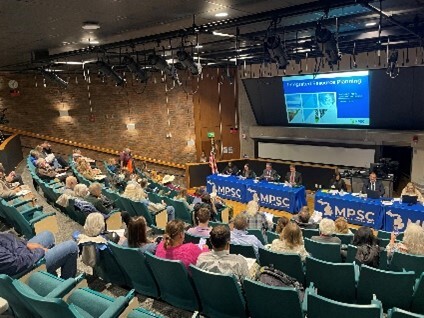
The MPSC held the second of two public hearings on how certain factors should be included in electric utilities’ long-range plans for producing electricity to meet customer energy needs in Michigan.
The Commission held a public hearing Oct. 27 at Oakland Community College’s Auburn Hills Campus. Around 75 people attended. Many shared concerns about the impact of data centers on Michigan’s power grid and the impact of demand growth on the state’s ability to meet long-term clean energy goals.
|
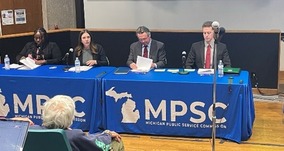
The Commission also held a hearing on this issue Sept. 9 in Grand Rapids.
The hearings gathered public input on how different electricity generating technologies should be analyzed to ensure utilities can meet future electricity needs.
Officially called Integrated Resource Plan (IRP) planning parameters, these guidelines establish what Michigan’s electric utilities must consider in their required long-term modeling of future electricity demand, essentially a roadmap for ensuring they’ll have enough electricity over a period of up to 20 years to meet residential and business customer demand, while meeting clean energy standards.
IRPs address a range of issues, including the planned retirement of current electricity generation resources, the planned or anticipated need for new power generation, the appropriate mix of different electricity generation technologies to meet customer needs, laws and regulations, the timing for building or acquiring those new resources. An IRP can also address programs that impact utility customer pocketbooks in other ways, such as home or business energy efficiency efforts that can reduce utility bills and programs to address utility affordability.
|

The MPSC is reminding Michiganders this month that carbon monoxide safety is important for every household.
Carbon monoxide, or CO, is known as the “silent killer,” because it’s invisible, colorless and odorless. CO poisoning leads to more than 400 deaths per year in the United States and more than 100,000 emergency room visits, according to Centers for Disease Control and Prevention data.
There are steps you can take to keep your family safe:
- Install and regularly maintain carbon monoxide alarms on every level of your home and outside each sleeping area and test the alarms monthly.
- Always use any portable generator outdoors, at least 20 feet away from vents, doors and windows. Check out our 6 Safety Tips for Portable Generators for more info.
- Make sure vents for fireplaces and appliances including furnaces, water heaters, stoves and clothes dryers are clear of snow and other debris.
- Have a qualified professional inspect your home’s heating system, chimney and vents inspected annually.
- Don’t use ovens or stoves to heat your home.
- Never leave a running automobile in a closed garage.
Carbon monoxide can cause death in as little as five minutes. Symptoms of CO poisoning include headache, shortness of breath, fainting, nausea, confusion and dizziness.
|
The most recent edition of the MPSC’s Behind the Meter podcast, which explores important topics in energy and telecommunications each month, tackled electric vehicles and the impact of additional demand on Michigan’s power grid.
MPSC Chief Operating Officer and podcast host Mike Byrne speaks with Commissioner Katherine Peretick and former Commissioner Alessandra Carreon, now the state of Michigan’s chief climate officer, in the October episode of the Behind the Meter podcast.
Give it a listen! You can find the MPSC’s podcast on our website, our YouTube channel, and major podcast platforms.
|

With colder temperatures here, the MPSC reminds Michiganders that there are wintertime and other shutoff protections available for people struggling with home energy bills.
The Winter Protection Plan prevents utilities from shutting off service between Nov. 1 and March 31 each year. Learn more about this protection and other resources at the MPSC’s tip sheet on Energy Assistance & Shutoff Protection tipsheet for residential customers.
There are also shutoff protections for medically vulnerable households, seniors and military customers or their spouses.
|
Recent commission meeting orders
Here is information about orders issued at the MPSC’s Nov. 6 Commission meeting:
- The MPSC issued a cease and desist order directing CMC Telecom and Internet Inc. to stop providing basic local exchange phone serve or presenting itself as a provider of the service without a license from the Commission, and to stop providing unlicensed voice service without registering as required under state law (Case No. U-21904). The Commission found CMC Telecom and Internet in violation of the Michigan Telecommunications Act and ordered the company to pay $60,100 in fines and issue refunds to two customers who filed complaints with the MPSC in summer and fall of 2024.
- The Commission approved Consumers Energy’s application for approval of a build transfer agreement between the utility and 45th Parallel Solar LLC to acquire the 45th Parallel Solar Project in Otsego County (Case No. U-21816). The 45th Parallel project will be 200 MW with an estimated installed capital cost of $436 million and a levelized cost of energy of $76 per megawatt hour over 35 years. The MPSC also approved Consumers Energy’s application for approval of power purchase agreements (PPAs) for the output of two solar plants in Case No. U-20604: a 15-year PPA with Pivot Energy MI 10 for the 3 MW output of the Pivot Energy MI 10 Solar Plant in Calhoun County, with an approximate cost of $3,541,005, and a 15-year PPA with Pivot Energy Michigan 19 LLC for the 2 MW output of the Pivot Energy MI 19 Solar Plant in Mecosta County with an approximate cost of $2,546,511.
Tune in to our next regularly scheduled commission meeting on Dec. 5 at 1 p.m.
|