|
Here’s your chance to have a say in Michigan’s energy future.
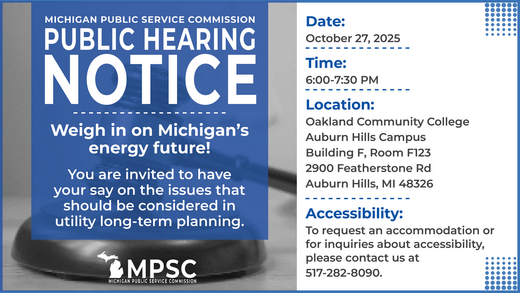
The MPSC is holding a public hearing on Oct. 27 in Auburn Hills to hear from the public about how certain factors should be included in the state’s electric utilities’ long-range plans for producing electricity to meet customer energy needs.
The hearing will be 6-7:30 p.m. on Monday, Oct. 27, at the Oakland Community College Auburn Hills Campus, in Building F, Room F123, at 2900 Featherstone Road. The hearing will be in-person, and anyone may attend and share their thoughts on how different electricity generating technologies should be analyzed to ensure utilities can meet their customers’ electricity needs in the long term. A previous hearing was held Sept. 9 in Grand Rapids.
The upcoming hearing in metro Detroit is about what are officially called Integrated Resource Plan (IRP) planning parameters. These are guidelines that establish what Michigan’s electric utilities must consider in their required long-term modeling of future electricity demand, essentially a roadmap for ensuring they’ll have enough electricity over a period of up to 20 years to meet residential and business customer demand while also meeting clean energy standards.
Can’t attend? You can find more information, including a draft report on the IRP planning parameters and how to submit comments in the case docket on this matter (Case No. U-21867), at the MPSC’s webpage on the event and the public notice about the hearing.

We hope you will follow us on Instagram, which the MPSC officially joined Oct. 6 as the Commission expands its outreach on social media to reach more Michiganders with important information about energy and telecommunications matters.
“The MPSC is excited to join Instagram to share information and connect with more Michiganders,” MPSC Chair Dan Scripps said. “Public participation is a priority of the Commission, and we are always looking for ways to broaden how we get information out to the public. Instagram will help increase our reach. We look forward to interacting with more Michiganders about matters that impact us all, from how we power our lives to how we ensure access online.”
The MPSC’s decision to launch an Instagram page was influenced by participants at a recent MPSC town hall. Participants told Commissioners and MPSC Staff that social media is one of the best ways to reach them with relevant information or announcements of activities in their areas, specifically recommending Instagram as a frequently used source of information.
|
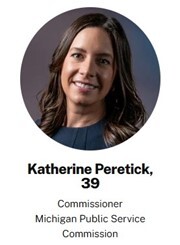
The MPSC’s very own Katherine Peretick was named to Crain’s Detroit Business’s 40 Under 40 list for 2025, letting folks in on what we at the MPSC have known for a while: Commissioner Peretick is a remarkable leader!
Honorees are nominated by peers, colleagues and others, and winners are selected by Crain’s editors for their vision and leadership, through what the publication describes as a rigorous editorial process. Crain’s says its annual list “celebrates rising leaders making a lasting impact across industries and communities.”
Commissioner Peretick was first appointed by Gov. Gretchen Whitmer in January 2021, following a career in which she interned at NASA and worked in the wind turbine and energy storage fields. She was raised in Saline, Mich., and has a bachelor’s degree in mechanical engineering and a master’s in energy systems engineering, both from the University of Michigan.
|

Michigan is a national leader in energy waste reduction efforts that work to enhance energy efficiency across the state. Investments made in 2024 will save Michiganders about $1.4 billion, according to the MPSC’s latest Utility Energy Waste Reduction Programs Annual Report on the Implementation of Public Act 295.
The report highlights a wide range of financial and other benefits of Michigan’s strong EWR programs. EWR offerings for residential customers include ways to upgrade lighting, heating, ventilation and cooling, weatherization, energy education, appliance recycling and other ways residential customers can use energy more efficiently and save money on their utility bills. There are also programs to help businesses of all sizes reduce their energy waste.
EWR programs resulted in savings of 1.73 million megawatt hours (MWh) of electricity and 6.44 million thousand cubic feet (Mcf) of natural gas last year. For comparison, the electricity saved by Michigan’s EWR programs is approximately double the total electricity sales for all homes and businesses in the City of Ann Arbor each year.
Michigan’s electric and natural gas utilities spent more than $583 million on EWR programs in 2024. That spending is expected to result in customer savings of $1.4 billion over the 12-year lifecycle of EWR programs and measures. For every dollar utilities spent on EWR programs in 2024, customers see $2.40 of benefits, the report concludes.
|
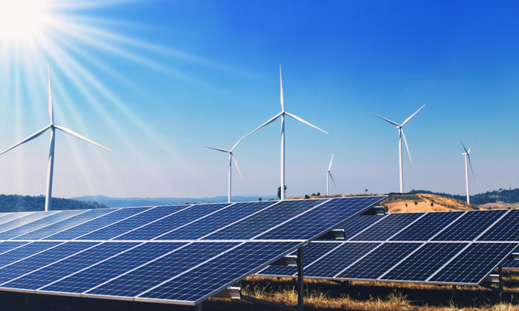
The MPSC’s annual Status of Renewable Energy, Distributed Generation, and Legacy Net Metering in Michigan report shows continued growth in the state’s renewable energy and distributed generation programs, with significantly more in the works.
The report finds that electric utilities regulated by the MPSC had more than 7,500 megawatts (MW) of renewable capacity at the end of 2024 and more than 8,300 MW expected by the end of 2025, based on contracts approved by the Commission. Utilities added 1,698 MW of renewable energy in 2024, an increase of 28.9% over the 5,882 MW of renewable capacity that was online at the end of 2023.
That figure is expected to reach 17,800 MW by 2030 as renewable energy expands to meet the standards set in Michigan’s energy laws revamped in 2023 and commitments made in utility resource plans that speed up the state’s transition to cleaner sources of energy and reduce reliance on fossil fuels that contribute to climate change.
Wind remains the largest source of renewable energy in Michigan, accounting for 67% of renewable generation. Solar generation continues to grow rapidly in Michigan, accounting for 18% of renewable generation in 2023, the report found.
|
Here is information about orders issued at the MPSC’s Sept. 30 and Oct. 9 Commission meetings:
- The MPSC awarded nearly $5 million in grants for renewable energy and electrification projects across the state to awardees ranging from local, state and Tribal governments to businesses and nonprofit organizations (Case No. U-21975). The MPSC developed the grant program as directed under Public Act 121 of 2024, the Fiscal Year 2025 budget, which provided $4.875 million in grants for planning, developing, designing, acquiring, or constructing renewable energy and electrification infrastructure projects. A full list of awardees and other information is available at the MPSC’s website for the program.
- The MPSC authorized Consumers Energy to raise natural gas rates by $157,495,000, a more than 36% decrease from the $248 million the company initially requested (Case No. U-21806). The increase is aimed at boosting the safety and reliability of its gas pipeline system by replacing lines most at risk of leaks and service interruptions for customers. The new rates go into effect Nov. 1. A typical residential customer using 75 ccf (hundred cubic feet) will see an increase of $6.44, or 8.1%, on their monthly bill.
Tune in to our next regularly scheduled commission meeting on Nov. 6 at 1 p.m.
|