The Michigan Public Service Commission is giving Michiganders the chance to have their say on the state’s energy future.
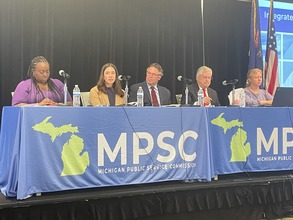
The Commission held a public hearing on utility long-term resource planning in Grand Rapids Sept. 9 and will hold a second session Oct. 27 in Auburn Hills.
Nearly 40 people attended the Grand Rapids session, with affordability and reliability at the top of mind of many commenters. The Commission and MPSC Staff hosted the public hearing at the Eberhard Center at Grand Valley State University in Grand Rapids.
|
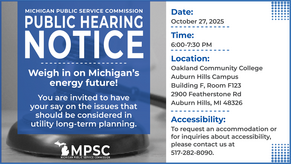
The second session will be Oct. 27, 6-7:30 p.m., at Oakland Community College’s Auburn Hills campus. The hearing will be in Building F, Room F123, at 2900 Featherstone Road. Anyone who may need an accommodation or have a question about accessibility may call the MPSC at 517-282-8090.
The Commission wants to hear from Michigan’s electric utility customers about what factors should be included in the state’s electric utilities’ long-range plans for producing electricity to meet customer energy needs.
Integrated Resource Plan (IRP) planning parameters are guidelines establishing what Michigan’s electric utilities must consider in their required long-term modeling of future electricity demand. An IRP is essentially a roadmap for ensuring a utility will have enough electricity over a period of up to 20 years to meet residential and business customer demand, while meeting clean energy standards.
IRPs address issues such as the retirement of current electricity generation resources, the potential need for new power generation, what mix of electricity generation technologies is appropriate, and the timing for building or acquiring those new resources. IRPs also address programs that impact utility customer pocketbooks, including energy efficiency efforts that can reduce utility bills and programs to address utility affordability.
IRP planning parameters address matters including:
- How much electricity will be needed by electric vehicles in the state.
- How much electricity will be needed for homes and other buildings that may switch to electricity for space and water heating.
- What is the expected cost for natural gas used to fuel power plants.
- How utilities will meet environmental standards and renewable goals and clean energy standards.
- How adoption of rooftop solar and other distributed generation technologies will impact electricity demand.
|

Beginning Oct. 7, anyone with a phone number in the 313 area code will have to include an area code with all local calls as the region prepares for a new overlay area code: 679.
This is the final phase of the implementation of a new 679 area code in metro Detroit, as the long-serving 313 area code is running out of available numbers to assign to new customers.
In March, the MPSC announced a six-month permissive dialing period during which callers in the 313 area code were urged to practice using 10-digit dialing for every call. As of Oct. 7, seven-digit dialing will no longer be optional. An area code will be required for every local call. Calls dialed without an area code will not be completed.
An important note: Current 313 area code customers will not have to change their phone number and will be able to keep their 313 area code.
The new 679 area code will apply to new phone numbers issued once the 313 area code numbers run out. The start date for the new 679 area code is officially Nov. 7, but new customers may not be given a 679 area code until the first quarter of 2028. That’s when available numbers in the 313 area code are projected to run out.
Learn more at our consumer tip sheet on the new area code.
|

Every September, the MPSC joins with agencies across the country to spread the word about Lifeline, a federal and state program that provides discounts on phone and internet service to income-qualified veterans, seniors and more.
Lifeline Awareness Week helps publicize the program’s benefits. Governor Whitmer issued a proclamation honoring the week.
Through the program, income-eligible people under age 65 get a minimum monthly discount on their bill of $8.25. Those age 65 and older receive a minimum discount of $12.35.
Dozens of Michigan telecommunications providers participate in Lifeline. For more information about Lifeline, see the MPSC's Federal Lifeline or Michigan Lifeline consumer tip sheets or contact the MPSC at 800-292-9555. To find a provider, check with the MPSC's list of participating companies to see if your local landline telephone company, wireless provider or broadband provider participates in Lifeline.
|
The MPSC approved an annual increase to the bill credits customers receive if they experience lengthy or repeat power outages.
The Commission raised the bill credit to $42 per day for customers who endure prolonged or frequent power outages (Case No. U-20629), effective Oct. 1. The power outage credit is now 68% higher than it was before the Commission updated the credits in 2023. Before then, customers were eligible only for a one-time $25 credit, and they had to request it from their utility.
The Commission’s 2023 updates raised the credit initially to $35 for each day a customer is without power and indexed the new credit to the rate of inflation. The Commission also made the power outage credit automatic, so that credits for long-duration or repeat outages now automatically show up on eligible customers’ bills. As a result of these changes, utility customers in 2024 received $8,456,093 in outage credits, a sevenfold increase over the $1,213,286 in credits provided to customers in 2022, the last year under the previous rules.
The International Week of Deaf People is Sept. 22-28, and the MPSC is highlighting the importance of the Michigan Telecommunications Relay Service that gives deaf, hard of hearing or speech-impaired people ways to communicate by phone.
Michigan’s Telecommunications Relay Service is a crucial tool in ensuring equal access for the approximately 7.4% of Michiganders who identify as deaf, deafblind or hard of hearing.
Individuals not familiar with the service may not know what to do if they receive a call through Michigan Relay. If you answer a call and someone says, “A person who may be deaf or hard of hearing is calling you through Michigan Relay,” don’t hang up!
Through Michigan Relay, people who are deaf, hard of hearing or have difficulty speaking can communicate using a TTY (teletypewriter), TDD (telecommunications device for the deaf) or other technology to connect with friends and family, conduct business, make or cancel appointments or other activities.
To learn more about how it works, you can read the MPSC’s consumer tip on the Michigan Relay. There are no extra charges for users of the Michigan Relay. Only normal telephone charges apply. There also are no limits on the number or length of calls for relay users.
Here is information about orders issued at the MPSC’s Aug. 21 and Sept. 11 Commission meetings:
- The Commission revoked the licenses of several telecommunications providers that appear to be no longer operating in Michigan and have not responded to multiple inquiries from the MPSC (Case No U-21868). The Commission in April commenced license revocation proceedings against four providers of basic local exchange phone service: ComTech 21 LLC; Osirus Communications Inc.; Crystal Automation Systems Inc., doing business as Casair Inc.; and MCC Telephony of the Midwest LLC. MPSC Telecommunications Staff found that the companies haven’t met statutory and regulatory responsibilities to maintain a license.
- The Commission raised fines for violations of gas safety standards to adjust for inflation (Case No. U-21961). Public Act 165 of 1969 gives the Commission authority to establish and enforce gas safety standards, and violators are subject to administrative fines of up to $200,000 for each violation for each day that the violation persists, with a maximum fine of $2.5 million for any related series of violations. With this year’s annual adjustment for inflation, the Commission set the new maximum fine of $202,511 for each violation for each day that the violation persists, and a maximum administrative fine of $2,531,383.
- The Commission accepted annual capacity demonstrations by all of Michigan’s electricity providers, showing that each has sufficient capacity to meet electricity customer needs four years into the future (Case No. U-21775). The Commission accepted MPSC Staff’s Capacity Demonstration Results Report, which is required under the state’s energy laws, for the 2028-2029 planning year. The state reliability mechanism capacity demonstration requirement applies to all load-serving entities, or LSEs, including investor-owned electric utilities, alternative electric suppliers, cooperative electric utilities and municipal electric utilities.
Tune in to our next regularly scheduled commission meeting on Tuesday, Sept. 30 at 11 a.m.
|