|
The MSPC on Dec. 1 approved a $368 million rate increase for DTE Electric Co., a reduction of more than 40% from the $622 million the utility requested (Case No. U-21297). The revenue collected from increased rates will fund the company’s infrastructure investments to improve reliability and speed up deployment of clean energy.
A typical residential customer who uses 500 kilowatt hours of electricity per month will see an increase of $6.51, or 6.38%, on their monthly bill. The new rates took effect Dec. 15.
The Commission approved a 50-50 debt to capital ratio and set a return on common equity of 9.9% and an overall rate of return of 5.56% on a jurisdictional rate base of $22,150,952,000.
The Commission approved a 2-year investment recovery mechanism designed to help track investments in DTE Electric’s distribution system and ensure continued investment in the distribution grid to improve reliability and resilience. These investments totaling more than $350 million will be made in 2024-2025 toward circuit conversions, sub-transmission redesign and rebuild, breaker replacement, underground residential distribution replacements, and 4.8 kilovolt circuit automation.
The Commission also approved funding for the company’s strategic capital program to improve reliability and modernize the grid. Noting safety issues with abandoned arc wire in Detroit, the Commission approved funding for DTE Electric’s efforts to harden the city’s 4.8 kV grid.
Read more about the rate increase in the Commission’s order and press release.
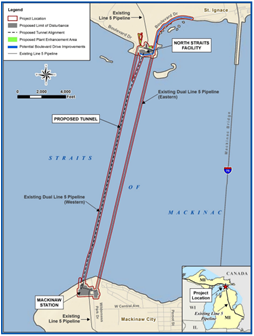
The MPSC on Dec. 1 approved Enbridge Energy LP’s siting application for a proposed replacement segment of pipelines now exposed on the lakebed of the Straits of Mackinac, subject to the company obtaining additional government approvals and permits and with conditions related to the tunnel’s safety and construction.
The Commission’s order (Case No. U-20763) determined that the evidence on the record supported a finding of public need for the replacement project.
The order also found there is a public need to protect the ecological, natural, and cultural resources of the Great Lakes that would be helped by replacing the existing dual pipelines, now exposed to the elements and risks including ship anchor strikes on the Straits’ lakebed, with a single pipeline deep beneath the lakebed.
Other modes of transporting Line 5’s products, such as by truck, rail, oil tanker, or barges, likely would increase environmental impairment and increase the risk of spills that could significantly harm the Great Lakes and its environment, the Commission found, and there are no feasible and prudent alternatives to the replacement project pursuant to the Michigan Environmental Protection Act.
To learn more about the approval, read the Commission’s press release, the order itself, or an issue brief about the Line 5 matter.
|

Michigan winters often mean increased bills for residents due to heating needs. The MPSC’s Be Winterwise webpage offers tips and resources that can help us reduce energy consumption - and energy costs - and still have a cozy Michigan winter.
The U.S. Department of Energy also has lots of tips on steps large and small that you can take to prepare your home for winter through its Energy Saver guide.
Power outages can occur at any time. Learn more about staying safe with consumer tips on downed wire safety and surviving power outages. The MPSC also has a webpage dedicated just to power outage preparedness so we can all learn more about it anytime, not just when a winter storm is brewing.
|
The Michigan Public Service Commission’s Winter Energy Appraisal for 2023-2024 projects demand for electricity will decline slightly while demand for natural gas will increase, mainly because of increased use of the fuel in electricity generation.
The annual report projects electricity demand will decline 2.7% overall, with residential demand declining 5.7% and commercial demand falling 2.5%, while industrial demand increases 0.9%. Consumption of natural gas is projected to increase 7.6%, due to increased use of gas in electrical generation, outweighing expected declines in the residential (-5.4%), commercial (-4.3%) and industrial (-1.6%) sectors.
While household electric use is expected to decline, the U.S. Energy Information Administration (EIA) forecasts that average electricity prices in the east north central part of the country, which includes Michigan, will increase to 16.09 cents per kilowatt hour (kWh), up 3.9% from 2022. For natural gas, the average commodity price for the upcoming home heating season is expected to be $3.53 per thousand cubic feet (Mcf), down from $5.80 per Mcf last winter.
Help is available for households needing assistance with energy costs at www.michigan.gov/mpsc/gethelp, a one-stop webpage that has information and links to state and utility company programs that offer energy bill assistance to income-qualified households, including State Emergency Relief, the Michigan Energy Assistance Program, and the annual Home Heating Credit.
Anyone needing help also may reach out to their utility or contact Michigan 211 by calling 211 or going to www.mi211.org. Michigan 211 is a free, confidential service that connects Michiganders with a broad range of assistance programs and services and other resources, including help with food, housing, transportation and home energy bills.
|