|
Commissioner Tremaine Phillips has made a decision to depart from the MPSC effective April 26, a move he said was the most difficult he’s faced in his life.
“This decision has been made after much thought and consideration of my family’s personal and professional priorities, taking into account an exceptional opportunity recently presented to my wife, which our family believes is too significant to pass up,” Commissioner Phillips told MPSC Staff in an email announcing his decision to leave.
Commissioner Phillips was appointed to the Commission by Gov. Gretchen Whitmer in September 2019 and became, in short order, the point person on the Commission on electric vehicles and telecommunications issues and a steadfast voice for ensuring that underserved and historically marginalized communities and their needs and considerations are factored into the work of the MPSC.
“Tremaine can’t be replaced,” Chair Dan Scripps said, “not only for his expertise, but also because he’s an exceptional human being. We will miss him greatly.”
Commissioner Phillips has served on the board of directors of the National Association of Regulatory Utility Commissioners and its Electric Vehicles State Working Group and Committee on Critical Infrastructure. He also was chair of the Committee on Telecommunications. In addition, he has served on the board of directors of the Organization of PJM States and represents the Commission on Governor Gretchen Whitmer's Michigan Poverty Task Force, the Michigan Council on Future Mobility and Electrification, the Michigan Environmental Justice Response Team, and the Connecting Michigan Task Force. He served on NARUC’s Broadband Expansion Task Force, a two-year effort to improve broadband access in underserved communities throughout the country.
“Commissioner Phillips has been instrumental in our ability to serve Michiganders over the past three and a half years, leading with thoughtfulness and compassion.” Commissioner Katherine Peretick said. “We will miss his steadfast presence and positivity that he has brought to his time on the Commission.”
The MPSC has increased power outage credits for customers who endure long-duration or frequent outages and, for the first time, the credits will be issued automatically.
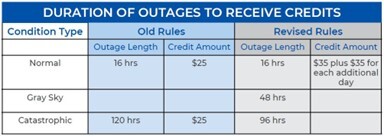
The Commission on March 24 approved raising the credits to $35 from $25, plus another $35 each day beyond acceptable thresholds. Customers no longer will have to apply to get them from utilities, which are now required to issue them automatically.
“The credits may not cover all of the losses electric customers face when they lose power, but this is a major step forward,” Scripps said. “Not only is the outage credit more, it’s also no longer a one-time credit per incident, and customers will no longer have to request the credits from utilities.”
The power outage credit kicks in after 96 hours during catastrophic conditions, defined as a utility having 10% or more of its customers without power; after 48 hours during gray sky conditions affecting between 1% and 10% of a utility’s customers, and after 16 hours during normal conditions of less than 1% of customers affected. The outage credits now also will be indexed to the rate of inflation.
The MPSC also announced at its March 24 meeting that it has launched a Distribution System Reliability Metrics webpage with information on outages among Michigan’s regulated utilities based on three widely used metrics that measure reliability of utilities’ distribution systems.
Find more on that step and others in the news release from the MPSC’s March 24 meeting.
The MPSC has scheduled technical conferences that build on its work to improve the reliability and resilience of Michigan’s power grid.
The Commission will hold two half-day meetings May 22 at 1 p.m. and May 26 at 9 a.m. for its technical conference focusing on resilience. The goal is to gather information on how best to improve the resilience of critical facilities, review tools and technologies available for those who experience the most frequent and longest outages, and provide additional support to customers who face disproportionate health and financial impacts and often have few means to recover from prolonged outages. The focus of the conferences will be on the engineering, technical, regulatory and cost barriers as well as potential solutions. Information on how to participate will be filed in the case docket in Case No. U-21388 by May 12.
A second technical conference will be held July 25 on residential energy storage. This conference is aimed at identifying best practices and opportunities in energy storage and generating consensus on topics including what residential energy storage should look like and how it should be implemented. Information on how to participate will be filed in the case docket in Case No. U-21399 by July 11.
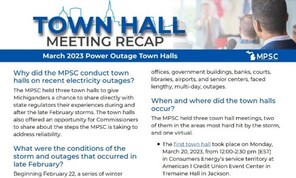
The MPSC has published a recap of the recent town halls the Commission held in March in Jackson and Dearborn, two areas hard hit by the winter storms that resulted in power outages affecting approximately 427,000 customers of Consumers Energy Co. and 630,000 customers of DTE Electric Co., and the death of a volunteer firefighter with the Paw Paw Fire Department who came in contact with a downed wire.
The Town Hall Meeting Recap includes information about issues raised by utility customers who attended the town halls, information and resources available for utility customers, and a rundown of actions the MPSC is taking to address the challenges Michigan’s electric grid faces.
|
The MPSC has issued a final report in its MI Power Grid effort launched in 2019 to maximize the benefits of Michigan’s transition to clean energy, but the Commission noted that its impact —and the work it produced — will continue.
The final report, to be posted in Case No. U-20645 in the MPSC’s E-Dockets, outlines how MI Power Grid included 386 stakeholders in 70 stakeholder meetings, resulting in 70 Commission orders in 16 case dockets. It notes accomplishments including adoption of recommendations on customer data and participation, an expedited review process for utility pilot projects, adoption of updated planning parameters and filing requirements for utility integrated resource planning, as well as higher power outage credits for customers who endure long outages and other improvements to service quality rules and technical standards.
“The MPSC is grateful to all the organizations and individuals who’ve put in so much effort along with MPSC Staff to dive deeply into issues facing the industry during this historic transition to clean, distributed energy resources,” MPSC Chair Dan Scripps said. “The incredible work done through MI Power Grid has helped inform and shape the ways Michigan will integrate new clean energy technologies, optimize grid investments and engage utility customers and other stakeholders to help ensure a modernized power grid that provides reliable, affordable service.”

April is national Safe Digging Month, and the MPSC reminds anyone planning a project that involves digging — no matter how small — to call MISS DIG 811 in advance so that underground utilities can be marked for safety.
If you’re putting in a new fence, garden or mailbox, call MISS DIG 811 first. It’s a simple step that can help prevent buried utility lines from being damaged, leading to possible service outages, injuries or deaths.
“Contacting MISS DIG 811 before you dig is free and easy, and it’s the law,” said Briant Thomas, President of MISS DIG System Inc. “No matter how shallow the digging may be before your project, make the call to 811, so you and your community can stay safe and connected.”
Call 811 at least three days before digging or fill out a request online at www.MISSDIG811.org. Trained workers from utility companies will be sent to job sites to mark the location of buried gas, electric, water and sewer, phone and other utilities with spray paint or flags. Anyone planning to dig is asked not to do so until utilities are marked, and to carefully dig by hand in the designated utility area.
“Contacting MISS DIG 811 before you dig is free and easy, and it’s the law,” said Briant Thomas, President of MISS DIG System, Inc. “No matter how shallow the digging may be before your project, make the call to 811, so you and your community can stay safe and connected.”
More information is available in the MPSC’s tip sheet on MISS DIG 811 and safe digging.
|
Here’s information about orders the Commission approved March 24 and April 13:
- The MPSC authorized Upper Peninsula Power Co. to raise customer rates by $10.8 million after a settlement agreement was reached with all parties involved in the utility’s request for a rate increase filed in September 2022 (Case No. U-21286). UPPCO initially sought an increase of $25.3 million, citing continued infrastructure investments and associated operating expenditures needed to improve reliability and resiliency. UPPCO agreed not to seek to have rates increased again before Jan. 1, 2025. A typical residential customer using 500 kilowatt hours per month will see an increase of $12.30, or 10.1%, on their monthly bill.
- The Commission approved the termination of Realgy LLC’s license to operate as an alternative gas supplier in Michigan, resolving all matters related to investigations and enforcement actions by the MPSC into the company’s marketing and business practices (Case No. U-15419).
- The MPSC announced it has awarded a $248,500 contract to Enercon Services East PC to conduct a feasibility study on nuclear power generation in Michigan as directed by Public Acts 166 and 218 of 2022 (Case No. U-21358). The study is required to consider advantages and disadvantages of nuclear energy in Michigan, its environmental and economic impacts and other issues.
- The Commission approved a one-time voluntary refund of $5 million from DTE Gas Co. to its customers in the form of reduced costs the company would seek in a future rate case related to routine capital expenses such as gas main replacement and maintenance, equipment upgrades and vehicle replacement (Case No. U-21331).
- The MPSC approved a Consumers Energy Co. one-time voluntarily refund to its customers of $5 million of $22 million in higher than expected earnings in 2022, in the form of payment assistance to low-income and payment-challenged customers (Case No. U-21332). The Commission, however, denied the utility’s request to allocate the remaining $17 million to incremental electric capital spending, or in the alternative, storm restoration efforts, finding that the company hadn’t sufficiently demonstrated a direct benefit to customers through using the $17 million refund to increase electric capital spending, nor adequately supported using the money to offset storm restoration costs. The Commission said it would be open to proposals that more directly benefit customers, such as tree trimming, additional assistance funding for low-income customers or a direct customer refund.
|