UPDATE: Governor Whitmer COVID-19 Daily Update June 26, 2020
Michigan Executive Office of the Governor sent this bulletin at 06/26/2020 06:30 AM EDT
Below is an update on the 2019 Coronavirus outbreak as of 10:00 PM on 6/25/2020
UPDATE
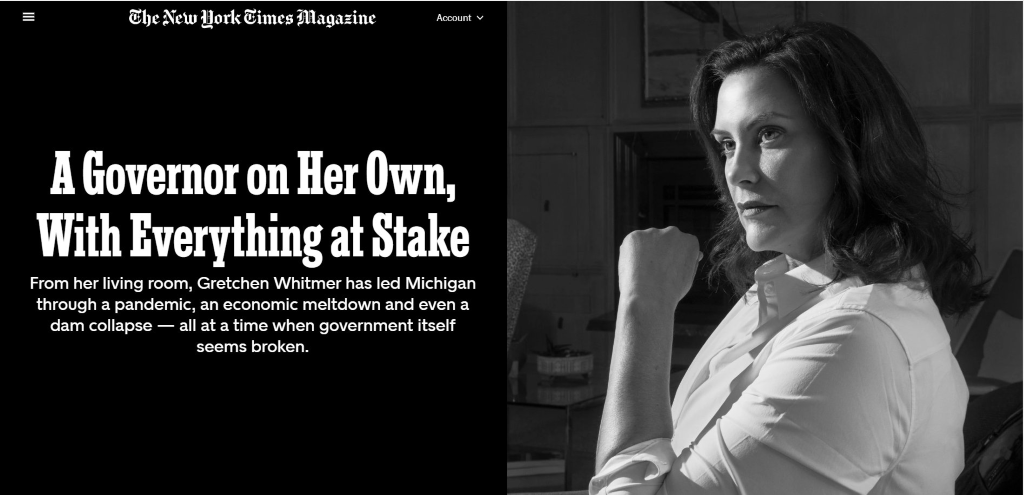
- Michigan has faced extraordinarily difficult circumstances over the past few months, and Governor Whitmer has remained laser focused on the state she calls home. Read more about it The New York Times profile below:
The New York Times: A Governor on Her Own, With Everything at Stake
BY: JONATHAN MAHLER
Gretchen Whitmer first heard the word “coronavirus” over the 2019 Christmas holidays from her younger sister, who a decade earlier contracted H1N1. Whitmer, just a year into office and preoccupied with her agenda for 2020, barely registered it. She was in a hurry to push forward on some of her campaign promises, like introducing an array of new education programs and repairing Michigan’s badly potholed roads. The state’s Republican lawmakers had blocked her at nearly every turn, but now, with the economy in Michigan and America booming, Whitmer had a plan to make an end-run around the Legislature by issuing $3.5 billion in bonds to help fund her projects. January was going to be about building political momentum for that effort and gearing up for a presidential election in which Michigan, where Donald Trump won by just 10,704 votes in 2016, was again going to be an important battleground state. Whitmer was tapped to deliver the Democratic response to Trump’s annual State of the Union address on Feb. 4.
The exchange — and the entire briefing — was a violent jolt to Whitmer. She asked her senior staff members if they thought she should declare a state of emergency, and they discussed the pros and cons. Doing so would unlock her emergency power and also communicate the seriousness of the threat to Michigan’s citizens. But without any positive tests, how would they justify such a drastic measure? After some debate, Whitmer decided not to. But she did start preparing for what now seemed inevitable, convening disparate agencies across the state government to anticipate and manage the multiple needs an epidemic might cause.
In mid-March, as Michigan’s caseload continued to grow, Whitmer faced another tough decision: Should she lock down the state? Though the federal government was now acknowledging that tens of thousands of Americans would likely be killed by Covid-19, it was declining to issue a national stay-at-home order or even offer guidance to the nation’s governors. Several pro-business groups, including Michigan’s Chamber of Commerce — a powerful force in state and national politics — were publicly pressing Whitmer to keep the state largely open. She worried that if she moved too soon, she would lose public support. On March 20, J.B. Pritzker, the governor of Illinois, which is near Michigan and had roughly the same number of cases, locked down his state. Whitmer still felt that a shutdown, with its attendant economic devastation, was premature.
Over the next 48 hours, Michigan’s caseload doubled to more than 1,000, and it became clear that the state had to close. But how much of it? Whitmer’s legal counsel, Totten, had already started writing a stay-at-home order. Now, alarmed by the exponential growth in cases, Whitmer felt the draft was too permissive. Michigan needed a near total lockdown. Totten brought the revised order to Whitmer in her office on March 23. He told her that the moment she signed it, she would almost certainly be exercising more power than any governor in the history of Michigan. “There has never been a governor who literally told everyone in the state to stay home,” he said. “That’s just extraordinary.”
Whitmer was also struggling to slow the virus’s spread. For all of the unknowns about Covid-19, one scientific certainty at the time was that diligent hand washing was critical to containing the outbreak. This guidance, seemingly simple, would be next to impossible for the thousands of Detroit residents who were without running water, in part because of a recent crackdown on late payments. Whitmer had actually anticipated this problem. On the eve of the state’s first reported cases, she and the mayor of Detroit introduced a joint program to restore water service immediately to homes where it had been shut off; customers would be billed later, at a rate of $25 a month for the duration of the outbreak. It soon became clear, however, that because of the city’s antiquated water system, many homes required extensive plumbing repairs before service could be restored. Whitmer issued an executive order requiring water suppliers to immediately send out crews to do whatever was necessary to restore service in every home.
The afternoon before the protest was scheduled to take place, the state’s legislative leaders decided to adjourn for the rest of the week. Given the now real possibility of violence, it was probably the responsible thing to do. But Whitmer was still appalled by the cynicism of her opposition. “The Republican leadership doesn’t want to be in town when the protesters they incited are coming,” she said. “They don’t want to be here because they know it’s going to be too much.”
Whitmer first learned that the Edenville Dam was in danger of collapse from her chief of staff on the evening of May 19. It gave way, and the resulting floodwaters quickly destroyed another dam farther downriver. Water was pouring into the nearby city of Midland. Whitmer had not left Lansing since the start of the pandemic, but the following morning she flew up to survey the damage. She visited a shelter to talk to some displaced residents, looked down on the wrecked homes and washed-out bridges from a State Police helicopter and gave a brief news conference in front of Midland High School. “I feel like I’ve said this a lot over the last 10 weeks, but this is an event unlike anything we’ve seen before,” Whitmer said.
Whitmer’s agenda for 2020 once included a Flint-inspired water initiative to replace dangerous lead pipes across the state and a long list of education programs. (Among other things, she was planning to devote an additional $60 million to academically at-risk or economically disadvantaged students.) Late last year, her senior staff members collected these and other proposals into a formal internal document: “2020 Priorities Strategy.” Recently, they held a burial ceremony for it over Zoom. Everyone took turns delivering eulogies. “Listen, it’s over,” one staff member said. “Pray for it.”
As the days passed, the decision facing Whitmer came to seem less complicated. The next time I talked to her, she had just returned from a march through Detroit with a group of local religious leaders. She went with one of her two teenage daughters, who had been pestering her for days to let her attend a protest. It was a peculiar development — a head of government participating in a protest against the government — but it also made perfect sense in this deeply disorienting moment. “There’s a lot of pain across this country,” she said when I asked what had inspired her to go to the protest. “This is a righteous cause and I wanted to be there in person.”
Whitmer and I had been talking for almost two months. We had covered a lot of ground: Her struggle to get medical supplies to her state; her inability to ban firearms from the Capitol; the bursting of a dam; the anger and pain now exploding across her state. As the weeks went by, it became increasingly clear to me that all of these different conversations about all of these different subjects were really one conversation about one subject: Her government — our government — was badly broken.
This breakdown — this growing sense that the government is them and not us — has played out at every level of American political life. Whitmer is not only fighting a rolling wave of crises perhaps without precedent, but the legacy of years of eroding faith in the institution she represents. Even when the government does try to lead, large chunks of the population don’t want to be led.
During one of our last conversations, I asked Whitmer how she defined success, given the almost unimaginably daunting choices that lay ahead for her. She had just returned from another trip to Midland, where she learned that only a small fraction of the flood victims were likely to have their claims paid by their insurance companies. It was the sort of question Whitmer usually steered away from, migrating instead to firmer ground: the intransigent Legislature, the White House, the budget. She thought about it for an uncharacteristically long moment as she paced outside the governor’s residence and then offered the only response she could. “That’s a hard question to answer,” she said. “It’s one that we’re grappling with.”
- Yesterday, Attorney General Dana Nessel announced that the Ingham County Circuit Court Judge James S. Jamo granted her motion for a temporary restraining order requiring Enbridge Energy to cease operations of Line 5. Governor Whitmer’s Press Secretary, Tiffany Brown released the following statement:
“Governor Whitmer applauds the court’s decision to issue a temporary restraining order to shut down Line 5 immediately, following severe damage to an anchor support. Enbridge’s decision to continue pumping crude oil through the Straits of Mackinac with so many unanswered questions was reckless and unacceptable. Enbridge owes a duty to the people of Michigan and must answer to the state for how it treats our Great Lakes. The governor will continue working to keep our water safe.”
The Michigan Department of Attorney General filed motions for a temporary restraining order and preliminary injunction Monday after Enbridge’s disclosure late last week of significant damage to an anchor support on the east leg of the Line 5 pipelines.
“Enbridge has failed to provide the State with information about the cause of this significant development involving Line 5, and so I’m very grateful for the Court’s decision today,” Nessel said. “While the fact that Enbridge reactivated one of the lines before consulting with the State is concerning, the fact that the company has failed to disclose the cause of this damage is equally alarming, considering the impact a breach in the pipeline could have to our state residents and economy. With the continued operation of this pipeline, the risk of severe and lasting environmental damage to Michigan’s most important natural resource continues to grow every day. However, this ruling, while significant, is only a short-term fix. If the lines are put back into operation, one mismanaged incident or accident would result in a historic catastrophe for our state. Work must continue toward complete removal of Line 5 from our waters.”
- Governor Whitmer signed Executive Order 2020-133, which sets guidelines for the safe return of professional sports, without a live audience. The order follows Major League Baseball’s announcement that a shortened 60-game season would begin on July 24 with players reporting for spring training at their home ballparks by July 1.
“Good news, sports fans,” Governor Whitmer said. “We are now ready to gradually and safely allow professional sports to resume in Michigan. While this is an encouraging step in the reopening of our economy, it is critical for athletes to continue social distancing and taking precautions to stay safe. We want to keep our momentum going and keep moving forward, so it’s incumbent on everyone doing their part to slow the spread of COVID-19.”
- The governor also signed Executive Order 2020-132, which continues to allow certain state administrative hearings to be held by video conference or phone in place of in-person hearings until July 31, 2020.
“By extending this executive order, we can protect public health and safety by allowing certain agencies and commissions to conduct their important work remotely, ” Governor Whitmer said. “Many Michiganders have done their part to protect the heroes on the front lines and lower the chance of a second wave, but COVID-19 is still impacting Michiganders across the state. That’s why it is important that we do not let our guard down yet and continue doing our part to protect Michigan families.”
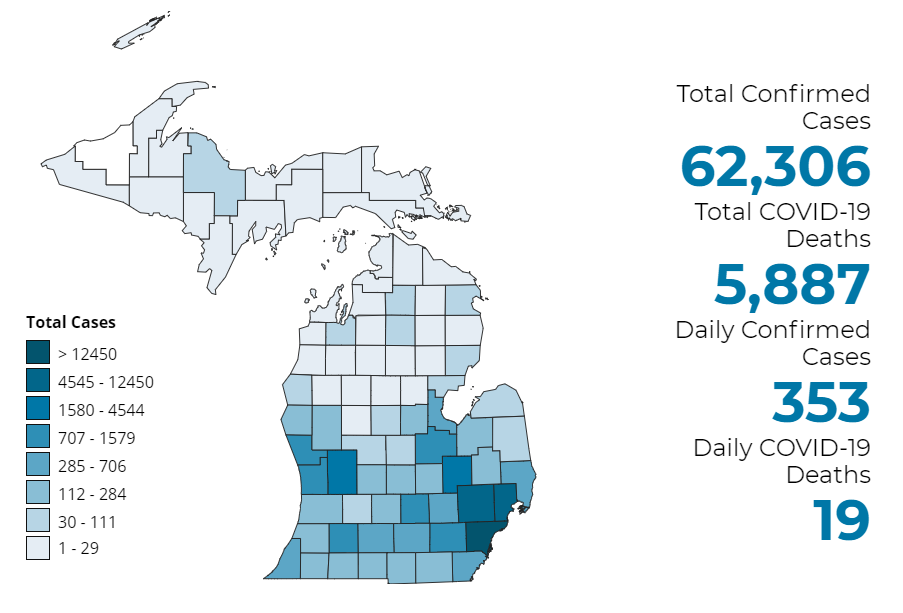
- The Michigan Department of Health and Human Services (MDHHS) announced 353 new cases of COVID-19 yesterday. This brings the total number of positive cases of COVID-19 to 62,306
HAPPENING ACROSS STATE GOVERNMENT
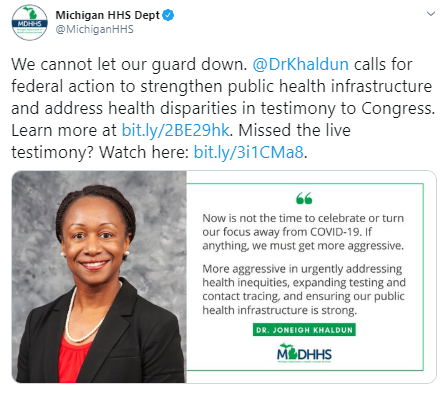
- MDHHS and Michigan’s Chief Medical Executive, Dr. Joneigh Khaldun continue to work hard every day to fight COVID-19. Yesterday, MDHHS reminded Michiganders to keep their guard up, while Dr. Khaldun urged for federal action and assistance with addressing health disparities across the state.
- The Department of Insurance and Financial Services is educating Michiganders on how they can protect their homes through lender programs for those impacted by COVID-19 and through insurance policy reviews to make sure they have the coverage they need before they need it.
“It is important to make sure homeowners understand how to financially protect their homes, especially as we recover from the COVID-19 pandemic,” said DIFS Director Anita Fox. “American Housing Month is a great opportunity to review lender programs and insurance policies to make sure you have the financial protection you need all year long.”
- The Michigan Department of Labor and Economic Opportunity announced Michigan Works! Agencies will manage and execute the 2020 Summer Young Professionals employment experience, preparation, and exploration program – a new initiative that provides a meaningful, individualized introduction to the world of work to under-represented young adults. The program is designed to reduce youth unemployment and place young adults, ages 14-24, on the right path to gain the skills necessary to achieve lifelong economic self-sufficiency. Young adults will be supported with stipends for career exploration and preparation or wages earned for participation in work experiences.
RESOURCES
- CDC Situation Updates
- Michigan Updates
- Map of country-specific travel health information
- About COVID-19
- COVID-19 Hotline 1-888-535-6136
MEDIA COVERAGE
- ESPN: Michigan Governor Gretchen Whitmer clears pro sports to resume in state without fans
- Detroit Free Press: Michigan Gov. Gretchen Whitmer executive order allows professional sports to return, without fans
- MLIVE: Michigan Gov. Gretchen Whitmer signs executive order for pro sports to return
- The Detroit News: Enbridge must temporarily shut down Line 5, Ingham Co. judge says
- MLIVE: Judge orders Enbridge Line 5 temporarily shut down
A BIT OF RELIEF