September 2025
Degrees Behind the Walls: MDOC’s Class of 2025
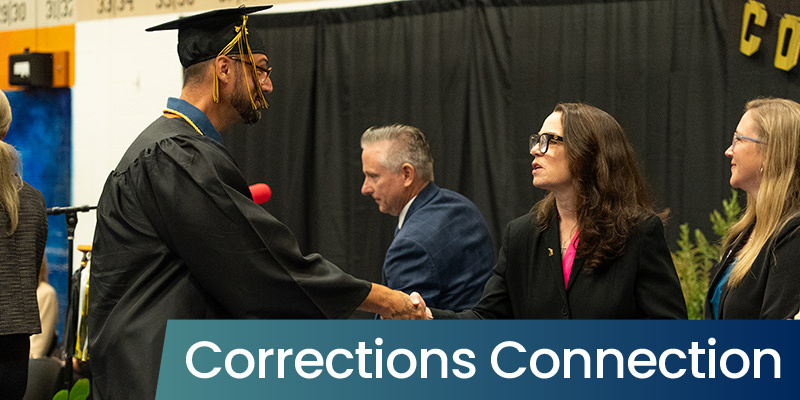
Hope College graduates celebrate their achievement at their Muskegon Correctional Facility ceremony on June 25, 2025.
Graduation season is coming to a close here at MDOC, with one last graduation still to come. With students donning tassels and gowns walking the stage to receive their degrees in front of their loved ones, it has been remarkable to see the Class of 2025 succeed. Here they are by the numbers:
- 10 college graduation ceremonies around the state in 2025.
- More than 250 graduates
- Degrees conferred in programs like business administration, social work, and community leadership.
We’ve seen the transformative power of these programs firsthand and the role they can play in helping returning citizens succeed. That’s why the department continues to commit to expanding post-secondary education opportunities for those in custody. Here is where we have grown to:
- Over 1,300 students enrolled in classes to earn an associate or bachelor’s degree, along with certificates that can help them get a good-paying job.
- 13 active college and university partners, with at least one more expected this fall.
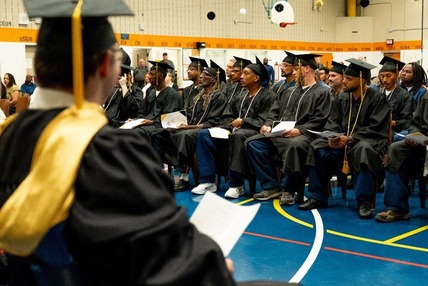
Students attend their graduation from Mott Community College on June 17, 2025, at Thumb Correctional Facility
Building a Safer Michigan:
Jerry Brown's Legacy
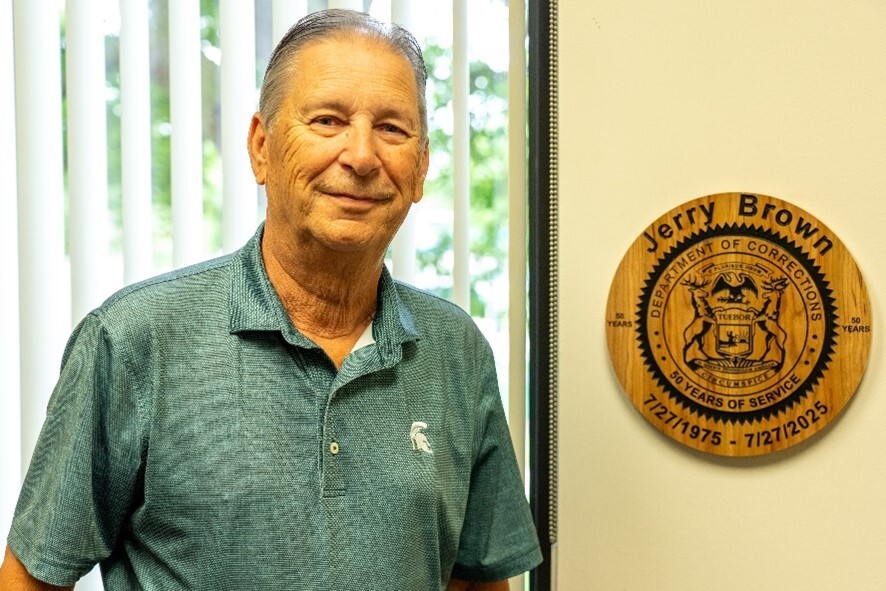
Supervisor Brown in his office with a plaque his colleagues presented him with
Jerry Brown has built a career serving Michigan for 50 years with MDOC. After graduating from MSU with a degree in criminal justice, he had an opportunity to join MDOC as a probation agent in Detroit. He talks about the giant physical binders he'd have to carry around to keep handwritten case notes.
His career then took him to several correctional facilities; first overseeing a housing unit at the now-closed Phoenix Correctional Facility and then as the Supervisor of Camp White Lake where he built strong community partnerships. Upon the closure of Michigan's prison camps, Jerry became assistant deputy warden at Robert Scott Correctional Facility in Plymouth, learning the ropes of a large facility with hundreds of offenders in custody there. He remembered one big hurdle implementing the policy banning cigarettes from housing units.
When that facility closed, he returned to field operations back at Detroit Lawton, helping open the Detroit Reentry Center, then to Macomb, and to where he is now as a supervisor at Oakland County Probation. He is grateful for the wide range of opportunities he's had during his career with the department, giving him new challenges and new motivation with each move.
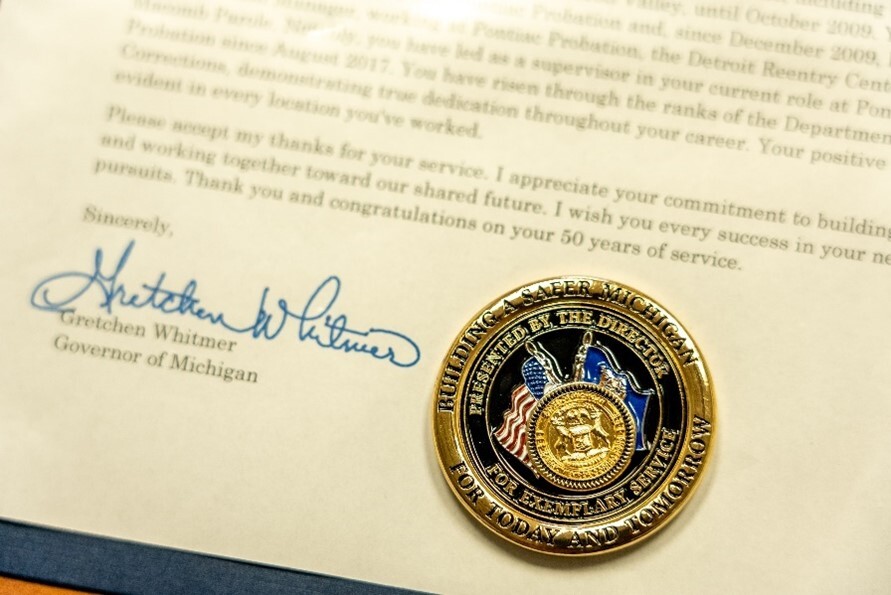
Supervisor Brown credits his ability to adapt and his focus on the positive aspects of this work as the key to his longevity. He has lived with the purpose of changing one life at a time to, in turn, change generations of lives. He received a recognition coin award upon his 50 years of service that says, "Building a safer Michigan for today and tomorrow", a phrase that encapsulates what he has done, and what keeps him motivated to continue his role at the Michigan Department of Corrections today.
A letter Supervisor Brown received from Gov. Whitmer and a coin received from MDOC Dir. Washington
A Day at the Lower Peninsula Officer Academy
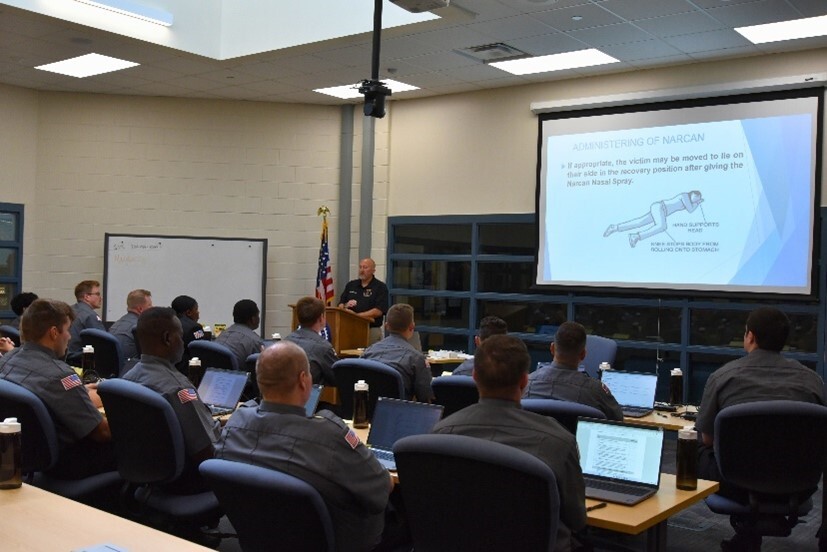
Recruits getting training in emergency first aid
The summer class of recruits are currently at the Lower Peninsula officer academy finishing up their 8 weeks of intensive training before heading to facilities across the state. At any point in time platoons are engaged in a wide variety of training; to gain skills they’ll need to be excellent corrections officers.
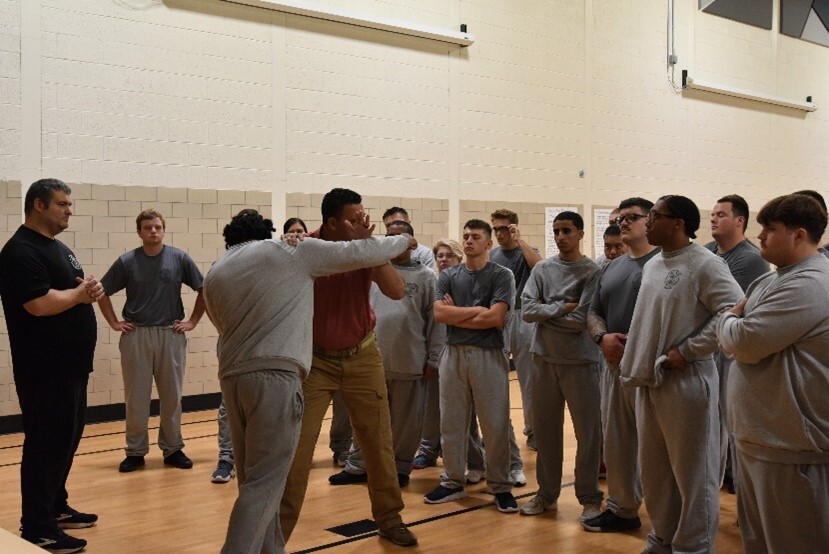
As a snapshot of the academy, we stopped by on one specific Tuesday morning to see what the different platoons were up to. One platoon was learning about filing offender misconducts, another was engaged in self-defense and prisoner management exercises. Two platoons were learning skills for emergencies in first aid and firearm handling respectively, and a fifth was focused on committing key policy to memory.
The Training Unit is proud that recruits don’t just learn policy or theory — they engage in scenarios that mimic real-world situations to apply it. Importantly, ethical decision-making is integrated throughout.
Recruits engaged in learning self-defense and prisoner management exercises
Agent Hughes Guides Juvenile Lifers to New Beginnings
Agent Hughes and Leonard share a laugh
Imagine you’re out and about experiencing today’s world with smartphone in hand, debit card in your pocket, sitting in your modern car with sophisticated features. Now imagine you’re experiencing this, but the last time you had been free to do so was 1975. This is the reality for Leonard. He was incarcerated at age 17 with a life sentence, but with support from his parole agent, Antoinette Hughes, he is finding his way in his new beginning.
Ten years ago, the U.S. Supreme Court ruled mandatory life sentences without parole for juveniles unconstitutional, leading to the resentencing for Leonard. After decades of incarceration for his crime, he faced the daunting task of imagining what life in today’s society would look like for him – something he never thought he would do. During his transport from the correctional facility to the parole office; he realized that for the entire drive he had been sitting as though he was in restraints even though he was not anymore.
Leonard was fortunate to be assigned Agent Hughes, an expert in juvenile lifer casework. He credits her with his successful reentry, going above and beyond to provide tools and resources, like help to find housing, transportation, employment, critical documents; and building a budget and credit. She hosts group meetings with lifers under her supervision to share experiences, struggles, and successes.
Today Leonard has stable housing, a paid-off car, a talent for landscaping, and a determination to do the best he can and never look back. His success is a testament to how Agent Hughes’ accountability and support have been instrumental as he navigates this new part of his life.
Agent Hughes at her desk
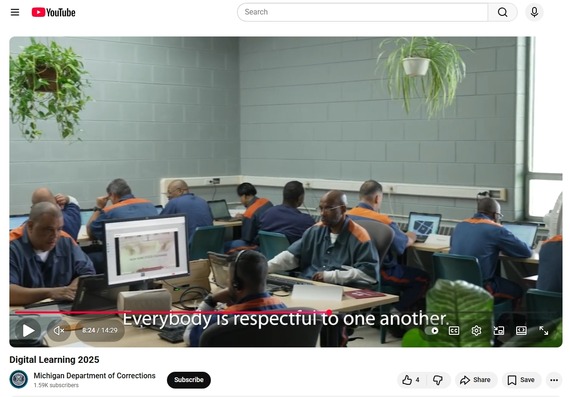
Earlier this month we released a special back-to-school edition of Corrections Connection highlighting teacher Greg Hauck and his recent award from Correctional Education Association. Now you can watch this video showing a behind the scenes look at Greg's class, how digital learning in a corrections setting has evolved, and testimony from some of his students. Click here to watch now.
Join the Family Advisory Board
MDOC has a Family Advisory Board that helps foster effective communication between the department and the loved ones of incarcerated individuals — the board is now looking for new members.
This group provides feedback to the department about opportunities to strengthen efforts for family reunification, effective reentry supports, and other topics impacting incarcerated individuals and their families.
You can express interest by filling out the form on our website. Those who are selected are expected to attend one virtual meeting per month, as well as two in-person meetings per year. Submitting a form is an expression of interest and not everyone will be selected for the role.
MDOC Minute: A Helpful Tip
|