MDHHS HCV Telehealth Treatment Program Expands Access to Cure
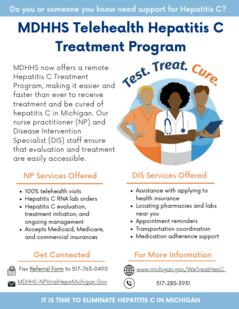
MDHHS hired nurse practitioner Elaine Engelsman in 2024 to implement the new hepatitis C all-telehealth treatment program (HTTP) which provides low barrier care and increases access to evaluation and treatment. The MDHHS hepatitis C Disease Intervention Specialist (DIS) team works alongside the nurse practitioner to provide case management support from diagnosis to cure, helping patients overcome barriers and successfully complete HCV treatment.
From July 1, 2025, to July 31, 2026, 189 individuals were referred for HCV treatment, 96 started treatment, 75 completed treatment, 41 confirmed sustained virologic response (SVR).
To learn more, visit Michigan.gov/WeTreatHepC.
|
Help Prevent Overdose: Get a Free Naloxone Box
MDHHS is providing free naloxone distribution boxes to any businesses, agencies or organizations interested in placing a naloxone box in their community. Naloxone boxes are weather-resistant metal boxes offering easy, 24/7 access to naloxone— lifesaving medication that can reverse an opioid overdose.
Naloxone distribution is a key component of Michigan’s continued efforts to reduce overdose deaths and save lives by addressing substance use disorder through the pillars of prevention, harm reduction, treatment and recovery services. In 2016, Michigan passed a Good Samaritan Law, to protect anyone administering naloxone, and a standing order law, allowing people to obtain naloxone for use in an emergency without an individual prescription. Community groups interested in distributing naloxone within their community can order free naloxone through Michigan’s Naloxone Direct Portal.
In the fourth quarter of fiscal year (FY) 2026, 50 naloxone boxes were distributed across Michigan to diverse groups including churches, syringe service programs, local health departments, police departments, homeless shelters, and recovery centers. MDHHS will extend this contract in FY 2027 to support further expansion of naloxone distribution boxes across the state. Organizations interested in naloxone administration training or implementing a naloxone distribution box in their community can submit their request through the MDHHS Naloxone Box Request Form.
For questions, contact the MDHHS Harm Reduction and Viral Hepatitis Prevention Unit at MDHHS-SyringeAccess@Michigan.gov. For a map of all naloxone supply locations in Michigan, visit the MDHHS Naloxone Directory.
Michigan's Childhood Vaccine Recommendations Remain Unchanged
MDHHS is encouraging residents to get up to date on recommended vaccines before the start of the school year, as Michigan continues to follow evidence-based vaccine guidance outlined in the Standing Recommendation.
In December 2025, Michigan’s Chief Medical Executive issued a Standing Recommendation, supporting vaccine recommendations grounded in rigorous scientific evidence and transparent decision-making. The Standing Recommendation advises clinicians to use the immunization schedules developed by the American Academy of Pediatrics and endorsed by 14 leading medical and health care organizations including the American Academy of Family Physicians, American College of Obstetricians and Gynecologists, American Medical Association and others as the standards of care for immunization practices.
“Michigan’s childhood vaccine recommendations, school requirements and exemption processes remain unchanged, even in light of the recent federal executive order,” said Dr. Natasha Bagdasarian, chief medical executive. “We understand that shifts in federal guidance can create uncertainty for parents and physicians, so we want to provide clarity. Michigan continues to support the immunization schedules outlined in our Standing Recommendation, which remain the foundation of our approach to protecting children’s health.”
Visit IVaccinate.org and Michigan.gov/Immunize for more information on vaccines.
Education and Resources
NEW: Free Hepatitis C Online Lesson on Children and Adolescents
Hepatitis C Online 4th Edition launched a new HCV in Children and Adolescents lesson on how to diagnose and treat HCV in these populations. It offers 1.0 free CME/CNE/Pharmacology CE for APNs.
Other HCV-related offerings from Hepatitis C Online:
- Seven modules with 37 no-cost CME/CNE/CE and 15 pharmacology CE for advanced practice nurses, and Certificates of Completion to document work.
- Multiple clinical calculators and screening tools, in-depth medications section, and illustrated HCV biology section.
- National hepatitis C experts explore treatment complexities via mini-lectures and clinical challenges.
Henry Ford Hepatitis C Clinical Consultation Program - Free consultation line available Monday-Friday 8 a.m. - 5 p.m. for all health care professionals with questions about hepatitis C disease management and treatment 313-575-0332.
MATEC Michigan - Free hepatitis C case-based office hours available for all health care professionals. To request an appointment with a physician specialized in HCV, please call 313-962-2000. For urgent questions, including after hours and on weekends, call 313-408-3483.
Overdose Prevention Engagement Network (OPEN) - Provides hepatitis C provider consultations for substance use related cases and education, both online learning and live webinars. In addition, OPEN has a number of programs offering various resources to communities and providers. To learn more, visit the OPEN website.
What is Harm Reduction and How Does it Relate to Hepatitis C?
- Harm reduction is a public health approach that uses practical strategies to reduce the negative impacts of drug use, such as preventing overdose deaths and limiting the spread of infections.
- As of August 2026, MDHHS supports and invests in 42 harm reduction agencies (HRAs) that operate over 150 locations in 75 counties.
- HRAs provide services to people who use drugs to avoid or reduce injection-related health risks including: safer use supplies; fentanyl test strips; naloxone, an opioid overdose reversal medication; infectious disease testing; referrals to treatment and services; including health education, wound care and more.
- A 2025 MDHHS study found harm reduction efforts make significant impacts on overdose deaths, hospitalizations, cases of hepatitis C.
- It is important to note that access to harm reduction services does not increase drug use. People who connect with HRAs are five times more likely to access substance use disorder and recovery services and are three times as likely to reduce or fully stop their use1-3.
- In the United States, injection drug use (IDU) is the leading cause of new HCV infections, accounting for about 70% of cases4. HRAs are associated with up to 50% reductions in prevalence of HCV and human immunodeficiency virus (HIV) 5.
-
Hagan, H., McGough, J.P., Thiede, H., Hopkins, S., Duchin, J., Alexander, E.R. (2000). "Reduced injection frequency and increased entry and retention in drug treatment associated with needle-exchange participation in Seattle drug injectors", Journal of Substance Abuse Treatment; 19:247–252.
-
Strathdee, S.A., Celentano, D.D., Shah, N., Lyles, C., Stambolis, V.A., Macal, G., Nelson, K., Vlahov, D. (1999). "Needle-exchange attendance and health care utilization promote entry into detoxification", J Urban Health; 76(4):448-60.
-
Heimer, R., (1998). “Can syringe exchange serve as a conduit to substance abuse treatment?”, Journal of Substance Abuse Treatment; 15:183–191.
-
Martin NK, Hickman M, Hutchinson SJ, Goldberg DJ, Vickerman P. Combination interventions to prevent HCV transmission among people who inject drugs: modeling the impact of antiviral treatment, needle and syringe programs, and opiate substitution therapy. Clin Infect Dis. 2013;57(Suppl 2):S39-S45.
-
Aspinall, E. J., Nambiar, D., Goldberg, D. J., Hickman, M., Weir, A., Van Velzen, E., Hutchinson, S. J. (2014). “Are needle and syringe programmes associated with a reduction in HIV transmission among people who inject drugs: a systematic review and meta-analysis”, Int J Epidemiol; 43(1), 235-248. doi:10.1093/ije/dyt243.
Interested in Integrating Harm Reduction into Your Practice?
Connect to a local HRA:
- HRAs in Michigan are more common than you think. Over the last several years, MDHHS has distributed opioid settlement funds to HRAs in support of the state strategy addressing prevention, harm reduction, treatment and recovery.
- To locate your local HRA go to: 2026 Harm Reduction Agency Map.
Distribute Naloxone:
- MDHHS is providing free naloxone distribution boxes to any businesses, agencies or organizations interested in placing a naloxone box in their community. Organizations interested in naloxone administration training or implementing a naloxone distribution box in their community can submit their request through the MDHHS Naloxone Box Request Form.
- For a map of naloxone supply locations across Michigan, visit the MDHHS Naloxone Directory.
- Community groups interested in distributing naloxone within their community can order free naloxone through Michigan’s Naloxone Direct Portal.
- For more options, visit MDHHS's Get Naloxone Now page.
Provide access to drug testing strips:
- Many Michigan HRAs offer free fentanyl, xylazine, and medetomidine test strips.
- Reach out to your local HRA to get test strips. To locate your local HRA go to: 2026 Harm Reduction Agency Map.
Stay up to date on changes in the unregulated drug supply:
- MDHHS sends email alerts when an emerging substance or substance of concern is detected in post-mortem toxicology testing. If you would like to be added to these alert emails, contact MDHHS-MODAsurveillance@michigan.gov.
Learn more and stay current on harm reduction:
- MDHHS offers Harm Reduction 101 training ranging from one hour to four hours based on your needs. Topics include history of harm reduction, how to integrate into practice, naloxone training, stigma reduction, person first language and more.
- Email MDHHS-SyringeAccess@michigan.gov for more information and to schedule your training.
|