|
January 2026
Welcome to the January 2026 edition of the Health Care Workforce Division newsletter!
This month’s newsletter will focus on Health Professional Shortage Area (HPSA) updates, the annual Nurse Licensure Survey (NLS), and other exciting division updates.
|
|
MI Health Care Workforce Shortage Areas
HPSAs in Proposed for Withdrawal Status and Upcoming MUA/P Designations Updates
Completed reassessments of areas with HPSAs in Proposed for Withdrawal Status:
Approximately 48 Health Professional Shortage Area (HPSA) designations were placed in proposed for withdrawal status after the 2025 National Shortage Designation Update (NSDU) completed on September 23, 2025. Following the update, several HPSAs were identified as ineligible due to changes in census tract boundaries or failure to meet federal thresholds such as lower poverty level or population to provider ratios. We extend our sincere appreciation to everyone who collaborated to review provider information and supported the HPSA reassessment process for HPSAs in proposed for withdrawal status. This effort ensured timely submissions and compliance with federal requirements and deadlines.
Service areas with HPSAs in proposed for withdrawal status were reassessed for eligibility under other types of shortage designations, including Medically Underserved Areas/Populations (MUA/P) and special population HPSAs such as Medicaid Eligible (ME) HPSAs. Overall, all proposed for withdrawal HPSAs were evaluated, and new applications were submitted for those meeting eligibility requirements. Applications for eligible areas were submitted and the federal government (HRSA) is currently reviewing the following submissions for a HPSA reinstatement or new designation in the area, which will replace current ineligible HPSAs in proposed for withdrawal status and ensure that the area has some type of shortage designation for eligibility to several HPSA/MUA/P- related programs.
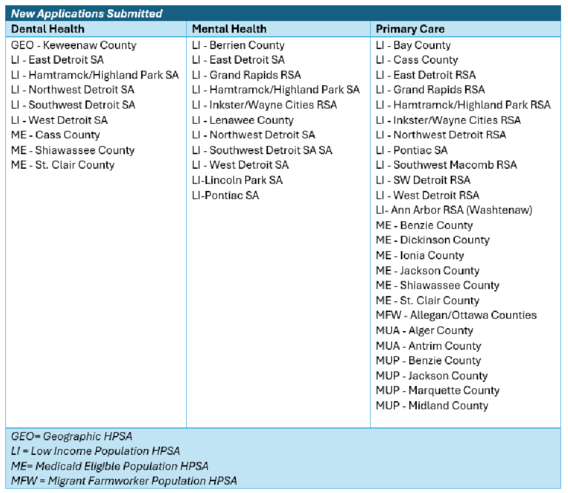 |
Please note that the federal review process may take up to 90 days for final determination after an application is submitted. HPSAs in proposed for withdrawal status that did not qualify for an application update, will be officially withdrawn in July 2026. We will continue to validate the provider data and future federal data sources updates such as new U.S. Census Data in the shortage designation system in spring for any changes that may support a HPSA reinstatement or new designation for some affected areas. You may find HPSAs designations by state and county, including approved designations and the list of current HPSAs in proposed for withdrawal status using the HPSA Find Tool.
Upcoming 2026 MUA/P Designations Updates
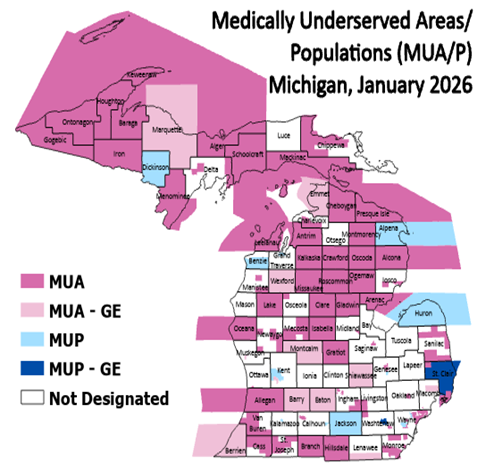
The next phase of the shortage designation process focuses on updating Medically Underserved Areas (MUA) and Medically Underserved Populations (MUP), some of which date back to 1978. Although HPSA designations are required to be updated every three years, currently, there is no requirement to update MUA/P designations per federal policies and regulations. We are proactively reevaluating all MUA/P designations in Michigan for updates to accurately represent the needs of the population in those areas based on current demographic data and workforce changes, supporting health center planning and development, rural health clinics certification, and other safety net providers and programs utilizing MUA/P designations.
Currently, there are 117 MUA/P designations in Michigan, which include 90 MUAs, 13 MUPs, and 14 MUA or MUP Governor’s Exceptions (GE). The Governor’s Exception is usually our last option if the area does not meet either the traditional MUA or MUP criteria and there is evidence of exceptional need for additional health resources in the area. As we work on the MUA/P updates, we anticipate that several outdated MUA/P designations will be replaced with new designations if they no longer meet the requirements for the existing designations in those areas. For instance, the MUA Governor’s Exception for Jackson County, last updated in 1996, did not qualify for a MUA update and the area was recently designated as a MUP designation instead, replacing the outdated MUA designation in the county. More information about the MUA/P Governors’ designations, including the Exceptional Medically Underserved Population (Exceptional MUP) and Governor’s-Designated Secretary-Certified Shortage Areas for Rural Health Clinics will be shared in future newsletter edition.
 |
Important Dates
- The federal Source Data Update (SDU) will occur on March 21, 2026, incorporating 2024 data for most federal datasets in the shortage designation system.
- The HPSA Moratorium Blackout Submission Window runs from March 9 to April 30, 2026, supporting the annual Federal Register Notice (FRN) publication targeted for July.
- Note that the shortage designation system will prevent users from submitting any designation application during the blackout period.
- All new designation applications or/and updates must be submitted by February 8TH to guarantee they are reviewed and approved by HRSA before the FRN data pull process on April 30, 2026.
- All applications submitted after February 8, 2026, require a waiver of the 30-day comment period to request an expedited federal review process for a HPSA. Waiver and designation approvals are not guaranteed by HRSA after this date.
- HPSAs in Proposed for Withdrawal status will be officially withdrawn on July 1, 2026.
Please email MDHHS-Shortage-Designations@michigan.gov with any shortage designation questions.
Additional Resources:
HPSA Tool - Find Shortage Designation by County
HPSA Tool - Find Shortage Designation by Site Address
Find MUA/P by State and County
|
|
Annual Nurse Licensure Survey
The 2026 Nurse Licensure Survey (NLS) is now open! The ONP appreciates support in sharing it across professional networks. All licensed nurses are encouraged to participate. The data collected informs efforts to strengthen nurse recruitment, education, and employment statewide. To learn more about the survey, visit Annual ONP Efforts and Reports.
To participate, visit the survey webpage or use the QR code below:
|
|
Rural Health Transformation Program Update

As part of the Policy and Planning Bureau, the Health Care Workforce Division contributed to the development of the Rural Health Transformation Program (RHTP) grant proposal in 2025. The Department has received notification of an award amount of $173,128,201 for FY 2026 by the Centers for Medicare & Medicaid Services (CMS). Please see the associated press release for more details regarding the award.
For updates regarding the RHTP sign up for the RHT listserv here. Please email MDHHS-RHTP@michigan.gov with any questions about Michigan's RHTP.
|
|
|
MI Opioid Treatment Access Program Expansion

The MI Opioid Treatment Access Loan Repayment Program (MIOTA LRP) has received additional funding for the 2026 application cycle. The total amount of funding available for 2026 is $2 million, a $1 million increase from the 2025 application cycle. The 2026 MIOTA LRP application cycle is anticipated to be held from Apr. 1, 2026, to May 30, 2026. Please visit the MIOTA LRP website for more information as the opening for the application cycle approaches.
In addition to increased funding for the MIOTA LRP, newly allocated funding will support the launch of two new MIOTA programs to be managed within the division: an SUD-focused internship stipend program and scholarship program. More details regarding these programs will be available as the development and implementation process for each program progresses. Please tune in to next month’s newsletter for more details about the MIOTA expansion programs.
|
|
|
Upcoming Opportunities & Other Updates
|
|
Health Care Workforce Division Staff

Staff Spotlight: Sharmin Salam, MSIA
Primary Care Workforce Analyst
Workforce/Access and Grants Management Section
Sharmin Salam serves as a Primary Care Workforce Analyst in the Health Care Workforce Division at MDHHS, where she supports Health Professional Shortage Area (HPSA) and Medically Underserved Area/Population (MUA/P) designation activities through data analysis, reporting, and technical assistance to communities working to expand access to primary care across Michigan. She holds a Master of Science in Information Assurance from the University of Detroit Mercy, completed post-baccalaureate studies in Biological Sciences at the University of Michigan–Dearborn and earned her bachelor’s degree in Asian Studies and Women’s Studies from the University of Michigan–Ann Arbor. With prior experience in clinical research management, data management, and program evaluation in public health and healthcare settings, she brings a wealth of expertise to advancing workforce initiatives statewide.
|
Amber Myers, MPH- Division Director MyersA1@michigan.gov
Miguelina Carela Garcia, MPH- Workforce/Access & Grants Management Section Manager CarelaGarciaM@michigan.gov
Casey Klein, BS- ONP Section Manager kleinc7@michigan.gov
Brittany Brookshire, MPH- MSLRP Coordinator BrookshireB1@michigan.gov
Ninette Probyn- MSLRP ProbynN1@michigan.gov
Sophia Hubbell- NLRP, MSLRP HubbellS1@michigan.gov
Juliette Rousseau- Free Clinics & NLRP Program Coordinator RousseauJ@michigan.gov
Megan Linton, JD- MIOTA LRP Coordinator, NHSC Contact LintonM3@michigan.gov
Sarah Kleis, MA- Conrad 30/J1 Visa Program Coordinator KleisS1@michigan.gov
Reanna Kathawa- BHLRP Program Coordinator KathawaR@michigan.gov
Mattie Robinson, MS- BHLRP RobinsonM28@michigan.gov
Jilliann Betzer, LMSW- BHLRP, MI-BHISP BetzerJ@michigan.gov
Sharmin Salam, MSIA- Primary Care Workforce Analyst SalamS2@michigan.gov
Sarah Jennings, DNP, MPA, RN, NEA-BC- ONP Senior Nurse Advisor jenningss2@michigan.gov
Kaylen Brooks, BA, BSN, RN- ONP Departmental Analyst brooksk22@michigan.gov
|
|
|
|
|