|
In this issue:

Jill Davenport, FNP-BC, PMHNP-BC
Great Lakes Bay Health Centers
Practice Address: 501 Lapeer Avenue, Saginaw, MI 48607 (multiple sites of operation)
Provider Specialty: Family Practice
Provider Subspecialty: Psychiatric/Mental Health
Supplemental Services Offered: Primary Care, Behavioral Health, MAT
|
What are successes and barriers to testing or treating hepatitis C?
Understanding proper screening and providing management of hepatitis C treatment in an overwhelming majority of the cases is relatively simple. Most Medicaid plans cover treatment cost and do not require prior authorization. However, there are sometimes barriers with insurance plans other than Medicaid. Prior authorization may be required, delaying access to medications for treatment. Additionally, some insurance plans require specific specialty pharmacies to be used to process the prescription for the treatment medication. The processing of the prescription can also contribute to a delay. When individuals have a primary and secondary health insurance plan, this can also contribute to complexities as the primary insurance plan may "prefer" the use of one medication for treatment and the secondary insurance will deny coverage of that "preferred" medication. This often requires additional steps from the healthcare team to get the prescription cost covered and available for patient use.
|
Can you share an experience with the ease of treating hepatitis C?
I had the opportunity to collaborate with Dr. Craig Weeks regarding the treatment of hepatitis C. He was instrumental in initiating the screening and treatment of hepatitis C in the residential setting I provide care in. He shared his vast knowledge and expertise with the management of cases identified and continues to assist in the complex cases that arise in this setting.
What is something you'd like to share with other providers who may not yet be testing and treating their patients for hepatitis C?
In effort of eradicating the disease, it is essential to implement a wide-spread screening plan and offer quick access to treatment for patients who have a positive case. Primary care clinicians are capable of initiating and managing treatment.
What are your thoughts on the We Treat Hep C Initiative?
The [We Treat Hep C] Initiative is essential to providing an awareness of hepatitis C. Hepatitis C does not discriminate. It is diagnosed in a wide variety of populations. Wide-spread screening is essential in the efforts to eradicate the disease. Clinicians need to understand the importance of wide-spread screening and referral to treatment. Primary care clinicians are capable of understanding management of treatment and providing treatment. Minimizing the perceived burden patients feel with accessing treatment (referrals to specialists, waiting for appointments with specialists, transportation/travel expenses to appointments with specialists) will increase the likelihood that patients will participate in treatment.
Additionally, the initiative can continue to advocate for insurance coverage for screening and treatment. This will help to eliminate the financial burden patients face with participating in treatment.
"Hepatitis C does not discriminate. It is diagnosed in a wide variety of populations. Wide-spread screening is essential in the efforts to eradicate the disease. Clinicians need to understand the importance of wide-spread screening and referral to treatment. Primary care clinicians are capable of understanding management of treatment and providing treatment."
Contact Jill Davenport: JDavenport@glbhealth.org
New to curing hepatitis C? Free clinician-to-clinician support is available!
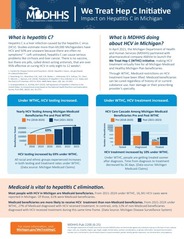
The MDHHS Harm Reduction and Viral Hepatitis Prevention Unit released a one-page fact sheet, We Treat Hep C Initiative: Impact on Hepatitis C in Michigan, to highlight the significance of Medicaid and the We Treat Hep C Initiative on hepatitis C elimination in Michigan.
The flyer also includes data comparing hepatitis C testing and treatment rates among Michigan Medicaid beneficiaries before and after We Treat Hep C was launched in 2021.
|
Under We Treat Hep C:
- Hepatitis C testing and treatment increased.
- All racial and ethnic groups experienced increases in testing and treatment rates.
- People are getting treated sooner after diagnosis.
- Medicaid beneficiaries are more likely to receive HCV treatment than non-Medicaid beneficiaries.
 |
|
On September 18, 2025, the MDHHS Viral Hepatitis Epidemiology Unit released the 2024 Viral Hepatitis Surveillance Report, which highlights state hepatitis B and C trends from the year prior.
This year, the report includes 5-year data trends for acute and chronic hepatitis B and C in Michigan (and national rates), focused data for noted population subsets, and data related to outcomes of hepatitis infections and special MDHHS viral hepatitis initiatives, including We Treat Hep C.
|
Key highlights from the report:
- Total reports of new hepatitis B cases have increased by 18% since 2020.
- Total reports of new hepatitis C cases have decreased by 44% since 2020.
- General age of hepatitis C cases reported in 2024 varies across race, as some races were more likely to be over 50 years of age while others were skewed toward 30-45 years old.
- In terms of hepatitis C related outcomes, the rate of hospital admission and death was higher in Black and American Indian/Alaska Native people when compared with white people.
Previous iterations of the viral hepatitis surveillance report can be found on the MDHHS Data and Statistics website. For questions or data requests, please contact the MDHHS Viral Hepatitis Epidemiology Unit at MDHHS-Hepatitis@Michigan.gov.
Harm reduction programs have saved lives, reduced hospitalizations and emergency department (ED) visits and prevented hepatitis C (HCV) cases, according to a new modeling study by the Michigan Department of Health and Human Services (MDHHS).
Harm reduction programs provide life-saving tools like naloxone, which can reverse the effects of opioids and prevent overdose deaths. These programs also help to stop the spread of HIV and HCV. Since 2018, MDHHS has been integral in developing Michigan's robust harm reduction infrastructure, currently comprised of 37 harm reduction agencies (HRAs) with more than 100 locations.
Analysis of provisional data from earlier in 2026 indicates a 36% reduction in overdose deaths from 2,931 deaths in 2023 to a provisional 1,877 in 2024. A recent MDHHS modeling analysis has examined the impact of Michigan's expansion in harm reduction efforts from 2017 to 2024 and estimated:
- More than 1,650 deaths prevented due to increased access to naloxone.
- An increase from 135 deaths prevented in 2019 to 569 deaths prevented in 2024.
- More than 13,000 hospitalizations due to injection drug use prevented between 2018 and 2024.
- An increase from 323 hospitalizations prevented in 2018 to 2,800 hospitalizations prevented in 2024.
- Approximately 13,200 ED visits prevented between 2018 and 2023.
- An increase from 2,521 ED visits prevented in 2021 to 5,300 ED visits prevented in 2024.
- More than 4,000 HCV cases avoided through the impacts of Medicaid treatment initiatives like We Treat Hep C and the expansion of HRAs.
- An increase from 211 HCV cases averted in 2018 to more than 1,000 cases of HCV prevented in 2024.
The analysis was funded through the State of Michigan Opioid Healing and Recovery Fund, which is receiving payments from the nationwide settlement with the three largest pharmaceutical distributors, as well as opioid manufacturer, Johnson and Johnson. Michigan is slated to receive nearly $1.6 billion from the settlement by 2040 with half being distributed to the state's fund and the other half being distributed directly to county, city and township governments. Over the last several years, MDHHS has been authorized by the Michigan Legislature to invest these funds in the state strategy addressing prevention, harm reduction, treatment and recovery.
The grant was designed to support communities severely affected by homelessness, addiction, and mental illness by combining hepatitis C prevention, testing, treatment, and cure with the provision of behavioral health services among individuals with substance use disorder (SUD) and/or serious mental illness (SMI).
Awards ranged from $2.5 million to $7.5 million for up to two years. Of the 19 recipients, three organizations in Michigan were recipients of the award:
- Arab Community Center for Economic and Social Services (ACCESS)
- Face Addiction Now (FAN)
- Henry Ford Health System
In 2024, the World Hepatitis Alliance launched World Hepatitis Testing Week, a global campaign observed during the third week of November to highlight the importance of early viral hepatitis detection, treatment, and vaccination.
This year, World Hepatitis Testing Week is observed November 17-23, 2025. Stakeholders, organizations, and advocates all around the world are encouraged to join the cause.
For different ways to get involved, view the World Hepatitis Testing Week Campaign Guidelines. Campaign supporters are encouraged to raise awareness through social media posts, posters, and calls to action. Free campaign resources and ways to take action are available on the World Hepatitis Testing Week website.
|
|