|
Outstanding Outreach with Hospital Communities
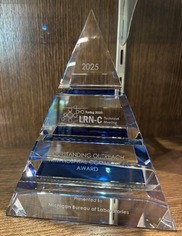
The MDHHS Bureau of Laboratories (BOL) was recently presented an award for “Outstanding Outreach with Hospital Communities” by the Association of Public Health Laboratories (APHL) at the Spring 2025 Laboratory Response Network for Chemical Threats (LRN-C) Technical Meeting.
 |
|
This award is given to an LRN-C member laboratory that has been involved in notable, sustained outreach and training initiatives and pursues ongoing improvements.
|
The BOL was recognized for their many years of dedicated work in hospital outreach, facilitating exercises, providing training, and contributing to Level 3 handbook revisions. One example of this dedication to improvement was when they became aware of hospital laboratory partners having issues obtaining dry ice to meet CDC (Centers for Disease Control and Prevention) Specimen Packaging and Shipping Exercise (SPaSE) requirements. They worked diligently to develop response plans to address this need in the case of a real surge sample collection event.
 Not pictured, but instrumental in these LRN-C outreach events and activities, is recently retired Chemical Threat Training Coordinator, Teresa Miller.
|
|
EMS Week
May 18 - 24 was EMS (Emergency Medical Services) week! A time to think about, and say thank you to, some of our most dedicated first responders. This year’s theme was, We Care. For Everyone. A reminder that EMS provides skilled, compassionate care in cities, small towns, private homes, businesses, and more. Serving every patient, no matter who or where they are. This is the work and mission of dedicated EMS clinicians everywhere.
 In honor of EMS, please consider donating blood. Prehospital blood transfusion is essential for patients with severe bleeding. It saves lives and improves health outcomes.
THANK YOU EMS!
|
|
ASPR TRACIE Honors EMS
Happy EMS Week to those who care for and serve our communities, from ASPR TRACIE (Administration for Strategic Preparedness and Response -Technical Resources, Assistance Center and Information Exchange). Please find EMS information on ASPR TRACIE's website, including the EMS Infectious Disease Playbook, and the EMS Resource Page. ASPR TRACIE appreciates you, EMS!
Developing and Maintaining Emergency Operations Plans
The Federal Emergency Management Agency (FEMA) recently updated their Comprehensive Preparedness Guide (CPG) 101 to version 3.1. CPG 101 provides guidance from FEMA on the fundamentals of planning and developing emergency operations plans. The guide describes the steps to produce an emergency operations plan, possible plan structures and components of a base plan and its
annexes.
CDC Measles Checklist
The measles checklist includes key activities that state, tribal, local, and territorial jurisdictions should consider to be prepared for a potential measles cluster or outbreak.
|
TEEX MGT-319: Point of
Dispensing, Planning and
Response
This two-day course will be hosted by
the Kent County Health Department in
September. The course serves as a
guide for local health officials and their
partners to coordinate plans for the
mass distribution of medical
countermeasures in response to a
large-scale public health incident. This
course focuses on planning
considerations, recommendations for
achieving the CDC’s 48-hour standard for Mass Prophylaxis, and the local community’s Mass Prophylaxis and Point of Dispensing (POD) site preparedness. The course material is applicable to pandemic influenza, bioterrorism, and other public health emergencies.
In-person
September 17-18, 2025
8:00 a.m. - 5:00 p.m.
Kent County Health Department
North County Training Room
4191 17 Mile Rd NE
Cedar Springs, MI 49319
PER-410 Enhancing
Planning, Preparedness,
and Response to
Pandemics and other
Large Scale Public Health
Emergencies
The goal of the course is to improve the
ability of public, private, and nonprofit
partners to establish more effective and
coordinated preparedness and
response efforts for public health (PH)
emergencies related to large-scale
biological, natural, or man-made
disasters, including pandemics.
Workshop discussions will be held to
enhance coordinated preparedness
and response for future pandemic,
biological, natural, or man-made
disaster-related PH emergencies.
In-person
July 21-22, 2025
8:00 a.m. - 5:00 p.m.
Leona Training Center
2123 University Park Dr, Suite 150
Okemos, MI 48864
The course is 16 hours, and
participants will earn 1.6 CEUs.
Participant materials will be provided
digitally. Please plan to bring an
electronic device to class.
|
|
|
The Guardian of Public Health is a monthly newsletter from the Bureau of Emergency Preparedness, EMS and Systems of Care (BEPESoC), within the Michigan Department of Health and Human Services (MDHHS). The Guardian aims to provide readers with relevant content on topics that affect the public health of Michigan's citizens and communities.
|
|
|
This publication was supported by Cooperative Agreement number 1NU90TP922062-01-00, funded by the Centers for Disease Control and Prevention. Its contents are solely the responsibility of the authors and do not necessarily represent the official views of the Centers for Disease Control and Prevention or the Department of Health and Human Services.
Bureau of Emergency Preparedness, EMS and Systems of Care | 1001 Terminal Rd, Lansing, MI 48906 | 517-335-8150
|
|
|
|
|