|
Marburg outbreak in Rwanda, situation in review
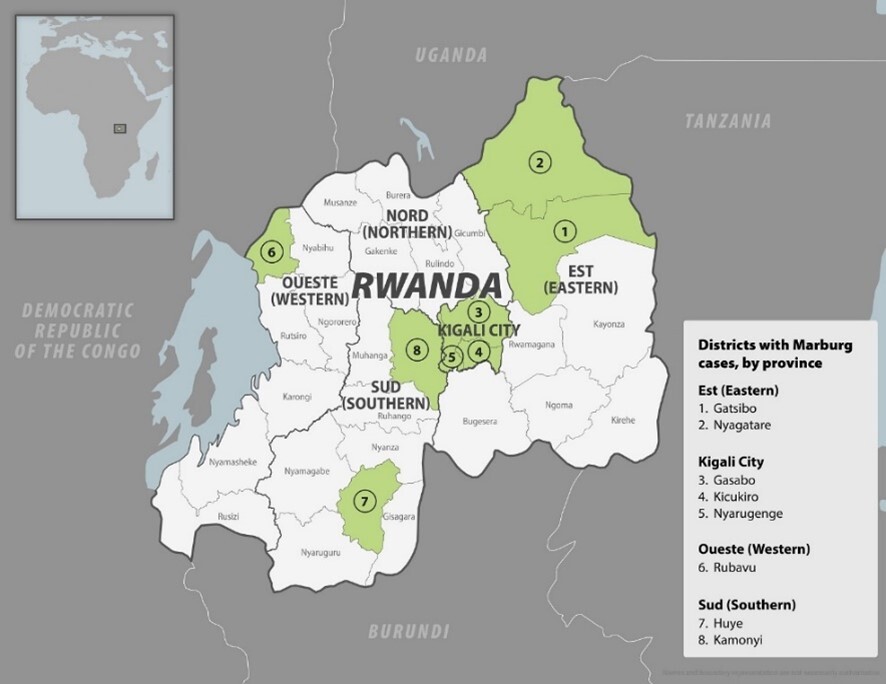
Rwanda reported its first Marburg virus disease (MVD) outbreak on September 27, which resulted in 66 illnesses and 15 deaths, primarily in Kigali hospitals (see map). Approximately 80% of cases were among healthcare workers providing care to infected patients. No MVD cases were reported outside of Rwanda. U.S. travel screening for arriving individuals with a 21-day travel history that included Rwanda began on October 8 and ceased on December 4 as travel monitoring activities ended.
Marburg virus disease is a rare but severe viral hemorrhagic fever similar to Ebola. MVD is initially transmitted to humans from the bite of an infected fruit bat and then spread from person-to-person through direct contact with infected bodily fluids or contaminated surfaces. It is not spread through airborne transmission. Symptoms may include fever, headache, fatigue, gastrointestinal issues, and, in severe cases, unexplained bleeding.
The last known MVD-infected patient tested repeat negative on November 7, and Rwanda started the 42-day countdown on November 8 to declare the outbreak over. Strong containment efforts, including disease surveillance, testing, infection control and contact tracing brought the outbreak under control. The Government of Rwanda officially declared the MVD outbreak over on December 20. Investigational vaccine trials in Rwanda with a focus on healthcare workers are ongoing in an effort to prevent future cases and outbreaks.
In Michigan, referrals for 72 individuals with a 21-day travel history including Rwanda were received during the outbreak. Only a small number required additional local health department follow-up, and none developed symptoms. With no new cases reported and Rwanda’s effective response, all public health screening and monitoring activities in the U.S. and Michigan have ended.
|
|
|
The Michigan Public Health Week Partnership (Partnership) invites you to nominate someone for the Hometown Health Hero award. This award is presented annually to individuals or organizations that have made significant and measurable contributions to preserving or improving the health of their community.
The 2025 event marks the 20th anniversary of these awards and the Partnership that sponsors them. Over the past twenty years, community leaders, organizations, and individuals have achieved remarkable milestones in improving community health and advancing health equity. The Partnership seeks to continue recognizing these accomplishments, but we need your help. Awardees are chosen exclusively from the nominations we receive. The only way for someone to receive this award is through a nomination.
Submit a completed nomination form to the Partnership by email or fax (517-335-8392) no later than 5:00 p.m. on January 31. Only nominations received by the deadline will be considered.
Awards will be presented in April at the Atrium of Heritage Hall in the State Capitol Building. This event is open to the public.
|
|
Don’t Forget Fido: A Call to Include Pets in Public Health Research and Policy to Support Families and Communities
American Journal of Public Health Volume 115, Issue 1
Emily D. Dolan, PhD; Brett Wyker, MS; Elizabeth A. Berliner, DVM, DABVP; Matt Goldweber, BA; and Ana Hernandez, MA
The Institute of Medicine describes the mission of public health as “fulfilling society’s interest in assuring conditions in which people can be healthy.”1(p7) This human-centered perspective overlooks the critical importance of companion animal welfare in community health. The powerful inter-connectedness of people and their pets means that the health and welfare of families and communities is entwined with the health and welfare of their pets. Because pets are not adequately considered in public health research and policy currently, the onus is disproportionately placed on the animal welfare field to solve community health problems associated with caring for pets. Animal welfare organizations such as humane societies, animal shelters, rescues, and other nonprofits are primarily dependent upon philanthropy; municipal funding is generally limited to a narrow scope, such as providing affordable rabies vaccination and animal control. To comprehensively address the needs of families and communities, recognition of the tangible and meaningful intersections of human and animal health, is required in research and policy planning.
Continued…

|
|
NACCHO's New Chemical Preparedness Virtual Community
The National Association of County & City Health Official's (NACCHO) ChemPrep Connect Virtual Community is now open to all local health department (LHD) staff. ChemPrep Connect is a dedicated virtual community designed to empower LHDs in preparing for and responding to chemical incidents. ChemPrep Connect offers a secure platform to collaborate and discuss monthly topics, share best practices and resources, seek peer advice, and raise questions to a network of public health professionals who understand the unique demands of chemical incident planning.
Join ChemPrep Connect today to enhance your preparedness and build a stronger network of support.
Strengthening Cyber Defenses: CISA’s Free Vulnerability Scanning Service
The Cybersecurity and Infrastructure Security Agency (CISA) offers a variety of free tools and services to support organizations in addressing their cybersecurity needs. Among these is CISA’s Vulnerability Scanning Tool, designed to regularly monitor and assess internet-connected assets to evaluate their security posture.
This tool scans for thousands of vulnerabilities, weak configurations, configuration errors, and poor security practices. By enrolling in this service, critical infrastructure owners and operators can:
- Identify and prioritize vulnerabilities.
- Improve response strategies.
- Reduce risk and strengthen defenses against evolving cyber threats.
CISA’s vulnerability scanning service empowers organizations to make informed decisions, protecting their assets from cyber threats and disruptions while enhancing overall cybersecurity resilience.
National Library of Medicine's New Public Access Policy
The National Institutes of Health (NIH) has introduced a new Public Access Policy, reinforcing its commitment to making research accessible to all. The updated policy eliminates the twelve-month embargo period, accelerating access to published results.
This significant milestone ensures that patients, families, and researchers can benefit more quickly from discoveries, promoting transparency and equitable access to federally funded research.
|
Public Information Officer Awareness: IS-29.A
The Public Information Officer Awareness Course (IS0029) introduces participants to the fundamental concepts of the Public Information Officer (PIO) role. This course is ideal for individuals new to the PIO position, offering a foundational understanding of its functions. It is also beneficial for those in executive-level roles, providing essential knowledge about PIO responsibilities during emergencies.
Web-based
MI-TRAIN ID: 1087762
Preparedness Lunch and Learn
January 21, 2025 - Hospital Emergency Response Team (HERT)
Ken Shawl from Bronson Hospital will describe the Occupational Safety and Health Administration (OSHA) requirements for hospital responders to contaminated patients, discuss the training requirements to participate in the Hospital Emergency Response Team, and the importance of safety of EMS personnel during prehospital response and patient handoff to hospital first receivers.
MI-TRAIN ID: 1112624
Preparedness Lunch and Learn Series
Through natural disasters, active assailant events, and even pandemics, Healthcare emergency managers are consistently challenged to help their organizations plan, train, and respond to incidents. This series of virtual trainings will continue to build knowledge for healthcare emergency managers. Please share this with your partners.
EMS, Physician, Nursing, Social Worker, and Nursing Home Administrator credits are available for all sessions, including EMS, NHA, CME, and CNE credits.
Schedule: Sessions occur on the third Tuesday of each month from 12:00 to 1:00 p.m. 2025 Session Dates:
- January 21
- February 18
- March 18
- April 15
- May 20
- June 17
- July 15
- August 19
- September 16
- October 21
- November 18
- December 16
MI-TRAIN ID: 1112624
|
|
|
The Guardian of Public Health is a monthly newsletter from the Bureau of Emergency Preparedness, EMS and Systems of Care (BEPESoC), within the Michigan Department of Health and Human Services (MDHHS). The Guardian aims to provide readers with relevant content on topics that affect the public health of Michigan's citizens and communities.
|
|
|
This publication was supported by Cooperative Agreement number 1NU90TP922062-01-00, funded by the Centers for Disease Control and Prevention. Its contents are solely the responsibility of the authors and do not necessarily represent the official views of the Centers for Disease Control and Prevention or the Department of Health and Human Services.
Bureau of Emergency Preparedness, EMS and Systems of Care | 1001 Terminal Rd, Lansing, MI 48906 | 517-335-8150
|
|
|
|
|