|
Vaccinations for COVID-19, influenza and RSV recommended this respiratory season
|
|
|
Donia Dalal, MPH, Nitya Mangina, MPH, MDHHS Division of Immunizations
Immunization against influenza (flu), COVID-19, and respiratory syncytial virus (RSV) remains the best way to protect patients against severe disease. Patients should receive all their recommended vaccines in a timely manner to help protect against these major respiratory diseases this fall and winter virus season. The Michigan Department of Health and Human Services (MDHHS) strongly encourages all Michigan residents to receive age-appropriate respiratory vaccines to protect themselves and their communities this respiratory season.
This recommendation comes after approval and authorization by the Food and Drug Administration (FDA) and guidance from the U.S. Centers for Disease Control and Prevention's Advisory Committee on Immunization Practices for the 2024-2025 COVID-19 vaccines. These updated vaccines are anticipated to offer protection against severe COVID-19 caused by currently circulating variants. The COVID-19 vaccine can be co-administered alongside other vaccines, such as those for flu and RSV.
All individuals aged 6 months and older should receive the 2024–2025 COVID-19 vaccine. This recommendation applies to those who have previously been vaccinated against COVID-19 as well as those who have had COVID-19.
There are three RSV vaccines that are recommended for all adults ages 75 and older and adults ages 60 through 74 who are at increased risk for severe RSV. There are two immunizations recommended to protect infants from severe RSV: a maternal RSV vaccine (Pfizer's Abrysvo) given during pregnancy, or an RSV monoclonal antibody given to infants after birth. “The CDC has updated its RSV vaccination recommendation for older adults to prioritize those at highest risk for serious illness from RSV,” said Mandy Cohen, M.D., M.P.H. “People 75 or older, or between 60-74 with certain chronic health conditions or living in a nursing home should get one dose of the RSV vaccine to provide an extra layer of protection.”
Everyone 6 months and older should get a flu vaccine every season with rare exceptions. Some children 6 months through 8 years may need an additional dose. All flu vaccines for the 2024-2025 season are trivalent in the United States. Trivalent flu vaccines are formulated to protect against three flu viruses (an A(H1N1) virus, an A(H3N2) virus, and a B/Victoria virus). The B/Yamagata flu virus was removed because it has not been detected in the population after March 2020 taking the flu vaccine from a quadrivalent formulation to a trivalent. Both trivalent and the previously recommended quadrivalent flu vaccines are expected to offer similar protection against the flu viruses they protect against. More information about trivalent flu vaccines is available.
When people get sick with a respiratory virus, CDC recommends that they stay home and away from others. For people with COVID-19 and influenza, treatment is available and can lessen symptoms and lower the risk of severe illness. The CDC recommends waiting at least 24 hours after symptoms have improved, and if a fever was present, it has resolved without the use of fever-reducing medications.
Data from the Michigan Care Improvement Registry (MCIR) shows a yearly decline in seasonal flu vaccine coverage among Michiganders since the 2020-21 flu season. For the 2020-21 season, coverage was 34%, compared to 26% in 2023-24. In 2021, 64.1% of people 12 and up had received at least one Covid vaccine. 59.4% had completed the series. Vaccination against these viruses is crucial for controlling the spread of respiratory illnesses in communities and reducing the risk of severe disease and hospitalizations.
To find a vaccine location near you, visit Vaccine Finder.
To learn more about seasonal respiratory illnesses and how to protect yourself, visit Michigan.gov/COVIDFluRSV.
References:
VFC turns 30!
The Vaccines for Children (VFC) Program turns 30 this year! This important program provides vaccines to children whose parents or guardians may not be able to afford them.
|
First At-home Influenza Vaccine
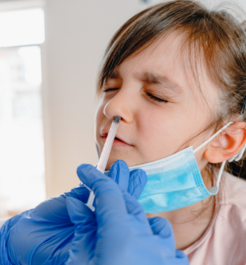
In September, the U.S. Food and Drug Administration (FDA) approved FluMist for self- or caregiver-administration. FluMist is approved for the prevention of influenza disease caused by influenza virus subtypes A and B in individuals 2 through 49 years of age. FluMist is sprayed into the nose and has been used safely and effectively for many years. It is the first vaccine to prevent influenza, more commonly known as the flu, that does not need to be administered by a health care provider.
FluMist is approved for the prevention of influenza disease caused by influenza virus subtypes A and B in individuals ages 2 through 49.
|
|
Coverage with Selected Vaccines and Exemption Rates Among Children in Kindergarten — United States, 2023–24 School Year
Abstract
In the United States, states and local jurisdictions set vaccination requirements for school attendance, conditions and procedures for exemptions from these requirements, grace periods for submitting documentation, and provisional enrollment for students who need more time to be vaccinated. States annually report data to CDC on the number of children in kindergarten who meet, are exempt from, or are in the process of meeting requirements. Data reported by 49 states and the District of Columbia (DC) for the 2023–24 school year were used for national- and state-level estimates of the following measures: complete vaccination with required doses of measles, mumps, and rubella vaccine (MMR), diphtheria, tetanus, and acellular pertussis vaccine (DTaP), poliovirus vaccine (polio), and varicella vaccine (VAR); exemptions from vaccination; and school attendance while meeting requirements. The 2023–24 kindergarten class became age-eligible to complete most state-required vaccinations during the COVID-19 pandemic, after schools had returned to routine in-person learning. Compared with approximated national coverage levels across all reported vaccines for the 2019–20 (95%) and 2022–23 (93%) school years, coverage dropped below 93% for the 2023–24 school year, ranging from 92.3% for DTaP to 92.7% for MMR. Exemptions increased to 3.3%, compared with those during the 2022–23 (3.0%) and 2021–22 school years (2.6%). Coverage with MMR, DTaP, polio, and VAR decreased in 35, 32, 33, and 36 jurisdictions, respectively, compared with the 2022–23 school year. Exemptions increased in 41 jurisdictions, with 14 reporting that >5% of kindergartners had an exemption from one or more vaccine. Efforts by health departments, schools, and providers are needed to ensure that students begin school fully vaccinated.
|
|
Scope of Practice Toolkit
The Scope of Practice Toolkit addresses key concepts regarding modifying the scope of practice of various healthcare and other practitioners in public health emergency response activities. The toolkit component documents are designed to assist in education, training, and planning activities to prepare for emergencies, as well as to serve as a quick reference resource during an emergency response to an event. The Scope of Practice Toolkit is one of six toolkits in ASTHO’s Legal Preparedness Series.
Response Readiness Framework
The 2024-2028 PHEP Program Priorities
The CDC's Public Health new Response Readiness Framework focuses on 10 priority areas that are essential to our ability to prepare for, respond to, and recover from health threats. The Response Readiness Framework defines excellence in response, focusing on improvements in emergency response operations designed to improve response outcomes and provides a coordinated strategy for the CDC, our preparedness partners, and our Public Health Emergency Preparedness (PHEP) jurisdictions, to ensure we are all working together to reach common response goals.
|
Emergency Preparedness Lunch and Learn Webinar Series
Hospital Cybersecurity - Live Lunch & Learn
This live session will be on hospital cybersecurity presented by Kelley Goldblatt – Cybersecurity Office for Michigan and Ohio with the US Cybersecurity and Infrastructure Security Agency.
November 19
12:00 - 1:00 p.m.
MI-TRAIN
Course ID: 1123478
Social Media Platforms in Disaster Management - WBT (PER-304-W)
This FEMA certified web-based training course is designed for individuals in the public and private sectors who are responsible for gathering and disseminating disaster-related information and who would like to increase their knowledge and understanding about social media and its uses during crisis communication to support organizational preparedness, response and recovery efforts.
Host Agency:National Disaster Preparedness Training Center
|
|
|
The Guardian of Public Health is a monthly newsletter from the Bureau of Emergency Preparedness, EMS and Systems of Care (BEPESoC), within the Michigan Department of Health and Human Services (MDHHS). The Guardian aims to provide readers with relevant content on topics that affect the public health of Michigan's citizens and communities.
|
|
|
This publication was supported by Cooperative Agreement number 1NU90TP922062-01-00, funded by the Centers for Disease Control and Prevention. Its contents are solely the responsibility of the authors and do not necessarily represent the official views of the Centers for Disease Control and Prevention or the Department of Health and Human Services.
Bureau of Emergency Preparedness, EMS and Systems of Care | 1001 Terminal Rd, Lansing, MI 48906 | 517-335-8150
|
|
|
|
|