|
Project Public Health Ready (PPHR)
Project Public Health Ready (PPHR) is a criteria-based training and recognition program created by the National Association of County and City Health Officials (NACCHO) and the Centers for Disease Control and Prevention (CDC) to help local health departments (LHDs) develop core public health, emergency preparedness competencies. An intensive 12-18 month program provides LHDs the structure to build training and preparedness capacity using a continuous quality improvement model.
PPHR criteria is updated regularly to align with federal guidelines and national initiatives, including:
- ASPR Hospital Preparedness Program (HPP) metrics.
- CDC’s Public Health Emergency Preparedness and Response Capabilities
- Public Health Accreditation Board’s (PHAB) Standards and Measures
- FEMA’s Homeland Security Exercise and Evaluation Program (HSEEP)
- CDC’s Operational Readiness Review (ORR) Tool
The PPHR program aims to help local emergency preparedness agencies fully integrate into the response community and prepare for any public health emergency. The PPHR program offers LHDs an opportunity to (1) build partnerships with local, state, and federal leaders, community response partners, and other stakeholders; and (2) facilitate collaboration and teambuilding across the entire health department. At the end of the program, LHDs will have a written comprehensive all-hazards response plan that aligns with the highest national and federal standards. Those who successfully complete the program are PPHR recognized for five years.
Since 2004, more than 525 LHDs have been recognized as meeting all the PPHR requirements individually or working collaboratively as a region, including 12 in Michigan: Allegan County Health Department, Barry Eaton District Health Department, Berrien County Health Department, Branch-Hillsdale St. Joseph Community Health Agency, Calhoun County Public Health Department, Ionia County Health Department, Kalamazoo County Health and Community Services Department, Kent County Health Department, Macomb County Health Department, Oakland County Health Division, Ottawa County Department of Public Health, and Van Buren District Health Department.
Due to a high-volume of 2023 re-recognition applications, first-time applicants may apply during the 2024 cycle. You can learn more about the application process through the PPHR Process Guide
Additional tools related to the PPHR can also be found through NACCHO's Toolbox. NACCHO’s Toolbox is a free, online collection of many public health tools and resources that have been created and shared by members of the public health community. Tools related to the PPHR application can be searched by simply choosing ‘PPHR toolkits’ in the drop-down box.
|
|
Caring for children during a disaster
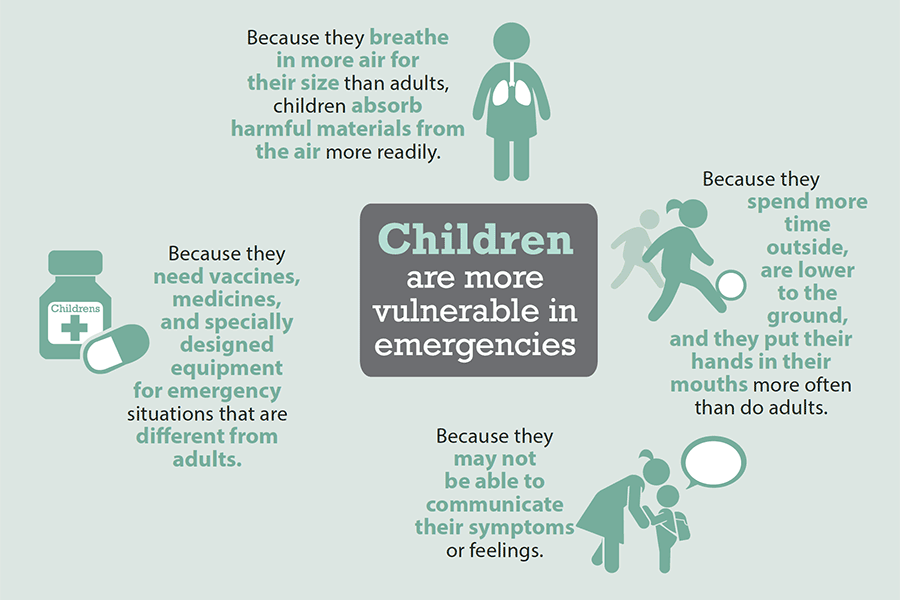
A public health emergency—such as a natural disaster, disease outbreak, or terrorist attack—can happen anywhere and at any time. Because children are more vulnerable than adults during disasters, the CDC’s Children’s Preparedness Unit and its partners work to protect children before and during an emergency.
Why This Is Important
- Limited emergency resources could be quickly overwhelmed with a surge in the number of patients who are children.
- Communities may face additional challenges protecting children during emergencies because of economic, geographic, or racial/ethnic disparities. For instance, rural communities may have fewer emergency responders, shelters, health facilities or equipment.
- Children with disabilities or other special needs are especially vulnerable during disasters.
How States and Communities Can Include Children’s Health Needs in Emergency Planning
- Include children’s needs in emergency exercises and planning. Children require special attention in all areas of public health response planning for emergencies, including evacuation, safe sheltering, reunification, and clean-up of dangerous and toxic substances.
- Train emergency responders to understand children’s needs and vulnerabilities. Emergency responders who are trained to focus on children will be better able to make sure children’s needs are not overlooked in an emergency.
- Establish connections between emergency response planners and medical professionals. Emergency response planners may not know the roles that children’s hospitals and healthcare providers are prepared to play in a health emergency. It is critical that they work together with families to successfully protect children in emergencies.
Future Opportunities to Protect Children
- Lead tabletop practice exercises that simulate a natural disaster, infectious disease outbreak, or terrorist attack and focus on children’s needs. Through exercises to prepare for emergency responses, emergency preparedness personnel can help to establish connections and strengthen communications within and across communities.
- Share recommendations with medical providers to improve treatment for children during and after emergencies. Work with others to develop guidance for healthcare professionals on treating children in many types of emergencies.
- Develop messages to help children and those who care for them understand what they can do to stay safe in an emergency.
|
|
2024 recommended immunization schedules now available
The 2024 ACIP Recommended Immunization Schedules are now posted online. As a reminder, the schedules summarize final recommendations that were previously adopted and made official by the CDC director. Therefore, these schedules are effective immediately.
*Earlier availability of the 2024 Immunization Schedules is part of CDC’s efforts to better support immunization professionals and improve timely implementation of new recommendations.
Recording now available: Supply Chain Disruptions Impacts on Vulnerable Communities
The recording and materials are now available from the National Academies of Sciences, Engineering, and Medicine's workshop, Supply Chain Disruptions: Impacts on Vulnerable Communities.
The workshop, which took place on September 12, was focused on understanding the impacts of supply chain disruptions on vulnerable communities, as well as both human and social impacts.
WHO, Center for Health Security launch WHO Generic All-Hazards Risk Assessment Tool for Mass Gathering Events
The Johns Hopkins Center for Health Security, in partnership with the World Health Organization (WHO), launched the WHO Generic All-Hazards Risk Assessment Tool for Mass Gathering Events (All-Hazards MG RA Tool). This user-friendly digital tool aims to support mass gathering event organizers in identifying, assessing, and mitigating risks associated with large-scale gatherings, ultimately enhancing event safety.
|
Pediatric Readiness Across the Continuum of Care – Lunch and Learn Series
Preparing for children during a disaster takes time and there has been an increased push nationally for pediatric disaster preparedness and readiness for well over a decade. This presentation will define pediatric readiness and how it provides value to your facility. It will also offer resources for pediatric readiness as well as changes in pediatric readiness over the years to include the ASPR Pediatric Disaster Centers of Excellence Cooperative Agreement that was released five years ago. As part of this presentation, the speakers will discuss hospital readiness scores from the National Pediatric Readiness Project, and steps that can be taken to develop quality improvement projects, research best practices, and develop transfer agreements with tertiary institutions as just some of the steps needed to improve pediatric readiness, and provide a framework of what to do during a disaster.
There are physician, nursing, social worker, EMS and nursing home administrator credits available for this session.
December 19, 2023
MI-TRAIN Course ID: 11126624
ICS 300 Sessions
This course provides training on and resources for personnel who require advanced application of the Incident Command System (ICS). The course expands upon information covered in the ICS-100 and ICS-200 courses. The course objectives are to describe how the National Incident Management System (NIMS) Command and Management component supports the management of expanding incidents and describe the Incident/Event Management process for supervisors and expanding incidents as prescribed by the ICS. Also covered is the implementation of the Incident Management process on a simulated Type 3 incident and development of an Incident Action Plan for a simulated incident.
The target audience for this course are individuals who may assume a supervisory role in expanding incidents or Type 3 incidents. Note: During a Type 3 incident, some or all the command and general staff positions may be activated, as well as division/group supervisor and/or unit leader level positions. These incidents may extend into multiple operational periods.
This course is 21 hours, and the learner must have ICS-100, ICS-200, IS-700, and IS-800 completed to register.
MI-TRAIN Course ID: 1029037
Training locations:
- Jan. 8, 2024: Monroe County EMD, Registration Deadline – Dec. 16, 2023
- Jan. 17, 2024: Branch Hillsdale St. Joesph Health Department, Registration Deadline – Jan. 3, 2024
ICS 400 Sessions
This course provides training on and resources for personnel who require advanced application of the Incident Command System (ICS). This course expands upon information covered in the ICS-100, ICS-200, and ICS-300 courses. The target audience for this course is senior personnel who are expected to perform in a management capacity in an area command or multi-agency coordination entity.
The course objectives are to explain how major incidents engender special management challenges, describe the circumstances in which an area command is established and describe the circumstances in which multiagency coordination systems are established.
This is a 16 hour course and learners must have completed ICS-100, ICS-200, ICS-300, IS-700, and IS-800 to register.
MI-TRAIN Course ID: 1029045
Training locations:
- Jan. 11, 2024 – Monroe County EMD, Registration Deadline – Dec. 30, 2023
- Jan. 22, 2024 – Macomb Community College, Registration Deadline – Jan. 5, 2024
- Jan. 24, 2024 – MSP Emergency Management and Homeland Security Division, Registration Deadline – Jan. 9, 2024
- Jan. 25, 2024 – Ascencion Borgess Hospital, Registration Deadline – Jan. 10, 2024
|
|
|
The Guardian of Public Health is a monthly newsletter from the Bureau of Emergency Preparedness, EMS and Systems of Care (BEPESoC), within the Michigan Department of Health and Human Services (MDHHS). The Guardian aims to provide readers with relevant content on topics that affect the public health of Michigan's citizens and communities.
|
|
|
This publication was supported by Cooperative Agreement number 1NU90TP922062-01-00, funded by the Centers for Disease Control and Prevention. Its contents are solely the responsibility of the authors and do not necessarily represent the official views of the Centers for Disease Control and Prevention or the Department of Health and Human Services.
Bureau of Emergency Preparedness, EMS and Systems of Care | 1001 Terminal Rd, Lansing, MI 48906 | 517-335-8150
|
|
|
|
|