What Providers Need To Know About Janssen Vaccine (Johnson & Johnson)
On February 27, 2021, the U.S. FDA authorized the emergency use of Janssen vaccine to prevent COVID-19 in persons 18 years of age and older.
EUA Fact Sheets
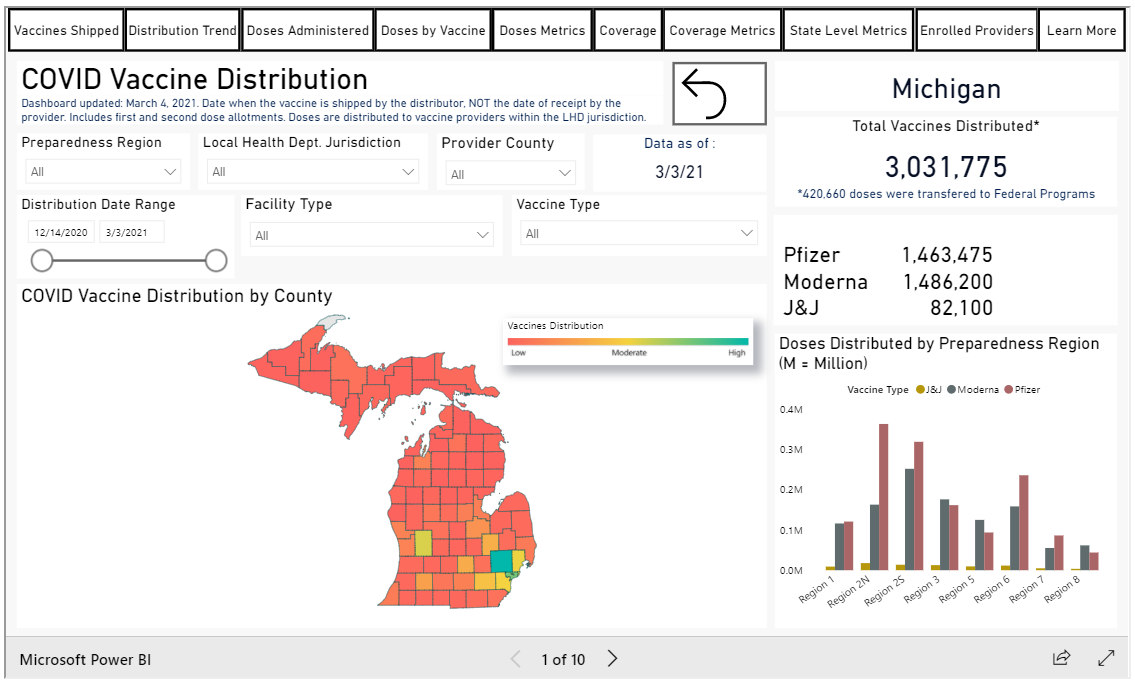
Michigan received 82,700 doses for the first allocation of the recently approved Janssen vaccine. All counties received part of these allocations with additional doses going to counties with lower rates of vaccination amongst individuals aged 65 years and older.
Efficacy
In a preliminary analysis, the Janssen vaccine demonstrated:
- Overall efficacy of 72% in the U.S.
- Efficacy estimates for severe outcomes assessed ≥28 days post vaccination were higher:
-
83.5% for severe disease
-
100% for hospitalization
The effectiveness shown from this vaccine is extremely promising, despite comparisons to other mRNA vaccines currently used. From a public health standpoint, the primary goal of vaccination is to keep people out of the hospital and prevent them from getting severe illness. The Janssen vaccine has demonstrated complete protection against hospitalization and death.
There has been no head-to-head comparison of the Janssen vaccine and the mRNA vaccines. The Janssen vaccine was studied under circumstances with different circulating variants and a higher baseline incidence. Therefore, individuals should not risk additional weeks of potential exposure simply to receive a vaccine that showed a higher rate of preliminary effectiveness.
Safety
- Consistent with other vaccine candidates that use the same AdVac technology.
- Serious Adverse Events (SAEs) reported in a similar proportion among recipients of vaccine and placebo (0.4% vs 0.4%).
- Local reactions within 7 days occurred in ~50% of vaccine recipients; most commonly pain at the injection site.
- Systemic reactions within 7 days occurred in ~55% of vaccine recipients; headache, fatigue and myalgia most common.
- Most symptoms resolved after 1-2 days.
Considerations for Use
A single-dose vaccine may be desirable for people who want to complete their immunization schedule quickly, do not want to return for a second dose, or have difficulty returning for a second dose. A single-dose vaccine may also be beneficial for settings where a walk-in model is used, or areas with less access to online scheduling models pose challenges. Additionally, the vaccine can be stored at refrigerated temperatures between 2°C and 8°C (36°F and 46°F) allowing for easier storage and transport.
Michigan Department of Health and Human Services recommends use of Janssen vaccine for the following groups:
People who are homeless – who may experience significant challenges returning for a second dose of the same brand.
College students – who may struggle to find time to schedule and attend appointments.
Migrant Workers – who move around week-to-week during the farming season and will have difficult returning for a second dose.
Substance Use Disorder and Sexually Transmitted Disease Clinics – people who visit these clinics may receive the service they need and not return for a second dose. The opportunity to treat these populations is greatest while they are being served at these clinics.
Manufacturing, including food service – people working in these industries may not have paid leave to make appointments; forcing them to decide between vaccination and pay.
Hospital discharge and Long Term Care (LTC) facility transfer – people discharging and transferring may not be able to return for a second dose.
People who are homebound – ease of storage and planning makes this population easier to reach with a one-dose vaccine.
|