|
COVID-19 Vaccine Data
We have distributed 1,795,575 vaccines to state partners for administration. We have reported administering 1,699,504 first and second doses of vaccines for priority groups. In addition, 499,200 has been allocated to the federal program for administration in long-term care facilities for a total of 2,294,775 vaccines distributed in the state.
This data is current data as of February 16, 2021 unless otherwise noted.

|
|
Michigan Care Improvement Registry Documentation
The Michigan Care Improvement Registry (MCIR) is an important tool to ensure Michiganders receive the right vaccine at the right time. It is critical that providers ensure accurate information, including date vaccine was received and vaccine brand are entered into the MCIR system.
If you are a COVID-19 vaccine provider and administered a COVID-19 vaccine remember it is your responsibility to ensure you document the vaccine within your documentation system, on the COVID-19 Vaccine Record Card, and ensure that it is in MCIR within 24 hours.
If you are a COVID-19 vaccine provider but did not administer the COVID-19 vaccine, ensure you have the most accurate information before documenting the dose. You can do this by looking up the patient's immunization history in MCIR, or asking if they have a COVID-19 Vaccine Record Card to help determine the date they received the vaccine and which vaccine was received.
|
|
|
Quarantine & Fully Vaccinated Individuals
Vaccinated persons with an exposure to someone with suspected or confirmed COVID-19 are not required to quarantine if they meet all of the following criteria:
- Are fully vaccinated (i.e., ≥2 weeks following receipt of the second dose in a 2-dose series, or ≥2 weeks following receipt of one dose of a single-dose vaccine)
- Are within 3 months following receipt of the last dose in the series
- Have remained asymptomatic since the current COVID-19 exposure
Individuals should keep their COVID-19 vaccination record card so they know exactly how long they may be exempt from quarantine. Persons who do not meet all 3 of the above criteria should continue to follow current quarantine guidance after exposure to someone with suspected or confirmed COVID-19.
This exemption does not apply to vaccinated inpatients and residents in healthcare settings. Inpatients and residents should continue to quarantine following an exposure to someone with suspected or confirmed COVID-19.
For Health Care Employees
For considerations for health care workers, please review Return to Work & Health Monitoring for Health Care Employees.
Exemption from quarantine could be applied when considering work restrictions for fully vaccinated healthcare personnel with higher-risk exposures, as a strategy to alleviate staffing shortages. Of note, exposed healthcare personnel would not be required to quarantine outside of work.
|
|
Updated Evidence for Double Masking
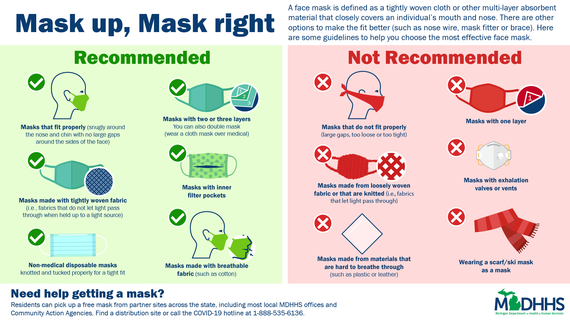
The protection offered by masks is limited by the way the mask fits. An ill-fitting mask does not offer the best protection against COVID-19.
-
Masks should fit snugly across the face. Gaps can let air with respiratory droplets leak in and out around the edges of the mask.
-
Masks with layers keep your respiratory droplets in and others’ out. A mask with layers will stop more respiratory droplets getting inside your mask or escaping from your mask if you are sick.
Wearing two masks is an easy way to increase protection against COVID-19. Double masking is an easy way to improve fit, which also improves protection. The more particles that are blocked, the better you are protected against getting COVID-19.
For example, when the source was unmasked and the receiver was fitted with the double mask or the knotted and tucked medical procedure mask, the receiver’s cumulative exposure was reduced by 83.0% (SD = 0.15) and 64.5% (SD = 0.03), respectively.
|
One party wearing “double masks”
|
Exposure reduced by 83%
|
|
Both parties wearing double masks
|
Exposure reduced by 96%
|
|
Both parties wearing medical masks knotted and tucked properly
|
Exposure reduced by 96%
|
Data Source: Maximizing Fit for Cloth and Medical Procedure Masks to Improve Performance and Reduce SARS-CoV-2 Transmission and Exposure, 2021
|
|
|
|