
IMPORTANT UPDATE regarding mRNA COVID-19 Vaccine Guidance on Storage and Transport
Michigan Dept of Health & Human Services sent this bulletin at 02/12/2021 12:57 PM EST
This message was sent to AIM, FAB, Health Systems, INE, IAP, LHD Health Officers, LHD Medical Directors, MACI, MACI 2, PH Imms Leads, COVID-19 Vaccine Providers, and Imms All Staff. I apologize for any duplications.
Hello Immunization Partners,
MDHHS would like to provide additional guidance on transport of mRNA vaccines. We received this updated guidance from CDC late last night. It can be found in the CDC Storage and Handling Toolkit, under the COVID-19 Vaccine Addendum. Pages 56-63 are COVID-19 mRNA vaccine specific product information.
In most instances COVID-19 vaccine will be delivered to the facility but, there may be times where COVID-19 vaccine needs to be redistributed or transported. This can occur if:
- A CDC Supplemental COVID-19 Vaccine Redistribution Agreement is in place for vaccine to be redistributed.
- A jurisdiction immunization program or commercial partner needs to redistribute vaccine within the jurisdiction based on need or to keep vaccine from being wasted.
- Vaccine needs to be transported for satellite, temporary, or off-site clinics, including programs at long-term care facilities, or a home healthcare program.
Appropriate precautions must be taken to protect the vaccine. Vaccine must only be transported using appropriate packing materials that provide maximum protection. Transporting vaccine requires planning and preparation to ensure the cold chain is maintained.
COVID-19 Vaccine Transport Requirements
- Vaccine must be transported in a stable storage unit and monitored with a digital data logger (DDL).
- Record the time and minimum/maximum temperature at the beginning of transport.
- Pfizer-BioNTech COVID-19 vaccine temperature logs can be found at: https://www.cdc.gov/vaccines/covid-19/info-by-product/pfizer/index.html
- Moderna COVID-19 vaccine temperature logs can be found at: https://www.cdc.gov/vaccines/covid-19/info-by-product/moderna/index.html
- In most instances, packing materials that vaccines were initially shipped in are not meant for reuse (the most common exception is ultra-cold vaccine shipping materials).
- Ensure you pack and transport an equal amount of vaccine, diluent, and ancillary supplies (including vaccination record cards and PPE).
- Immediately upon arrival at the destination, record the time and minimum/maximum temperature of the portable vaccine unit. Vaccines should be stored in an appropriate storage unit with a DDL. If this is not possible, vaccines should be kept in the portable storage unit and the unit temperature recorded every time the portable unit is opened.
- CDC recommends transporting vaccine in vials. A partially used vial cannot be transferred from one provider to another or across state lines.
We are going to discuss key points about transporting Pfizer-BioNTech and Moderna COVID-19 vaccine at refrigerated temperatures, but the CDC Storage and Handling Toolkit provides guidance on transporting at frozen temperatures as well.
During refrigerated vaccine transport of the Pfizer-BioNTech COVID-19 vaccine follow these requirements and general principles:
- Refrigerated transport (2°C and 8°C (36°F and 46°F).
- Individual vials or partially filled trays must be transported at refrigerated temperatures.
- Once vaccine vials are removed from the tray, the thawing process has begun, and the vaccines require refrigerated transport.
- Vaccine may be stored at refrigerated temperatures for up to 120 hours (5 days).
- Any time used for transport counts against the 120-hour limit.
- Take care to ensure vaccine does not refreeze during transport.
- Transport vaccine in insulated containers qualified to maintain a temperature range of 2°C to 8°C (36°F and 46°F) for the duration of transport.
- Handle vaccines with care and package securely to minimize shaking and avoid breakage.
- When transport is complete, vaccine should immediately be placed in a vaccine storage unit at 2°C to 8°C (36°F and 46°F).
- Keep the vaccine out of direct sunlight.
- Punctured vials may be transported.
- Once mixed, the vaccine MUST be used within 6 hours. Any vaccine remaining after 6 hours must be discarded.
- Time used for transport counts as part of the 6-hour time limit.
- CDC recommends transporting vaccine in vials, over a prefilled syringe.
During refrigerated vaccine transport of the Moderna COVID-19 vaccine follow these requirements and general principles:
- Refrigerated transport (2°C to 8°C; 36°F to 46°F).
- Vaccines that will be transported in a refrigerated state should begin transport in a frozen state if possible.
- Take care to ensure vaccine does not refreeze during transport.
- Transport vaccine in insulated containers qualified to maintain a temperature range of 2°C to 8°C (36°F and 46°F) for the duration of transport.
- Protect vaccines as much as possible from drops, shocks, and vibration. To minimize movement:
- Vaccine should be transported in the carton whenever possible.
- If individual vials are transported, vials should be placed with dunnage (padding material like bubble wrap or similar padding).
- Transport containers must be secured during transport.
- When transport is complete, vaccine should immediately be placed in a vaccine storage unit between 2°C and 8°C (36°F and 46°F). The vaccines can remain at these temperatures for up to 30 days. All transport time is included in the 30-day time frame.
- Once thawed, vials that have not been punctured may be kept between 8°C and 25°C (46°F and 77°F) for up to 12 hours.
- Once the vaccine has been brought to room temperature the vial (unpunctured and punctured) cannot be put back into the refrigerator.
- Once punctured, the vaccine MUST be administered within 6 hours. Any vaccine remaining after 6 hours must be discarded.
- Punctured vials can be transported.
- CDC recommends transporting vaccine in vials, over a prefilled syringe.
There may be instances when the only option is to transport vaccine in a pre-drawn syringe. U.S. Pharmacopeia (USP) includes guidance for transporting pre-drawn vaccine in syringes in the USP COVID-19 Vaccine Toolkit: Operational Considerations for Healthcare Practitioners. This guidance document has been referred to in a recent email from the Immunization Action Coalition (IAC) and in the CDC Storage and Handling toolkit. The USP toolkit contains information regarding syringe storage and transport of vaccines to home-bound patients. The USP Vaccine Handling Toolkit also has guidance on transport of frozen solid vaccine vials, transport of the thawed multidose vaccine vials, and transport of pre-drawn syringes. Information about transport begins on page 7 with specific information about transporting pre-drawn syringes on page 11.
Transfer of pre-drawn syringes (from the USP)
The following operational considerations are offered for both Pfizer-BioNTech and Moderna COVID-19 Vaccines according to the temperatures defined below for pre-drawn syringe stability provided by the manufacturer:
- Use a continuous temperature monitoring device to ensure consistent temperature monitoring during transport (Digital Data Logger is required).
- Portable refrigerated units may be used to transport the vaccine.
- Appropriate measures should be taken to ensure the vaccine is cushioned and protected from agitation.
- Expanded polystyrene foam containers can be used for maintaining cold chain/temperature consistency across transport to administration site.
- In addition, to protect from damage during transport, a hard-plastic container should be considered to carry the expanded polystyrene foam container (NOTE: a hard-sided plastic container alone may not be sufficient to maintain temperature control).
- If a cooling agent is used, a thick barrier (at least 1 inch) of bubble wrap or corrugated cardboard may be utilized as a barrier between the transport container cooling agent and the container with pre-drawn syringes. This is to prevent direct contact between pre-drawn syringes and the cooling agent that may cause the vaccine to freeze or deviate from appropriate cold chain.
Pfizer-BioNTech COVID-19 Vaccine
- Pfizer has conducted physical and chemical stability studies which have shown that the vaccine maintains all its measured quality attributes when the diluted vaccine is stored in polycarbonate and polypropylene syringes with stainless steel needles for 6 hours at 2°C to 25°C (35.6°F to 77°F) after the source vial is diluted.
Moderna COVID-19 Vaccine
- According to the Chemistry, Manufacturing and Control (CMC) department at Moderna, pre-drawn syringes can be either stored in the refrigerator at 2°C to 8°C (36°F to 46°F) or at ambient room temperature at 15°C to 25°C (59°F to 77°F), provided they are administered within 6 hours of the first time the source vial is punctured.
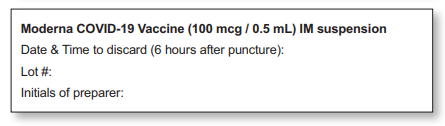
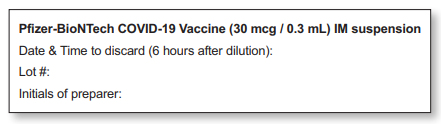
Pre-drawn syringes prepared for administration must be labeled with legible identifying information to prevent errors during storage, dispensing, transport, and use. Pre-drawn syringe labeling components:
- Name and amount of vaccine
- The exact beyond-use date and time (e.g., 6 hours for pre-drawn syringes for both Pfizer-BioNTech and Moderna COVID-19 Vaccines from when the vaccine is diluted or the first dose is withdrawn from vial, respectively)
- Lot number
- Initials of preparer
Examples of pre-drawn syringe labels
Ensuring that COVID-19 vaccine is properly stored and transported is essential to vaccine safety and efficacy. For further information and guidance on Moderna and Pfizer vaccine and on vaccine storage handling:
- U.S. COVID-19 Vaccine Product Information
- Moderna COVID-19 Vaccine Information
- Pfizer BioNTech COVID-19 Vaccine Information
- CDC Vaccine Storage and Handing Toolkit
- MDHHS Guidance on Vaccine Transport
As we receive additional guidance regarding storage and handling of COVID-19 vaccines we will share it. Thank you for all your hard work to protect Michiganders from vaccine-preventable diseases!
-The Immunization Nurse Education Team, Andrea, Heidi, Maria, and Terri
Please direct Coronavirus (COVID-19) related inquiries to the DHHS COVID-19 hotline at 1-888-535-6136. For the most up-to-date information, facts and FAQs, go to www.michigan.gov/Coronavirus.

|
If this email was forwarded to you and you would like to receive updates from MDHHS directly, please sign up here. |
| STAY CONNECTED: | |||||||

|

|

|
 |
||||
SUBSCRIBER SERVICES:
Manage Subscriptions | Unsubscribe All | Subscriber Help