|
COVID-19 Vaccine Data
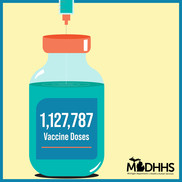
A million thanks to all the health care workers administering the COVID vaccine! This week Michigan crossed the million-dose threshold.
We have distributed 1,324,875 vaccines to state partners for administration. We have reported administering 1,127,787 first and second doses of vaccines for priority groups. In addition, 493,350 has been allocated to the federal program for administration in long-term care facilities for a total of 1,818,225 vaccines distributed in the state.
This data is current data as of February 3, 2021 unless otherwise noted.
|
|
|
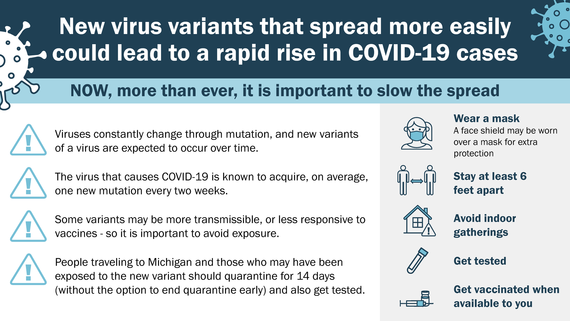
Update on COVID-19 Variants in Michigan
Variant Case Count
B117 – 30 cases | B1351 – has not been detected in Michigan
About the Variants
B117 and B1351 are believed to be more contagious, but there has been no indication that it affects the clinical outcomes or disease severity compared to the SARS-CoV-2 that has been circulating across the U.S. for months.
- However, a higher rate of transmission would increase the number of people who need clinical care for COVID-19 should the new variant begin circulating in Michigan.
- At this time, little-to-no impact is expected for natural immunity or testing.
- There is no indication that B117 impacts the effectiveness of current vaccines, however, current vaccines do not seem to be as effective at preventing B1351.
- It is possible that some mutations impact the effectiveness of monoclonal antibody treatments, however there is currently no evidence that this is the case with B117 and B1351.
CDC Variant Information Page
|
|
Adjusting for Social Vulnerability in Vaccine Allocation
Not all populations are equally at-risk for acquiring COVID-19 or suffering adverse outcomes from it. The State of Michigan uses the Social Vulnerability Index (SVI) to adjust population-based allocation of vaccinations to increase supplies to communities at greater risk for adverse outcomes from COVID-19.
The SVI assess the extent that 15 known vulnerabilities (indicators) are present within a community. SVI indicators like poverty and transportation can highlight places where people may have difficulty accessing COVID-19 testing, treatment, and vaccination. While vaccine supplies are low, outreach efforts must be concentrated in areas with higher social vulnerabilities, where people may face more difficulty accessing vaccine. Vaccine administrators should use the SVI to develop targeted outreach strategies while planning vaccine clinics to ensure protection of people who may be the most vulnerable.
When SVI is used to adjust vaccine allocations, areas with higher SVI values will see an increase in vaccine allocation, areas with lower SVI values will see a decrease. Read Michigan's Interim COVID-19 Vaccination Strategy to learn more about the state's strategy for vaccine allocation.
County level detail of population estimates and social vulnerability

|
|
|
|