City of Detroit to begin East Jefferson redesign to improve safety, help connect residents to riverfront
City of Detroit, Michigan sent this bulletin at 05/14/2018 03:32 PM EDT
FOR
RELEASE:
Monday, May 14, 2018
City of Detroit to begin East Jefferson redesign to improve safety, help connect residents to riverfront
Road to
be converted from seven driving lanes to five to calm traffic
Shorter
pedestrian crossing distances & clearer crosswalks to improve safety
Addition
of protected bike lanes to help connect residents to Belle Isle &
Riverfront
The City of Detroit this week will begin the first phase of
a project to increase safety, mobility and connectivity along a 5.4-mile
stretch of East Jefferson, redesigning driving lanes and installing new
protected bike lanes and dedicated parking lanes, Department of Public Works Director
Ron Brundidge announced today.
The road surface redesign will help improve safety for motorists,
bicyclists and pedestrians and will include new and improved pedestrian
crosswalks along East Jefferson, connecting residents safely to the Riverfront.
Key elements of the redesign include:
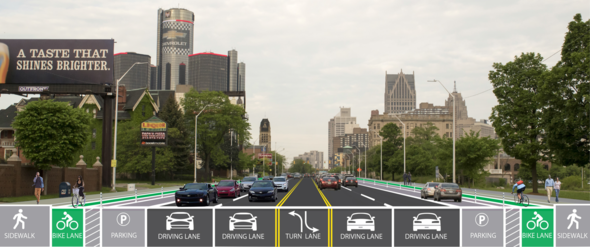
Converting the road from seven driving lanes to five
lanes (two driving lanes in each direction and a dedicated left-turn lane.) This will create shorter crossing
distances for pedestrians and help to calm traffic along East Jefferson,
as well.
Installing clearer crosswalks to further improve
pedestrian safety.
Adding protected bike lanes on both sides of East Jefferson. The bike lanes will occupy the curb
lane. To improve pedestrian and bicyclist safety, a designated formal
parking lane will be installed next to the bike lane, away from the curb, and
with a buffer zone between it and the bike lane.
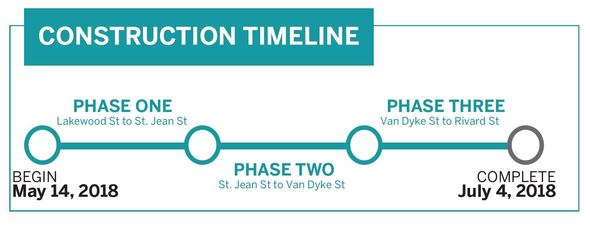
Schedule The project will begin the week of May 14 and is expected to
be complete by July 4. Work will be done
in three individual phases to reduce the project’s impact on traffic. The first
section to be redesigned will be on the east end from Lakewood to St. Jean
streets. Once that is completed and
fully reopened, Phase Two installation will occur from St. Jean to Van Dyke,
followed by Phase Three from Van Dyke to Rivard.
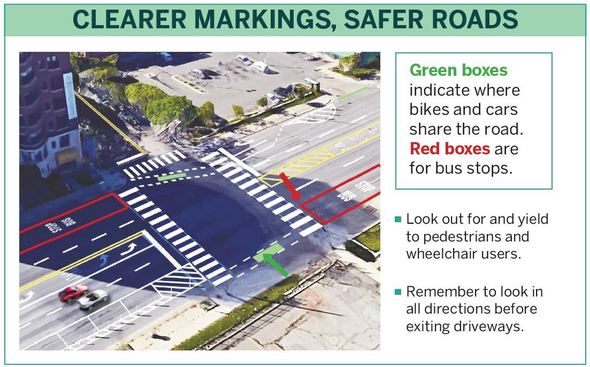
Public Education Because the new design will bring together several new visual
street elements, including red painted boxes on the pavement to identify bus
stops and green sections where bikes and cars share the road, the City is
undertaking a public education effort to help residents understand the changes
before they are put in place.
This week, every household north and south of East Jefferson
within the project limits will receive a printed brochure that explains each
aspect of the redesign and provides tips for motorists and bicyclists on how to
safely use the newly designed road. Street signs will be installed temporarily along
the length of the project reminding motorist that the parking lane is now set
farther out from the curb because of the addition of the bike lanes.
The city also has set up a web page at www.detroitmi.gov/eastjefferson which
includes the same information, along with an email address where residents can
submit feedback. The City will evaluate
the project based on safety data, mobility data, and community feedback to
determine any design changes that may be necessary.
“The safety of our streets starts by designing them for
everyone who uses them,” said Brundidge “Effective public education is another
part of that strategy that reinforces safety when we bring new designs to our
roads.”
District managers, DPW and Planning Department staff will be
available to attend community and block club meetings. To request city staff
attend a meeting, contact your district manager or email eastjefferson@detroitmi.gov.
Reasons for the
changes East Jefferson, which carries more than 20,000 vehicles per
day, saw 777 traffic crashes from 2012-2016. Six of those crashes were fatal,
with three of them pedestrians. The
Detroit Police Department regularly addresses issues of speeding and other
traffic violations along this stretch of East Jefferson, which passes several
schools and residential buildings for senior citizens.
The City of Detroit wants to ensure that everyone, whether they’re driving, walking or
riding their bike, can safely get to their destination. The safety improvements
and protected bike lanes along East Jefferson will help accomplish this goal by
providing safe routes for cyclists while also improving experiences for
pedestrians and improving traffic safety.
The protected bike lanes are being installed this summer
ahead of a planned 2020 repaving of East Jefferson when the Detroit Water and
Sewerage Department will also replace outdated water and sewer lines. To avoid
repetitive and wasteful repaving, the city will restripe East Jefferson this
summer, waiting until 2020 to fully resurface the road.
Minor impact on
vehicle traffic There may be a minor adjustment period during the construction
period, but the conversion of East Jefferson’s lanes is not expected to significantly
impact the overall flow of traffic, and will calm traffic along East Jefferson.
Street parking will be unavailable for a short period in each phase of
construction. When construction is complete, drivers will have designated
on-street parking spaces located on the traffic side of the protected bike
lanes. Drivers will park in areas marked by paint along bollards protecting the
bike lanes.
Improved safety for
bicyclists Cyclists can expect safer bike lanes, protected by bollards,
painted buffers and on-street parking following construction. During
construction, bike lanes will have limited access in construction zones. Upon
completion, cyclists will be able to ride protected from vehicular traffic and
separated from opening car doors.
Shorter pedestrian
crossing distances Pedestrians can expect limited impacts during the
construction period, and great benefits following construction. New and
improved pedestrian crosswalks will be installed along the entire stretch of
East Jefferson, improving safety and walkability. The conversion of lanes will
also create shorter crossing distances using nationally recognized standards, and
promoting connectivity from East Side neighborhoods to the Riverfront, which millions
of visitors enjoy each year.