|
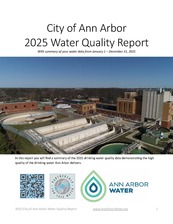
2025 Ann Arbor Water Quality Report coverThe City of Ann Arbor released its latest Water Quality Report, an annual publication required by the U.S. Environmental Protection Agency (EPA) to inform residents about the quality of their drinking water.
While the report fulfills federal regulatory requirements, it also highlights the city’s strong performance and ongoing commitment to delivering safe, high-quality drinking water. Ann Arbor’s water consistently meets or exceeds all applicable state and federal standards.
This success is driven by the expertise and dedication of the Water Treatment Plant staff. Through continuous monitoring, rigorous testing, and the use of advanced treatment technologies, the team ensures that water delivered to homes and businesses is safe and reliable. Operators and laboratory professionals work around the clock to maintain system performance and respond proactively to any potential issues.
The report provides detailed information on water sources, treatment processes, and testing results, along with educational resources to help residents better understand their drinking water.
The city remains committed to transparency, operational excellence, and ongoing investment in infrastructure and staff training. These efforts ensure that Ann Arbor continues to provide water that residents can trust today and into the future.
|
|
This past spring, the U.S. Environmental Protection Agency (EPA) officially designated the Gelman Sciences site and the associated 1,4-dioxane groundwater plume as a Superfund site on the National Priorities List. This means federal oversight and resources are now formally directed toward addressing this contamination — a significant shift from where things have stood for a very long time.
Your drinking water continues to be safe. The city's water treatment system tests regularly for 1,4-dioxane and other contaminants. That monitoring is ongoing and will not change and those results are posted to www.a2gov.org/watertreatment.
We want to be straightforward about what this news means and what it doesn't.
What the Superfund designation means: Regulatory oversight transitions from the Michigan Department of Environment, Great Lakes, and Energy (EGLE) to the EPA. The federal government is now formally engaged and accountable. The city will be meeting with state, local, and federal partners in the coming weeks and months to discuss next steps in that transition. The EPA will conduct further studies to determine the full nature and extent of the contamination and identify cleanup options. They have authority to act quickly if there is ever an imminent threat to public health.
What the Superfund designation doesn’t mean: This is not an immediate cleanup. Superfund timelines are highly variable — they can range from a few years to several decades.
For those of you who have been following this issue for years — some of you for decades — we understand that news of a Superfund designation can feel like a big win or another step in a process that never seems to end. We hear that. What we can say is that federal designation is not a symbolic gesture. It is a legal and regulatory commitment, and it changes the landscape of how this contamination is addressed going forward.
We will continue to keep you informed as the transition to EPA oversight moves forward.
For the history, details and updates visit www.a2gov.org/gelman.

Wondering where, and how, you could build a rain garden? Get an expert consultation in your own yard.Washtenaw County Water Resources Commissioner staff give advice to homeowners to design and install rain gardens on their property. Residents who build a rain garden after the consultation can receive a free rain garden sign and t-shirt.
The Huron River receives fewer fertilizers, chemicals, and other harmful runoff. Each residential rain garden does its part. Altogether, residential rain gardens in Washtenaw County capture more than 20 million gallons of water a year - preventing pollution and sewer overflows.
Schedule a free visit for drainage and rain garden advice in your yard. To schedule please book us online at MasterRainGardener.org.
Funding for this program is provided by the City of Ann Arbor.
|
|
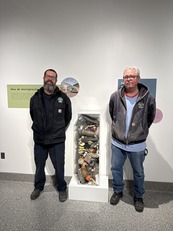
Last spring, staff at the Water Treatment Plant spent three days collecting debris from Barton Dam, and what they found told a familiar story. Plastics, wrappers, and fragments of all kinds had made their way into one of our most important drinking water sources, carried there by wind, rain, and everyday carelessness.
Rather than simply disposing of the debris, Water Treatment Plant employees Nick Baran and Mark MacArthur transformed it into something far more powerful: two hands-on educational displays that show visitors exactly how common litter breaks down into microplastics over time. Since then, those displays have become a centerpiece of our facility tours, helping guests of all ages understand why source water protection matters and how their habits connect directly to the water flowing from their taps.
One of the displays earned a wider audience as part of a display at the University of Michigan Museum of Natural History as part of a special exhibit on microplastics, which opened this past March and will run for a full year.
|
|
|
Streets can have several storm drains, which all play an important role in managing the rain that falls in Ann Arbor. Storm drains move water from streets into the city’s stormwater system, which deposits rain water into the Huron River. But storm drains work best when they are free of debris.
Looking after a storm drain in your neighborhood is a great way to spend time outdoors while helping contribute to cleaner, safer water in the community. Take part in protecting local rivers and streams, and reducing localized flooding, by adopting a storm drain today!
Learn more at www.a2gov.org/stormwater and via the city’s partner, the Huron River Watershed Council.
2026 is one of Ann Arbor's busiest construction seasons in memory. Much of what gets built or maintained this year runs underground, unseen but essential, touching every resident every single day who turns the tap, flushes the toilet or watches rain fall.
- 11 major infrastructure projects involving water underway
- 30+ feet underground — the deepest shaft being dug on First Street
- 100+ years old — some water mains being replaced this year
For information on these and other projects, please visit Engage Ann Arbor.
Sewer Trunkline Capacity Improvements, First and Washington
A tunneling machine will drill more than 30 feet underground along First Street and Washington Street to install a new 5-foot diameter conduit — big enough to house a 3-foot sanitary sewer pipe inside it. The project expands sewer capacity to support U-M's new Central Campus residential complex, opening Fall 2026. The First & Washington intersection will be closed for the duration of construction.
Ann Street Improvements, North First to North Fifth
A century-old, undersized water main gets replaced with a new 12-inch main. Oversized infiltrating storm sewers will capture the first inch of rainfall — pulling runoff out of the stressed Allen Creek watershed and sending it back into the earth. New concrete bump-outs, replaced trees, and a resurfaced road round out the project.
Ingalls/Kingsley Water Main and State to Ingalls
An aging, break-prone 6-inch main is upsized to a 12-inch main to improve reliability and water pressure. The project also resurfaces streets and is considering restoring two-way traffic on Kingsley Street between State and Ingalls.
North University and Thayer Improvements
Two aging water mains become one. A new infiltration trench filters stormwater into the aquifer instead of sending it directly to the Huron River. Eastbound transit gets a dedicated lane, complementing the northbound transit lane on State Street completed in Fall 2025. Cyclists keep their bike lanes. A new raised crosswalk at Ingalls Mall improves pedestrian safety.
Packard Street from South Main to State
A new 12-inch water main replaces aging infrastructure under Packard. The street is resurfaced, sidewalk ramps are brought up to ADA standards, signals at Fourth and Fifth are upgraded to mast arm standards, and the quick-build bike lanes become permanent, all aligned with the city's Vision Zero plan.
Arbordale and Sherwood Streets
Ten-plus water main breaks in 15 years have made replacement unavoidable. Cast iron out, ductile iron in, upsized from 6 to 8 inches. Storm structures are replaced, the road is resurfaced, and new speed management devices are added to protect pedestrians and cyclists. A new fire hydrant fills a coverage gap.
South Maple Road Water Pressure, Breckenridge to Country Village Court
Low water pressure on the west side of South Maple gets addressed with a new 8-inch looping main and check valves at both ends, a targeted fix for a longstanding reliability issue.
Pittsfield Village Utility and Road Improvements
One of the most comprehensive projects of the season, touching every system at once. New storm infrastructure and detention ponds tackle surface flooding that has long plagued the neighborhood. Larger sanitary pipes and curb drains reduce the risk of basement backups. Water mains are upsized to improve fire protection and minimize service disruptions if a break occurs. And individual water meters replace outdated master meters on condominiums, giving residents and the city much better visibility into water use and a faster path to detecting leaks.
Nixon Corridor Complete Road Reconstruction
A full corridor rebuild that goes well below the surface, new water main and stormwater infrastructure accompany the complete road reconstruction, ensuring the street is built right from the ground up.
Medford / Needham / Buckingham: Pattengill Neighborhood
A continuation of multi-year investments in the Pattengill neighborhood, aging drinking water pipes replaced, stormwater infrastructure repaired to clear up chronic street drainage problems, and roads in poor condition brought back to life. Each year's work builds on the last.
Packard at Mallets Creek Water Main Replacement
A targeted but high-impact swap: the aging 12-inch cast iron main here is replaced with a 14-inch HDPE pipe, stronger, more flexible, and sized for the future. Getting the utilities right now also sets up the corridor for the planned Packard resurfacing project in 2027, avoiding a second round of excavation just a year later.
|