 New Filing Schedule for Unemployment
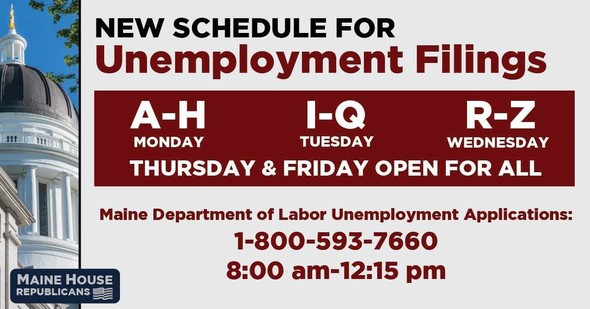
Starting Monday, April 6, Maine people seeking to file for unemployment with last names beginning with A-H should call on Monday; I-Q on Tuesday; R-Z on Wednesday. Thursday and Friday will be left unassigned for those who miss their alphabetical day or need to call at that time. The number is 1-800-593-7660. You can also apply for unemployment online at www.maine.gov/unemployment. For password resets and basic questions, contact a Career Center: www.mainecareercenter.gov/locations/index.shtml
Paycheck Protection Program (PPP)
The $2 trillion coronavirus stimulus package includes $349 billion in small business loans and $500 billion in loans for distressed corporations.
These small business loans — known as the Paycheck Protection Program (PPP) — will be run through the same infrastructure as existing 7(a) loans from the Small Business Administration (SBA). Loans can be for up to two and a half times a company’s average monthly payroll costs (from last 12 months and excluding the pay of people who earn $100,000 or more). Loans are for up to $10 million dollars and are guaranteed at 100% by the SBA. The program was created to help small businesses affected by coronavirus to maintain their workforce. So up to eight weeks of payroll, mortgage interest, rent and utilities covered by a PPP loan will be forgiven, as long as the full-time headcount and payroll stay the same as they were on average between February 15, 2019 and June 30,2019 (or January 1, 2020 to February 15, 2020 if you launched your business just this year). Businesses that have already let employees go or cut salaries have until June 30, 2020 to rehire or reinstate salaries.
The part of the loan that does not become a grant (you’ll have to request forgiveness once you can certify that you used the money to cover payroll, etc.) will be due in two years, though payments are deferred for six months. The interest rate is fixed at 1.00%. (If you don’t maintain headcount and payroll at pre-pandemic levels, the amount that is forgiven will be reduced.)
To be eligible, a business generally must have 500 or fewer employees. Sole proprietors and independent contractors may also apply. You can submit an application for one of these loans through a local lender. The only other paperwork you need is payroll documentation. Lenders may begin processing applications from small business owners and sole proprietors Friday, April 3, 2020, and from independent contractors and self-employed individuals the following week, April 10, 2020. (That said, many major banks were saying they were not ready yet to take applications on April 3.) The deadline is June 30, 2020, but you should apply quickly, since the program is first-come, first-serve, and Congress has capped the program at $349 billion. For more details, including a list of participating lenders, once it’s available, go to the SBA website.
Economic Injury Disaster Loans (EIDLs)
President Trump also signed legislation to support low-interest Economic Injury Disaster Loans (EIDLs) for any business impacted by coronavirus. These loans are administered by the SBA and are available for up to $2 million in states where an economic disaster has been declared. The interest rate is 3.75% for businesses and 2.75% for nonprofits. The loan term varies by applicant but could be up to 30 years. Interested small business owners can apply here. Make sure you also understand business interruption insurance coverage.
Additionally, under this program, small business owners may apply for an emergency cash advance for up to $10,000. If the money is used to cover such expenses as payroll, the advance will become a grant. Application procedures are the same as for EIDLs.
Employee Retention Credit
If you had to suspend business because of a government authority order or your gross receipts are less than 50% of what they were the same quarter last year – and if you decide against getting a PPP loan – you may be eligible for the Employee Retention Credit. This credit amounts to 50 percent of the qualified wages (including qualified health plan expenses) you paid in a calendar quarter, up to $10,000 per employee for all calendar quarters. (So the maximum credit amount is $5,000 per employee for all calendar quarters.) The covered period is March 12, 2020 to the end of the year. Generally, if you take the credit, you can apply it against your portion of Social Security taxes that you pay. If there is an overpayment, it can be applied to other tax liability – or in anticipation of receiving the credit, you can access withheld taxes that are required to be deposited with the IRS. Again, you cannot claim the Employee Retention Credit if you get a PPP loan. But you can receive tax credits for qualified paid leave under the Families First Coronavirus Response Act and the Employee Retention Credit if they are for different wages.
SBA Debt Relief Program
The SBA Debt Relief Program gives immediate relief to borrowers with existing SBA 7(a) loans, 504 loans and microloans. For these existing borrowers, the SBA will cover all loan payments for the next six months. This includes principal, interest and fees. This relief is also available for businesses who take out new loans within six months of the CARES Act being enacted. This debt relief is automatic, but make sure to check with your lender to make sure. Check with your bank or lender to see if they offer these loans or contact SBA to find one.
SBA Express Bridge Loans
SBA is also offering express bridge loans for businesses negatively impacted by the COVID-19 pandemic. This is an expansion of a program launched in 2017. These loans, for up to $25,000, are to help small businesses get through a presidential-declared disaster, in this case the pandemic. Loans for the COVID-19 pandemic can be made through March 13, 2021. The maximum term of the loan is seven years. These loans can be used as a stop-gap while you wait for a larger Economic Injury Disaster Loan (EIDL). Then you can use an EIDL to repay the express bridge loan in full or in part. These loans are offered by local banks and lenders, or the SBA can help you find a lender.
SBA 7(a) Program
The SBA’s 7(a) program is an existing loan program available to small businesses. The Paycheck Protection Program (PPP), described above, is running on the existing 7(a) program’s infrastructure. These non PPP loans can be for up to $5 million and are guaranteed by the SBA for between 75% and 85% of the loan. SBA has a list of banks who are able to give out 7(a) loans. You may be better off looking for loans under the PPP, but 7(a) loans are still an option. Similarly to the other programs, these loans are offered by local lenders and banks.
Express Loan Program
The Express Loan Program is a type of 7(a) loan. These loans are for up to $350,000 and are guaranteed at 50% by the SBA. The upside is that the decision to make the loan is made by the lender rather than the SBA, and is made within 36 hours. Again, the PPP may make more sense if you are dealing with fallout from the COVID-19 crisis, but these express loans may still be an option. These loans are given by local lenders.
Community Advantage Loan Program
Using the same general rules as the 7(a) program, Community Advantage loans are for up to $250,000 and are for businesses in underserved markets. The loan application is here.
504 Loans
504 loans are designed to foster economic development and job creation. These loans can only be used for the acquisition or eligible refinance of fixed assets. These loans are generally capped at $5 million. Apply for 504 loans here.
Microloans
Microloans are made through non-profit lending organizations to underserved markets. Loans can be for up to $50,000 and the average loan size is $14,000. Find a local microloan provider here. Additionally, don’t forget that the 2020 deadline for filing taxes has been pushed back to July 15 for both individuals and businesses. More federal relief efforts are likely to be coming in the days and weeks ahead.
How Do I Qualify?
For the federal programs, you qualify based on the size of your business. Your small business must have 500 or fewer employees. Private nonprofits and 501(c)(19) veterans organizations also qualify. It’s possible for some companies with more than 500 employees to qualify if they align with the SBA’s size standards for certain industries. In addition, hospitality and food industry businesses could qualify at each location with fewer than 500 employees even if the overall business employs more than 500 people.
Your business qualifies if the “current economic uncertainty makes the loan necessary to support your ongoing operations,” according to an SBA fact-sheet. Your need for a loan is contingent upon a decision from an SBA-approved lender based on SBA guidelines. But amid this coronavirus crisis, there will not be a separate review from the SBA.
Normally, there are much more stringent requirements and documentation, but the loans offered under the CARES Act are being given under looser guidelines, allowing banks and other lenders to get money to companies quickly so they can cover things like rent and payroll.
There are also individual state and local programs, described below, each of which has its own guidelines. The size varies by state. For instance, in San Francisco the business must have less than $2.5 million in revenue while in Delaware the number is $1.5 million. Some programs are based on the number of employees a business has — one program in New York, for instance, is for businesses with less than 100 employees.
How Much Do I Get?
The size of these loans largely depends on what you ask for and what you need. The Paycheck Protection Program loans offered under the CARES Act are for up to $10 million or two and a half times a company’s average monthly payroll costs during the year before the loan is made. EIDLs are for up to $2 million.
How Do I Apply?
To get a loan under the Paycheck Protection Program, you’ll need to talk to a local lender, such as a bank or credit union, that participates in the SBA’s 7(a) loan program. Maine has launched a program for small businesses to get loans of up to $50,000 at the Wall Street Journal Prime rate minus 1%. The term is 12 months but can be extended. The application package is here and can be sent to business@FAMEmaine.com.
|