Rep. Tuell's News from the Legislature: Coastal Grants Available, Notice to Lobster License Holders, & Community Events
Maine House Republican Office sent this bulletin at 02/18/2020 03:05 PM EST
Coastal Grants Available for Municipal and Regional Projects
The Municipal Planning Assistance Program at the Maine Department of Agriculture, Conservation, and Forestry and Maine Coastal Program at the Department of Marine Resources are seeking applications for a new round of Coastal Community Grants (CCGs) for FY 2021. The grants are for municipal and regional projects in Maine’s coastal zone. Funding for these technical assistance grants comes from the Maine Coastal Program’s annual grant from the National Oceanic and Atmospheric Administration (NOAA).
The Coastal Communities Grants have a maximum award of $100,000. Communities eligible to apply include towns in Maine’s coastal zone, groups of towns in Maine’s coastal zone, coastal regional planning commissions, and coastal councils of government.
Grant applications are due Wednesday, April 1, 2020.
Eligible projects must be designed to improve water quality, increase resiliency/adaptation to erosion and flooding, conserve coastal habitat, promote sustainable development, and enhance the coastal-dependent economy while preserving natural coastal resources. This initiative is designed to address the five priority goals of the Maine Coastal Program, including:
addressing the effects of land use activity on water quality;
restoring coastal habitats; and
preparing for coastal storms, erosionm and flooding, coastal hazards.
Coastal Community Grants are an important element of the Municipal Planning Assistance Program’s mission to foster innovative and effective approaches to land use management by providing technical and financial assistance to Maine municipalities. The FY 2021 Coastal Community Grant Program (CCG) Statement can be found online here.
Case studies, which include ‘Lessons Learned’ of projects funded with CCGs are available on MPAP’s CCG Case Studies Web page.
More information about the Maine Coastal Program can be found online here.
Based on additional comments received at the last round of zone council meetings, the Department of Marine Resources is proposing to further amend the gear marking requirements adopted last November to create a new exception for fishermen fishing in shallow waters. Specifically, the Department is proposing that vertical lines less than 100 ft. in length will need only two purple marks (a 36-inch mark in the top two fathom, and a 12 inch mark at the bottom of the line).
This proposed regulation will be published tomorrow, February 19, with a 30-day comment period ending on March 20. If the new exception is approved, it is anticipated that it will be in effect by early April.
It is understood that questions remain about gear marking. Please contact your local Marine Patrol officer or a Marine Patrol division office for assistance.
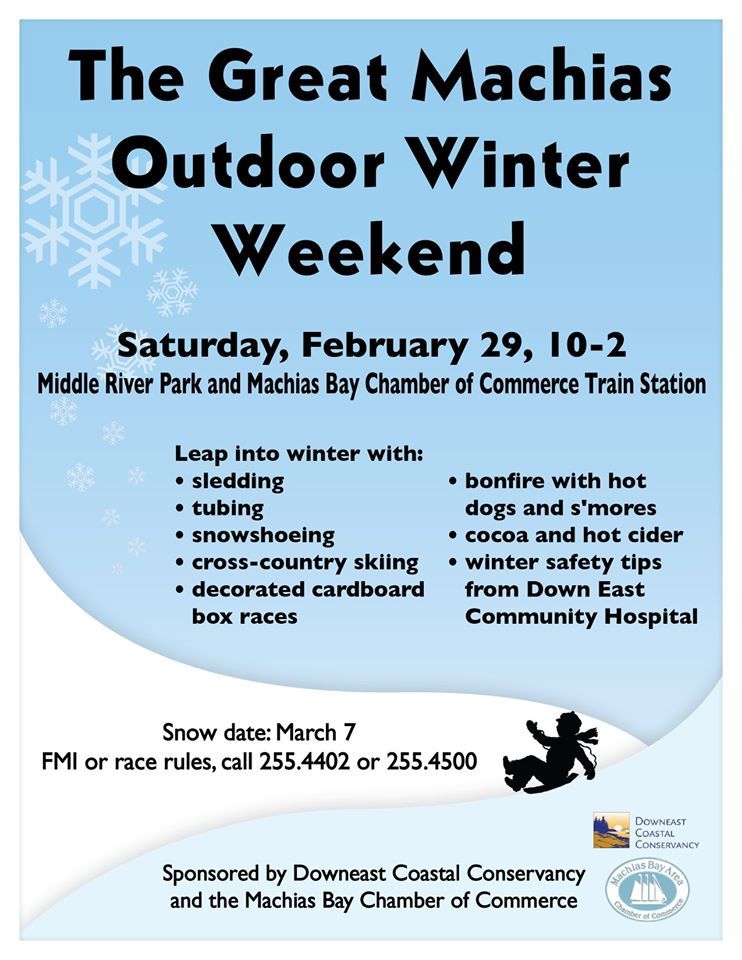
The Great Machias Outdoor Winter Weekend
Opportunities from the IRS
Understanding the Gig Economy
Thursday, February 20, 2020
2 p.m. Eastern Time
This free 60-minute webinar is open to All
This webinar will cover the following:
What is the Gig Economy?
How does a gig worker know if they are an employee or self-employed?
Business expenses and recordkeeping for gig workers
Class Description: Learn how to organize your financial records, understand your tax responsibilities, become familiar with tax forms, and file your taxes with confidence. This workshop is designed for sole-proprietors.
Pleasant River Fish & Game Conservation Association
U-Maine Extension 4-H
University of Maine Cooperative Extension 4-H will offer a free “4-H Family Hour of Code” session on Saturday, February 22, from 11 a.m. to noon, at the Peabody Memorial Library, 162 Main Street, Jonesport.
Another session will be held on Tuesday, February 25, from 3:30 p.m. to 4:30 p.m., at Porter Memorial Library, 92 Court Street, Machias.
The event, designed for youth and their parents to learn their first hour of coding together, features an introduction to Scratch – a free programming language – and presents career options in the computer science field.
These events are free; registration is required and limited to six families.