Rep. Lyford's News from the Legislature: Legislative Update & Constituent Survey
Maine House Republican Office sent this bulletin at 11/25/2019 03:09 PM EST
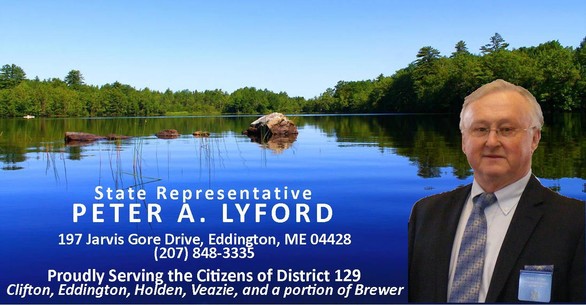
You should have received a copy of my 2019 Legislative Update in the mail, which highlights some of the bills that became law during the Legislature’s First Regular Session. Within the mailer is a constituent survey. I hope you will take a few minutes to fill it out and mail it back to me. You also have the option of visiting MaineHouse.Org to complete the questionnaire online. The survey code is 129.
- Rep. Peter A. Lyford
Dear Neighbor:
The First Regular Session of the 129th Legislature adjourned on Thursday, June 20. During this period came the return of one-party government for the first time since 2011. As your representative, I voted to defend proven policies, allowing you the continued opportunity to realize success and provide for your loved ones.
Notable highlights earlier this year include the reaffirmation of Maine’s health insurance law, thus protecting those with pre-existing conditions and preserving the ability to keep children up to the age of 26 on insurance policies. Property tax relief measures, such as increasing the homestead exemption and revenue sharing, were implemented as part of the biennial budget. In total, the State budget increased 11% from the previous administration’s budget — $7.1 billion to $8 billion. This includes spending the $128 million surplus.
In addition to what became law, legislative success can also be measured by what was defeated and prevented from becoming law. As the minority party, with the makeup of the House consisting of 89 Democrats, 56 Republicans, and six independents, House Republicans voted unanimously to stop tax increases on home heating fuel (L.D. 1231); gasoline (L.D. 434); and beer, wine, and spirits (L.D. 1070). We were also able to protect Maine’s influence over presidential elections by unanimously voting against a proposal to disregard the State election outcome; favoring instead whoever won the national vote (L.D. 816).
This legislative session likewise saw Maine move to allow taxpayer funding of elective abortions and the elimination of the requirement that only doctors can perform the medical procedure.
Inside this mailer you will find more details about the 129th Legislature’s First Regular Session, along with a short opinion survey.
The feedback, advice, and support I continually receive from the people of District 129 is appreciated. It is an ongoing honor to serve you in Augusta.
Sincerely,
Property Tax Relief
Crafted by House Republican members of the Appropriations and Financial Affairs Committee, $75 million in property tax relief has been implemented. As part of the plan, Maine’s homestead property tax exemption is increased by $5,000, allowing residents to reduce up to $25,000 from the value of their home for property tax purposes without any negative impact on local municipalities. Revenue sharing, Maine’s way of distributing a small portion of the State’s broad-based income and sales tax revenue to all municipalities in Maine for the purpose of reducing the property tax burden, is increasing both years of the biennium, reducing cuts proposed in the Governor’s budget. Finally, the Property Tax Fairness Credit’s tax-to-income threshold is reduced from 6% to 5%, thus letting 13,000 more Mainers to receive a partial refund on their property taxes.
Protecting Consumers from Medical Debt
L.D. 110, “An Act Regarding Credit Ratings Related to Overdue Medical Expenses,” (Public Law 2019, Chapter 77) prohibits credit reporting agencies from reporting debt from overdue medical expenses on a credit report in a way that negatively impacts the consumer’s credit history or rating. This applies when the first delinquency on the debt is less than 180 days old, and the consumer is making regular payments.
One in six Americans have past-due healthcare bills on their credit report, with a debt totaling more than $81 billion. This new law will help individuals work toward paying off medical debt without bearing a lowered credit score.
Homeless Veteran Programming
L.D. 184, “An Act To Amend the Veterans' Homelessness Prevention Coordination Program,” (Public Law 2019, Chapter 504) was emergency legislation which establishes the Veterans’ Homelessness Prevention Partnership Fund to provide reimbursements to volunteer organizations that offer transitional housing to homeless veterans. The Bureau of Maine Veterans’ Services is further directed to establish a program of partnerships with volunteer organizations to provide housing and coordinate efforts to remedy and prevent homelessness among veterans in Maine at the grass roots level.
Ballot Clarity
In response to increasingly complex ballot initiatives, L.D. 534, “An Act To Make Ballot Questions Easier To Read and Understand for Maine Voters,” (Public Law 2019, Chapter 414) requires that ballot questions be written in a manner that is understandable to the greatest number of voters possible. By requiring ballot questions to be written by the Secretary of State in simple terminology, voters of all education and reading comprehension levels will be able to make more informed decisions on how they vote. In addition, the initiative requires that ballot questions explicitly declare the effect a “yes” or “no” vote may have. This will help to reduce instances of confused voters seeking clarification from clerks and election staff, as well as to ensure voters are able to vote the way they intend to.
Improving Education Standards
L.D. 985, “An Act To Maintain High School Diploma Standards by Repealing Proficiency-based Diploma Standards,” (Public Law 2019, Chapter 202) repeals Maine’s proficiency-based diploma standards and encourages school administrative units to develop multiple innovative pathways that allow all students to learn and demonstrate their achievement through various means and measures. It protects disabled students’ opportunity to receive a diploma, and further safeguards the arts, languages, career and technical education, and physical education while clearly outlining the guiding principles each school must integrate as part of their outcomes.